|
TRANSLATE THIS ARTICLE
Integral World: Exploring Theories of Everything
An independent forum for a critical discussion of the integral philosophy of Ken Wilber
  Frank Visser, graduated as a psychologist of culture and religion, founded IntegralWorld in 1997. He worked as production manager for various publishing houses and as service manager for various internet companies and lives in Amsterdam. Books: Ken Wilber: Thought as Passion (SUNY, 2003), and The Corona Conspiracy: Combatting Disinformation about the Coronavirus (Kindle, 2020). Frank Visser, graduated as a psychologist of culture and religion, founded IntegralWorld in 1997. He worked as production manager for various publishing houses and as service manager for various internet companies and lives in Amsterdam. Books: Ken Wilber: Thought as Passion (SUNY, 2003), and The Corona Conspiracy: Combatting Disinformation about the Coronavirus (Kindle, 2020).
Check out my other conversations with ChatGPT Gravity: From Occult Force to Cosmic IllusionThe Strange Story of a Reluctant ConceptFrank Visser / ChatGPT
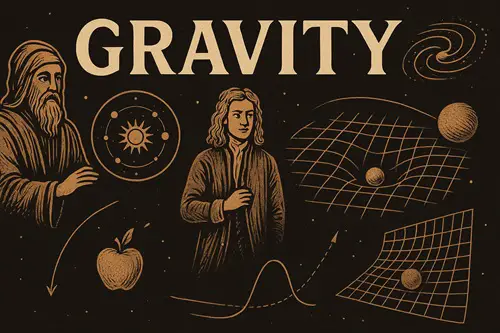 Gravity is the most familiar force in the universe—you feel it the moment you get out of bed—yet it remains the most conceptually slippery. It resists visualization, resists unification, and resists final explanation. Its history reads like a series of failed metaphors the universe keeps laughing at. No force has travelled a stranger intellectual arc: from medieval occult influence… to Newton's “action at a distance”… to Einstein's curved spacetime… to today's speculations that gravity might not be a fundamental force at all, but an emergent illusion. This is the story of how science has struggled—brilliantly and bravely—to make sense of what holds the cosmos together. 1. Gravity Before Science: The Realm of Occult ForcesLong before physics, falling objects and planetary motions invited mystical explanations. Aristotle thought objects sought their “natural place,” heavier ones falling faster because they supposedly contained more “earth.” Early thinkers saw the heavens guided by ethereal harmonies or Divine geometry. There was no unified principle—just metaphysical speculation attached to everyday observation. Gravity was not yet a force; it was a metaphysical disposition of matter. Nature did things because that was its “essence.” This worked—until it didn't. 2. Kepler's Cosmic Magnet: A First Step Toward the InvisibleJohannes Kepler, intoxicated by geometry and the music of the spheres, broke decisively with Aristotle. He suspected planets were moved by something like a magnetic force emanating from the sun. Gravity, for Kepler, was an animating influence, a kind of proto-field with faint occult overtones. He lacked a proper theory—but he saw that motion required cause, not Aristotelian “purpose.” Kepler's mystical intuition—an invisible agent acting across space—was the first crack in the Aristotelian cosmos. Yet he did not know what the agent was. 3. Newton: The Occult Force Becomes MathematicalIsaac Newton took the decisive leap. With breathtaking audacity, he assumed that whatever force governed apples also governed planets. But he did not explain what gravity is—he only described what it does. His law of universal gravitation unified the cosmos, but at the cost of introducing a deeply unsettling concept: action at a distance. How could one body pull on another across the void? Even Newton called this an “occult quality.” He detested the idea philosophically but could not deny it empirically. His calculus made the heavens predictable, but the mechanism remained a mystery. He famously quipped: Hypotheses non fingo—“I feign no hypotheses.” Helpfully or unhelpfully, he left the problem for future generations. 4. Faraday and Einstein: The Turn to GeometryThe 19th century replaced occult “pulling” with fields—continuous structures permeating space. Faraday and Maxwell made electromagnetism geometrical, and this paved the way for Einstein, who took the boldest step yet: Gravity isn't a force at all. It's geometry. Einstein's general relativity taught that mass warps spacetime, and spacetime tells matter how to move. No pulling. No action at a distance. Space itself curves and things fall freely along that curvature, like marbles on a stretched sheet. For the first time, gravity became visualizable—sort of. Yet even this triumph had a twist: curved spacetime doesn't tell us what spacetime actually is. Einstein removed forces from gravity, but at the price of introducing a new kind of mystery. And then came the atom. 5. Quantum Mechanics: Gravity Refuses to QuantizeQuantum physics quantized the other forces—electromagnetism, the weak force, the strong force—but gravity remained stubborn. Gravity didn't fit with quantum fields. It refused renormalization. It produced infinities. It broke models. Attempts to quantize gravity led to:
The problem: gravity is too weak, too universal, and too geometrical to behave like the other forces. It is more like spacetime itself than like electromagnetism. Yet we know spacetime must be quantum, somehow. Gravity again slipped from our grasp. 6. The Modern Twist: What if Gravity Isn't Fundamental at All?Some of today's boldest theories suggest that gravity is an emergent phenomenon—more like temperature or elasticity than a basic force. If so, all previous attempts to “explain” gravity were like trying to explain temperature by studying individual molecules rather than statistical ensembles. Two modern ideas stand out: a. Entropic Gravity (Erik Verlinde)Gravity arises from the statistical behavior of microscopic degrees of freedom we have not yet identified—like entropy gradients producing the illusion of attraction. b. Holographic Gravity (AdS/CFT)Gravity in a 3D universe emerges from quantum interactions on a 2D boundary. Gravity is a hologram—a projection. In this view:
This doesn't make gravity less “real”—only less fundamental. It would complete physics' centuries-long demystification of the cosmos by dissolving the oldest “force” into something deeper. 7. Why Gravity Is So Hard to UnderstandThe history reveals a pattern: It is universal. It is incredibly weak. It is tied to spacetime. It might not be a force. It refuses to merge with quantum mechanics Our best theories talk past each other. Gravity is elusive because it is the boundary between our most successful descriptions of nature. It is where our conceptual schemes crack. 8. The Mystery That Holds the Universe TogetherFrom occult affinity to emergent illusion, gravity's story is the story of science itself: each explanation works brilliantly, until new data shatters the picture and exposes deeper puzzles. Newton revealed the clockwork of the cosmos—without knowing what powered the gears. Einstein turned force into geometry—without knowing what spacetime is. Modern theorists dissolve geometry into quantum information—without knowing what that rests on. Gravity has always been a window into what we don't yet understand. It binds galaxies, bends time, shapes the universe—and keeps slipping out of every conceptual net we cast. Perhaps that is gravity's final lesson: And the deeper we go, the stranger it gets.
Widget is loading comments...
|