|
TRANSLATE THIS ARTICLE
Integral World: Exploring Theories of Everything
An independent forum for a critical discussion of the integral philosophy of Ken Wilber
  Frank Visser, graduated as a psychologist of culture and religion, founded IntegralWorld in 1997. He worked as production manager for various publishing houses and as service manager for various internet companies and lives in Amsterdam. Books: Ken Wilber: Thought as Passion (SUNY, 2003), and The Corona Conspiracy: Combatting Disinformation about the Coronavirus (Kindle, 2020). Frank Visser, graduated as a psychologist of culture and religion, founded IntegralWorld in 1997. He worked as production manager for various publishing houses and as service manager for various internet companies and lives in Amsterdam. Books: Ken Wilber: Thought as Passion (SUNY, 2003), and The Corona Conspiracy: Combatting Disinformation about the Coronavirus (Kindle, 2020).
Check out my other conversations with ChatGPT The Evolving U.S.-European Peace Proposals for UkraineStalled Talks and Escalating TensionsFrank Visser / Grok
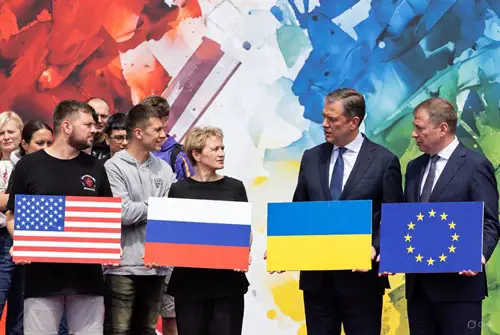 As the Russia-Ukraine war enters its fourth year, with over 500,000 casualties and widespread devastation, the incoming Trump administration's 28-point peace proposal—leaked in mid-November 2025—has sparked intense debate and diplomatic maneuvering. Aimed at brokering a ceasefire and long-term settlement, the U.S. draft emphasized pragmatic concessions to Russia, including territorial cessions of Crimea and parts of Donbas, an indefinite NATO membership ban for Ukraine, and a cap on its military at 600,000 personnel. In exchange, Ukraine would receive vague NATO-like security guarantees, economic reconstruction aid potentially totaling $500 billion (partly from frozen Russian assets), and phased Russian troop withdrawals from non-ceded areas. Proponents viewed it as a "reality-based" path to end endless U.S. aid commitments exceeding $175 billion, preventing escalation risks like nuclear threats. However, critics, including Ukrainian President Volodymyr Zelenskyy and European leaders, decried it as one-sided appeasement, rewarding Russia's unprovoked invasion by legitimizing annexations without reparations or accountability for war crimes. In response, the "European E3" (Britain, France, and Germany) swiftly tabled a counter-proposal on November 23, 2025, revising the U.S. framework point-by-point to prioritize Ukrainian sovereignty and multilateral enforcement. Key amendments included reconfirming Ukraine's full territorial integrity without mandatory cessions—instead, negotiations would start from the current Line of Contact, with both sides pledging not to alter borders by force. The military cap rose to 800,000 peacetime troops for stronger deterrence, while security guarantees mirrored NATO's Article 5, backed by automatic sanctions restoration and a joint U.S.-Ukraine-Russia-Europe taskforce. NATO aspirations remained open, contingent on alliance consensus, and a post-peace Russia-NATO dialogue addressed long-standing ambiguities without freezing expansion. Reconstruction focused on the victim, with frozen Russian assets funding full compensation and a global development fund for Ukraine's tech, infrastructure, and energy sectors; Russia gained phased economic reintegration (e.g., sanctions relief, G8 return) only upon compliance. Humanitarian elements, such as "all for all" prisoner exchanges and IAEA-supervised 50-50 sharing of Zaporizhzhia nuclear power, added de-escalation layers, enforced by a Trump-chaired Board of Peace with legal penalties. Comparing the two, the European version markedly improved fairness by shifting from the U.S. draft's perceived 70% tilt toward Russian demands—echoing Putin's 2022 "wishlist"—to a more balanced 60/40 favoring Ukraine. It upholds international norms like the UN Charter's ban on conquest, avoiding explicit territorial trades that could undermine global order and signal weakness to aggressors like China over Taiwan. Yet, both plans shared pragmatic flaws: implicit acceptance of occupied territories risked "frozen conflicts," and vague enforcement could falter given Russia's history of breaching pacts like the 1997 Friendship Treaty or Minsk agreements. True equity, per analysts, demands full Russian withdrawal and ICC prosecutions, elements still absent. Beneficiaries shifted accordingly. In the U.S. original, Russia gained most—locking in territorial wins, NATO exclusions, and sanctions easing—while the U.S. achieved domestic political victories by curbing aid and refocusing on China, leaving Ukraine and Europe as net losers amid sovereignty erosion and alliance strains. The European revisions empowered Ukraine with robust defenses and EU integration paths, bolstering Europe's security architecture through multilateralism and deterrence. Russia retained conditional incentives but faced stricter accountability, potentially pressuring Putin to negotiate amid economic drains exceeding $300 billion. The U.S. benefited indirectly from a refined framework that mitigated backlash, though Trump's extended November 27 deadline underscored urgency. Since late November, negotiations have evolved amid Geneva follow-ups and bilateral U.S. engagements, but momentum has stalled as of December 3, 2025. After U.S.-Ukraine talks in Florida reduced the draft to 19 points—removing some Russian "maximalist" demands like full demilitarization—Zelenskyy expressed optimism on December 2, telling Irish lawmakers that Ukraine was "closer to peace than ever before" with a "real chance" of agreement. Ukrainian delegates, led by Defense Minister Rustem Umerov and Andrii Hnatov, briefed European leaders in Brussels on U.S.-Russia discussions, preparing for a U.S. meeting with Trump's envoys. A pivotal December 2 meeting in Moscow between U.S. special envoy Steve Witkoff, Trump's son-in-law Jared Kushner, and Putin—lasting five hours—yielded no breakthrough on a revised 27-point variant. Russian aide Yuri Ushakov called it "very useful and constructive," with some points accepted and others critiqued, while the Kremlin denied outright rejection, framing it as a "normal process." However, Putin escalated rhetoric, declaring Russia "ready" for war with Europe if provoked and dismissing European counter-proposals as "absolutely unacceptable" with "no peace agenda." He accused Europe of blocking U.S. efforts, bolstered by claimed battlefield gains like capturing Pokrovsk (denied by Ukraine), which Ukrainian officials say strengthens Moscow's intransigence. Sticking points persist: Russia's insistence on Ukrainian territorial cessions in Donbas, NATO renunciation, and weakened security guarantees, versus Kyiv's rejection of any "compromise as the victim." EU foreign policy chief Kaja Kallas warned on December 1 that "this week could be pivotal," stressing Russia's lack of genuine interest in peace. At a December 3 NATO summit in Brussels, Secretary-General Mark Rutte affirmed U.S. consistency in supporting Ukraine, crediting Trump as the potential deadlock-breaker while urging Europeans to increase funding—no "Plan B" was needed, he said, but two-thirds of allies committed via the PURL mechanism. Hungary's Foreign Minister Peter Szijjarto decried European "war fanaticism" for undermining Trump. On the economic front, EU Commission President Ursula von der Leyen proposed on December 3 repurposing €190 billion in frozen Russian assets (mostly in Belgium) as a "reparations loan" to cover two-thirds of Ukraine's €90 billion reconstruction needs over two years, with safeguards against legal risks—welcomed by Ukrainian PM Yulia Svyrydenko as an "important step" and positively received by the U.S. Belgium raised residual concerns, but von der Leyen claimed most were addressed. Ongoing talks signal diplomatic fluidity, but without substantial concessions, experts warn of prolonged stalemate amid Russia's battlefield leverage and transatlantic tensions. As Putin eyes further gains and NATO bolsters support, the path to sustainable peace—if built on equity rather than expediency—remains precarious, averting precedents that could "tear the post-WWII order."
Overall balanceU.S. original: 70/20 Russia-Ukraine (heavily pro-Moscow) European version: 35/55 Russia-Ukraine (clearly pro-Kyiv, more equitable)
Widget is loading comments...
|