|
TRANSLATE THIS ARTICLE
Integral World: Exploring Theories of Everything
An independent forum for a critical discussion of the integral philosophy of Ken Wilber
  Frank Visser, graduated as a psychologist of culture and religion, founded IntegralWorld in 1997. He worked as production manager for various publishing houses and as service manager for various internet companies and lives in Amsterdam. Books: Ken Wilber: Thought as Passion (SUNY, 2003), and The Corona Conspiracy: Combatting Disinformation about the Coronavirus (Kindle, 2020). Frank Visser, graduated as a psychologist of culture and religion, founded IntegralWorld in 1997. He worked as production manager for various publishing houses and as service manager for various internet companies and lives in Amsterdam. Books: Ken Wilber: Thought as Passion (SUNY, 2003), and The Corona Conspiracy: Combatting Disinformation about the Coronavirus (Kindle, 2020).
Check out my other conversations with ChatGPT The Multipolar World and the Geography of DesireWhy people vote with their feetFrank Visser / ChatGPT
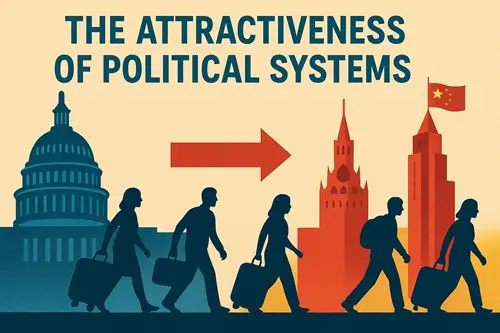 In debates about a shifting multipolar world—whether the future belongs to the West, China, or a resurgent Russia—much time is spent on GDP charts, military capabilities, “civilizational states,” and shifting alliances. Less often asked is the most revealing question of all: If borders were open, where would people choose to live? This question does not rely on geopolitical ideology or cultural preference, but on a universal human instinct: seeking a better life. Migration—forced or voluntary—is the most honest referendum on political systems. The West: Imperfect, Yet ChosenThe West is loud, argumentative, often hypocritical—and embarrassingly self-critical. But when one looks at migration behavior, the picture clarifies: Refugees flee Syria not toward Moscow Dissidents from Hong Kong flee not to Shanghai but to Canada or the UK Venezuelans cross jungles to reach the U.S.—not China, despite decades of anti-imperialist rhetoric Even Russian millionaires park their children and their money in London, Paris, and Miami Why? Because the West offers three things many other systems do not:
Western democracies also offer intangible rewards: cultural openness, freedom to criticize the government, LGBTQ+ rights, and a general sense that one's identity does not need to flatter the state. It is not paradise—but people believe they can live as themselves. And that belief is powerful enough to make borders leak in only one direction. Russia: Security Without ChoiceRussia portrays itself as a civilizational alternative to Western liberalism: conservative, patriotic, spiritually coherent. It promises order over chaos, heritage over decadence, unity over individual ambition. But people rarely migrate toward systems built on unity enforced from above. Russia attracts:
Yet when opportunities arise, even Russia's own youth leave—to Georgia, Armenia, Finland, Germany, or Israel (where many qualify for citizenship due to history's darker ironies). A system built on state control, limited rights, and managed democracy is attractive only to those who benefit from hierarchy—or those without alternatives. China: Prosperity Without VoiceChina is the most serious contender to the Western model. It has lifted hundreds of millions out of poverty, built world-class infrastructure, and now exports not just products—but governance style. Its appeal rests on:
For many developing nations, China looks like proof that democracy is optional and growth is not. Yet, China faces a paradox: As its middle class grows, so does the desire to leave. Chinese migration patterns tell an unmistakable story: Wealthy Chinese buy property abroad at record levels and seek residency in Canada, Australia, Singapore, and Europe—not because they reject China's achievements, but because they want insurance against an unpredictable state. Economic success is attractive—but the inability to speak freely, criticize leadership, or live outside state narratives places limits on how deeply that attractiveness penetrates. Where People Don't GoNotably absent as migration magnets:
Any “strong-state” or “civilizational” regimes often hailed as alternatives to the West in intellectual rhetoric These systems may inspire admiration in theory—but few dream of building their future there. The Revealing MetricInternational relations scholars measure power through:
But there is another metric—simple and unforgiving: Net migration direction.
This migration gradient reflects not propaganda, but lived preference. Conclusion: The Silent VoteThe coming multipolar world will not simply be a map of competing power blocs—it will be a map of where humanity chooses to move. People do not flee democracy. They may criticize it, argue within it, and reshape it—but they rarely run from it. Authoritarian systems offer pride, identity, and certainty. Democracies offer discomfort, argument, and rights. And when the choice is free—not rhetorical—most people choose rights. The world is becoming multipolar in power, yes. But in terms of where humans want to build their lives, the verdict is not multipolar at all. It remains stubbornly unipolar. Not because the West is morally superior, but because: Freedom—even messy, chaotic, noisy freedom—is more attractive to ordinary people than disciplined national greatness. And refugees, migrants, and dreamers continue to cast that vote with their feet.
Widget is loading comments...
|