|
TRANSLATE THIS ARTICLE
Integral World: Exploring Theories of Everything
An independent forum for a critical discussion of the integral philosophy of Ken Wilber
  Frank Visser, graduated as a psychologist of culture and religion, founded IntegralWorld in 1997. He worked as production manager for various publishing houses and as service manager for various internet companies and lives in Amsterdam. Books: Ken Wilber: Thought as Passion (SUNY, 2003), and The Corona Conspiracy: Combatting Disinformation about the Coronavirus (Kindle, 2020). Frank Visser, graduated as a psychologist of culture and religion, founded IntegralWorld in 1997. He worked as production manager for various publishing houses and as service manager for various internet companies and lives in Amsterdam. Books: Ken Wilber: Thought as Passion (SUNY, 2003), and The Corona Conspiracy: Combatting Disinformation about the Coronavirus (Kindle, 2020).
Check out my other conversations with ChatGPT The Return of the Old ArgumentA Critical Examination of God: The Science, the EvidenceFrank Visser / ChatGPT
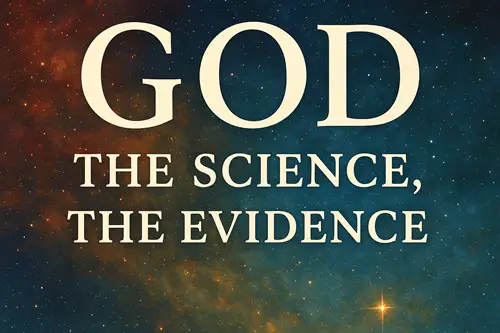 By any historical measure, arguments for God have never disappeared—only changed costumes. Where medieval theology invoked Aristotelian metaphysics, and 19th-century apologetics leaned on natural theology, contemporary revivalist efforts increasingly borrow the language of physics, cosmology, and probability. Michel-Yves Bolloré and Olivier Bonnassies' God: The Science, the Evidence is a prominent example of this latest turn: faith presented not as revelation or intuition, but as the rational endpoint of modern scientific knowledge. The book has enjoyed considerable public attention and commercial success, particularly among readers who sense—correctly—that physics today raises deeper questions than the overly confident materialism of the mid-20th century allowed. Fine-tuning, cosmic contingency, entropy, and the puzzle of consciousness have reopened philosophical space. Bolloré steps into this opening with a sweeping claim: that new scientific discoveries now point toward the necessity—not merely the possibility—of a creator. This is a dramatic framing. But does the argument withstand scrutiny? 1. The Form of the Argument: A Familiar PatternAt first glance, Bolloré's book presents itself as evidence-driven, cumulative, and restrained. It begins with cosmology, proceeds through thermodynamics, mathematical reasoning, and the origins of life, and finally culminates in the conclusion that the hypothesis of God offers the simplest and most coherent explanation of the universe. But structurally, the book follows a recognized apologetic template: Identify open scientific problems. Frame those problems as insurmountable without intelligent direction. Suggest that randomness and natural processes are mathematically impossible. Conclude that purpose and design remain the only rational alternative. This form is not unique. It is the scaffolding of William Paley's watchmaker analogy, refurbished with cosmological constants and probability calculus. The vocabulary has evolved; the logic has not. 2. Fine-Tuning and the Argument from ImprobabilityThe fine-tuning argument is foregrounded: the physical constants of the universe appear “set” with astonishing precision to allow complex structures and life. Bolloré treats this as persuasive evidence for intention. But fine-tuning does not uniquely point to design. It can also be understood through: Selection effects (we can only observe a universe conducive to observation), Unknown physical necessity (constants may not be variable), Naturalistic cosmological models (including ensembles and inflationary structures), or the simplest position of all: brute fact. To infer design from improbability commits a category error: statistical reasoning cannot adjudicate between metaphysical explanations when the probability space itself is unknown. If one does not know how many universes are possible, one cannot meaningfully estimate the probability of ours. 3. Probability as Metaphysics in DisguiseBolloré repeatedly treats improbability as evidence of intention, constructing a form of statistical mysticism. But improbability does not require agency any more than rolling a sequence of prime numbers requires a mathematician behind the dice. The argument rests not on data but intuition—specifically, the human difficulty in grasping large numbers and non-anthropocentric contingency. Ockham's Razor applies here with precision: positing a timeless, omniscient creator to explain unknown initial conditions introduces vastly more metaphysical machinery than alternative explanations require. If a phenomenon can be explained without invoking supernatural causation, the simpler hypothesis is epistemically preferable—not because it is emotionally satisfying, but because it avoids multiplying untestable entities. 4. The Drift from Physics to TheologyPerhaps the most revealing weakness of the book is its gradual shift in register. It begins in the language of cosmology and mathematics, but ends in moral proclamation, purpose, and religious reassurance. The transition is rhetorical, not logical. The ultimate goal is not merely to argue that the universe may be contingent or structured; it is to restore an anthropocentric cosmos in which the human mind—and by implication, human morality and meaning—originate from a transcendent intelligence. Science becomes a staging ground for existential desire. The conclusion was present before the evidence was collected. 5. Why Such Arguments Remain Culturally AppealingIf arguments of this kind fail philosophically and scientifically, why do they recur—generation after generation? Three reasons: Psychological comfort. A universe with purpose feels safer than one without metaphysical guarantees. Cognitive bias. Humans are pattern-seeking animals, predisposed to infer intention even where none exists. Cultural memory. For millennia, cosmic order implied cosmic authorship. Breaking this assumption remains emotionally and culturally unsettling. Put differently: the conclusion feels right before it is defended. 6. The Real Philosophical QuestionThe book implicitly assumes that a universe without a creator is metaphysically unacceptable—that a godless cosmos is absurd, unstable, or meaningless. But that premise is never demonstrated. To accept the universe as self-existing, contingent, and indifferent requires no metaphysical inflation. It requires only intellectual sobriety: The universe exists. It displays lawful regularities. We are capable of observing and interpreting them. Anything added beyond that is worldview—not inference. Conclusion: A Well-Packaged Return to Theological CertaintyGod: The Science, the Evidence is not a breakthrough in philosophy, cosmology, or theology. It is a carefully curated narrative that reinterprets unresolved scientific questions as confirmation of preexisting metaphysical commitments. Its success is cultural, not intellectual: it offers reassurance at a moment when science continues to erode older certainties. But reassurance is not argument. The universe may turn out to be stranger than materialism assumes. It may contain levels of structure and causation not yet understood. But if science teaches anything, it is patience—not premature metaphysics offered as conclusiveness. To mistake mystery for evidence—and evidence for proof—is not a triumph of reason. It is simply the latest chapter in the long history of explaining gaps in knowledge with the oldest hypothesis humanity ever invented.
Widget is loading comments...
|