|
TRANSLATE THIS ARTICLE
Integral World: Exploring Theories of Everything
An independent forum for a critical discussion of the integral philosophy of Ken Wilber
  Frank Visser, graduated as a psychologist of culture and religion, founded IntegralWorld in 1997. He worked as production manager for various publishing houses and as service manager for various internet companies and lives in Amsterdam. Books: Ken Wilber: Thought as Passion (SUNY, 2003), and The Corona Conspiracy: Combatting Disinformation about the Coronavirus (Kindle, 2020). Frank Visser, graduated as a psychologist of culture and religion, founded IntegralWorld in 1997. He worked as production manager for various publishing houses and as service manager for various internet companies and lives in Amsterdam. Books: Ken Wilber: Thought as Passion (SUNY, 2003), and The Corona Conspiracy: Combatting Disinformation about the Coronavirus (Kindle, 2020).
Check out my other conversations with ChatGPT From Siberia to Mexico with LoveWhy Ken Wilber's Cartoon Version of Evolution Doesn't Survive Contact with Actual ScienceFrank Visser / Grok
 “And so Spirit-in-action becomes the very means and mechanism whereby the manifest universe is manifested by Spirit. So what we have is an actual intermediate mechanism that helps us understand how something comes out of nothing. How this extraordinary, marvelous, unbelievably gorgeous universe has come into being. As Spirit-in-action, as an inherent self-organizing drive, as something that is vital, conscious, creative...” - Ken Wilber, 2014 (italics added).
In summary, Wilber's critique isn't "updating" evolution; it's regressing to pre-Darwinian vitalism dressed in New Age jargon.
Ken Wilber's commentary in this quote reveals a profoundly superficial and outdated grasp of evolutionary biology, riddled with misconceptions that echo long-debunked creationist talking points rather than engaging with actual science.[1] He straw-mans the neo-Darwinian synthesis (the integration of natural selection with genetics) as "absolutely inadequate," then invokes a mystical "Spirit-in-action" to fill imagined gaps, complete with probabilistic hand-waving and anthropomorphic storytelling (e.g., males in Siberia romancing females in Mexico). This isn't philosophy grounded in evidence—it's a caricature that ignores population genetics, incremental adaptation, and the vast timescales involved. Wilber's views not only misrepresent the mechanisms of evolution but also perpetuate misinformation that can mislead seekers of integral wisdom, particularly new generations who might encounter his work without the tools to critique it. By framing evolution as a teleological "winding up" against entropy, driven by a cosmic force, he dismisses the empirical foundation of biology, which has been rigorously tested through fossils, genomics, and lab experiments. This failure to align with science undermines the credibility of his broader integral framework, as it prioritizes metaphysical speculation over verifiable facts. Below, I'll dismantle his key claims step by step, drawing on established evolutionary principles, with expanded explanations, additional examples, and historical context to highlight where Wilber goes astray—ensuring that future thinkers can see the clear demarcation between pseudoscience and genuine biology. 1. Misconception: Speciation Requires 6-8 Simultaneous, Non-Lethal Mutations in a Single OrganismWilber claims that jumping from one species to another demands "six to eight" mutations happening all at once, none lethal, and magically coalescing into a functional system that provides a survival edge "without even being tried." He treats this as an "extremely improbable" event, like winning a cosmic lottery, and implies that such coordinated leaps are unexplained by standard evolution. Debunk: This is a fundamental misunderstanding of how speciation works, rooted in a pre-genetic era view of evolution that ignores the population-level dynamics central to modern biology. Speciation doesn't require a burst of simultaneous mutations in one individual; it's a gradual process occurring over generations in populations, often through the accumulation of small genetic changes that spread via natural selection, genetic drift, and gene flow. The theoretical minimum for speciation can be as low as one mutation if it leads to reproductive isolation (e.g., a chromosomal rearrangement preventing interbreeding), but typically, it's the buildup of many minor variations over time, each potentially neutral or slightly beneficial in their environment. Mutations don't need to be "drawn together" in a single leap—they arise sequentially, with each step tested by selection, which preserves those that enhance fitness. For instance, in real-world cases like the Lenski long-term evolution experiment with E. coli, complex traits (e.g., citrate utilization) evolved through a series of mutations over thousands of generations, not all at once. This experiment, running since 1988, has documented over 70,000 generations, showing how rare mutations (like those enabling aerobic citrate metabolism) build on prior ones, with intermediate steps providing no immediate advantage but becoming crucial later—a process known as potentiation. Wilber's "6-8" figure seems plucked from thin air; actual genetic differences between closely related species (e.g., humans and chimps) involve thousands of changes, but these accumulated over millions of years in large populations, not in one "super-offspring." His insistence on simultaneity ignores that beneficial mutations can fix in populations independently and recombine through sexual reproduction. Moreover, not all mutations are lethal; most are neutral, and deleterious ones are weeded out by purifying selection, allowing advantageous ones to persist. This population perspective, formalized in the 1930s-1940s Modern Synthesis, explains why speciation often occurs via allopatric (geographic separation) or sympatric (within the same area) mechanisms, without needing miraculous coordination. Wilber's view harks back to saltationist ideas (sudden jumps) debunked over a century ago, failing to account for the gradualism supported by the fossil record, such as the stepwise evolution of tetrapods from fish-like ancestors over 20 million years. 2. Misconception: Complex Systems Like the Immune System Must Emerge "All at Once" with Hundreds of Untested ComponentsWilber cites the immune system as an example of something that supposedly required "hundreds of components" to appear simultaneously, untested, and perfectly integrated, calling it "really stretching the belief." He argues that without prior "checking," these parts couldn't function together. Debunk: This is a textbook case of the "irreducible complexity" argument, popularized by Michael Behe in the 1990s and thoroughly refuted by evolutionary biologists. Complex systems don't pop into existence fully formed; they evolve incrementally, with intermediate stages serving different functions or providing partial benefits—a concept called scaffolding or exaptation. The vertebrate adaptive immune system, for instance, built on simpler precursors found in invertebrates, such as pattern recognition receptors in sponges or the variable lymphocyte receptors in jawless fish like lampreys. Antibody diversity, generated via V(D)J recombination, evolved from ancient transposon-like elements (RAG genes) that were co-opted over time for somatic rearrangement, not in a single burst. Behe's claims about the immune system's irreducibility were debunked in court during the 2005 Kitzmiller v. Dover trial, where evidence showed that removing "essential" parts yields functional simpler versions in ancestral organisms. For example, the complement system—a key immune component—has homologs in sea urchins, predating vertebrates by 500 million years, and evolved through gene duplication and divergence. Wilber's "none of those components has yet been checked" is flat-out wrong—comparative genomics across phyla traces these origins, revealing stepwise assembly. Evolution isn't about untested leaps; it's about tinkering with existing parts. Another classic example is the bacterial flagellum, often cited by irreducible complexity proponents: its motor evolved from type III secretion systems used for injecting toxins, with intermediates serving as protein pumps. Lab studies, like those on hemoglobin evolution, show how single mutations can enhance function incrementally, building complexity without requiring all parts upfront. Wilber overlooks these, perpetuating a God-of-the-gaps fallacy where ignorance of mechanisms implies supernatural intervention. 3. Misconception: Mutations Must Occur Simultaneously in Mating Pairs, Who Then Magically Find Each Other Across Vast DistancesWilber's folksy tale of a male in Siberia and a female in Mexico needing identical mutation sets, then courting over dinner and flowers, is meant to highlight improbability—but it's pure fiction. He calculates odds like "one in seventeen billion" for a dozen non-lethal mutations occurring together. Debunk: Evolution operates on populations, not isolated individuals, making Wilber's scenario a gross caricature. A beneficial mutation arises in one organism, spreads through its descendants via reproduction, and can combine with others through gene flow, recombination, and migration. There's no need for the same mutations to hit both sexes at the exact same moment; sexual reproduction shuffles genes across the population, allowing advantageous alleles to rise in frequency if they confer fitness benefits. Over generations, in groups of thousands or millions, rare mutations become common—think of lactase persistence in humans, which arose multiple times and spread in dairy-farming populations over 10,000 years. His "one in seventeen billion" odds is a miscalculation based on assuming independence, simultaneity, and tiny populations in a vacuum. In reality, mutation rates (around 10^-8 per base pair per generation in humans, or higher in microbes) combined with population sizes (e.g., billions for bacteria) and deep time (billions of years) make complex adaptations probable. Geographic separation? That's how allopatric speciation happens—populations diverge in isolation (e.g., Darwin's finches on Galápagos islands), adapting locally before potentially reconnecting or speciating fully. No global matchmaking required; gene flow occurs within demes, and barriers like rivers or mountains drive divergence. Wilber ignores effective population size in genetics, where even small groups can harbor enough variation for selection to act, as seen in ring species like the Ensatina salamanders, where gradual changes around a geographic loop lead to incompatibility at the ends. His probabilistic dismissal fails to consider that evolution isn't a lottery—selection biases outcomes toward functionality. 4. Misconception: Evolution Is "Pushing Against" Entropy, Requiring an "Upward Drive" Like SpiritWilber argues the universe trends toward "entropy, dissipation, and downward movement," so evolution's "winding up" (from dust to Shakespeare) can't be random—it needs a cosmic force or "Spirit-in-action" to self-organize against this tide. Debunk: This mangles the second law of thermodynamics, which states entropy increases in closed systems. Earth is an open system, constantly receiving low-entropy energy from the sun, allowing local decreases in entropy (like life organizing) while total entropy rises (e.g., solar fusion waste heat). Far from contradicting evolution, entropy gradients drive it—dissipative structures (like cells) emerge to efficiently disperse energy, as per nonequilibrium thermodynamics pioneered by Ilya Prigogine. Self-organization isn't mystical; it's emergent from physical laws, chemistry, and selection. Autocatalytic cycles in prebiotic chemistry (e.g., RNA world hypotheses) or pattern formation in reaction-diffusion systems (like Turing patterns in animal coats) show how complexity arises without a "spirit." Wilber's appeal to Alfred North Whitehead's "creative advance into novelty" is philosophical poetry, not science—evolution produces novelty through variation and selection, no teleological force needed. Creationists have misused the second law similarly since the 1970s, but it's been refuted repeatedly: life's local order increases entropy elsewhere, like how refrigerators cool inside by heating outside. Examples abound, from hydrothermal vents fostering early life through energy gradients to ecosystems where biodiversity enhances energy flow. Wilber's "upward drive" adds unnecessary vitalism, ignoring that complexity evolves when it aids survival, not as a predetermined ascent. 5. Misconception: Neo-Darwinism Is Inadequate, So Insert SpiritWilber dismisses the neo-Darwinian synthesis as a "likely story" and posits evolution as "Spirit-in-action," claiming founders like Darwin had something similar in mind. He invokes self-organization as evidence for a vital, conscious force. Debunk: While the Modern Synthesis (neo-Darwinism) has been expanded into the Extended Evolutionary Synthesis—incorporating evo-devo, epigenetics, niche construction, plasticity, and multilevel selection—its core (mutation, selection, drift) remains robust and empirically supported. Calls for updates aren't admissions of failure; they're refinements based on new data (e.g., genomics revealing horizontal gene transfer in microbes). Darwin himself was agnostic on ultimate causes but grounded in naturalism—no "spirit" required, though he speculated on a creator setting initial laws. Wilber's alternative veers into intelligent design territory, which is pseudoscience: it posits an unspecified "drive" without testable mechanisms or evidence. Evolution explains "from quarks to Shakespeare" through bottom-up processes: atoms to molecules via chemistry, cells via abiogenesis, multicellularity via symbiosis (e.g., mitochondria from engulfed bacteria), and cognition via neural expansions selected for problem-solving. Recent advances, like CRISPR experiments recapitulating evolutionary changes, affirm the synthesis's adequacy. Wilber cherry-picks self-organization (e.g., from Kauffman) but ignores its naturalistic basis in physics, not spirituality. In summary, Wilber's critique isn't "updating" evolution; it's regressing to pre-Darwinian vitalism dressed in New Age jargon. Real evolutionary biology is a mature field with mountains of evidence from fossils, genetics, and experiments. For new generations, recognizing these failures is crucial: Wilber's errors highlight the dangers of conflating philosophy with science, potentially stunting critical thinking. If Wilber wants to philosophize about "greater wholeness and love," fine—but don't masquerade it as biology. For a genuine understanding, consult sources like Why Evolution Is True by Jerry Coyne or the TalkOrigins archive, not armchair mysticism. 6. Misconception: “Spirit-in-action” Is an Actual Mechanism That Explains How Something Comes from NothingNear the climax of his talk, Wilber triumphantly declares: “And so Spirit-in-action becomes the very means and mechanism whereby the manifest universe is manifested by Spirit. So what we have is an actual intermediate mechanism that helps us understand how something comes out of nothing.” This is the pivotal moment where the entire argument is supposed to land. After ridiculing neo-Darwinism for failing to explain complexity, Wilber promises that his spiritual ontology delivers what science cannot: a genuine causal mechanism bridging absolute nothingness (the unmanifest Spirit) and the manifest cosmos. Debunk: What Wilber actually delivers is a majestic-sounding phrase — “Spirit-in-action” (sometimes called Eros, Love, or Creativity) — that functions as a semantic black box with zero explanatory power. He presents no testable process, no predictive model, no mathematical formalism, no experimental protocol, and no falsification criterion. In short, he offers precisely the opposite of a mechanism. In science, a mechanism must specify:
For example:
All of these are genuine intermediate mechanisms, complete with equations, observables, and experimental tests. 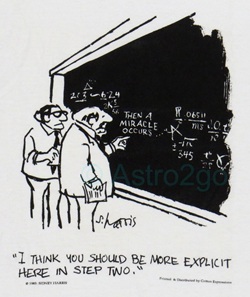
“Spirit-in-action,” by contrast, is a classic example of what philosophers of science call a “promissory note” or a “verbal formula masquerading as explanation.” It is the metaphysical equivalent of saying “Then a miracle occurs” in a cartoon. Wilber repeatedly uses active verbs — “Spirit creates,” “Eros drives,” “Creativity creatively creates” — but never unpacks what any of these terms actually do at the physical or informational level. When pressed in writing or interviews, he falls back on panentheism, process theology, or Whiteheadian occasions of experience, none of which have ever been formulated in a way that generates quantitative predictions about mutation rates, speciation events, or the emergence of novelty beyond what standard evolutionary theory already accounts for. Worse, Wilber explicitly rejects the need for such rigor. He has written that the “Eye of Spirit” transcends the “eye of flesh” and the “eye of mind,” implying that demanding empirical mechanisms is itself a category error committed by flatlanders. This is intellectual sleight-of-hand: first declare that science is catastrophically incomplete because it cannot explain X; then, when asked for your own explanation of X, reply that the very request betrays a lower level of consciousness. The manoeuvre shields the claim from ever being examined, which is the hallmark not of a higher truth but of pseudoscience. Cosmologists and quantum-gravity theorists who actually work on “something from nothing” (e.g., Hawking's no-boundary proposal, Vilenkin's quantum tunneling, Carroll's inflationary fluctuations) offer mathematically precise mechanisms that make testable predictions about the cosmic microwave background, primordial density perturbations, or gravitational wave signatures. Wilber offers none. He simply re-labels the mystery “Spirit-in-action” and declares victory. In the end, the promise of an “actual intermediate mechanism” is the most revealing failure of the entire lecture. Wilber spends twenty minutes mocking evolutionary biology for alleged explanatory gaps, yet when he finally presents his own positive theory, the gap is not filled — it is merely given a mystical name and declared off-limits to scientific scrutiny. That is not transcendence; it is evasion. New generations deserve to see this clearly: invoking “Spirit” does not constitute a mechanism. It is the surrender of mechanism. 7. The Fatal Flaw of “Transcend-and-Include” When the Inclusion Is FictionalKen Wilber's entire philosophical brand rests on the slogan “transcend-and-include.” Higher stages, he insists, do not deny or abolish lower ones; they preserve their truths while adding new depth. Science, in this model, is supposed to be the shining example: the integral vision honours the empirical discoveries of physics, biology, and neuroscience, then embeds them within broader interiors (consciousness, culture, spirit). It sounds noble in theory. In practice, when it comes to evolutionary biology, Wilber's “inclusion” is a sham because the science he claims to include has been systematically distorted beyond recognition. To “include” a domain means to accurately represent its findings and then show how they fit into a larger context. Wilber does the opposite: he caricatures neo-Darwinism as a cartoon of blind, random, entropic, downward-pushing chance, declares it “absolutely inadequate,” and then slots his own mystical teleology into the artificial gap he just created. The real science (population genetics, evo-devo, multilevel selection, thermodynamic openness, scaffolded complexity, exaptation, deep time, vast population sizes) is never faithfully included; it is replaced by a straw man so flimsy that only “Spirit-in-action” can rescue it. This is not transcendence-and-inclusion; it is misrepresentation-and-replacement. When an integral map quietly rewrites the empirical data of a external quadrant so that only the internal quadrant can “save” it, the entire edifice collapses into bad faith. True integral thinking would say: “Here is what the best evolutionary science actually says (with citations, nuance, and humility); now watch how beautifully it dovetails with developmental, cultural, and contemplative truths.” Wilber never does that. Instead, he teaches his audience that mainstream biology is a “likely story” that only makes sense if Eros is secretly pulling the strings. That is not inclusion of science; that is ideological capture of science. The danger for new generations is severe. Thousands of spiritually inclined, intellectually curious people encounter Wilber as their first exposure to an allegedly “integral” treatment of evolution. They absorb the message that real biologists are reductionist flatlanders who believe in a meaningless, random, entropic universe, and that only Ken Wilber's higher vision reveals the true creative ascent. Armed with this false dichotomy, they feel justified dismissing Dawkins, Coyne, Carroll, or the entire peer-reviewed literature as “merely exterior” or “orange-stage” thinking. The result is a spiritually coated anti-science bubble that looks sophisticated but is, at its core, intellectually irresponsible. Genuine transcendence-and-inclusion would rejoice in the staggering empirical power of modern evolutionary theory and then ask: “Given that natural selection plus deep time plus geochemical gradients can produce everything from prokaryotes to Proust, what does this tell us about the nature of creativity, consciousness, and Spirit?” That conversation is thrilling, humbling, and truly integral. Wilber, by contrast, poisons the well from the outset by misrepresenting what science actually claims. Until the integral community stops laundering outdated creationist objections through spiritual language and starts engaging evolutionary biology on its own terms (with accuracy, citations, and respect), the promise of “transcend-and-include” will remain hollow rhetoric. The map is not the territory, and no amount of turquoise altitude can compensate for getting the green-level science catastrophically wrong. New generations deserve better: an integral approach that actually includes the science, rather than one that sacrifices it on the altar of a pre-packaged metaphysics. NOTES
“What we see as evolution moves—from dust to Shakespeare—is a winding up.”
[1] The quote is taken from "Taking Evolution into Account", a talk by Wilber at the Fourth Turning Conference, video #4, 2014. It is now behind a paywall on Integral Life as part of the "The Fourth Turning of Buddhism Conference" course. “We can think of this as "Spirit-in-action", if we wish we can think of this as "Evolution-in-action", as long as the evolution is updated, from the mere neo-Darwinian synthesis, which the more you look at that, the more absolutely inadequate it becomes to account for evolution. One quick example. The standard talk is of mutations occurring, in humans or any other life, genetic material, and then this, apparently, has some capacity to help an organism survive, in the overall, generalized, "survival of the fittest". But in order for that to happen, a couple of almost impossible things have to happen. One, to get from one species to the next, you have to have mutations occurring, anywhere from six to eight. Almost all mutations are lethal. So we are going to have this extraordinary capacity of six to eight mutations occurring, none of them lethal. They are drawing together to create some kind of organic system, that is going to give, whoever inherits that, a major advantage in survival of the fittest. So we have these extremely improbably genes, all coming together, at the same time, that will also include all of the improvements that are going to increase average survival and advantage of the fittest, and in fact none of them have actually been checked out. So they are coming together, still in some random kind of fashion, and it is sort of said that when they are passed on, they are going to do much, much better, in the competition, for survival. So how those are actually known to do that, how these six mutations are, unbelievably, going to produce something that is going to make a subsequent organism just incredibly more survival capable... that is not explained. If you look at something like the immune system, with hundreds of components, and it was supposed to come into existence more or less at the same time, all at once, but none of those components has yet been checked! So how do we know, that all hundred of these things, are going to automatically work together, without ever having done so before, to create an immune system that is going to take care of this organism. That is really stretching the belief that that could occur. That's just the beginning. Those hundred things that are going to get together in one organism—the male—the number of hundred random mutations have to come together in the female! She's in Mexico, he's in Siberia [audience starts laughing]. Somehow they have got to find eachother... a little dinner.... some flowers... a little candy... and they have sex. And all of these marvelous, outrageously impossible things have to come together and then their offspring, is like some kind of super-offspring, that has all these things in place, and then we have to make sure that they grow up and, you know, don't get eaten by bears, or anything, and then they also have to come together, and mate, and produce more of those kinds of things, and they have to somehow catch on and start their life processes, and so on. And the whole thing, in general, starts to sound so outlandish, that is what Plato called "a likely story", and so we have this likely story of evolution, occurring under those circumstances... and it really strains the imagination. Now all of this is put in place, because the assumption is that there is nothing in the universe, that drives it upward. There is only a universe that drives toward entropy, dissipation, and downward movement. So that is what evolution is pushing against. And if it is not pushing against and against it, the odds are very small that it is going to overcome any of those problems. Female in Mexico, male in Siberia... how in God's name do we get them together, and all of those dozen or so mutations have to occur simultaneously, and non-lethally, and without even being tried... and that those are somehow going to get together... How? Not explained. How they come together in the first place, not explained. The odds of having a dozen non-lethal mutations occur together, simultaneously, is something like one in seventeen billion, and this has to occur IF the male in Siberia and the female in Mexico actually find eachother. A likely story! So what we are really have to backup and look at is the idea that somewhere in the cosmos, is it just a drive to fall apart? What we see as evolution moves—from dust to Shakespeare—is a winding up. There is some sort of force, of upper evolutionary drive, that is behind this extraordinary capacity that evolution has produced. Again, from quarks and strings and atoms, to you! That is not a random process! There is no way in hell that is a random process. So one of the ways to talk about this is as "Spirit-in-action". And of course many of the founders of evolution had something very similar in mind. And so we can see evolution as a Spirit-in-action, that is first pushing uphill, and second, self-organizing, inherently self-organizing, to bring these various factors together, not just to have them randomly separated, and falling apart, and making it less and less likely that they are even going to find eachother,... And so Spirit-in-action becomes the very means and mechanism whereby the manifest universe is manifested by Spirit. So what we have is an actual intermediate mechanism that helps us understand how something comes out of nothing. How this extraordinary, marvelous, unbelievably gorgeous universe has come into being. As Spirit-in-action, as an inherent self-organizing drive, as something that is vital, conscious, creative...
Whitehead said there are only three categories needed to get a universe going. One was the concept of "the One", one was "the Many", and the third was "the creative advance into novelty". And if you look at evolution on the whole, that is primarily what you see. You see atoms growing into molecules, molecules into cells, cells into multi-cellular organisms, organisms into plants, into amphibians, into reptiles—each of these with increased physiological ingredients and components. Where did those all come from? More random mutations and natural selection? Right! [eyes rolling upward] They came into being through a self-organizing drive to produce this higher and more holistic material. And so just by looking at evolution itself, we can start to get a very positive sense, of what Spirit—talking a bit metaphorically and anthropocentrically—what Spirit might have in mind, because from the very beginning it is driven in a certain direction. Of greater wholeness, of greater love, of greater care, of unfolding. And that is a extraordinarily beautiful set of requirements for the cosmos to unfold into.
And if I were Spirit, just looking into something that I would help to create, the Grand Canyon would be a great start! And then all of these extraordinary capacities that humans have, that deers have, that ants have... Some of these animal capacities are staggering. And all of that has been part of this ongoing evolutionary growth of... Spirit.”
Comment Form is loading comments...
|