|
TRANSLATE THIS ARTICLE
Integral World: Exploring Theories of Everything
An independent forum for a critical discussion of the integral philosophy of Ken Wilber
  Frank Visser, graduated as a psychologist of culture and religion, founded IntegralWorld in 1997. He worked as production manager for various publishing houses and as service manager for various internet companies and lives in Amsterdam. Books: Ken Wilber: Thought as Passion (SUNY, 2003), and The Corona Conspiracy: Combatting Disinformation about the Coronavirus (Kindle, 2020). Frank Visser, graduated as a psychologist of culture and religion, founded IntegralWorld in 1997. He worked as production manager for various publishing houses and as service manager for various internet companies and lives in Amsterdam. Books: Ken Wilber: Thought as Passion (SUNY, 2003), and The Corona Conspiracy: Combatting Disinformation about the Coronavirus (Kindle, 2020).
Check out my other conversations with ChatGPT Pan-Interiorism in ContextBetween Idealism, Panpsychism, and Teleological MetaphysicsFrank Visser / ChatGPT
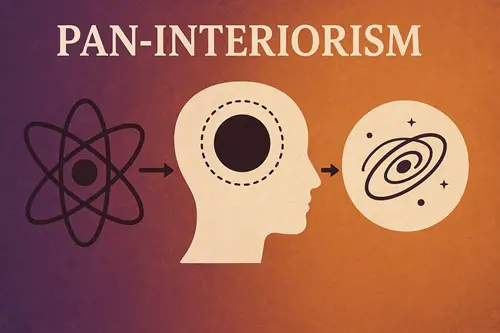 Ken Wilber's self-label pan-interiorist is meant to distinguish his position from both reductive materialism and classical idealism. On the surface, it sounds like a refined metaphysical stance—suggesting that interiority or subjectivity pervades all levels of reality. In practice, however, it places Wilber firmly inside a rapidly evolving territory in contemporary philosophy of mind occupied by panpsychists, cosmopsychists, neutral monists, and process ontologists. To understand where (and whether) this position belongs philosophically, it helps to map it against a framework proposed by David Chalmers—specifically his distinction between micropsychism, macrophyschism, and cosmopsychism within the family of panpsychist theories. What Pan-Interiorism MeansIn Wilber's usage, pan-interiorism means that: All holons (entities) possess some form of interiority—however primitive. This interior dimension is paired with an exterior dimension (behavior, form, material correlates), leading to his familiar AQAL four-quadrant model. Bacteria have proto-feelings, atoms have “prehensions,” and evolution moves toward increasing depth, complexity, and awareness. Interior and exterior co-arise as inseparable aspects of reality. This moves Wilber into philosophical territory shared with:
But Wilber goes further: evolution is not merely accompanied by consciousness—it is driven by an inner morphogenetic pull (Eros) toward higher consciousness. This is where metaphysics leaves the paved road. The Landscape: Where Does It Fit?Within contemporary philosophy of mind, Wilber's stance intersects with several frameworks:
In short: pan-interiorism is a hybrid of panpsychism, idealism, and teleological metaphysics dressed in integral language. Wilber's Claim: An Interior Dimension All the Way DownWilber's core proposal is simple: All holons—atoms, cells, organisms, cultures—possess both interior (subjective) and exterior (objective) dimensions. This is one of the pillars of AQAL metaphysics and is what justifies attributing proto-awareness to electrons and “depth” to evolutionary unfolding. Interiority is not emergent; it is primitive and universal. That puts Wilber squarely in the panpsychist rather than emergentist camp. Consciousness is not produced by complexity—it is already present and evolves in form. Chalmers' Taxonomy: Where Might Wilber Fit?Chalmers distinguishes among three versions of panpsychism:
Now, where does Wilber belong? He explicitly adopts micropsychism's continuity thesis—proto-experience “all the way down.” But his broader metaphysics is unmistakably cosmopsychist:
Thus, Wilber occupies a hybrid position: micropsychism at the ontological base, cosmopsychism at the teleological apex. He skips macropsychism almost entirely, because individual minds are not simply emergent—they are nodal expressions of a deeper Spirit-process. The Motivation Behind Pan-InteriorismWilber's position is not merely a philosophical speculation. It is functionally required by his larger narrative:
Without the assumption of primordial interiority, the entire spiritual arc of the Integral system collapses into naturalistic emergentism—and loses its metaphysical drama. Strengths: Why Some Find It PlausibleWilber's instinct is not without contemporary traction:
Seen in that light, Wilber is riding the same dissatisfaction with reductive materialism that drives current panpsychist revival. Weaknesses: Where the View StrugglesHowever, Wilber's version introduces additional commitments that make it less rigorous than contemporary analytic frameworks. 1. The Teleological LeapPan-interiorism is tied to purpose, direction, and value in evolution. But evolutionary biology and cosmology do not support a directional or spiritualized unfolding. Consciousness is rare, fragile, and not clearly increasing on a cosmic scale. 2. Lack of Mechanistic AccountChalmers and analytic panpsychists focus on explanatory models (e.g., IIT, compositionality frameworks). Wilber offers none. His mechanism is: “Spirit evolves toward higher realization.” Which—philosophically speaking—is not an explanation but a destination. 3. Immunity to FalsificationBecause interiority is assumed even where no evidence could detect it, the proposal is unfalsifiable. This places pan-interiorism closer to esoteric metaphysics than philosophy of mind. Final AssessmentWilber's pan-interiorism is best interpreted as: A spiritually motivated cosmopsychist-panpsychist hybrid with a strong teleological component. It resonates with current debates about consciousness and offers a poetic alternative to reductive materialism. But judged by contemporary standards of analytic rigor and empirical accountability, it lacks:
It succeeds more as a worldview architecture than as a defensible metaphysical theory. Put differently: Wilber gives consciousness a cosmic story. But he does not resolve the metaphysical puzzles that make that story necessary.
Widget is loading comments...
|