|
TRANSLATE THIS ARTICLE
Integral World: Exploring Theories of Everything
An independent forum for a critical discussion of the integral philosophy of Ken Wilber
  Frank Visser, graduated as a psychologist of culture and religion, founded IntegralWorld in 1997. He worked as production manager for various publishing houses and as service manager for various internet companies and lives in Amsterdam. Books: Ken Wilber: Thought as Passion (SUNY, 2003), and The Corona Conspiracy: Combatting Disinformation about the Coronavirus (Kindle, 2020). Frank Visser, graduated as a psychologist of culture and religion, founded IntegralWorld in 1997. He worked as production manager for various publishing houses and as service manager for various internet companies and lives in Amsterdam. Books: Ken Wilber: Thought as Passion (SUNY, 2003), and The Corona Conspiracy: Combatting Disinformation about the Coronavirus (Kindle, 2020).
Check out my other conversations with ChatGPT Entropy, Complexity, and the Meaning We ProjectSean Carroll, Ken Wilber, and Bobby Azarian ComparedFrank Visser / ChatGPT
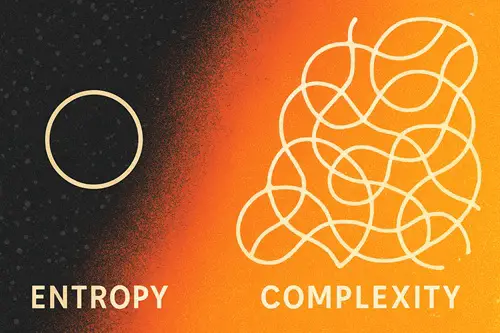 The concepts of entropy and complexity act like philosophical tuning forks: strike them, and you quickly hear where a thinker stands on evolution, purpose, and the nature of reality. In contemporary discourse, three figures—Sean Carroll, Ken Wilber, and Bobby Azarian—offer particularly revealing contrasts. Each takes the same scientific vocabulary and uses it to anchor very different worldviews: one staunchly naturalistic, one spiritually teleological, and one hybridizing scientific mechanism with emergent meaning. Sean Carroll: Entropy Without Cosmic StorytellingFor theoretical physicist Sean Carroll, entropy is neither mystical nor morally uplifting—it's simply a measure of how many microstates correspond to a macrostate. The universe, by his account, began in a state of remarkably low entropy, and its evolution is governed by the second law of thermodynamics: entropy increases. But—and this is key—Carroll stresses that order does not require purpose. Local pockets of complexity can increase as global entropy rises. Stars form, planets differentiate, and life evolves—not because the universe wants complexity, but because high-entropy gradients enable energy flows, which can support structure temporarily. In Carroll's view:
He leaves no room for metaphysical smuggling: any teleology added to entropy is a human projection. Ken Wilber: Complexity as Evolutionary Spirit in ActionKen Wilber reads entropy and complexity through a completely different lens. For him, evolution displays a clear directional thrust: from matter to life, to mind, to spirit. Wilber frequently cites what he calls the universe's movement toward greater complexity, depth, and interiority—a movement he associates with Eros, a drive built into the fabric of reality itself. Entropy, for Wilber, isn't merely disorder. He reframes it as part of a dialectical process: chaos provides the fertile ground from which novel higher-order systems emerge. He invokes Prigogine, Kauffman, the second law, and self-organization not merely as mechanisms, but as signposts of Spirit evolving itself. In Wilber's metaphysics:
Carroll would call this metaphysics disguised as science. Wilber would reply that Carroll mistakes the map for the territory. Bobby Azarian: The Middle Position—Complexity as an Emergent Evolutionary PrincipleBobby Azarian occupies an intriguing middle space. Like Carroll, he accepts methodological naturalism, statistical mechanics, and evolutionary biology. Yet like Wilber, he sees in the universe a pattern of rising complexity that is neither random nor trivial. Azarian's framework emphasizes:
Unlike Wilber, Azarian doesn't invoke Spirit or metaphysical teleology. But unlike Carroll, he suggests that patterns in nature—autocatalytic networks, complexification trends, and information dynamics—may indicate deep rules or constraints that bias evolution toward structure. To him, complexity behaves like an entropic loophole—a lawful process where systems exploit gradients to build order while increasing global entropy. In this sense, complexity is neither miracle nor accident, but thermodynamic inevitability under the right conditions. Azarian's position could be framed as: Purpose without a Purposer. Direction without metaphysics. Three Answers to the Same QuestionQuestion: Does entropy allow or imply a direction toward complexity? Sean Carroll Bobby Azarian Ken Wilber
Why the Debate MattersEntropy and complexity are not just thermodynamic terms—they have become metaphysical battlegrounds. Carroll protects scientific humility, warning against sneaking theology in through thermodynamics. Wilber defends cosmic significance, refusing to let the universe collapse into indifferent physics. Azarian looks for a path where meaning emerges naturally, without violating physics or reducing awe. What they disagree about isn't the equations—but what the equations mean. Conclusion: Three Cosmologies, One UniverseEntropy will continue rising whether or not humans philosophize about it. Complexity may flourish for a while and then disappear entirely, swallowed by proton decay or heat death. Yet our interpretations reveal more about us than about the laws themselves. Carroll reminds us that nature doesn't need our stories. Azarian suggests nature might contain patterns that resemble stories. Wilber insists nature is a story—one of unfolding interiority and purpose. Between those poles—explanation, interpretation, and meaning—we see not just different cosmologies, but different temperaments: the physicist's restraint, the mystic's narrative, and the synthesizer's curiosity. The universe remains silent on which one is right. But it allows us—at least for a while—to ask.
Widget is loading comments...
|