|
TRANSLATE THIS ARTICLE
Integral World: Exploring Theories of Everything
An independent forum for a critical discussion of the integral philosophy of Ken Wilber
  Frank Visser, graduated as a psychologist of culture and religion, founded IntegralWorld in 1997. He worked as production manager for various publishing houses and as service manager for various internet companies and lives in Amsterdam. Books: Ken Wilber: Thought as Passion (SUNY, 2003), and The Corona Conspiracy: Combatting Disinformation about the Coronavirus (Kindle, 2020). Frank Visser, graduated as a psychologist of culture and religion, founded IntegralWorld in 1997. He worked as production manager for various publishing houses and as service manager for various internet companies and lives in Amsterdam. Books: Ken Wilber: Thought as Passion (SUNY, 2003), and The Corona Conspiracy: Combatting Disinformation about the Coronavirus (Kindle, 2020).
Check out my other conversations with ChatGPT Evolution: Blavatsky, Wilber, and Science in TensionFrank Visser / ChatGPT
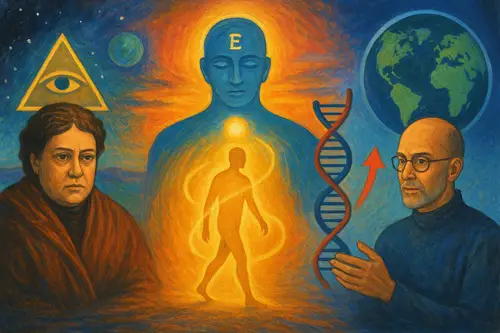 Few concepts have so radically transformed human self-understanding as biological evolution. Since Darwin, it has become the central framework for explaining the diversity of life, including humankind. But alongside this scientific narrative, alternative interpretations have emerged from religious, esoteric, and spiritual traditions. Helena P. Blavatsky, the founder of Theosophy, and Ken Wilber, the architect of Integral Theory, both developed sweeping evolutionary visions that attempt to go beyond—or against—mainstream science. Comparing their views with the scientific account reveals not only deep incompatibilities but also a telling pattern: both insist evolution must be guided, though for very different reasons. Blavatsky's Guided MythologyBlavatsky (1831-1891), in The Secret Doctrine (1888), presented a vast cosmology in which evolution is not merely biological but cosmic, spiritual, and cyclical. Humanity, she taught, has passed through successive “Root Races,” each tied to distinct epochs and levels of consciousness. Darwin's idea of gradual adaptation through natural selection is acknowledged only to be surpassed by a scheme guided by hidden intelligences and karmic necessity. For Blavatsky, chance has no place in cosmic history. As she put it: “The universe is not the result of a fortuitous concurrence of atoms.”[1] Evolution, to her, was a stage-managed process, overseen by spiritual hierarchies and aiming at the divinization of humankind. From the standpoint of modern biology, these notions are mythological rather than scientific—but they demonstrate how evolutionary language was adapted to serve a spiritual worldview. Wilber's Spiritualized EvolutionKen Wilber (b. 1949) reinterprets evolution through his Integral Theory. While less mythological than Blavatsky, his stance is structurally similar: he, too, refuses to believe that chance and natural processes alone suffice to explain complexity. For Wilber, the universe is driven by Eros—a spiritual force or intrinsic tendency toward higher integration and consciousness. He insists that “something other than chance is pushing the universe.”[2] Unlike Blavatsky, Wilber grounds his argument not in occult races or hidden Masters but in the idea that complexity, depth, and consciousness continually emerge in ways Darwinism cannot explain. To make his case appear more scientific, he frequently appeals to the modern concept of self-organization—the spontaneous emergence of order in complex systems. Self-Organization: The Decisive TestHere lies the crux of the matter. Self-organization shows how natural systems, from snowflakes to galaxies, from chemical networks to embryonic development, produce order without any guiding hand. Local interactions governed by simple rules can generate astonishing complexity. Modern complexity theory has demonstrated this across physics, chemistry, and biology. This is precisely the point: self-organization is what makes inner guidance unnecessary. It explains how complexity and novelty arise in the absence of a designer, a hidden hierarchy, or a spiritual Eros. The very concept Wilber borrows to buttress his case undermines it completely. When Wilber cites self-organization but then insists that it must be the manifestation of Spirit, he performs a bait-and-switch:
This is not integration but appropriation. It is, in fact, disingenuous. For if self-organization suffices to explain emergent complexity, then Wilber's Eros becomes redundant—a metaphysical add-on, not an explanatory principle. Where science sees a natural mechanism, Wilber sees proof of Spirit, but only by rebranding a naturalistic insight into a mystical one. Science: Evolution Without GuidanceModern evolutionary theory explains life through undirected processes:
No teleological principle is needed. The success of this framework is demonstrated daily, from tracking viral mutations to reconstructing the tree of life. Complexity is not an anomaly to be explained away by metaphysics; it is the natural outcome of evolutionary processes amplified over deep time. Three Stories, One Verdict
The pivot point is self-organization. For Blavatsky, it never entered the picture; for Wilber, it becomes a rhetorical tool. But in science, it renders both Blavatsky's occultism and Wilber's vitalism obsolete. Conclusion: The Redundancy of SpiritThe history of thought about evolution shows a recurring temptation: to resist the stark elegance of Darwin's insight by smuggling purpose back into the picture. Blavatsky did so with occult races and Masters; Wilber does so with Eros and Spirit. Yet science has demonstrated that complexity, directionality, and novelty need no hidden guidance. Self-organization, far from supporting Wilber's metaphysics, is the decisive evidence against it. In the end, the difference is simple: science explains how evolution works, while Blavatsky and Wilber tell us what they wish it meant. But when “meaning” becomes explanation, myth masquerades as science—and the real power of evolution's story is lost. NOTES[1] Helena Petrovna Blavatsky, The Secret Doctrine, 1888, vol. 1., p. viii. The aim of this work may be thus stated: to show that Nature is not “a fortuitous concurrence of atoms,” and to assign to man his rightful place in the scheme of the Universe; to rescue from degradation the archaic truths which are the basis of all religions; and to uncover, to some extent, the fundamental unity from which they all spring; finally, to show that the occult side of Nature has never been approached by the Science of modern civilization. [2] Ken Wilber, A Brief History of Everything, 1996, p. 26. Something other than chance is pushing the universe. For traditional scientists, chance was their god. Chance would explain it all. Chance—plus unending time—would produce the universe. But they don't have unending time, and so their god fails them miserably. That god is dead. Chance is not what explains the universe; in fact, chance is what that universe is laboring mightily to overcome. Chance is exactly what the self-transcending drive of the Kosmos overcomes. Widget is loading comments...
|