|
TRANSLATE THIS ARTICLE
Integral World: Exploring Theories of Everything
An independent forum for a critical discussion of the integral philosophy of Ken Wilber
  Frank Visser, graduated as a psychologist of culture and religion, founded IntegralWorld in 1997. He worked as production manager for various publishing houses and as service manager for various internet companies and lives in Amsterdam. Books: Ken Wilber: Thought as Passion (SUNY, 2003), and The Corona Conspiracy: Combatting Disinformation about the Coronavirus (Kindle, 2020). Frank Visser, graduated as a psychologist of culture and religion, founded IntegralWorld in 1997. He worked as production manager for various publishing houses and as service manager for various internet companies and lives in Amsterdam. Books: Ken Wilber: Thought as Passion (SUNY, 2003), and The Corona Conspiracy: Combatting Disinformation about the Coronavirus (Kindle, 2020).
Check out my other conversations with ChatGPT Three Competing Narratives of the Ukraine WarDisaster, Humiliation, or Western Collapse?Frank Visser / ChatGPT
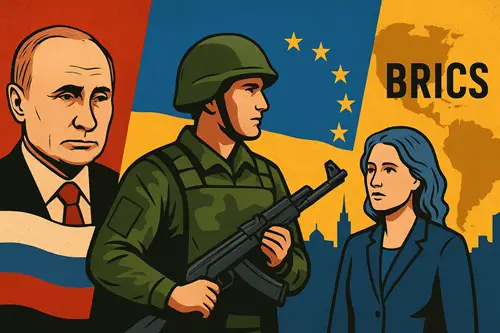 The war in Ukraine has become one of the most consequential conflicts of the 21st century, but how it is interpreted depends heavily on the vantage point. To some, it is Vladimir Putin's greatest blunder—a war that has weakened Russia economically, militarily, and diplomatically. To others, it is a civilizational turning point in which the West is repeating its colonial arrogance and faces its own “century of humiliation.” Still others argue that far from being weakened, Russia is the party in control, while Europe and Ukraine are heading for collapse. These starkly different framings, exemplified in recent commentaries by Frank Visser, Jan Krikke, and Joe Corbett, reveal not only competing analyses but also deep ideological divides over geopolitics, history, and power. 1. The Disaster Narrative: Putin's Overreach and Strategic DeclineThe first interpretation, reflected in mainstream Western analysis and Frank Visser's essay, sees the war primarily as a disaster for Putin. By launching a full-scale invasion of Ukraine in February 2022, he hoped to topple the Kyiv government within days and install a compliant regime. Instead, Ukraine resisted fiercely, Western nations rallied with unprecedented sanctions, and NATO found renewed purpose. From this perspective, the costs to Russia are staggering:
In this framing, Ukraine is not a pawn but a protagonist: its defense of sovereignty has reshaped European security and exposed the limits of Russian power. Putin's quest for empire has led to overreach, entangling Russia in a costly quagmire. The Ukraine war, then, is less a display of Russian strength than a sign of decline. 2. The Humiliation Narrative: The West vs. BRICS and the Shadow of ColonialismJan Krikke offers a different lens, shifting focus from Russia to the larger historical stage. He argues that the Ukraine conflict is not merely a regional war but part of a broader struggle between Western powers and the rising BRICS bloc. With “a bit of historical awareness,” Krikke suggests, one can see Europe itself sliding toward a “century of humiliation” analogous to what China endured under colonial domination. This framing emphasizes:
Here, Putin is not necessarily seen as either winning or losing on the battlefield. Instead, he is a symbol of resistance to Western overreach, playing a role in a global shift toward multipolarity. For Krikke, the “real story” is not Putin's miscalculation but the historical turning of the tide against Western dominance. 3. The Collapse Narrative: Putin in Control, the West in DisarrayJoe Corbett pushes the inversion even further. In his view, the notion that the war has been disastrous for Putin is “ass-backward.” He argues that Russia is in a position of strength, while the real crisis looms over Europe and Ukraine. His perspective emphasizes:
Forced response: Russia's invasion is framed not as aggression but as a defensive reaction to NATO expansion and Western hubris. This narrative reframes the war as a Western miscalculation: the attempt to isolate Russia has backfired, revealing the overreach of U.S. and EU policies. Putin, rather than weakened, is portrayed as holding the strategic initiative. 4. Why These Narratives DivergeThe divergence of these three narratives—disaster, humiliation, collapse—reveals less about Ukraine itself than about differing worldviews:
5. Conclusion: A Fractured DiscourseThe war in Ukraine is not only a battle of armies but also of narratives. For some, it has exposed the hubris of Putin's neo-imperial ambitions and cemented Western solidarity. For others, it is the latest theater in a long civilizational shift away from Western dominance. And for still others, it demonstrates the West's fragility, with Russia emerging as the true victor. Each narrative highlights part of the truth while obscuring others. Ukraine itself, caught between these interpretations, continues to fight for survival—not as a symbol in a global chess game, but as a nation struggling to preserve its independence. Whether the future validates one perspective over the others remains uncertain. What is clear is that the war has become a mirror in which competing visions of world order are projected, debated, and contested. Widget is loading comments...
|