|
TRANSLATE THIS ARTICLE
Integral World: Exploring Theories of Everything
An independent forum for a critical discussion of the integral philosophy of Ken Wilber
  Frank Visser, graduated as a psychologist of culture and religion, founded IntegralWorld in 1997. He worked as production manager for various publishing houses and as service manager for various internet companies and lives in Amsterdam. Books: Ken Wilber: Thought as Passion (SUNY, 2003), and The Corona Conspiracy: Combatting Disinformation about the Coronavirus (Kindle, 2020). Frank Visser, graduated as a psychologist of culture and religion, founded IntegralWorld in 1997. He worked as production manager for various publishing houses and as service manager for various internet companies and lives in Amsterdam. Books: Ken Wilber: Thought as Passion (SUNY, 2003), and The Corona Conspiracy: Combatting Disinformation about the Coronavirus (Kindle, 2020).
Check out my other conversations with ChatGPT Groupthink and Its Manifestations in the Ukraine WarMedia, Propaganda, and ScholarshipFrank Visser / ChatGPT
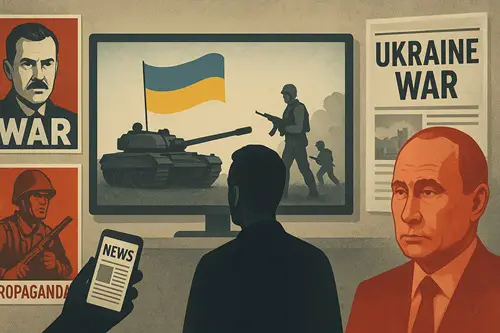 Introduction: The Dynamics of Groupthink in Modern ConflictsThe Ukraine war has not only been fought on the battlefields of Eastern Europe but also within the realm of global narratives—shaped by media ecosystems, propaganda machinery, and academic discourse. In this contested informational space, groupthink—a psychological phenomenon where the desire for conformity within a group results in irrational or dysfunctional decision-making—plays a pivotal role. Originally conceptualized by Irving Janis in the early 1970s, groupthink manifests when consensus is prized over critical evaluation, leading to self-censorship, stereotyping of opponents, and an inflated sense of moral superiority. In the context of the Ukraine war, groupthink has permeated both Western and Russian narratives, structuring how events are interpreted, communicated, and internalized by societies. This essay explores the role of groupthink in shaping media coverage, state propaganda, and scholarly analysis, and reflects on the broader implications for democratic deliberation and informed policy-making. 1. The Psychology of Groupthink in Times of WarWars amplify the human tendency to seek certainty and solidarity. In such high-stakes environments, dissent can be perceived as disloyalty, and complexity as weakness. This climate fosters the core symptoms of groupthink:
These psychological patterns shape not just public opinion but also elite decision-making circles—whether in Washington, Brussels, Moscow, or Kyiv. 2. Media Narratives: The Manufacture of ConsensusMainstream media in both the West and Russia has played a central role in reinforcing groupthink dynamics. The framing of the Ukraine war has differed dramatically across these spheres, yet the underlying structure—mobilizing collective identity through narrative simplification—remains strikingly similar.
Both sides employ emotive language, selective reporting, and expert commentary aligned with their narrative frames, leaving little room for nuanced analysis. Social media algorithms amplify this by creating echo chambers, reinforcing existing biases and deepening polarization. 3. Propaganda: From State Messaging to Cultural WeaponizationPropaganda during the Ukraine war has evolved beyond traditional state messaging into hybrid information warfare. Russia employs disinformation campaigns, cyberattacks, and historical revisionism to justify its actions. The Kremlin frames its war as a continuation of the Great Patriotic War, tapping into deep cultural memories of WWII to legitimize aggression. The West, while decrying Russian disinformation, engages in its own narrative management through strategic communication and information operations. Terms such as “defending the rules-based order” and “standing with Ukraine” serve to unify public opinion while obscuring the geopolitical calculus underlying Western support. Cultural narratives—from Hollywood portrayals of Ukrainian resilience to viral social media stories—further embed the moral framing of the war. 4. Academic and Policy Scholarship: Echoes of GroupthinkEven scholarly discourse is not immune to groupthink. In Western academic circles, analyses often gravitate toward the paradigm of Russian revanchism and the security dilemma is discussed only within narrow bounds. Structural realist arguments—such as John Mearsheimer's thesis that NATO expansion provoked Russia—are frequently caricatured or dismissed outright. Similarly, Russian scholarship, shaped by state influence and funding constraints, tends to reinforce nationalist narratives and delegitimize Western perspectives as “Russophobic.” Think tanks and policy institutes, reliant on government or defense-industry funding, amplify consensus positions that support continued military aid and escalation deterrence, while voices advocating for diplomacy risk being sidelined as naïve or defeatist. 5. Consequences of Groupthink: Policy and Public OpinionThe most alarming consequence of groupthink in the Ukraine war is the narrowing of the Overton window—the range of acceptable policy options. In the West, advocating for negotiations can be equated with appeasement, while in Russia, anti-war activism is criminalized. This climate of intellectual conformity inhibits creative solutions and prolongs conflict. Furthermore, media-driven groupthink fosters public opinion polarization, making democratic deliberation increasingly fragile. Citizens are not exposed to the full spectrum of facts and interpretations but to curated narratives that reinforce in-group loyalty and out-group hostility. Conclusion: Breaking the CycleThe Ukraine war illustrates how groupthink—manifested through media, propaganda, and scholarship—shapes not only perceptions but also material outcomes on the ground. While wartime cohesion may serve short-term strategic goals, it poses long-term risks for democratic societies that rely on open debate and critical inquiry. Breaking the cycle of groupthink requires:
In an age where wars are fought as much in the information sphere as on physical battlegrounds, resisting groupthink is not merely a moral imperative—it is a strategic necessity.
Widget is loading comments...
|