|
TRANSLATE THIS ARTICLE
Integral World: Exploring Theories of Everything
An independent forum for a critical discussion of the integral philosophy of Ken Wilber
  Frank Visser, graduated as a psychologist of culture and religion, founded IntegralWorld in 1997. He worked as production manager for various publishing houses and as service manager for various internet companies and lives in Amsterdam. Books: Ken Wilber: Thought as Passion (SUNY, 2003), and The Corona Conspiracy: Combatting Disinformation about the Coronavirus (Kindle, 2020). Frank Visser, graduated as a psychologist of culture and religion, founded IntegralWorld in 1997. He worked as production manager for various publishing houses and as service manager for various internet companies and lives in Amsterdam. Books: Ken Wilber: Thought as Passion (SUNY, 2003), and The Corona Conspiracy: Combatting Disinformation about the Coronavirus (Kindle, 2020).
Check out my other conversations with ChatGPT The Tragedy of GeographyUkraine Caught Between SuperpowersFrank Visser / ChatGPT
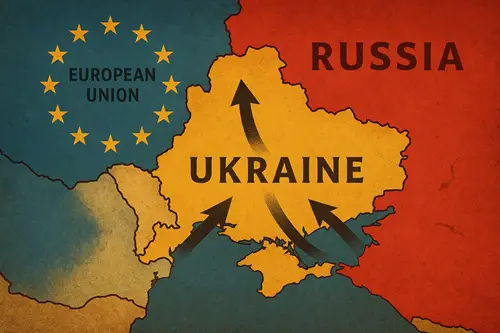 The fate of nations is often determined not only by the choices of their leaders or the spirit of their people but also by the unforgiving dictates of geography. Few countries exemplify this better than Ukraine. Situated in the vast flatlands between Central Europe and Russia, Ukraine has long been both bridge and battleground, breadbasket and buffer. Its location is strategic, its resources abundant, but its position precarious. To be Ukraine is to exist in a state of perpetual vulnerability, pressed between superpowers whose ambitions rarely pause to respect its sovereignty. This essay explores the tragedy of geography that shapes Ukraine's past and present. It considers the historical precedents of imperial domination, the modern dilemma of navigating between East and West, and the grim concept of the Bloodlands—Timothy Snyder's term for the swath of Eastern Europe where geography amplified the violence of both Hitler's and Stalin's regimes. Together, these perspectives underscore the reality that Ukraine's predicament is not merely political but structural, woven into the very terrain it inhabits. Geography as DestinyUkraine's geography is a paradox of blessing and curse. On the one hand, its fertile black soil, the chernozem, has earned it the title of Europe's breadbasket. Its rivers, particularly the Dnipro, provide arteries of commerce and life. Its position at the crossroads of trade routes has long made it a natural hub of exchange and culture. On the other hand, Ukraine's geography is perilously open. Unlike countries shielded by mountains, seas, or deserts, Ukraine's borders are drawn across plains that armies can march across with ease. The lack of natural defenses has made Ukraine historically indefensible against larger powers. Geography, in short, has left Ukraine exposed—its riches attracting empires, its flatness denying protection, its centrality ensuring contest. Between Empires: A Historical PatternThe historical fate of Ukraine has been shaped by its inescapable position between empires. In the early modern era, the Cossack Hetmanate attempted to chart an independent course, yet it could only survive by negotiating between the Polish-Lithuanian Commonwealth and Muscovy. The Treaty of Pereyaslav in 1654, in which the Cossacks pledged loyalty to the Tsar, illustrates how geography forced tragic compromises. A state in the middle could rarely remain neutral—it had to align with one neighbor against the other, often at the cost of its autonomy. The 19th and early 20th centuries brought further subjugation. Ukraine was partitioned between the Russian Empire and the Austro-Hungarian Empire, its cultural and political life constrained by imperial rule. Independence after World War I was fleeting, crushed by the Red Army in the chaos of revolution. Ukraine became a Soviet republic, once more tethered to the dictates of geography: its land and resources were too valuable for Moscow to relinquish. The Bloodlands: Geography as CatastropheNo period better demonstrates the lethal consequences of Ukraine's location than the era Snyder terms the Bloodlands—the vast region stretching from the Baltic to the Black Sea where Nazi and Soviet terror overlapped between 1933 and 1945. Ukraine was at the very heart of this zone, where geography made it the stage for atrocities on a scale that defies comprehension. First came Stalin's policies. In 1932-33, the collectivization of agriculture and the extraction of grain for export precipitated the Holodomor, the man-made famine that killed millions of Ukrainians. Geography played a crucial role: Ukraine's fertile soil was both its blessing and its curse, as Moscow treated its harvests as imperial spoils to feed industrialization and export markets, leaving the peasantry to starve. A few years later, Nazi Germany invaded the Soviet Union, and Ukraine once again bore the brunt of geography's cruelty. Hitler's quest for Lebensraum targeted Ukraine's land as Germany's breadbasket, its people disposable. The Holocaust and mass reprisals unfolded on Ukrainian soil, where Jewish, Polish, and Ukrainian civilians alike became victims of systematic slaughter. In the space of little more than a decade, millions perished in Ukraine's villages and fields, making the country one of the bloodiest chapters in Europe's darkest history. Snyder's notion of the Bloodlands illustrates vividly that geography is not neutral: it shapes where ideologies collide, where totalitarian ambitions overlap, and where violence concentrates. Ukraine's tragedy was that it lay precisely in the zone of overlap between Hitler's Germany and Stalin's Soviet Union, crushed between two superpowers whose designs were ruthless and absolute. Independence and the New DilemmaWhen the Soviet Union collapsed in 1991, Ukraine seized the opportunity for independence. For the first time in centuries, geography did not immediately dictate subordination to an empire. Yet the structural predicament remained: Ukraine was still situated between a resurgent Russia and an expanding European Union. Independence did not alter the map; it merely reset the players in the perennial contest. This predicament reached a breaking point in 2014. Ukraine's tentative movement toward integration with the European Union, symbolized by the Euromaidan protests, provoked a decisive Russian response: the annexation of Crimea and the fomenting of war in the Donbas. Russia's actions made clear that, for Moscow, Ukraine was not a foreign state but a necessary buffer and a core part of its strategic depth. For Europe, conversely, Ukraine became the frontline of democratic aspiration against authoritarian regression. Once again, Ukraine's geography placed it in the crosshairs of larger powers, its sovereignty constrained by forces it could not control. The Present Struggle: Superpowers and SurvivalThe ongoing war that began with Russia's full-scale invasion in 2022 is the most recent manifestation of Ukraine's geographic tragedy. Russia frames its actions as defensive—seeking to prevent NATO's encroachment into what it regards as its sphere of influence. The West, by contrast, interprets Ukraine's struggle as one of self-determination and the right to choose alliances freely. For Ukraine, however, this is not an abstract debate about spheres of influence or alliances; it is an existential fight. Geography dictates that neutrality is fragile at best, while alignment with either side invites hostility from the other. Ukraine is too strategically significant for Russia to allow it to drift Westward, yet too independent-minded to accept subjugation. Strategies Amid the TragedyUkraine's leaders face a near-impossible balancing act. On the one hand, integration with Western institutions offers security guarantees, economic growth, and alignment with democratic values. On the other hand, it provokes Russia's wrath, for which Ukraine pays a devastating price. Neutrality, often proposed as a solution, is no guarantee of safety: without strong defensive alliances, neutrality merely leaves Ukraine exposed. The tragic insight is that Ukraine cannot escape geography—it can only mitigate its consequences. Strengthening its military, investing in defense infrastructure, and securing international support are attempts to create deterrence against the relentless pull of geography. Yet the underlying truth remains: Ukraine will always be the crossroads, the contested ground, the space between superpowers. Conclusion: The Enduring TragedyThe tragedy of geography is not unique to Ukraine, but nowhere is it more visible or more cruel. From the Cossack Hetmanate to the Holodomor, from the Nazi occupation to the current war, Ukraine has repeatedly suffered the fate of a nation whose location condemns it to be both target and prize. Snyder's notion of the Bloodlands underscores the depth of this tragedy: geography not only shaped political dilemmas but also concentrated some of the most horrific violence of the 20th century in Ukraine's lands. Geography is not destiny in the strict sense—human choices matter, and Ukrainians have demonstrated resilience and agency in the face of impossible odds. Yet geography sets the stage on which choices unfold, narrowing options and amplifying risks. Ukraine's story is thus both inspiring and tragic: inspiring in its determination to survive, tragic in the merciless logic of its location. In this sense, Ukraine stands as a symbol of a broader truth: nations do not choose their geography, but they must live with its consequences. For Ukraine, the tragedy of geography is the recurring dilemma of survival between superpowers, a dilemma that remains unresolved and perhaps, given the map, unresolvable.
Widget is loading comments...
|