|
TRANSLATE THIS ARTICLE
Integral World: Exploring Theories of Everything
An independent forum for a critical discussion of the integral philosophy of Ken Wilber
  Frank Visser, graduated as a psychologist of culture and religion, founded IntegralWorld in 1997. He worked as production manager for various publishing houses and as service manager for various internet companies and lives in Amsterdam. Books: Ken Wilber: Thought as Passion (SUNY, 2003), and The Corona Conspiracy: Combatting Disinformation about the Coronavirus (Kindle, 2020). Frank Visser, graduated as a psychologist of culture and religion, founded IntegralWorld in 1997. He worked as production manager for various publishing houses and as service manager for various internet companies and lives in Amsterdam. Books: Ken Wilber: Thought as Passion (SUNY, 2003), and The Corona Conspiracy: Combatting Disinformation about the Coronavirus (Kindle, 2020).
Check out my other conversations with ChatGPT The War in UkraineDisaster or Strategic Survival for Putin?Frank Visser / ChatGPT
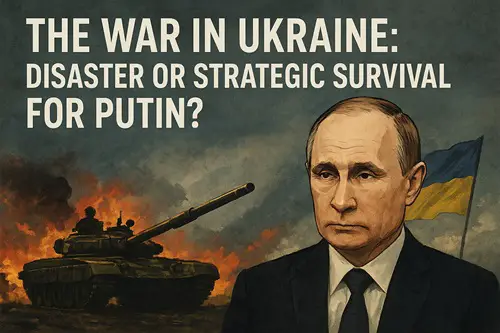 When Vladimir Putin launched a full-scale invasion of Ukraine in February 2022, the decision represented the culmination of decades of his vision for Russia. He aimed not only to topple Kyiv and install a pro-Russian government but also to assert Moscow's dominance over its former Soviet sphere, reverse what he perceives as the West's encroachment, and restore Russia's image as a great power. Nearly three years into the conflict, the war has produced consequences that are both catastrophic and surprisingly resilient for the Russian leader. Evaluating its outcomes requires balancing visible costs—military, economic, and diplomatic—against the strategic and domestic gains Putin has secured, sometimes against overwhelming odds. Strategic and Military SetbacksFrom the beginning, the war was characterized by strategic miscalculations. Putin appeared to assume that Ukraine, a nation of roughly 44 million people, would collapse within days under the weight of Russian military superiority. He underestimated both the determination of the Ukrainian people and the sophistication of their armed forces, which had been modernizing and training with NATO partners for years. Blitzkrieg-style tactics quickly faltered, supply chains collapsed, and morale among Russian conscripts remained low. Far from fragmenting, Ukrainian national identity hardened around resistance, and President Volodymyr Zelensky emerged as a symbol of defiance that galvanized global support. The Russian military suffered staggering losses in personnel and equipment. Independent estimates suggest hundreds of thousands of Russian casualties, alongside the destruction or capture of thousands of armored vehicles, artillery pieces, and aircraft. The military's logistical inefficiencies and the exposed corruption within its command structure became evident in repeated failed offensives. What was presented domestically as a swift, decisive campaign instead became a drawn-out war of attrition. Economically, the invasion triggered a wave of Western sanctions unprecedented in modern history. Russia was cut off from critical financial networks, restricted in its access to advanced technologies, and faced reduced export revenues from key markets. While the Kremlin managed to stabilize the ruble and redirect trade toward Asia, the long-term prospects remain precarious: a shrinking technological base, a brain drain of educated professionals, and increasing dependence on authoritarian or non-aligned states threaten Russia's ability to modernize. Diplomatically, Russia has become increasingly isolated. The European Union and the United States have actively sought to marginalize Moscow, cutting off energy dependence and engaging in coordinated political, economic, and military support for Ukraine. Even longstanding partners tread carefully: China and India, while maintaining pragmatic relations, have not endorsed Russia's war aims, instead using Moscow's vulnerability to extract favorable trade terms. In global perception, Russia has shifted from a recognized great power to a pariah state, its image tarnished in much of the world. Domestically, the war has put pressure on Russian society. Mobilizations and conscriptions have provoked unease and anxiety among families. The state has relied on propaganda and censorship to maintain social cohesion, but cracks are visible, particularly among the urban middle class and elites who see the economic consequences firsthand. The Wagner mutiny in 2023 briefly exposed tensions within the security apparatus, revealing that even loyalist forces are not immune to discontent. Strategic and Domestic GainsYet these setbacks coexist with gains that are more subtle but significant. Putin's overriding objective—regime survival—remains intact. Opposition figures have been neutralized, independent media silenced, and dissent criminalized. The failure of the Wagner mutiny ultimately reinforced his authority by eliminating a potential rival and demonstrating that challenges to his power would be swiftly contained. From this perspective, the war has strengthened the foundations of his authoritarian rule. Economically, while sanctions have imposed costs, Russia has adapted in ways that Western analysts did not fully anticipate. Trade with China, India, and the Middle East has expanded. Energy exports, particularly to Asia, have generated substantial revenue. The government has prioritized military-industrial production, ensuring the armed forces remain supplied despite battlefield losses. While ordinary Russians face inflation and shortages, the state has preserved employment and maintained social stability, avoiding the kind of widespread unrest that could threaten Putin personally. Militarily, although Russia has not achieved its initial goals, it has consolidated control over significant swaths of eastern and southern Ukraine, including the land corridor to Crimea. This territorial control, while costly, ensures Russia's strategic depth and access to the Black Sea. The conflict has devolved into a war of attrition, which may ultimately favor an authoritarian state with deep manpower reserves over a democracy reliant on foreign support. Globally, the war has kept Russia central to international affairs. States in the Global South, the Middle East, and parts of Asia continue to engage with Moscow pragmatically, ensuring that Russia cannot be entirely isolated. While NATO has strengthened, Putin can exploit divisions and fatigue among Western publics, who are increasingly concerned about the economic and political costs of sustained support for Ukraine. The war has also strengthened nationalist narratives within Russia. Propaganda and education campaigns emphasize patriotism and portray the conflict as a defensive struggle against Western encirclement. These narratives reinforce the legitimacy of Putin's rule and help maintain social cohesion, at least outwardly. In effect, the war has militarized Russian society and solidified the alignment between the state and national identity. Dialectical AssessmentThe war in Ukraine is both a disaster and a source of strategic resilience for Putin. On one hand, the human, economic, and military costs have been enormous. Russia's global reputation is diminished, NATO is stronger, Ukraine remains independent and increasingly oriented toward Europe, and domestic strains are real. From a conventional perspective of military success and international standing, the war is a profound failure. On the other hand, from the perspective of regime survival and strategic positioning, Putin has not only endured but adapted. He retains political control, consolidated nationalist legitimacy, and maintained strategic territorial gains. Russia continues to assert itself globally as a force to be reckoned with, and the Kremlin has demonstrated resilience in sustaining a war effort despite extensive sanctions and international condemnation. The conflict has revealed the durability of authoritarian governance in the modern era, even at great cost. Potential Scenarios: The Next Five YearsLooking forward, several scenarios could determine whether the war ultimately proves disastrous or solidifies Putin's rule. Prolonged Attrition and Russian SurvivalIf the war continues as a protracted conflict of attrition, Russia may stabilize its economy through alternative trade networks and maintain internal cohesion through nationalist mobilization. Western fatigue or political shifts could reduce support for Ukraine, allowing Moscow to consolidate its gains in eastern and southern regions. In this scenario, Putin emerges as a “resilient survivor,” having maintained power despite international isolation. Internal Strains and Regime VulnerabilityAlternatively, domestic pressures—economic stagnation, conscription fatigue, elite dissent—could intensify over the next five years. If the war drags on without clear gains, public dissatisfaction may grow, threatening regime stability. Russia's authoritarian structure makes large-scale unrest difficult but not impossible, particularly if elite factions begin competing over limited resources and strategic direction. Negotiated Settlement and Strategic CompromiseAnother plausible outcome is a negotiated settlement mediated by neutral powers. While Ukraine is unlikely to cede territory willingly, a frozen conflict or partial compromise could allow Russia to claim a degree of victory domestically while stabilizing the economy. Such a scenario preserves Putin's power but leaves long-term tensions unresolved, keeping Russia and the West in a protracted geopolitical standoff. Escalation and Global RisksA final scenario involves escalation—either militarily into neighboring countries or via nuclear brinkmanship. While extreme, this option reflects Putin's willingness to leverage Russia's military capabilities to achieve strategic objectives. Escalation could reinforce domestic legitimacy through nationalism, but it also risks catastrophic consequences for Russia and the global order, potentially undermining any long-term gains. ConclusionThe war in Ukraine defies simple categorization. Militarily, economically, and diplomatically, Russia has suffered enormous costs. NATO has strengthened, Ukraine remains independent and increasingly aligned with the West, and global perception of Russia has deteriorated. Yet Putin has survived politically, consolidated nationalist legitimacy, and maintained strategic footholds. The conflict has demonstrated the resilience of authoritarian governance even under extreme duress. Over the next five years, the ultimate outcome will depend on a delicate balance of Western unity, Russian domestic cohesion, and Ukraine's ability to sustain resistance. The war is simultaneously a disaster and a testament to Putin's strategic adaptability—a paradox that underscores the complex interplay between authoritarian survival and the costs of military adventurism.
Widget is loading comments...
|