|
TRANSLATE THIS ARTICLE
Integral World: Exploring Theories of Everything
An independent forum for a critical discussion of the integral philosophy of Ken Wilber
  Frank Visser, graduated as a psychologist of culture and religion, founded IntegralWorld in 1997. He worked as production manager for various publishing houses and as service manager for various internet companies and lives in Amsterdam. Books: Ken Wilber: Thought as Passion (SUNY, 2003), and The Corona Conspiracy: Combatting Disinformation about the Coronavirus (Kindle, 2020). Frank Visser, graduated as a psychologist of culture and religion, founded IntegralWorld in 1997. He worked as production manager for various publishing houses and as service manager for various internet companies and lives in Amsterdam. Books: Ken Wilber: Thought as Passion (SUNY, 2003), and The Corona Conspiracy: Combatting Disinformation about the Coronavirus (Kindle, 2020).
Check out my other conversations with ChatGPT Is Entropy Really Disorder?What the Early Universe Teaches UsFrank Visser / ChatGPT
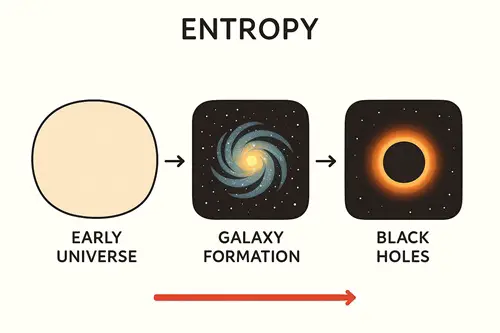 1. Why This Question MattersIf you've read any popular science book—or even Ken Wilber's writings—you've probably come across the idea that entropy equals disorder. The Second Law of Thermodynamics, we are told, says that the universe is running down into chaos. Spiritual writers often add that this trend needs to be balanced by an opposite force, some kind of cosmic Eros pulling things toward order and complexity. It sounds dramatic. It also turns out to be misleading. In physics, entropy does not literally mean disorder. And when we look at the early universe, the story becomes even more fascinating: the universe began in a state of incredibly low entropy, despite appearing perfectly uniform and “disordered” to our everyday intuition. Let's unpack why. 2. What Entropy Actually MeansEntropy is best understood as a measure of how many microscopic arrangements (microstates) can correspond to a system's overall condition (its macrostate). The more ways you can rearrange the pieces without changing the big picture, the higher the entropy.
So yes, in simple systems, entropy and “messiness” roughly align. But this picture breaks down for gravitational systems like the universe. 3. Gravity Changes EverythingHere's the twist: in a universe dominated by gravity, uniformity is not high entropy—it's the opposite. Gravity loves to clump matter together. Stars, galaxies, and black holes all represent higher-entropy states than a smooth, evenly distributed cloud of particles. So:
And if you didn't know: black holes are entropy monsters. A single supermassive black hole has more entropy than all the ordinary matter in its galaxy combined. 4. The Early Universe Was SpecialRight after the Big Bang, the universe was:
Roger Penrose calls this “the low-entropy puzzle.” The gravitational field was in an extraordinarily ordered state. In fact, Penrose estimates the odds of such an initial configuration as 1 in 1010^123—a number so huge that even writing it down is impractical. Why does this matter? Because this initial low entropy sets the arrow of time. From that special starting point, entropy has been increasing ever since. 5. The Myth of “Entropy as Disorder”This is where the disorder metaphor fails. To the naked eye, the early universe looked boring and featureless—surely the ultimate “disorder.” But from a thermodynamic perspective, it was the opposite: a state of extreme order in terms of gravitational possibilities. A better way to think of entropy is as a measure of how many different ways the universe could be arranged without changing its large-scale characteristics. 6. Does Ken Wilber Still Get This Wrong?Ken Wilber frequently frames the Second Law as a “tendency toward disorder” that must be balanced by a countervailing force—Eros—that drives complexity upward. His argument appears in Sex, Ecology, Spirituality (1995) and elsewhere: without such a cosmic force, he says, we couldn't explain the emergence of life, mind, and culture in an entropic universe. The problem? This interpretation rests on the disorder metaphor and overlooks how complexity emerges naturally from local decreases in entropy powered by energy flows (think stars, geothermal heat, chemical gradients). There is no need to invoke a metaphysical Eros to “rescue” evolution from entropy. Moreover, cosmology tells us the early universe didn't start in maximum entropy at all—it started in a very special, low-entropy state, leaving plenty of room for entropy to increase while complex structures form along the way. In short:
7. So Where Does This Leave Us?Entropy is not “the triumph of chaos.” It's a measure of possibilities, and in a universe with gravity, the road to higher entropy is paved with structure: stars, galaxies, and black holes. The early universe's smoothness wasn't messy—it was extraordinarily special. And that, not some cosmic life-force, is what makes the arrow of time possible. How Sean Carroll Explains Entropy and Complexity
Where Does Complexity Come From? (Big Picture Ep. 3/5)
Entropy and complexity co-emerge until complexity reaches its zenit, and goes down again—with entropy still rising:
So complexity emerges in the middle, at the medium entropy phase of the universe (and your coffee cup). At the final phase, complexity disappears!

Source: The universe and your morning coffee, Cassandra R. Hunt
Widget is loading comments...
|