|
TRANSLATE THIS ARTICLE
Integral World: Exploring Theories of Everything
An independent forum for a critical discussion of the integral philosophy of Ken Wilber
  Frank Visser, graduated as a psychologist of culture and religion, founded IntegralWorld in 1997. He worked as production manager for various publishing houses and as service manager for various internet companies and lives in Amsterdam. Books: Ken Wilber: Thought as Passion (SUNY, 2003), and The Corona Conspiracy: Combatting Disinformation about the Coronavirus (Kindle, 2020). Frank Visser, graduated as a psychologist of culture and religion, founded IntegralWorld in 1997. He worked as production manager for various publishing houses and as service manager for various internet companies and lives in Amsterdam. Books: Ken Wilber: Thought as Passion (SUNY, 2003), and The Corona Conspiracy: Combatting Disinformation about the Coronavirus (Kindle, 2020).
Check out my other conversations with ChatGPT Soul, Afterlife, and HeavenRelics of a Prescientific Past?Frank Visser / ChatGPT
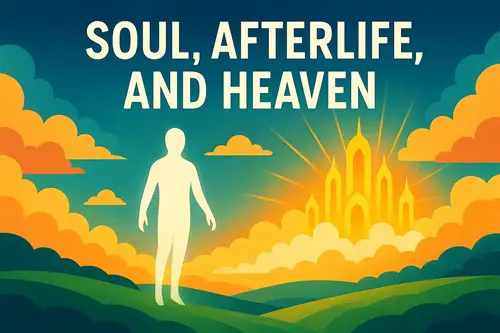 Humanity has always wrestled with mortality. Long before science offered naturalistic accounts of life and death, cultures developed rich metaphysical frameworks to ease existential anxiety. The ideas of soul, afterlife, and heaven belong to this heritage: imaginative constructs designed to give continuity to human existence beyond its apparent limits. They made sense in the cosmological and metaphysical frameworks of antiquity. Yet in the light of modern science, they increasingly appear as concepts out of joint with our current worldview. The Metaphysical Superstructure of the PastIn ancient thought, the soul was conceived as a subtle essence animating the body. Philosophers from Plato to Aquinas debated its origin, substance, and destiny. Religions elaborated further, situating the soul in a moral cosmos: those who lived righteously were promised heaven, while others faced punishment or dissolution. The afterlife was the ultimate arena of justice, correcting what earthly existence left unresolved. This metaphysical superstructure rested on assumptions that were then taken for granted: that the human self is an immaterial entity separable from the body, that the universe is governed by divine purposes, and that morality requires cosmic enforcement. These assumptions made sense before biology, neurology, and cosmology transformed our understanding of life. The Physicalist WorldviewToday, neuroscience shows that consciousness is deeply rooted in brain activity. Identity, memory, and personality are all bound to neural processes that degrade with injury and cease with death. Evolutionary biology traces human origins through a long chain of animal ancestry, eroding the image of humans as metaphysically distinct beings. Physics and cosmology present a universe governed by impersonal laws rather than divine intentions. Within this framework, the notion of a disembodied soul persisting beyond death is no longer required—or even coherent. The afterlife becomes an unverifiable hypothesis, unsupported by empirical evidence. Heaven turns from a literal place into, at best, a poetic metaphor. The Power of Nonordinary ExperienceYet, one might object: people continue to report near-death experiences, mystical states, and apparitions. Do these not testify to the reality of the soul and the afterlife? Here caution is warranted. Nonordinary experiences are undeniably powerful and transformative, but they do not necessarily reveal metaphysical truths. Rather, they are states of consciousness shaped by brain chemistry, cultural expectations, and psychological needs. A near-death experience may feel like a glimpse of eternity, but science can explain its features through oxygen deprivation, neural hyperactivity, or dream-like hallucination. Mystical rapture may dissolve the sense of self, yet this does not entail the existence of another world—it reveals the flexibility of the brain's self-model. In short, extraordinary experiences do not override the larger evidential base that anchors our worldview in physicalism. Ockham's Razor and Metaphysical EconomyHere the principle of Ockham's Razor becomes decisive: entities should not be multiplied beyond necessity. To explain human consciousness and mortality, we already possess well-grounded naturalistic models. Introducing immaterial souls, heavenly realms, or postmortem destinies adds layers of speculative machinery without explanatory gain. Indeed, when a straightforward physicalist account suffices—consciousness emerges from neural complexity and ends with its cessation—the appeal to invisible metaphysical substances is a violation of explanatory economy. This does not disprove the existence of the soul or afterlife, but it exposes them as unnecessary hypotheses. In modern science, explanatory redundancy is a reason for rejection. What cannot be justified by necessity or evidence is best set aside. Living Without Metaphysical GuaranteesAbandoning belief in soul, afterlife, and heaven need not entail nihilism. On the contrary, it invites us to ground meaning in this world, not the next. Mortality, far from being an error awaiting cosmic correction, can be accepted as the natural conclusion of life. Ethics becomes no less urgent when unmoored from divine judgment—it becomes more so, since justice must be enacted here and now. In this sense, shedding prescientific metaphysical constructs can liberate us to live more fully. Instead of deferring fulfillment to an imagined beyond, we can treasure our finite existence, cultivate compassion, and build enduring legacies in the only world we know we have. ConclusionThe soul, the afterlife, and heaven were once central pillars of human meaning-making. Today, however, they survive largely as cultural inheritances from an age when metaphysical superstructures were needed to explain what science could not. Their persistence reflects deep-seated human hopes, not confirmed realities. Even if nonordinary experiences tempt us toward metaphysical interpretations, a physicalist worldview remains the most coherent framework for understanding ourselves. To recognize these concepts as relics of the prescientific past is not to diminish human life—it is to face it honestly. And in that honesty lies a new source of dignity, meaning, and depth. Appendix: Addressing Common ObjectionsThe original essay argues that concepts like soul, afterlife, and heaven belong to a prescientific worldview and that physicalism remains the most parsimonious explanation of life and consciousness. Several thoughtful objections deserve consideration. Below, I address the main themes raised by critics who cite near-death experiences (NDEs), reincarnation research, mediumship studies, and claims of extrasensory perception (ESP). 1. The Hard Problem and “Science Can't Explain Consciousness”It is true that science has not solved the “hard problem” of consciousness—how subjective experience arises from neural activity. But acknowledging an explanatory gap does not justify leaping to immaterial souls or afterlife hypotheses. These do not resolve the problem; they only relocate it: How does an immaterial soul think? How does it interact with matter? By Ockham's Razor, we should avoid introducing untestable entities if current evidence supports a brain-based model. That model is not complete, but it is coherent, progressively explanatory, and consistent with vast data linking mental states to neural states. 2. Near-Death Experiences (NDEs)Critics argue that NDEs cannot be explained by hypoxia, hallucination, or neural surges because these typically produce confusion, while NDEs are often vivid and structured—even when the cortex appears inactive. This point, while striking, is not conclusive: Residual Activity: EEG “flatlines” do not guarantee total cortical silence; deep subcortical and transient bursts of activity can occur after cardiac arrest. Drug Analogues: Ketamine and DMT reliably produce NDE-like states—life reviews, tunnels, transcendence—suggesting such experiences are neurochemically possible. Interpretive Bias: Reports of “offline cortex” usually come from retrospective inference, not continuous brain monitoring. Decades of NDE research (Ring, Greyson, Long) enrich our understanding of human consciousness under extreme conditions, but they have not produced verifiable evidence of survival after death. Phenomenology is not ontology. 3. Reincarnation and MediumshipProponents cite Stevenson and Tucker's studies of past-life memories and Beischel's quintuple-blind mediumship tests. These cases are intriguing but far from conclusive: Cultural contamination, selective reporting, and confirmation bias complicate reincarnation cases. Mediumship “hits” often involve vague or general statements, susceptible to the Barnum effect. Independent replication is scarce, and no mechanistic framework exists for “discarnate communication.” A handful of anomalies does not outweigh the extensive evidence linking consciousness to the functioning brain. 4. ESP and Remote ViewingAuthors like Russell Targ and Dean Radin claim small but statistically significant psi effects. Yet large-scale replications under rigorous controls fail to reproduce these findings reliably. The most plausible explanations remain methodological noise, file-drawer effects, and cognitive bias—solutions that require no violation of physics or introduction of nonphysical minds. 5. Are Physicalist Accounts “Comforting Odes”?Some critics suggest physicalism is a psychological refuge, ignoring the “bigger reality” revealed by transpersonal experiences. But this reverses the situation: physicalism is intellectually sobering, not comforting. It denies what many long to believe—personal immortality. The temptation to preserve these ideas is precisely why critical scrutiny is essential. 6. Acknowledging the Limits—and the FrontierCurrent explanations are provisional. Science is open-ended; it thrives on revision. Dismissing unverified claims is not dogmatism but methodological humility. That said, richer naturalistic models—drawing on systems theory, emergence, and complexity—may eventually offer deeper accounts of consciousness without resorting to prescientific metaphysics. For now, the survival hypothesis lacks compelling evidence, mechanistic plausibility, and theoretical economy. Until that changes, Ockham's Razor favors the view that consciousness depends on the living brain and ends when the brain ceases to function. Bottom Line: Extraordinary claims demand extraordinary evidence. So far, the evidence for survival remains intriguing but insufficient. Until then, grounding meaning in this life, not the next, remains the most rational and responsible course.
Widget is loading comments...
|