|
TRANSLATE THIS ARTICLE
Integral World: Exploring Theories of Everything
An independent forum for a critical discussion of the integral philosophy of Ken Wilber
  Frank Visser, graduated as a psychologist of culture and religion, founded IntegralWorld in 1997. He worked as production manager for various publishing houses and as service manager for various internet companies and lives in Amsterdam. Books: Ken Wilber: Thought as Passion (SUNY, 2003), and The Corona Conspiracy: Combatting Disinformation about the Coronavirus (Kindle, 2020). Frank Visser, graduated as a psychologist of culture and religion, founded IntegralWorld in 1997. He worked as production manager for various publishing houses and as service manager for various internet companies and lives in Amsterdam. Books: Ken Wilber: Thought as Passion (SUNY, 2003), and The Corona Conspiracy: Combatting Disinformation about the Coronavirus (Kindle, 2020).
Check out my other conversations with ChatGPT Spirit in ActionA Geocentric Fantasy in a Cold UniverseFrank Visser / ChatGPT
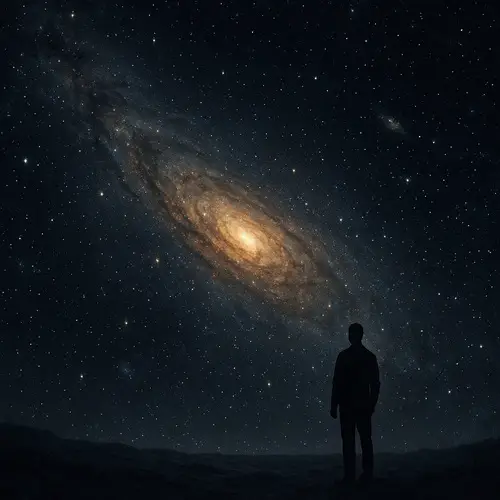 Ken Wilber's oft-repeated phrase “Spirit-in-action” is meant to capture the grand, sweeping dynamic of evolution, consciousness, and development as the manifest unfolding of Spirit through time. It is both metaphysical and motivational, functioning as a religious affirmation that the universe is not random, meaningless, or materialistic, but purposeful, intelligent, and ultimately divine. However, this metaphysical flourish sits uneasily with what we empirically know of the universe. The cold, vast, and largely lifeless expanse of space seems to contradict such a geocentric and anthropomorphic notion. The Human-Centered Myth of Cosmic SpiritualityAt its core, the idea of "Spirit-in-action" reflects a distinctly human perspective projected onto the cosmos. It is difficult to imagine that a supernova in a distant galaxy, or the chaotic collisions of black holes, are somehow expressions of a benevolent Spirit working toward greater wholeness. The overwhelming majority of the known universe is inhospitable to life. In fact, life as we know it appears to be a marginal phenomenon—localized, fragile, and possibly unique. This basic scientific observation presents a major challenge to any universalist metaphysics that sees the cosmos as inherently spiritual. Wilber's framework depends on the assumption that evolution trends toward complexity, consciousness, and unity—and that this trend is evidence of Spirit itself. But this vision mirrors human aspirations more than it reflects astrophysical reality. It is, in effect, a projection of human meaning-making onto the indifference of the cosmos. The Anthropic FallacyWilber's invocation of “Spirit-in-action” often overlaps with a spiritualized version of the anthropic principle: that the universe appears fine-tuned for human life, and therefore must have a higher purpose. But this is a fallacy of selection bias. Of course we observe a universe that supports human life—if it didn't, we wouldn't be here to observe it. But that doesn't imply any intent or design behind it. Wilber takes this one step further by insisting that the presence of life and mind on Earth is indicative of a universal trend. In his view, the fact that humans have evolved to reflect on Spirit is proof that Spirit is evolving through us. But this assumes what it seeks to prove. It is more plausible—if less flattering—that consciousness is a rare, contingent byproduct of cosmic chemistry rather than the telos of the universe. Cosmic Silence and Spiritual InflationThe universe as we know it is largely silent. In contrast to Wilber's spiritually saturated cosmos, the observable universe exhibits no sign of teleological drive. Galaxies drift apart. Stars burn out. Entropy increases. The Fermi paradox—the absence of detectable intelligent life elsewhere—deepens the sense that life is a rare exception, not a cosmic rule. Even on Earth, evolution has produced mindless diversity for billions of years before self-reflection emerged in a single species. To call all this “Spirit-in-action” is to dramatically inflate the concept of Spirit. It becomes a catch-all term that encompasses everything from the birth of stars to the rise of Beethoven. But if everything is Spirit, then nothing specifically is. It becomes an empty metaphor. Evolution vs. Entropy: Wilber's Overlooked ParadoxOne of the most glaring blind spots in Wilber's metaphysical framework is his failure to seriously engage with the paradox between evolution and entropy. Evolution, for Wilber, is the signature of “Spirit-in-action”—a grand, upward arc from subatomic particles to self-awareness to spiritual enlightenment. He sees it as the very essence of cosmic unfolding. But entropy—the second law of thermodynamics—describes the opposite trend: a universal increase in disorder, the gradual degradation of energy, and the eventual heat death of the universe. Rather than wrestle with this tension, Wilber dismisses it altogether. He has gone so far as to call the idea that the universe is "running down" ridiculous, implying that increasing complexity is not a local anomaly but a cosmic Law—a built-in vector of development, and therefore evidence of Spirit's ongoing manifestation. In doing so, he inverts the scientific consensus: entropy is not a minor countercurrent to evolutionary ascent, but the fundamental rule, under which complexity is the fleeting exception. While it's true that local systems (like stars, organisms, or societies) can temporarily increase in complexity, they do so by exporting entropy to their surroundings. This is not a violation of the second law, but an expression of it. The very processes that enable life and mind depend on entropic gradients and energy dissipation. In this thermodynamic view, evolution does not stand outside entropy, much less refute it—it is nested within it. By treating the evolutionary arc as a universal trajectory, Wilber bypasses the deeper scientific insight that complexity is temporary, fragile, and extremely rare. His metaphysics turns a marginal phenomenon into a cosmic principle, confusing the possibility of emergence with the purpose of existence. A truly integrative view would face the paradox head-on: that Spirit, if it exists, expresses itself through a universe overwhelmingly governed by decay. The Evolutionary Theodicy ProblemIf Spirit is indeed evolving through nature, why so much waste, extinction, and suffering? Wilber's metaphysics must answer the same question theology has long struggled with: why does a good, evolving Spirit permit so much apparent evil and indifference? From mass extinctions to cosmic catastrophes, the evidence suggests that the universe is not particularly interested in moral or developmental outcomes. Wilber might respond by invoking “depth” rather than “span”—Spirit works more intensively where it is more deeply present—but this is an ad hoc rationalization that only applies to Earth and to humanity. The Alternative: A Humble NaturalismRather than interpreting evolution and consciousness as signs of “Spirit-in-action,” one might adopt a more naturalistic humility. Life and mind are incredible, rare phenomena—worthy of awe—but they do not require cosmic spiritual justification. They can be appreciated as emergent properties of complex systems within a largely indifferent universe. Meaning, in this view, is local and created, not cosmic and given. Such a perspective allows us to remain grounded without succumbing to nihilism. It frees us from the burden of metaphysical inflation and respects the scale of the universe as it is: vast, mostly lifeless, and profoundly non-anthropocentric. Conclusion: From Earth to Cosmos, from Myth to MaturityWilber's “Spirit-in-action” serves a powerful psychological and philosophical function—it reassures us that we matter, cosmically. But it does so at the cost of realism. The known universe appears to be not the unfolding of Spirit but the indifferent theater in which life has emerged against all odds. Recognizing this isn't cynicism—it's maturity. The challenge is not to mystify the universe into meaning, but to find meaning despite its silence. That would be a spiritual accomplishment worthy of our humanity.
Comment Form is loading comments...
|