|
TRANSLATE THIS ARTICLE
Integral World: Exploring Theories of Everything
An independent forum for a critical discussion of the integral philosophy of Ken Wilber
  Frank Visser, graduated as a psychologist of culture and religion, founded IntegralWorld in 1997. He worked as production manager for various publishing houses and as service manager for various internet companies and lives in Amsterdam. Books: Ken Wilber: Thought as Passion (SUNY, 2003), and The Corona Conspiracy: Combatting Disinformation about the Coronavirus (Kindle, 2020). Frank Visser, graduated as a psychologist of culture and religion, founded IntegralWorld in 1997. He worked as production manager for various publishing houses and as service manager for various internet companies and lives in Amsterdam. Books: Ken Wilber: Thought as Passion (SUNY, 2003), and The Corona Conspiracy: Combatting Disinformation about the Coronavirus (Kindle, 2020).
Check out my other conversations with ChatGPT The Semantic Slipperiness of “Spirit”A Critique of Wilberian MetaphysicsFrank Visser / ChatGPT
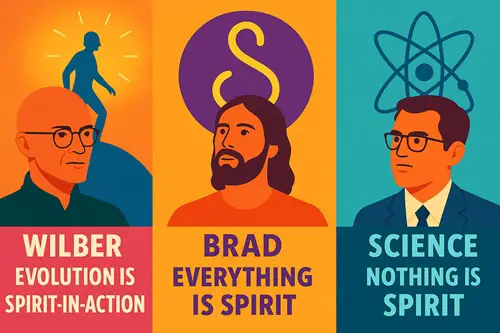 One of the central pillars of Ken Wilber's Integral Theory is the idea that evolution is Spirit-in-action—a grand, developmental unfolding of consciousness and complexity driven by an inner, spiritual telos. This poetic framing seeks to harmonize the scientific story of evolution with the mystical intuitions of perennial wisdom traditions. However, the concept of "Spirit" in this formulation—echoed in different forms by Wilberian thinkers like Brad Reynolds—suffers from deep semantic ambiguities and ontological inflation. It is used in inconsistent, often contradictory ways that invite both metaphysical overreach and conceptual confusion. Wilber's Ambiguous Use of SpiritWilber's use of "Spirit" is multifaceted: sometimes it is the nondual Ground of all being (as in Vedanta or Mahamudra), sometimes it is a telos or force of emergence within evolution, and sometimes it is the goal toward which evolution is heading. This polyvalence—Spirit as source, agent, and destination—blurs crucial philosophical distinctions. By saying "evolution is Spirit-in-action," Wilber appears to reify a metaphysical abstraction (Spirit) into a quasi-causal agent operating in the empirical world. This amounts to what Alfred North Whitehead called the fallacy of misplaced concreteness: taking abstract constructs and treating them as if they had concrete, explanatory power within natural processes. This is not just a technical mistake—it reflects a deeper semantic sleight of hand. "Spirit" floats between metaphor and mechanism, between poetic invocation and ontological assertion. It is never quite clear whether Wilber means this as a symbolic narrative to orient consciousness, or as a literal claim about what drives evolution. Brad Reynolds: From Eros to Nondual SpiritBrad Reynolds, one of Wilber's most enthusiastic interpreters, tries to resolve this ambiguity by going further: everything is Spirit. Not only is evolution Spirit-in-action, but so is everything else—rocks, bacteria, galaxies, even ignorance. There is no process moved by Spirit, because there is no distinction between Spirit and manifestation. Spirit is not in the world, it is the world. But in resolving one ambiguity, Reynolds introduces another: Spirit becomes indistinguishable from “everything.” If Spirit just means “all that exists,” then the word adds no explanatory value—it becomes redundant. Worse, it loses any moral, mystical, or teleological force, because there is no longer any direction or purpose to evolution. Spirit, in this framing, becomes a semantic black hole: everything gets absorbed into it, but nothing meaningful emerges from it. The Scientific Counterpoint Represented by FrankFrom the standpoint of mainstream science, both Wilber and Reynolds introduce metaphysical concepts where they are not needed and cannot be tested. Evolutionary biology operates within the framework of methodological naturalism. It does not deny the possibility of meaning or transcendence—but it finds no empirical necessity for invoking “Spirit” or “Eros” to explain how complex organisms evolve. When Wilber talks about Eros as an “inherent drive” in evolution, science sees this as anthropomorphic and ungrounded. When Reynolds claims that everything is Spirit, science sees that as category error: turning a metaphysical abstraction into a universal substance. For science, Spirit is not falsifiable, measurable, or predictive. Therefore, it cannot function as an explanatory principle. This, too, is a case of the fallacy of misplaced concreteness—albeit viewed from a different angle. Science insists that metaphysical terms like "Spirit" belong to the human domain of meaning-making, not to the domain of causal explanation. Spirit as Ground and Goal: Wilber's Idealist and Perennialist AnchorsKen Wilber is not merely invoking “Spirit” out of thin air—his metaphysical vision is deeply indebted to two philosophical traditions: German Idealism (especially Hegel and Schelling) and the Perennial Philosophy of mysticism across cultures. These form the dual anchor points for his interpretation of Spirit as both the Ground of Being and the goal of becoming. 1. German Idealism: The Dialectic of Spirit Becoming ItselfFrom Hegel, Wilber inherits the notion that reality is Spirit unfolding dialectically. For Hegel, history and consciousness evolve through a rational process of contradiction and synthesis, culminating in Absolute Spirit realizing itself. This metaphysical narrative treats Spirit not as a static essence, but as a dynamic process of self-realization—history itself is Spirit coming to know itself through finite forms. Wilber adopts this frame but extends it beyond cultural history into biological and cosmic evolution, thereby spiritualizing the entire developmental arc of the universe. Evolution is not merely biological adaptation but a teleological movement of Spirit toward greater self-awareness. However, this move universalizes what Hegel saw as a logical and historical process, and applies it to pre-human nature, where such dialectical rationality may not be justified. Wilber blends subjective idealism with objective cosmology, which critics argue is a category error. 2. Neo-Perennialism: The Great Chain ReimaginedWilber's other anchor is the Perennial Philosophy, particularly as interpreted through modern figures like Aldous Huxley, Huston Smith, and Frithjof Schuon. These traditions maintain that all religions point to the same ultimate metaphysical truth—that Spirit (or Brahman, God, Tao) is the ultimate Ground of Reality. Wilber synthesizes this into a developmental model: Spirit descends into manifestation (involution), and re-ascends through evolution. The path from matter to life to mind to soul to Spirit reflects both the return to Source and the unfolding of latent divine potential. This gives his metaphysical system a cosmic narrative arc that is both mystical and developmental: Spirit hides itself in matter and awakens through us. But it also reinterprets traditional perennialism by temporalizing it—what was once a metaphysical hierarchy becomes a historical and evolutionary process. Strange Bedfellows: Brad and Frank Both Ask for ClarificationThere is a revealing irony at the heart of the debate around Wilber's use of “Spirit”: both his closest allies and his most vocal critics are calling for greater clarity—often for opposite reasons. On one side stands Brad Reynolds, Wilber's devoted interpreter and spiritual ally; on the other stands scientific critics like Frank Visser, who challenge Wilber from a naturalistic perspective. Both express frustration with the semantic ambiguity of Wilber's metaphysics. Brad's Nondual Alarm: Spirit Can't Be a Separate ForceBrad Reynolds supports Wilber's overarching spiritual vision but objects when Wilber describes Spirit or Eros as if it were a quasi-separate force operating within evolution. To Brad—drawing from Advaita Vedanta and other nondual traditions—Spirit is not something that acts upon the world; Spirit is the world. Everything is already divine, already That. Evolution doesn't need to be guided by Spirit because it is Spirit expressing itself as form. From this perspective, Wilber's invocation of Spirit as a kind of causal agent risks smuggling in a dualism that contradicts the very nondual teachings he claims to embrace. Reynolds urges Wilber to fully integrate the view that there is no second—no outside agent, no evolutionary driver distinct from Spirit itself. Frank's Challenge: Spirit Isn't an Explanation at AllMeanwhile, critics like Frank Visser—speaking from a scientific and naturalistic standpoint—have long pointed out that Wilber's use of “Spirit” is vague, unfalsifiable, and rhetorically slippery. For science, Spirit is not too dualistic—it's too mystical, speculative, and unanchored. Visser challenges Wilber's tendency to speak in mythopoetic terms (e.g. “Eros drives evolution”) while simultaneously suggesting these are legitimate metaphysical insights that science should someday embrace. But science has no need for such untestable hypotheses. Evolution works just fine without Eros. For Visser, Wilber needs to either retreat to metaphor or advance a clear, evidence-based theory—but he cannot hover ambiguously between the two. A Convergence of FrustrationThe irony is striking: Brad, the spiritual insider, and Frank, the empirical outsider, are both asking the same thing—that Wilber stop equivocating and make his position clear.
In dodging these questions, Wilber risks alienating both sides. His vision remains expansive, but its foundations seem semantically ungrounded, and therefore vulnerable to both philosophical critique and metaphysical overreach. Conclusion: Spirit as Symbol, Not SubstanceThe concept of Spirit, when used with poetic restraint, can serve as a powerful metaphor for the mystery of existence, the luminosity of consciousness, or the awe we feel at the unfolding of life. But when inflated into a substance-like agent or an ontological placeholder, it obscures more than it reveals. Wilber's “Spirit-in-action,” Reynolds' “Spirit-is-all,” and science's “Spirit-is-nothing” are three positions orbiting a semantic void. Unless we clarify what we mean by “Spirit,” and what kind of claim we are making when we invoke it, we risk turning integral thought into a metaphysical Rorschach test—where everyone sees what they want, and no one agrees on what's real.
Widget is loading comments...
|