|
TRANSLATE THIS ARTICLE
Integral World: Exploring Theories of Everything
An independent forum for a critical discussion of the integral philosophy of Ken Wilber
SEE MORE ESSAYS WRITTEN BY FRANK VISSER
NOTE: This essay contains AI-generated content
Check out my other conversations with ChatGPT
Beyond the Gametes
The Sex Binary Debate and the
Limits of Scientific Tunnel Vision
Frank Visser / ChatGPT
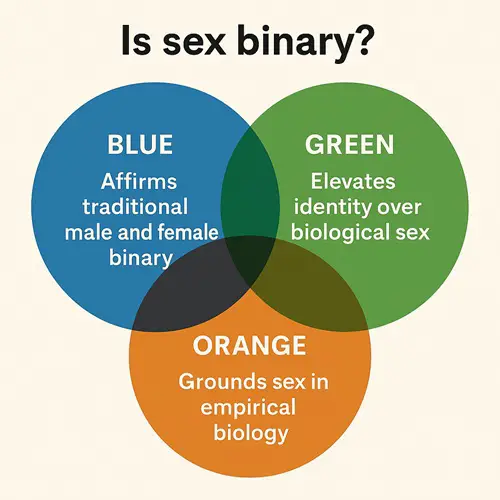
The question “Is sex binary?” has become a cultural flashpoint—at once biological, political, and philosophical. On one side, biologists like Richard Dawkins and Jerry Coyne assert that sex is clearly binary, based on gamete production: you are either male (producing small gametes) or female (producing large ones). On the other, social theorists, activists, and some biologists argue that sex is more complex—a spectrum involving chromosomes, hormones, anatomy, identity, and experience.
What's often missing in this polarized debate is nuance: not only in understanding the biological facts, but also in recognizing the limitations of science when it becomes narrowly reductionist. Both sides claim to be “following the science,” but each appeals to a different conception of what science is.
This essay explores how a fixation on gametes—while technically correct—can produce an incomplete and culturally tone-deaf account of sex. It also examines how integral thinking, such as Ken Wilber's color-coded developmental model, might clarify the culture war over sex by acknowledging both the biological binary and the social complexity.
The Gamete Argument: Dawkins and Coyne's Position
Richard Dawkins has repeatedly insisted that “sex is binary,” grounding his argument in the fact that humans (like most animals) exhibit anisogamy: the existence of two distinct gamete types. Males produce sperm; females produce eggs. There is no third gamete. End of story.
Jerry Coyne, evolutionary biologist and author of Why Evolution Is True, echoes this view: sex, he writes, “is defined by the size of the gametes an individual makes or would make in a functioning reproductive system.” Intersex conditions, he argues, are developmental anomalies, not evidence of a sex spectrum.
While this framing is biologically sound, it tends to conflate biological essence with cultural significance. It overlooks the fact that sex is not merely a matter of gametes, but also of bodies, identities, roles, and social recognition—factors that matter deeply to human beings living in complex societies.
The Tunnel Vision of Gamete Reductionism
Dawkins and Coyne are right about the biology—but wrong to assume that biology is the only valid framework for understanding sex.
This reductionist view has several blind spots:
Intersex individuals: While rare, they challenge neat chromosomal, anatomical, and hormonal binaries. Simply dismissing them as "statistical noise" is both scientifically and ethically inadequate.
Transgender experience: Human self-understanding involves consciousness, identity, and narrative. To treat trans identities as irrelevant because they do not align with gametic function is to ignore the psychological and phenomenological dimensions of sex and gender.
Social roles and expectations: Evolutionary biology explains reproductive function; it does not explain the ethics of inclusion, dignity, or recognition in pluralistic societies.
In this way, the gamete definition of sex resembles what Ken Wilber might call a mean Orange meme: a hyper-rationalist, empirical stance that prides itself on objectivity but ignores subjective depth and intersubjective meaning.
Is Sex Binary? Yes and No.
So, is sex binary? The honest answer is: biologically, usually yes; existentially, often no.
Most people fall into a biological binary—male or female—based on chromosomes, gonads, and gametes.
But variations and exceptions exist at every level: chromosomal (XXY, XO), anatomical (intersex conditions), and hormonal (androgen insensitivity).
And social experience complicates things further: gender identity, lived experience, and cultural recognition do not always track biological sex.
To say that “sex is a spectrum” is not to deny biology. It is to recognize that biology alone cannot capture the full human reality of sexed and gendered life.
Toward an Integral View: Blue, Orange, Green
Wilber's Spiral Dynamics-inspired color coding can clarify what's at stake in this debate:
Blue: Traditional moral absolutism—male and female are divinely ordained categories; deviation is sin or pathology.
Orange: Modern science—sex is defined by biology, specifically gametes; deviations are exceptions, not new categories.
Green: Postmodern pluralism—emphasis on lived experience, identity, and systemic inclusion; sex and gender are fluid and socially constructed.
Each perspective has valid insights and pathological extremes:
| Meme |
Healthy Expression |
Pathology |
| Blue |
Upholding social order and ethical norms |
Rigid, punitive gender roles |
| Orange |
Emphasis on evidence and clarity |
Reductionist, dismissive of experience |
| Green |
Compassion and inclusion |
Relativism, ideological coercion |
An integral approach would honor the biological foundations of sex without ignoring the lived complexities of gender identity and social belonging. It would resist ideological capture from both traditionalist and activist extremes.
Conclusion: From Either/Or to Both/And
The sex binary debate is not just a scientific question—it is a cultural, ethical, and developmental one. Scientists like Dawkins and Coyne serve a valuable role in defending biological facts. But their tunnel vision reveals a deeper problem: the tendency to treat science as epistemically complete rather than epistemologically situated.
Biology tells us much about what sex is, but little about what it means—to individuals, societies, and moral systems.
To make progress, we need not less science, but more context—more humility about what science can explain, and more openness to the multidimensional nature of human life. Biology may ground sex in gametes, but humanity grounds it in language, meaning, identity, and relationship.
Only by integrating these levels can we move beyond the culture war and toward something more constructive: a science that informs without dominating, and a society that respects both fact and experience.
|

 Frank Visser, graduated as a psychologist of culture and religion, founded IntegralWorld in 1997. He worked as production manager for various publishing houses and as service manager for various internet companies and lives in Amsterdam. Books: Ken Wilber: Thought as Passion (SUNY, 2003), and The Corona Conspiracy: Combatting Disinformation about the Coronavirus (Kindle, 2020).