|
TRANSLATE THIS ARTICLE
Integral World: Exploring Theories of Everything
An independent forum for a critical discussion of the integral philosophy of Ken Wilber
  Frank Visser, graduated as a psychologist of culture and religion, founded IntegralWorld in 1997. He worked as production manager for various publishing houses and as service manager for various internet companies and lives in Amsterdam. Books: Ken Wilber: Thought as Passion (SUNY, 2003), and The Corona Conspiracy: Combatting Disinformation about the Coronavirus (Kindle, 2020). Frank Visser, graduated as a psychologist of culture and religion, founded IntegralWorld in 1997. He worked as production manager for various publishing houses and as service manager for various internet companies and lives in Amsterdam. Books: Ken Wilber: Thought as Passion (SUNY, 2003), and The Corona Conspiracy: Combatting Disinformation about the Coronavirus (Kindle, 2020).
Check out my other conversations with ChatGPT
The War on ScienceLeft, Right, and Which is Worse?Frank Visser / ChatGPT
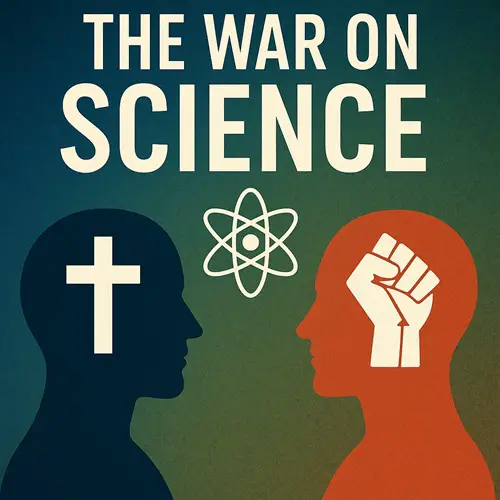 In recent years, the phrase “the war on science” has been used by both secular intellectuals and political commentators to describe ideological assaults on reason, evidence, and objectivity. But who, exactly, is waging this war? Traditionally, conservatives have been blamed: religious fundamentalists denying evolution and climate change, populist leaders downplaying pandemics, and libertarians resisting regulation based on scientific consensus. Yet increasingly, critics now point to a new source of anti-scientific sentiment—one emerging from the cultural left, under the banner of social justice, identity politics, and epistemic relativism. 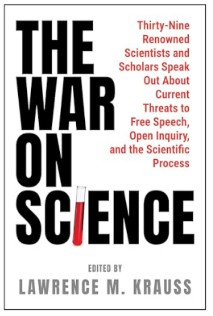
With the recent publication of The War on Science, edited by physicist Lawrence Krauss—a prominent atheist and secular rationalist—this debate has come to a head.[1] The book collects essays from figures like Richard Dawkins, Steven Pinker, Jordan Peterson, and Alan Sokal, united not by theological or political affiliation, but by concern over how progressive ideology is eroding scientific norms. Ironically, this book is published by Post Hill Press, a conservative Christian-linked publisher more commonly associated with right-wing political fare than secular science. That an outspoken atheist like Krauss found his most receptive audience among conservative readers says much about the shifting battlegrounds of cultural conflict. This reversal is echoed in the writings of Ken Wilber, who once positioned himself as a spiritual progressive but has since become fixated on what he calls the “mean green meme” (MGM)—his term for the pathological excesses of postmodern egalitarianism. In Trump and a Post-Truth World, Wilber attributes America's political turmoil not to Donald Trump himself, but to the cultural overreach of postmodern elites.[2] In his view, the rise of Trumpism was an inevitable, even necessary, backlash against a Green stage that had lost touch with reality. Here, we must ask: is there really a war on science from both sides? And if so, which is worse? The Right's Assault on ScienceHistorically, the political right has mounted explicit challenges to the authority of science. These include: Creationism and Intelligent Design: Rejection of Darwinian evolution in favor of religious accounts of origin, often under the guise of “teaching the controversy.” Climate Denial: Downplaying or rejecting the scientific consensus on anthropogenic climate change, often for economic or ideological reasons. COVID Misinformation: Promotion of vaccine skepticism, pseudoscientific treatments, and anti-lockdown rhetoric during the pandemic. These positions undermine public trust in scientific expertise and have had tangible consequences on public health and environmental policy. The Left's Subtler UnderminingOn the other hand, certain factions on the cultural left—especially within academia and activism—have challenged science in more subtle but corrosive ways: Epistemic Relativism: The idea that scientific knowledge is just one narrative among many, and that objective truth is a construct of power relations. Equity over Evidence: Calls to decolonize math, de-center Western science, or reject standardized testing in the name of social justice, regardless of empirical validity. DEI Bureaucracies: Imposing ideological litmus tests on research, hiring, and publishing, which threaten academic freedom and reward conformity over inquiry. This critique of science doesn't reject it outright, but reinterprets it through the lens of identity, politics, and oppression. It casts science not as a method, but as a cultural artifact of whiteness, patriarchy, or capitalism. Which is Worse?The right's war on science is more obvious, and more historically entrenched. But the left's version may be more insidious because it cloaks itself in moral righteousness and operates within institutions of higher learning, where future scientists and educators are trained. When DEI statements become mandatory for job applications in science departments, or when journals prioritize ideological alignment over methodological rigor, the long-term damage may be profound. A generation raised to suspect that objectivity is just a tool of oppression may lose the ability—or the will—to distinguish good science from bad. That said, both forms of anti-science are damaging. The right's rejection of climate science threatens the planet. The left's capture of academia threatens the integrity of knowledge itself. Color Coding the Culture Wars: A Wilberian InsightKen Wilber's Spiral Dynamics-inspired color scheme can be a useful lens through which to view these culture wars:
Each of these worldviews has both healthy and pathological expressions. Wilber often critiques the "mean green meme" for its excesses—hypersensitivity, victimhood culture, and deconstruction without reconstruction. But it's important to recognize that there is also a mean blue meme (rigid fundamentalism, moral authoritarianism) and a mean orange meme (scientism, corporate exploitation, nihilistic materialism). Rather than demonize Green exclusively, an integral approach would seek to integrate the best of all three stages:
Science needs Blue's moral conscience, Orange's epistemic standards, and Green's ethical sensitivity—but in their mature, healthy forms. When these systems operate in isolation or pathology, they wage war on one another—and on science. Wilber's MisstepWilber's critique of the “mean green meme” fits neatly into this analysis, but his attempt to explain the rise of Trump as a developmental necessity risks trivializing the very real threats posed by authoritarianism, conspiracy thinking, and anti-intellectualism. While he rightly critiques postmodern excesses, his underestimation of right-wing regressivism makes his integral vision appear more like an apologetics for reactionary politics. Wilber's intention may be to transcend left and right, but in his eagerness to deconstruct Green, he ends up echoing conservative talking points and alienating many progressive readers. The same could be said of Krauss, who, in fighting woke distortions of science, finds himself published by a press affiliated with the religious right. ConclusionThe war on science is real, and it's being fought on multiple fronts. From the right, it takes the form of denialism, conspiracism, and anti-intellectual populism. From the left, it emerges as ideological orthodoxy, relativism, and politicization of knowledge. Both are dangerous, and neither should be excused. Yet an integral understanding urges us to see beyond the binaries. Blue religion, Orange science, and Green progressivism each offer indispensable insights—and each harbors destructive shadows. A truly integral culture would not pit them against one another, but would weave their healthy aspects into a coherent whole. Science, after all, is not just a casualty of the culture wars. It is a fragile, hard-won achievement of civilization—one that must be defended, not only from the enemies of truth, but from the zealots of certainty.
notes[1] Lawrence Krauss (Editor), The War on Science: Renowned Scientists and Scholars Speak Out About Current Threats to Free Speech, Open Inquiry, and the Scientific Process, Post Hill Press, 2025. [2] Ken Wilber, Trump and a Post-Truth World, reprinted as: A Post-Truth World: Politics, Polarization, and a Vision for Transcending the Chaos, Shambala, 2024.
Widget is loading comments...
|