|
TRANSLATE THIS ARTICLE
Integral World: Exploring Theories of Everything
An independent forum for a critical discussion of the integral philosophy of Ken Wilber
  Frank Visser, graduated as a psychologist of culture and religion, founded IntegralWorld in 1997. He worked as production manager for various publishing houses and as service manager for various internet companies and lives in Amsterdam. Books: Ken Wilber: Thought as Passion (SUNY, 2003), and The Corona Conspiracy: Combatting Disinformation about the Coronavirus (Kindle, 2020). Frank Visser, graduated as a psychologist of culture and religion, founded IntegralWorld in 1997. He worked as production manager for various publishing houses and as service manager for various internet companies and lives in Amsterdam. Books: Ken Wilber: Thought as Passion (SUNY, 2003), and The Corona Conspiracy: Combatting Disinformation about the Coronavirus (Kindle, 2020).
Check out my other conversations with ChatGPT
Consciousness: The Illusion vs. the MysteryDennett vs. Wilber on the MindFrank Visser / ChatGPT
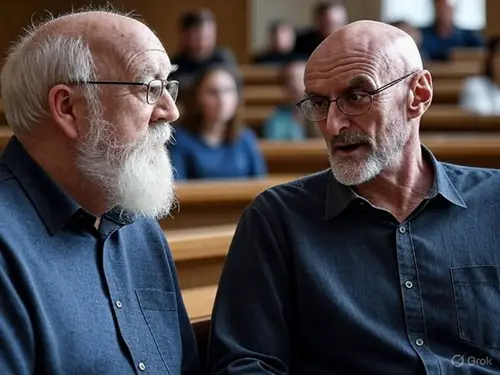 Consciousness—the intimate, first-person experience of being—has long puzzled philosophers and scientists alike. Many regard it as the ultimate mystery, defying reduction to materialistic explanations. Two towering figures, Daniel Dennett and Ken Wilber, represent starkly opposing views on the nature of consciousness. Dennett, a champion of scientific materialism, sees the specialness of consciousness as an illusion. Wilber, the architect of Integral Theory, insists that consciousness is not only special but fundamental to the universe. This essay explores Dennett's "illusionist" approach and contrasts it with Wilber's "perennialist" metaphysics, highlighting the deep epistemological rift between modern scientific naturalism and spiritual holism. 1. Daniel Dennett: Consciousness DemystifiedDaniel Dennett, a philosopher of mind and cognitive science, is best known for his provocative thesis that consciousness is not what it seems. In Consciousness Explained (1991), he argues that our intuitive understanding of consciousness—as a unified, subjective inner theater—is deeply misleading. He likens this intuition to a user-illusion: a simplified interface evolved to help organisms navigate the world, not a faithful representation of the mind's underlying mechanisms. For Dennett, the brain is a massively parallel, information-processing organ. What we call “consciousness” arises from complex but purely physical processes—neural firings, feedback loops, and representational systems. There is no "Cartesian Theater" where it all comes together; instead, consciousness is a distributed, fragmented, and constantly shifting pattern of activity. It is not a thing, but a process—a "center of narrative gravity." Crucially, Dennett denies that there's a "hard problem" of consciousness (as posed by David Chalmers)—the idea that subjective experience resists physical explanation. He considers this problem a cognitive illusion: once we understand how cognitive functions like perception, memory, and language emerge, the need for an extra "inner glow" disappears. In this sense, the feeling that consciousness is something irreducibly special is, for Dennett, itself a trick of the mind. 2. Ken Wilber: Consciousness as Kosmic GroundKen Wilber takes precisely the opposite stance. In his extensive Integral framework, he treats consciousness not as an evolutionary accident but as the very foundation of reality. Drawing on Eastern mysticism, Western philosophy, developmental psychology, and systems theory, Wilber constructs a model in which consciousness evolves through increasingly complex stages—from matter to life to mind to Spirit. In Wilber's view, consciousness cannot be reduced to brain processes because it is the interior of all manifest phenomena. Every "thing" has both an exterior (objective, observable) and an interior (subjective, experiential) dimension—a principle he formulates in his “Four Quadrants” model. Science, he argues, has focused exclusively on the exterior (brain, behavior, systems), neglecting the interior domain of meaning, value, and self-awareness. Unlike Dennett, Wilber fully embraces the "hard problem" of consciousness. In fact, he goes further: he believes that science must be supplemented by “spiritual science,” which uses introspection, meditation, and altered states to explore higher dimensions of consciousness. His notion of “Eros”—a drive toward increasing complexity, depth, and self-awareness—is seen as the animating force of evolution itself. Consciousness, in this model, is not emergent from matter; rather, matter is a condensation or expression of Spirit. 3. A Contemplative "Dissolution" of the Mind-Body ProblemOne of the most distinctive elements of Wilber's approach is his claim that the mind-body problem—the seemingly intractable puzzle of how mental states relate to physical brain states—cannot be solved through rational analysis alone. For Wilber, this dualism arises only when we misunderstand the nature of reality as being split between inner and outer, mind and matter. In truth, he suggests, these are not two substances but two aspects of one underlying reality: Spirit. Wilber therefore advocates not a philosophical solution to the mind-body problem, but what he calls a dissolution—achieved through contemplative insight. Just as in some schools of Vedanta or Mahayana Buddhism, the apparent duality of subject and object is overcome in direct experience, so too the split between mind and body is seen as illusory. Through meditative practice and interior realization, one awakens to the nondual Ground in which both arise. This view places Wilber within a long tradition of mystics who hold that reason can take us only so far. The final step is not theoretical understanding but transcendence: a shift from discursive mind to contemplative awareness. From this vantage point, consciousness is not "in" the brain nor the brain "in" consciousness—both are manifestations of Spirit-in-action, seen differently depending on the lens of perception. To mainstream philosophy, this approach can appear evasive or anti-intellectual. But to Wilber, it represents a deeper epistemology—one that includes rational thought, but transcends it through spiritual realization. 4. Why Wilber Is Ignored by the Philosophy of MindDespite the ambition and scope of Wilber's project, his work is almost completely absent from contemporary discussions in the analytic philosophy of mind. His name rarely appears in peer-reviewed journals or academic conferences on consciousness, and his theories are generally not taught in university curricula. Why? There are several reasons. First, Wilber's reliance on metaphysical constructs such as Spirit, Eros, and cosmic consciousness places him outside the empirical and methodological boundaries accepted by mainstream philosophy. While philosophers like David Chalmers are open to non-reductive and even dual-aspect theories of mind, they still work within a framework that demands logical clarity, argumentative rigor, and engagement with current scientific findings. Wilber's writings, in contrast, are often sweeping, synthetic, and spiritually infused, drawing from mystical traditions rather than experimental results. His “all-levels, all-quadrants” approach does not easily lend itself to testable hypotheses or falsifiable claims. To many professional philosophers, this style is reminiscent of metaphysical speculation rather than disciplined inquiry. An anecdote illustrates this distance. When one of Wilber's essays was sent to David Chalmers—a key figure in the philosophy of mind known for his serious engagement with consciousness studies—he filed it under Miscellaneous. This quiet dismissal is telling: it suggests that Wilber's spiritualized vision of mind is not considered a serious philosophical contribution, but an outlier—perhaps interesting, but methodologically alien. In a field where even panpsychism and quantum theories of consciousness are debated within strict philosophical frameworks, Wilber's integral vision seems too diffuse, too grand, and too theological to be taken seriously. 5. Reductionism vs. HolismAt the core of this contrast lies a fundamental disagreement about the explanatory power of science. Dennett believes that a full account of consciousness will come from neuroscience, psychology, and artificial intelligence. He warns against "mysterians" who claim that consciousness transcends scientific explanation, seeing them as retarding intellectual progress. To him, mind emerges from matter, and apparent mysteries are problems to be dissolved, not solved. Wilber, by contrast, argues that science's third-person, exterior focus is inherently limited. Subjective experience cannot be captured in objective terms. To truly understand consciousness, he says, we must honor all “ways of knowing”—not just empirical observation, but introspection, phenomenology, and contemplative insight. For Wilber, reductionism flattens reality, while integral holism restores its depth. This disagreement extends to how they view the history of thought. Dennett traces a lineage from Darwin to Dawkins to cognitive science, where mind is increasingly explained without invoking metaphysical entities. Wilber aligns with a “perennial philosophy” stretching from Plato and Plotinus to the Upanishads and modern mystics, where the ultimate reality is nondual and self-aware. 6. Critiques and CrossroadsCritics of Dennett accuse him of explaining consciousness away rather than explaining it. His refusal to take subjective experience at face value, they argue, amounts to a denial of the phenomenon he purports to explain. As philosopher Thomas Nagel put it, Dennett's theory is like denying the existence of music because one has analyzed sound waves. Critics of Wilber, meanwhile, accuse him of overextending spiritual metaphors into domains better handled by science. His teleological vision of evolution driven by Eros is seen as a romantic reinterpretation of nature, unsupported by empirical evidence. The risk, skeptics argue, is collapsing into a kind of “mystical creationism,” cloaked in developmental jargon. Yet there are points of convergence. Both thinkers reject dualism—the idea that mind and matter are separate substances. Both see human cognition as embedded in a broader evolutionary context. And both believe that understanding consciousness has profound implications for ethics, identity, and culture. 7. Beyond Dualism? Wilber's Transcendental TurnEarlier we noted that both Dennett and Wilber reject substance dualism—the Cartesian view that mind and matter are two entirely different kinds of stuff. But the similarity ends there. While Dennett adopts a rigorous materialist monism, Wilber veers in the opposite direction, toward an all-encompassing transcendentalism. Wilber frequently uses the language of non-duality to describe his philosophy, borrowing from Vedanta, Mahayana Buddhism, and Plotinian thought. In this view, reality is ultimately “Spirit” or “Suchness,” which manifests in dual forms (e.g., subject and object, mind and body) but is itself beyond all dualities. On the surface, this may sound like a sophisticated rejection of dualism. But in practice, it amounts to a spiritual absolutism: all relative phenomena are grounded in an ineffable, all-pervasive consciousness. This is a far cry from Dennett's position. Whereas Dennett attempts to explain mind from the bottom up—starting with neurons and computation—Wilber frames the mind-body relation within a top-down metaphysical vision, in which Spirit “descends” into matter, evolves through life and mind, and ultimately “wakes up” to itself. Ironically, Wilber's non-dualism ends up reintroducing the very thing dualism tried to preserve: an ontologically distinct realm of consciousness that cannot be reduced to physical explanation. Only now it's not a separate substance, but the source of all substances. For this reason, calling Wilber a non-dualist can be misleading in the context of analytic philosophy. While he rejects the Cartesian split, he replaces it with a panentheistic metaphysics—Spirit is both immanent in and transcendent of the world. This makes his system far more metaphysically loaded than Dennett's eliminative naturalism. In short: both reject dualism, but Wilber reinterprets it through a grand transcendental synthesis that places Spirit at the heart of reality. This may offer existential and spiritual appeal—but it does so at the cost of metaphysical parsimony. 8. The Matter of Economy: Parsimony vs. SpeculationOne reason materialism remains the dominant framework in science and philosophy of mind is its economy of explanation. Materialism offers a unified metaphysical basis: all phenomena—whether physical, biological, mental, or cultural—are ultimately rooted in matter and energy. It does not require invoking special substances, spiritual essences, or transcendent realms to explain the universe or the human mind. This metaphysical minimalism gives materialism a distinct advantage. It adheres to Ockham's Razor—the principle that we should not multiply entities beyond necessity. From this standpoint, consciousness is expected to be explainable, eventually, in terms of physical processes, even if current science has not fully succeeded. For thinkers like Dennett, it is reasonable to assume that cognitive neuroscience, artificial intelligence, and evolutionary biology will gradually fill in the gaps. In contrast, idealist or spiritual accounts—such as Wilber's—tend to expand the ontology rather than reduce it. They posit an ultimate Ground (Spirit, Eros, Brahman) underlying both mind and matter, and often rely on esoteric traditions or mystical experience as sources of knowledge. While these frameworks may offer a more meaningful or spiritually satisfying picture of reality, they are metaphysically expensive: they introduce additional entities and processes that cannot easily be verified, tested, or falsified. This speculative nature makes such theories attractive to seekers of depth but unpersuasive to philosophers and scientists who prioritize epistemic rigor and empirical accountability. The hope that materialism will one day provide a full account of mind may be optimistic, but it remains, for many, the most disciplined and promising research program. In short: materialism offers coherence, continuity with science, and conceptual modesty. Spiritual idealism, though rich in vision, risks becoming a closed system—immune to disproof, detached from evidence, and vulnerable to projection. 9. Conclusion: Mystery or Mirage?Is consciousness the crowning jewel of the universe or a clever evolutionary illusion? For Daniel Dennett, the mystery fades as science advances; for Ken Wilber, the mystery deepens into the sacred. Dennett's deflationary stance demystifies the mind, while Wilber's elevates it to cosmic significance. This clash is not just philosophical—it reflects two worldviews, two temperaments, and two visions of what it means to be human. Are we clever apes with narrative software, or incarnations of Spirit waking up to itself? Perhaps the enduring power of this debate lies in the way it forces us to ask not only what consciousness is, but what kind of universe we believe we live in—and what kind of explanations we are willing to accept. Comment Form is loading comments...
|