|
TRANSLATE THIS ARTICLE
Integral World: Exploring Theories of Everything
An independent forum for a critical discussion of the integral philosophy of Ken Wilber
  Frank Visser, graduated as a psychologist of culture and religion, founded IntegralWorld in 1997. He worked as production manager for various publishing houses and as service manager for various internet companies and lives in Amsterdam. Books: Ken Wilber: Thought as Passion (SUNY, 2003), and The Corona Conspiracy: Combatting Disinformation about the Coronavirus (Kindle, 2020). Frank Visser, graduated as a psychologist of culture and religion, founded IntegralWorld in 1997. He worked as production manager for various publishing houses and as service manager for various internet companies and lives in Amsterdam. Books: Ken Wilber: Thought as Passion (SUNY, 2003), and The Corona Conspiracy: Combatting Disinformation about the Coronavirus (Kindle, 2020).
Check out my other conversations with ChatGPT
A More Adequate Spectrum of Colors?A Critical Look at Wilber's Color Revision of Spiral DynamicsFrank Visser / ChatGPTIn “A More Adequate Spectrum of Colors?”, Frank Visser offers a deep and pointed critique of Ken Wilber's reworking of the Spiral Dynamics color system—a system originally designed for psychological clarity, which Wilber has attempted to "upgrade" by aligning it with the colors of the rainbow and traditional chakra psychology. The essay serves as both an empirical analysis and a philosophical challenge to Wilber's claim that his modified color scheme is “more adequate.”[1] From Spiral Dynamics to Integral Color-Coding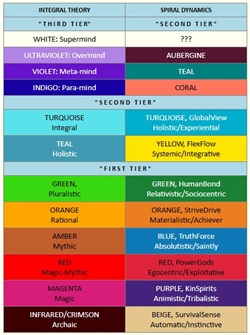
The original Spiral Dynamics (SD) model, developed by Don Beck and Chris Cowan based on Clare Graves' research, uses color as a mnemonic tool for different developmental value systems—ranging from survivalist BEIGE to integrative YELLOW and global-holistic TURQUOISE. These colors weren't meant to reflect any metaphysical or energetic reality; instead, they used familiar symbolic associations (e.g., RED for passion and impulsiveness, BLUE for order and obedience) to help convey cultural and psychological modes of being. When Wilber adopted Spiral Dynamics into his Integral Theory framework in the early 2000s, the model fit seamlessly into his broader scheme of developmental lines and tiers. But over time, Wilber grew uneasy with the SD color terminology. In his later work—especially Integral Spirituality (2006) and The Religion of Tomorrow (2017)—he introduced a revised palette of colors based, ostensibly, on the natural order of the rainbow and its use in tantric traditions of subtle energy. Gone were familiar SD colors like BEIGE, PURPLE, BLUE, and YELLOW. In came INFRARED, MAGENTA, AMBER, and TEAL, among others. Wilber's justification? That energetic coherence, not just intuitive symbolism, should govern the developmental color coding—especially if these systems are to be used in practices like meditation, subtle energy work, or even technological “bio-machines” that might interface with human consciousness. But Visser points out that these revisions were neither necessary nor well-executed. They muddled communication within the Integral community, obscured the original psychological clarity of Spiral Dynamics, and failed to deliver on their promise of esoteric accuracy. Most damningly, Visser argues that Wilber's new color system doesn't even faithfully correspond to the very rainbow or chakra traditions he claims to honor. Color Chaos: Between Pedagogy and EsotericismTo test Wilber's claims, Visser systematically compares three frameworks:
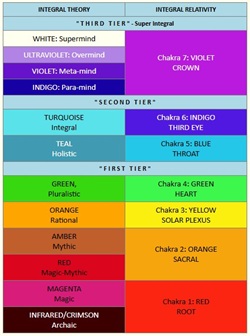
The result? A visual and conceptual misalignment. Aside from some overlap at the extremes—RED for the root chakra and VIOLET/WHITE for the crown—most correspondences between Wilber's stages and traditional chakras fail to hold. BLUE (throat chakra) and YELLOW (solar plexus) are notably absent from Wilber's revised lower-tier stages, despite being primary colors and crucial elements in both chakra psychology and color theory. Instead, the lower half of Wilber's model is saturated with various reddish hues—CRIMSON, MAGENTA, RED, ORANGE—leaving out the balancing cool tones traditionally used to mark relational, expressive, or ethical development. The result is an imbalance not just in color aesthetics, but in conceptual mapping. If RED tones are associated with aggression, power, and raw instinct, what does it mean to cover half the human developmental spectrum in these colors? This isn't just a matter of style or preference, Visser argues—it affects how we think about human growth. Where Spiral Dynamics offered a psychologically intuitive progression of alternating warm and cool stages—emphasizing a balance between self-expression and self-sacrifice—Wilber's linear progression from red to violet strips away that nuance. The spiral becomes a ladder. The warmth-cool alternation becomes a chromatic gradient. Does It Matter?The debate over color coding might seem trivial at first glance. Aren't colors just symbolic labels? Does it really matter whether we call a developmental stage “BLUE” or “AMBER,” “YELLOW” or “TEAL”? Can't we just agree on the ideas behind the colors and move on? Visser invites us to take this question seriously. Because yes—it does matter. And here's why: 1. Psychological Intuition vs. Esoteric SymbolismSpiral Dynamics was designed for clarity, not mystery. Its color choices were pedagogical tools to help people quickly grasp complex human value systems. They didn't claim metaphysical authority—they aimed for accessibility. In contrast, Wilber's revisions attempt to inject metaphysical significance, claiming energetic fidelity to ancient traditions. But if that symbolic fidelity is faulty—as Visser demonstrates—then the clarity of the original system has been sacrificed for an illusion of precision. And in doing so, a bridge to broader public understanding has been weakened. 2. Communication and Cultural LiteracyColor-talk has become shorthand in the Integral community. Referring to someone as “very Green” or “moving into Teal” only makes sense if everyone shares the same codebook. The moment Wilber altered the definitions, communication fractured. People using Spiral Dynamics and those using Integral color theory now speak overlapping but increasingly incoherent dialects. In effect, this creates an insider language that can feel cultic or exclusionary—something Spiral Dynamics originally sought to avoid. Without clarity in terminology, we risk groupthink, confusion, or even the loss of the public relevance of these models. 3. The Danger of Pseudo-PrecisionBy grounding his revisions in the energetic reality of chakras, Wilber invites a metaphysical reading that isn't supported by empirical evidence. Worse, he flirts with a kind of spiritual technocracy: if colors are energetic frequencies, and stages must correspond precisely to them, then spiritual growth becomes a matter of calibration—less lived experience, more metaphysical engineering. This opens the door to dubious applications. Imagine devices that stimulate chakras using colors based on a misaligned system—Wilber even mentions such “biomachines.” If the model is inaccurate, the spiritual technology built upon it may be ineffective or misleading. 4. Symbolism and Developmental IntegrityFinally, there's the matter of symbolic coherence. Colors carry deep cultural and psychological associations. Removing YELLOW—a color of optimism, clarity, and intellect—from the developmental ladder leaves a symbolic void. Excluding BLUE—the color of truth, order, and trust—may distort our conception of ethical or mythic consciousness. In spiritual traditions, symbolic systems matter. They organize meaning. So if Wilber claims fidelity to esoteric systems, he must be held to their standards. Visser shows that his system fails this test. Conclusion: Lost in the SpectrumVisser's verdict is not that color systems must be rigidly enforced or that Spiral Dynamics is beyond critique. Rather, he asks for coherence, consistency, and humility. Wilber's color revision, while ambitious, ends up being a hybrid mess—neither pedagogically effective nor metaphysically accurate. It lacks the psychological expressiveness of Spiral Dynamics and fails to achieve symbolic alignment with chakra models. If the goal is developmental clarity, Spiral Dynamics still shines. If the goal is esoteric resonance, then Wilber's scheme falls short. And if the goal is to do both—bridge science and spirituality, as Wilber often aims—then the bridge needs firmer supports, not just a prettier paint job. In the end, the colors we use to describe development shape how we see ourselves and others. They are more than labels—they are tools of meaning-making. And in this case, Wilber's spectrum might not be as adequate as it claims. Frank Visser's Final Caution:Wilber's attempt to correct an imaginary flaw in Spiral Dynamics has, ironically, introduced a real one—misalignment. Unless corrected, this new spectrum risks alienating the very audience Integral Theory hopes to serve: curious, psychologically informed, spiritually grounded thinkers seeking clarity, not confusion. Appendix: Is There Really a Third Tier?Wilber is, in a paradoxical way, more empirical than Graves when it comes to the higher tiers—but only if one accepts the legitimacy of first-person contemplative methods: He draws on decades of meditation research, cross-cultural comparisons, and the “phenomenological cartography” of mystical states. He distinguishes between states (temporary) and stages (structural traits), suggesting that sustained access to higher states (e.g., causal or nondual awareness) can stabilize into higher stages of development. His Wilber-Combs lattice even attempts to integrate developmental level + state access, which allows for a nuanced mapping of experiences like “Magenta Catholic” vs. “Turquoise Zen.” Still, this is not empirical in the standard scientific sense. It's closer to structured introspective phenomenology, which is epistemologically fraught for many psychologists. Realism of Wilber's Higher TiersSecond Tier (Yellow, Turquoise)There's some empirical support for cognitive complexity, systems thinking, and post-integrative consciousness, notably in:
Third Tier (Subtle, Causal, Nondual)These are not developmental stages in a traditional cognitive sense, but realms of contemplative awareness: Wilber borrows from Hindu, Buddhist, and Christian mysticism, viewing these states as latent potentials in all humans The idea that they can become permanent structures is less empirically verified and more based on long-term meditation reports Critics argue these are states of consciousness, not structural stages Bottom LineGraves stayed psychological and secular, but speculative beyond Stage 6. Wilber extended Graves with a spiritual-metaphysical model, but grounded it in cross-cultural phenomenology and contemplative practices. If you accept contemplative data as valid, Wilber's Third Tier is arguably more “empirical” than Graves' speculative second tier. But from a mainstream scientific perspective, both models lose empirical traction beyond Stage 6 or 7, and Wilber's later stages shift from psychology to philosophy and spirituality. NOTES[1] Frank Visser, "A more adequate spectrum of colors?, A Comparison of color terminology in chakra-psychology, Integral Theory and Spiral Dynamics", www.integralworld.net, May 2017 (Part 3 of a 7-part review of The Religion of Tomorrow).
Widget is loading comments...
|