|
TRANSLATE THIS ARTICLE
Integral World: Exploring Theories of Everything
An independent forum for a critical discussion of the integral philosophy of Ken Wilber
  Frank Visser, graduated as a psychologist of culture and religion, founded IntegralWorld in 1997. He worked as production manager for various publishing houses and as service manager for various internet companies and lives in Amsterdam. Books: Ken Wilber: Thought as Passion (SUNY, 2003), and The Corona Conspiracy: Combatting Disinformation about the Coronavirus (Kindle, 2020).
Check out my other conversations with ChatGPT Trump, Integral Theory and the Post-Post-Truth WorldWhat the 2026 Elections Reveal About the Limits of Ken Wilber's Political PhilosophyFrank Visser / ChatGPT
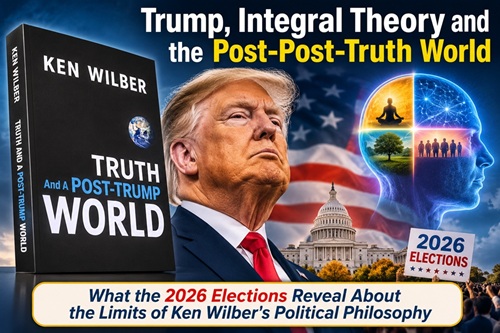 Introduction: Time for a Second Look at Trump?In 2017, Ken Wilber published Trump and a Post-Truth World, an attempt to interpret the rise of Donald Trump through the conceptual vocabulary of Integral Theory. Rather than treating Trump's electoral success simply as an aberration, Wilber sought to explain it as an expression of deeper developmental, cultural and political tensions in American society. His argument was provocative. Trump's rise, Wilber suggested, could not be understood without examining the excesses and limitations of progressive postmodernism, the cultural alienation of substantial parts of the American population, and the developmental differences between competing worldviews. This was an interesting undertaking. It also raised questions about the explanatory ambitions of Integral Theory. Could a developmental model of consciousness really explain the complexity of contemporary American politics? And was Wilber sufficiently critical of the political movement he was attempting to explain? Almost a decade later, these questions deserve renewed attention. The American elections of November 3, 2026, have produced a remarkable reversal of political fortunes. The Democrats have regained control of Congress, inflicting a substantial electoral setback on Trump's Republican Party. The result does not mean that Trumpism has disappeared, nor that American society has suddenly embraced a unified progressive alternative. But it does challenge any interpretation of Trump as the inevitable political expression of a new developmental stage in American history. It also creates an opportunity to revisit Wilber's political philosophy. My suggestion is that Wilber should write a genuine sequel to his original book, one that takes the intervening political developments seriously. A new edition of an earlier argument is not enough. What is needed is a reassessment of its assumptions, explanatory mechanisms and political implications. The central question would be: If Trump's rise was a reaction against the perceived failures of progressive postmodernism, what does his electoral setback tell us about the limitations of Trumpism itself? 1. What Wilber got right in 2017To assess the need for a sequel, we should first reconstruct Wilber's original argument fairly. His central thesis was that Trump's rise could not be explained simply by the supposed backwardness of his supporters. Instead, Wilber identified a crisis within the progressive cultural elite. The postmodern, pluralistic or Green worldview had made important contributions to society: civil rights, feminism, environmentalism, multiculturalism and greater sensitivity to marginalized groups. But, according to Wilber, this worldview had also developed pathological tendencies. Among these were political correctness, moral superiority, cultural elitism, excessive relativism and a tendency to dismiss people who did not share its assumptions. Large sections of the population, particularly those experiencing economic insecurity and cultural displacement, felt increasingly excluded from the progressive consensus. Wilber's explanation was therefore not simply that Trump represented an inferior developmental stage. It was that the excesses of the progressive leading edge had helped generate the backlash that brought him to power. There is something worth taking seriously here. Political movements do not emerge in a vacuum. They frequently develop in reaction to the perceived failures of their opponents. A progressive movement that loses contact with the economic and cultural experiences of ordinary citizens can create political opportunities for populist challengers. Wilber was also right to resist the temptation to explain millions of Trump voters through a single psychological or moral defect. Their motivations were diverse, and some of their grievances were genuine. But this is where his explanation needed more empirical grounding. Identifying grievances does not establish that the political movement claiming to represent them offers appropriate solutions. Nor does explaining a political backlash amount to justifying its leadership. The distinction between explaining Trumpism and excusing Trumpism should have been central to Wilber's subsequent analysis. 2. The problem with the developmental explanationWilber's most distinctive contribution was also his most problematic one: interpreting political conflict through developmental stages of consciousness. In his framework, traditional, modern, postmodern and integral worldviews represent different stages in the evolution of human consciousness. Political conflicts can consequently be interpreted as clashes between different developmental levels. This provides an attractive overarching narrative. But does it actually explain political events? Consider the problem. If progressive postmodernism produces an authoritarian backlash, is that evidence of a developmental crisis? Possibly. But what if the backlash itself generates new forms of exclusion, nationalism, political intimidation and hostility toward independent institutions? Would these developments also be interpreted as evolutionary corrections? And if so, what would count as evidence that the process was moving in the wrong direction? Wilber's 2017 interpretation contained an important asymmetry. He devoted considerable attention to the pathological tendencies of the progressive leading edge, while the pathologies of the populist movement received less systematic developmental scrutiny. A genuinely integral analysis would have to apply the same critical standards to both sides. Progressive movements can become intolerant, self-righteous and disconnected from ordinary economic realities. Conservative populism can become authoritarian, conspiratorial, nostalgic and hostile to inconvenient facts. Neither political orientation possesses an automatic developmental advantage. More importantly, political positions cannot simply be assigned to developmental stages on the basis of their ideological labels. A conservative can defend democratic institutions, scientific inquiry and individual liberty. A progressive can defend them too. Conversely, both can abandon those principles when political circumstances become inconvenient. Political behavior requires historical, institutional, economic and psychological explanation. Developmental classification alone cannot substitute for it. 3. The 2026 elections as a test of Wilber's thesisThe November 2026 elections provide an unusually interesting opportunity to examine Wilber's argument. According to the Associated Press and Reuters, Democrats have regained control of both chambers of Congress, making substantial gains in traditionally Republican territory. The results were driven by several factors, including dissatisfaction with the cost of living, the war with Iran and concerns about government corruption. The geographical breadth of the Democratic gains is particularly significant. This was not simply a mobilization of established progressive constituencies in metropolitan areas. Democrats made inroads in states and communities that had supported Trump in 2024. What does this tell us about the developmental interpretation? First, it suggests that political allegiance is more contingent than a stage-based interpretation might imply. Voters can support a populist candidate in one election and reject his party in the next. Their political behavior responds to changing circumstances, material interests, political performance and the perceived credibility of competing alternatives. Second, the election demonstrates that the grievances that helped bring Trump to power do not necessarily translate into permanent support for his political movement. Voters who feel economically neglected may initially turn toward populism, but they can also turn away when the promised improvements fail to materialize. Third, the results challenge the idea that the Trump phenomenon can be understood primarily as an evolutionary correction to progressive excesses. The Democrats' victory does not prove that postmodernism has been vindicated. It does suggest that Trumpism has generated its own political liabilities, which cannot be explained away by pointing to the shortcomings of its opponents. There is a further irony here. Wilber once described the election of Trump as a possible example of evolution making a self-correcting adjustment. In his 2017 essay, he wrote about evolutionary realignments that respond to new information about the direction of cultural development. But if Trump's rise was a self-correction, what was his defeat? Could it be a second self-correction, this time correcting the correction? The joke points toward a serious theoretical problem. If both the rise and fall of a political movement can be interpreted as manifestations of evolutionary self-correction, the concept risks becoming impossible to falsify. It can accommodate every possible political outcome without explaining why one occurred rather than another. An explanatory theory should do more than provide an attractive interpretation after the event. It should identify mechanisms, specify conditions and generate expectations that can be examined independently. 4. The missing half: an integral critique of TrumpismA genuine sequel should devote as much attention to the political pathologies of Trumpism as the original book devoted to those of postmodern progressivism. There are several subjects that deserve particular attention. Truth and political reality. The original book's title placed post-truth politics at the center of its analysis. But the problem of post-truth cannot be confined to progressive relativism or the alleged inability of postmodernists to recognize objective reality. Political misinformation, conspiracy theories, selective use of evidence and attacks on independent sources of information deserve equal scrutiny wherever they occur. An integral approach should ask whether its own political sympathies interfere with its commitment to truth. Power and institutions. Trumpism cannot be understood solely as a cultural reaction. It is also a political project involving executive authority, institutional appointments, party loyalty, judicial power and the relationship between government and private interests. These are questions of institutional design and political accountability, not merely developmental psychology. Economic interests. Wilber's original analysis acknowledged the economic displacement experienced by sections of the American population. But a fuller analysis would have to examine who actually benefits from Trump-era economic policies. The interests of working-class voters, wealthy donors, corporations and political insiders do not necessarily coincide. Nationalism and collective identity. Trump's appeal also draws upon national nostalgia, cultural identity and perceptions of lost status. These motivations deserve to be taken seriously without automatically being classified as either legitimate expressions of collective belonging or pathological regression. Foreign policy and moral consistency. An integral political philosophy should also examine how American nationalism relates to international obligations. The wars in Ukraine and Iran, American relations with Israel, the humanitarian catastrophe in Gaza, NATO and the relationship with China all raise questions that cannot be reduced to the American culture wars. A worldview that claims to integrate individual, cultural, social and systemic perspectives should be particularly well equipped to examine these subjects. Yet that promise has to be demonstrated in practice. 5. The Democratic victory: a new developmental stage?One possible response from Wilber would be to interpret the Democratic victory as evidence of a renewed progressive or Green resurgence. But that would be too easy. The Democrats did not win because the American electorate suddenly adopted Integral consciousness. Nor can their victory be taken as evidence that the country has collectively moved beyond traditional, modern or postmodern value systems. The coalition that produced the result is likely to contain a mixture of motivations: economic dissatisfaction, opposition to the Iran war, concerns about corruption, defense of democratic institutions, dissatisfaction with Trump's personal style and disagreement with particular Republican policies. These motivations do not necessarily point in the same ideological direction. Indeed, one of the most interesting features of the election is that political support can cross conventional ideological boundaries. A voter can be economically conservative but opposed to Trump's foreign policy. Another can be culturally progressive but dissatisfied with the Democratic establishment. A third can support immigration restrictions while rejecting executive overreach. Such combinations are difficult to capture through a simple developmental hierarchy. Perhaps this is where Integral Theory could make a more useful contribution: not by assigning political parties to developmental stages, but by identifying the multiple dimensions of political motivation and explaining how they interact. An integral political analysis should be capable of recognizing genuine insights in opposing political positions without pretending that all positions are equally supported by evidence. It should also distinguish between developmental complexity and political correctness. A sophisticated vocabulary does not automatically produce a more accurate understanding of political reality. 6. The post-Trump world is also an international problemA sequel should not limit itself to domestic American politics. Trump's presidency has affected the international political environment in ways that extend far beyond the United States. His approach to NATO, Ukraine, Russia, China, Iran, Israel and international trade has forced governments around the world to reconsider their assumptions about American leadership. The Democratic victory introduces a new institutional constraint on Trump's foreign policy, but it does not automatically reverse his executive decisions. For Europe, the implications are particularly important. A more supportive Congress may improve the prospects for American assistance to Ukraine and strengthen traditional Atlanticist positions. But European governments cannot assume that the American political pendulum will never swing back. For Israel, the changing Democratic attitude toward unconditional support for Benjamin Netanyahu's government deserves attention. For Palestinians, greater congressional scrutiny of American military assistance could create additional diplomatic opportunities, although it does not guarantee improvements in Gaza. For China, the election raises questions about the future of American trade policy and strategic competition. And for the international climate agenda, it creates the possibility of a more cooperative congressional environment. These issues expose another limitation of Wilber's original approach. American political developments cannot be adequately understood without examining the international systems in which they occur. An integral perspective that claims to embrace the whole should not become excessively preoccupied with the internal developmental dynamics of American culture. 7. The 2024 edition: a missed opportunity?There is an important bibliographical detail here. Wilber did not simply leave his 2017 analysis untouched. In 2024, he published A Post-Truth World: Politics, Polarization, and a Vision for Transcending the Chaos, a revised and expanded treatment of the subject.[1] The publisher describes it as an examination of political polarization through Integral Theory, again emphasizing the failures of postmodernism and the possibility of a new Integral leadership. This makes the case for another book even more interesting. Wilber has already had an opportunity to revisit his original argument. But the political developments since 2024 have created new questions that could not have been addressed in that edition. The 2026 electoral reversal is particularly relevant because it challenges the temptation to interpret American politics as a one-directional struggle between developmental stages. A sequel should therefore not simply update the original diagnosis with new examples. It should reconsider the explanatory framework itself. Has Wilber sufficiently examined the possibility that the political movement he interpreted as a reaction against progressive excesses might itself have become a source of new political and institutional pathologies? Has he adequately distinguished legitimate cultural grievances from the political exploitation of those grievances? And has he developed criteria by which the Integral interpretation of political events can be independently tested? These are not minor editorial questions. They go to the heart of Integral Theory's claim to provide a more comprehensive understanding of human affairs. 8. What would a genuinely integral political philosophy look like?I would propose that Wilber's sequel be organized around a different central question: How can we develop a political philosophy that learns from the failures of both progressive postmodernism and conservative populism without simply reproducing the limitations of either? This would require several intellectual commitments. First, an integral political philosophy must be genuinely symmetrical in its criticism. It cannot reserve its strongest criticism for one political camp while treating the other as an understandable reaction to its opponents. Second, it must take empirical reality seriously. Claims about developmental stages, cultural evolution and collective consciousness should be examined against historical and sociological evidence rather than treated as self-validating interpretations. Third, it must distinguish between explaining political behavior and evaluating its consequences. Understanding why people support an authoritarian leader does not establish that the resulting political arrangements are desirable, effective or morally defensible. Fourth, it must recognize that democratic institutions are not merely expressions of particular developmental stages. They are historical achievements that require protection, maintenance and continuous improvement. Finally, it must make room for a secular, naturalistic understanding of human progress. The future of political cooperation does not necessarily require an evolutionary Spirit, a cosmic Eros or a metaphysical account of consciousness. Human beings have sufficient practical reasons to develop more inclusive, rational and cooperative institutions without assuming that the universe itself guarantees such progress. This last point is particularly important. Integral Theory should not confuse its philosophical interpretation of evolution with the actual mechanisms of social and political change. Conclusion: Beyond Wilber's original diagnosisA sequel to Trump and a Post-Truth World would be timely, but it should not simply defend the original thesis against subsequent political developments. Wilber's 2017 book identified something important: progressive movements can become disconnected from the populations they claim to represent, and political backlash can be partly understood as a reaction to that failure. But the 2026 elections demonstrate that the backlash itself is not immune to political failure. Trumpism has encountered resistance not only from established progressive constituencies but also from voters in traditionally Republican territory. The American electorate has demonstrated that political allegiance is contingent, that grievances can change direction and that no political movement possesses a permanent claim to represent the future. For Wilber, this should be an invitation to reconsider his developmental interpretation of contemporary politics. Perhaps the most important lesson is that neither the progressive leading edge nor its populist opposition should be granted the status of an evolutionary vehicle simply because it challenges the other. An integral political philosophy must be capable of criticizing both the reaction and the reaction against the reaction. Otherwise, Integral Theory risks becoming another participant in the culture wars, equipped with an elaborate developmental vocabulary but insufficiently critical of its own political assumptions. I would welcome a new book from Wilber, but I would also welcome something more demanding: an examination of whether Integral Theory itself has learned anything from the Trump era. The post-Trump world is not automatically an Integral world. The defeat of one political movement does not constitute the arrival of a higher stage of consciousness. And the restoration of democratic checks and balances, important as it is, does not solve the deeper problems of political polarization, economic inequality and international instability. Perhaps the real challenge is to abandon the comforting idea that history is necessarily moving toward an Integral resolution. The future has to be built, politically and institutionally, through human decisions, scientific knowledge, democratic experimentation and critical self-correction. Wilber once asked how we arrived at a post-truth world. After the American elections of 2026, the more pressing question is whether Integral Theory can help us move beyond it without becoming another part of the problem. Editorial suggestion: This essay could serve as a companion piece to a future, more detailed critical review of Wilber's 2024 edition of A Post-Truth World. The central distinction would be between the explanatory value of Wilber's developmental model and its tendency to interpret political events through an evolutionary narrative that may be difficult to test independently. Appendix: Has evolution regained its sanity again? ;-)There is a delicious irony in the American elections of November 2026 when viewed through Ken Wilber's evolutionary philosophy. If we recall his argument in Trump and a Post-Truth World (2017), Trump's rise could be interpreted as a kind of evolutionary correction: a reaction against the excesses of the progressive Green worldview, which had become culturally dominant in certain influential circles but had allegedly lost touch with large sections of the population. Evolution, in this interpretation, was not necessarily moving backward when Trump appeared. It was making a corrective adjustment. The political pendulum had swung too far in one direction, and a counter-movement was needed. Fine. But now comes the awkward question: what happens when the corrective adjustment itself becomes dysfunctional? After two years of Trump's second presidency, American voters have delivered a substantial rebuke to his political movement. Does this mean that evolution has now corrected its previous correction? Has Spirit-in-action, having briefly experimented with MAGA, decided that perhaps this particular evolutionary experiment was not such a brilliant idea after all? One could almost imagine the cosmic Eros scratching its head. Of course, there is a more mundane explanation. Political movements make promises, exercise power, encounter resistance and are eventually judged by their performance. Voters respond to economic circumstances, foreign-policy decisions, institutional behavior and their own changing expectations. No cosmic intelligence needs to intervene to explain this process. But Wilber's evolutionary vocabulary creates an interesting problem. If Trump's rise was evidence of evolutionary intelligence at work, why shouldn't his electoral setback be interpreted in exactly the same way? And if both outcomes qualify as evolutionary corrections, what would count as evolutionary regression? This is the danger of an explanatory framework that can accommodate every possible outcome. Evolution always wins the argument because whatever happens can retrospectively be described as necessary for the next stage. Perhaps we should introduce a more modest principle: evolution does not necessarily know what it is doing. Biological evolution has no foresight, no moral compass and no guaranteed destination. Cultural and political evolution are similarly contingent processes, involving experimentation, adaptation, conflict, mistakes and occasional reversals. Democracy itself can be understood as one of humanity's institutional mechanisms for correcting political mistakes. Elections allow populations to withdraw their support from governments that fail to meet expectations. That is a perfectly respectable form of collective self-correction, without invoking a metaphysical evolutionary force. So, has evolution regained its sanity? Perhaps not. Perhaps it never possessed any in the first place. The more interesting possibility is that human beings, through democratic institutions and critical reflection, occasionally manage to regain theirs. ;-) And that, I suspect, would be a much more defensible evolutionary achievement than anything Wilber's cosmic Eros can presently claim. NOTES[1] In the Preface to the 2024 edition, Wilber does not evaluate his thesis, but continues to mansplain his readers about the history of Western culture through the stages of magic, myth, reason and eventually "unreason" or pluralism. Trump isn't even mentioned at all, even though he is the main subject of the book. Instead, pro-West and -Israel scholar Douglas Murray gets mentioned on three occasions (in the span of nine pages): two of his books are named, Wilber claims that Murray "agrees with much of my assessment", and again two Murray books are praised. Two quotes stand out: "you will be introduced to a very simple and very easy to apply 'integral model', or a model that claims (and millions of followers around the world agree) that is unites and integrates virtually all of the various human knowledge disciplines..." (p. xiv) This is pure hype and self-promotion. The last sentence is: "The modernist and postmodernist Left and Right have continued to push things forward in this regard, and the aware reader will notice such happenings as January 6, Ukraine, Israel/Gaza, the rightward lurch of Europe, the upcoming presidential elections, and China/Taiwan." (p. xv) The 2024 edition might have been "expanded", but none of these geopolitical topics are covered, as far as I could see. The new, 13 page Afterword of the book contains "a distilled overview of Integral Theory", but with no specific bearing on the Trump phenomenon.
Comment Form is loading comments...
|