|
TRANSLATE THIS ARTICLE
Integral World: Exploring Theories of Everything
An independent forum for a critical discussion of the integral philosophy of Ken Wilber
  Frank Visser, graduated as a psychologist of culture and religion, founded IntegralWorld in 1997. He worked as production manager for various publishing houses and as service manager for various internet companies and lives in Amsterdam. Books: Ken Wilber: Thought as Passion (SUNY, 2003), and The Corona Conspiracy: Combatting Disinformation about the Coronavirus (Kindle, 2020). Frank Visser, graduated as a psychologist of culture and religion, founded IntegralWorld in 1997. He worked as production manager for various publishing houses and as service manager for various internet companies and lives in Amsterdam. Books: Ken Wilber: Thought as Passion (SUNY, 2003), and The Corona Conspiracy: Combatting Disinformation about the Coronavirus (Kindle, 2020).
Check out my other conversations with ChatGPT Trump and a Post-Truth World RevisitedA Critical ReviewFrank Visser / ChatGPT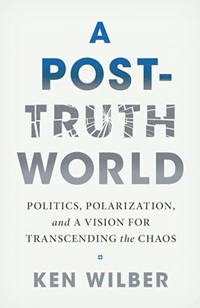
Ken Wilber's Trump and a Post-Truth World (2017) is less a political analysis in the conventional sense than a full-scale application of his Integral Theory to the Trump phenomenon and the broader crisis of liberal democracy. It is also, in many respects, a diagnostic essay that attempts to reframe populism, postmodernism, and cultural polarization as expressions of developmental dynamics. The result is intellectually ambitious, but also highly contentious in both its explanatory reach and its political framing. At the core of the book is Wilber's familiar AQAL model of developmental stages (red, amber, orange, green, and so on), which he uses to map political psychology. Trump's rise is interpreted not primarily as an economic or institutional failure, but as a backlash against what Wilber calls the “Green” postmodern stage: a culturally dominant progressive ethos characterized by pluralism, identity politics, and strong sensitivity to oppression narratives. In his account, Green overextends its legitimate insights into relativism and moral delegitimation of earlier stages, producing resentment in “Amber” and “Orange” populations who feel culturally and economically displaced. This framing yields the book's central thesis: Trump is an “evolutionary self-correction,” a kind of systemic feedback from earlier developmental strata against the excesses of the progressive leading edge. Wilber's intent is explicitly integrative rather than partisan. He wants to show that both Trump voters and his critics occupy partial truths located at different developmental levels, and that a healthier future requires transcending this antagonism through a higher-order “Integral” perspective. The explanatory power of this model is also its most obvious liability. By translating a complex electoral and institutional phenomenon into a stage-theory conflict, Wilber compresses economic restructuring, media fragmentation, racial politics, and institutional decline into a single developmental narrative. This produces an elegant schema, but at the cost of empirical granularity. Structural factors such as deindustrialization, financialization, and party-system polarization are acknowledged only indirectly, and tend to be absorbed into the broader “developmental mismatch” storyline. As a result, the model risks appearing more interpretive than explanatory. A second tension lies in Wilber's treatment of postmodernism. The book relies heavily on a critique of “Green” relativism and what he calls “aperspectival madness,” suggesting that academic and cultural elites have undermined shared standards of truth. While there is a recognizable phenomenon here—epistemic fragmentation and distrust in expertise—Wilber's characterization often treats postmodern theory as more monolithic and self-undermining than it actually is. He tends to conflate academic constructivism, activist politics, and cultural liberalism into a single developmental “stage,” which flattens important distinctions within contemporary intellectual life. Politically, the book is also marked by a strong asymmetry of critique. Although Wilber insists on balance, Trump's base is largely interpreted as developmentally “earlier” but psychologically coherent, whereas progressive elites are portrayed as both more advanced and more prone to pathological overreach. This creates an implicit moral inversion: regression is explained sympathetically, while excess development is treated as the primary source of dysfunction. Critics have noted that this structure can unintentionally normalize reactionary politics by embedding it within a developmental necessity narrative. That said, the book does have a clear strength: it highlights a real phenomenon that many political analyses underplay, namely the cultural and epistemic divide between cosmopolitan, post-material value systems and more traditional or material-security-oriented populations. Wilber is at his best when describing how identity, dignity, and recognition politics interact with economic insecurity to produce volatile political outcomes. His emphasis on “meaning systems” rather than purely economic incentives adds a useful interpretive layer. However, the central weakness remains methodological. Integral Theory functions here less as a testable framework and more as a totalizing interpretive lens. It is capable of absorbing almost any political fact into its schema, which raises the question of falsifiability. If any outcome can be redescribed as a stage interaction, explanatory risk diminishes. This is the familiar critique of Wilber's broader project: high integrative ambition paired with limited empirical constraint. In sum, Trump and a Post-Truth World is best read not as political analysis but as a cultural-philosophical essay attempting to map contemporary polarization onto a developmental cosmology. Its value lies in its attempt to think systemically about cultural backlash and epistemic fragmentation. Its weakness lies in the confidence with which a single developmental model is made to carry a very large and heterogeneous set of historical causes. The result is intellectually stimulating, but structurally overdetermined: a compelling narrative framework that struggles to stay tethered to the complexity of the political reality it seeks to explain.
Widget is loading comments...
|