|
TRANSLATE THIS ARTICLE
Integral World: Exploring Theories of Everything
An independent forum for a critical discussion of the integral philosophy of Ken Wilber
  Frank Visser, graduated as a psychologist of culture and religion, founded IntegralWorld in 1997. He worked as production manager for various publishing houses and as service manager for various internet companies and lives in Amsterdam. Books: Ken Wilber: Thought as Passion (SUNY, 2003), and The Corona Conspiracy: Combatting Disinformation about the Coronavirus (Kindle, 2020).
Check out my other conversations with ChatGPT Taub's Four Ages ReconsideredJan Krikke's Defense of a Prophetic Social TheoryFrank Visser / ChatGPT
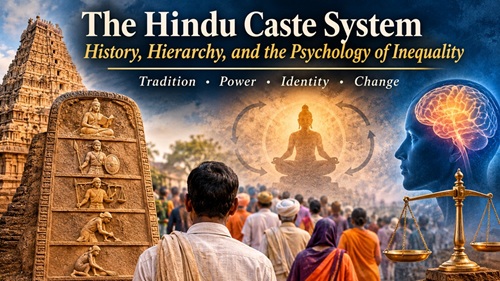 Jan Krikke's response "Varna, Caste and the Meaning of Taub's Model" to my earlier essay on the Indian caste system raises an important question: should Lawrence (Larry) Taub's historical model be judged primarily as a theory of social stratification, or should it be understood as a psychological typology combined with a theory of historical development? Krikke argues for the latter interpretation. In his view, Taub's model has been insufficiently understood because critics concentrate too heavily on hereditary caste and the historical dominance of particular social groups. Taub, he insists, is proposing something more ambitious: four recurring psychological orientations, expressed successively as dominant cultural and political forces in human history. This is a worthwhile clarification. It also provides an opportunity to examine the actual merits and weaknesses of Taub's theory. My central objection, however, remains: reinterpreting caste as psychology and history as a succession of dominant orientations does not establish that the proposed categories are scientifically meaningful, that the historical sequence is valid, or that humanity is moving toward a new spiritual-religious age. Krikke improves the presentation of Taub's argument. He does not establish its explanatory validity. 1. The psychological reinterpretation: a useful distinction, but an incomplete defenseKrikke's strongest point concerns the distinction between varna and hereditary caste. He emphasizes that Taub's four categories are psychological orientations rather than inherited social identities. The four orientations are:
Krikke correctly observes that these orientations need not correspond to someone's occupation or social position. A university professor might be predominantly merchant-oriented, while a factory worker might be deeply interested in spiritual questions. Individuals can combine several orientations, although one supposedly predominates. This is a more defensible interpretation than treating the categories as four hereditary social classes. It also makes the model potentially interesting as a framework for discussing different motivations and sources of social power. But a fundamental question remains unanswered: what exactly makes these four orientations a meaningful psychological classification? Are they empirically distinguishable personality types? Are they motivational priorities? Are they cultural archetypes? Or are they simply four broad categories into which practically any human activity can be retrospectively classified? Krikke does not establish this distinction. There is a considerable difference between observing that people have different motivations and proposing that human psychology can be adequately represented by four fundamental orientations. The former is commonplace; the latter requires argument and evidence. For example, why should spiritual understanding, military authority, commercial enterprise and productive labor constitute the four fundamental orientations? Why not include artistic creativity, scientific curiosity, caregiving, political participation or technological innovation as independent categories? One can certainly incorporate these activities into Taub's fourfold scheme, but that raises another problem: the more elastic the categories become, the less explanatory power they possess. A classification that can accommodate virtually every human motivation may be intuitively attractive without being particularly informative. 2. From psychological types to historical epochs: the missing bridgeThe central ambition of Taub's theory is not psychological classification. It is the claim that these four orientations have successively dominated human history. Krikke explains the proposed sequence as follows:
The problem is that the transition from psychological orientations to historical epochs is not self-evident. Even if we accept that these four orientations exist, why should they dominate history in precisely this sequence? Krikke argues that the coexistence of different groups does not invalidate Taub's model. A merchant society still requires soldiers, intellectuals and workers. What matters is which orientation determines its institutional priorities and definitions of success. This is a reasonable qualification. It also changes the nature of the theory. We are no longer talking about four successive populations or occupational groups replacing one another. We are talking about changing configurations of social power. But how do we identify the dominant orientation? Does a society become merchant-oriented when its economy is predominantly commercial? When its political leadership comes from business? When consumerism becomes culturally dominant? Or when financial interests increasingly determine public policy? These criteria could produce quite different historical periodizations. Consider the Netherlands, Britain, the United States and China. Each has experienced periods in which religious, military, commercial and productive interests have exercised considerable influence. Their histories do not neatly follow a single universal sequence. The distinction between coexistence and predominance is useful, but it does not solve the problem of establishing predominance objectively. 3. The historical problem: whose history?Taub's model proposes a universal macrohistory, but the historical record is considerably more complicated. Religious authority, military power, commerce and productive labor have been intertwined throughout civilization. Ancient Mesopotamian societies combined temple institutions, military organization, agricultural production and long-distance trade. Medieval European societies had powerful religious institutions, aristocratic military elites, expanding commercial networks and productive communities. Early modern Europe saw these forces develop together rather than appear in a simple succession. Indeed, the historical relationship between religion and commerce is particularly inconvenient for a rigid sequence. Religious institutions were not merely spiritual authorities. They were also major landowners, financial actors, political powers and economic organizations. Likewise, merchants have exercised substantial political influence long before the conventional beginning of the modern capitalist age. Krikke is right that predominance does not require exclusivity. But if every age contains all four orientations, and if the boundaries between them are flexible, what precisely distinguishes one historical age from another? This is not a minor technicality. It is the central methodological problem of Taub's historical model. A theory of historical succession needs identifiable transition criteria, not merely retrospective descriptions of changing social priorities. 4. The problem of historical prophecyThe most ambitious part of Taub's theory is its prediction of a Second Spiritual-Religious Age. Humanity supposedly moves through the spiritual, warrior, merchant and worker phases before returning to a spiritual orientation at a higher level of development. Krikke compares this expectation with the Christian Second Coming. He is careful to say that the two are not doctrinally equivalent, but that both anticipate a decisive spiritual renewal. This comparison reveals something important about the underlying structure of Taub's theory. It is not simply a descriptive account of history. It is also a teleological narrative: history has a direction, and that direction culminates in a spiritually renewed humanity. But what evidence supports this conclusion? The fact that religious institutions once exercised considerable power does not establish that humanity began in a Spiritual-Religious Age. Nor does the subsequent development of military, commercial and productive institutions demonstrate that a new spiritual age must follow. The argument risks confusing historical analogy with historical necessity. There is also a problem of defining what a Second Spiritual Age would actually look like. Would it involve renewed religious authority? A global spiritual culture? Greater psychological maturity? A secular society in which people pursue meaning beyond material consumption? These are very different possibilities. If spirituality is defined broadly enough to include almost any form of human self-development, the prediction becomes difficult to disprove. If it is defined more narrowly, the historical evidence for its imminent return becomes much less convincing. A prophetic model must do more than promise a desirable future. It must specify what developments would count as confirmation and what developments would count against it. 5. The Sarkar Game: an illustration is not a validationKrikke introduces the Sarkar Game, developed by Peter Hayward and Joseph Voros, as a practical demonstration of the usefulness of fourfold social typologies. Participants are assigned roles corresponding to workers, warriors, intellectuals and capitalists. They receive symbolic resources and interact, negotiating, forming alliances, asserting authority and sometimes resisting domination. The exercise can reveal interesting dynamics. Workers discover the power of withholding labor; warriors discover the potential for protection to become coercion; intellectuals discover how knowledge can legitimize authority; capitalists discover the tension between accumulation and collective welfare. This is potentially a useful educational exercise. But Krikke himself acknowledges an important limitation: Sarkar's categories and historical sequence are not identical to Taub's, and the game does not prove that humanity must pass through a predetermined succession of historical ages. I would go further. A simulation in which participants are assigned four different roles demonstrates that people can interact through four different roles. It does not demonstrate that these roles represent the fundamental structure of human psychology. Nor does it demonstrate that historical societies necessarily evolve through the same sequence. The Sarkar Game is therefore an illustration of a conceptual framework, not empirical confirmation of Taub's macrohistory. This distinction deserves emphasis because integral and post-integral discussions frequently move too quickly from an interesting pedagogical exercise to much larger claims about human development. 6. The China example: a particularly revealing simplificationKrikke adds that orthodox communism failed because it sidelined merchants, whereas China became an economic powerhouse after reintegrating them into its economic system. This is an interesting observation, but it is also an oversimplification. China's economic transformation cannot be adequately explained by the reintegration of a supposedly merchant-oriented psychological type. It involved a much wider set of developments: agricultural reforms, special economic zones, foreign investment, technology transfer, export-oriented manufacturing, state-directed industrial policy, infrastructure development and integration into global markets. Moreover, the Chinese Communist Party did not simply hand power to merchants. It retained political control while selectively introducing market mechanisms and encouraging private enterprise. China is therefore an interesting case of the interaction between political authority, commercial activity and productive capacity. But it does not straightforwardly demonstrate a transition from one varna orientation to another. In fact, China illustrates the difficulty of Taub's classification. Is contemporary China a Worker Age society because of its Confucian and productive traditions, a Merchant Age society because of its enormous commercial economy, or a Warrior Age society because of its centralized political and military power? The answer is that all three dimensions are important. Calling one of them dominant requires additional criteria that Taub's framework does not adequately establish. 7. The problem of unfalsifiabilityThere is a more fundamental methodological problem. Taub's model seems to possess considerable interpretive flexibility. Historical developments can be accommodated by emphasizing whichever of the four orientations appears most relevant. If religious institutions dominate, we are in a Spiritual Age. If military elites dominate, we are in a Warrior Age. If financial and commercial interests prevail, we are in a Merchant Age. If productive labor and professional competence become increasingly important, we are in a Worker Age. But what would count as evidence against the model? Suppose a society experiences a powerful religious revival while simultaneously expanding its military capabilities and commercial economy. Which age is it entering? Suppose the supposedly declining Merchant Age continues to expand its influence through digital platforms, financial institutions and global corporations. Is this a delayed transition or evidence that the model is mistaken? And if the predicted Second Spiritual Age does not materialize, how long must we wait before reconsidering the theory? Krikke's defense does not address these questions. A historical theory that can accommodate virtually every possible development after the fact risks becoming a classification system rather than an explanatory theory. Taub's model needs to demonstrate not merely that its categories can be applied to history, but that they explain historical developments better than competing frameworks. 8. The neglected alternativesTaub's approach also needs to be evaluated against existing theories of historical development. There is nothing particularly novel about the idea that different social groups or sources of power dominate at different historical moments. Marx emphasized changing modes of production, class relations and economic power. Weber examined the relationships between religious authority, political legitimacy and economic organization. Pareto and Mosca studied ruling elites. More recently, historical sociology has investigated the changing relationships between states, markets, social classes and institutions. And, of course, P. R. Sarkar developed his own theory of social cycles, with workers, warriors, intellectuals and capitalists succeeding one another in positions of dominance. Krikke mentions Sarkar, but the relationship between these theories deserves more attention. What does Taub explain that Sarkar does not? What does either model explain that established historical sociology cannot? A fourfold classification may offer an appealing overview, but elegance is not evidence. The real test is comparative explanatory performance. Does the model generate better historical explanations? Does it identify developments that other theories overlook? Does it produce successful predictions that could not easily have been derived from existing knowledge? Without such comparisons, Taub's model remains an interesting interpretive proposal rather than an established theory of historical development. 9. What Krikke's defense actually accomplishesTo be fair, Krikke makes several valuable corrections to a potentially superficial reading of Taub. First, he correctly distinguishes psychological orientations from hereditary caste identities. Second, he emphasizes that the four orientations are complementary rather than intrinsically hierarchical. Third, he explains that historical dominance does not imply the disappearance of other social functions. Finally, he draws attention to the practical usefulness of the Sarkar Game as an exercise in understanding different sources of power. These are worthwhile contributions. However, they do not resolve the central problems. Krikke moves rather easily between three different levels of analysis:
These propositions are related, but they are not interchangeable. Evidence that different psychological orientations exist does not establish that they determine institutional power. Evidence that institutions change over time does not establish that they follow a universal fourfold sequence. And evidence of historical change does not establish that history culminates in a renewed spiritual age. Each transition requires its own argument. This is where Krikke's defense remains insufficient. 10. Conclusion: a suggestive metaphor, not a demonstrated law of historyJan Krikke has provided a more sympathetic and sophisticated presentation of Lawrence Taub's model than a simple equation of Taub's theory with the Indian caste system would allow. That clarification is welcome. But there is a danger in rescuing a grand historical theory through increasingly flexible reinterpretations. The more we emphasize that the four categories are psychological rather than occupational, that they coexist rather than exclude one another, and that their historical dominance is a matter of degree rather than exclusivity, the more difficult it becomes to identify what the theory actually predicts. Taub's four orientations can certainly serve as a heuristic framework for discussing different sources of social power. Religious authority, military force, commercial wealth and productive competence are all important dimensions of civilization. But recognizing these dimensions is not the same as discovering a universal law of historical succession. Nor does it establish that humanity is approaching a Second Spiritual-Religious Age. That final claim introduces a spiritual teleology into what might otherwise be a useful sociological classification. It transforms an account of changing institutions into a story about humanity's ultimate destiny. And that is precisely where critical scrutiny becomes most necessary. My verdict: Krikke succeeds in defending Taub against an overly literal identification with hereditary caste. He does not succeed in establishing Taub's psychological typology as an empirically grounded model, his four historical ages as a universal sequence, or his predicted spiritual culmination as a credible historical forecast. Taub's model deserves consideration as speculative macrohistory. It does not deserve exemption from the evidential standards applied to other grand theories of human development. There is a difference between finding an attractive pattern in history and demonstrating that history actually follows that pattern. Appendix: Three questions Jan Krikke should addressRather than continuing the discussion at the level of competing interpretations, I would suggest three more specific questions. 1. Psychological validity: What empirical research demonstrates that spiritual, warrior, merchant and worker orientations constitute four fundamental and sufficiently distinct psychological types? How would we measure them, and how could the classification be falsified? 2. Historical validity: What independent criteria establish the beginning and end of each of Taub's historical ages? Can the proposed sequence be demonstrated without retrospectively selecting historical developments that fit it? 3. Predictive validity: What specific, observable developments would demonstrate that humanity is entering the Second Spiritual-Religious Age? And what developments would count as evidence that this prediction is wrong? These questions are not intended to dismiss Taub's work. They are intended to distinguish an interesting intellectual framework from a theory that can withstand critical examination. I would be particularly interested in Krikke's response to the second question. The historical sequence is, after all, the distinctive claim that turns Taub's psychological classification into a macrohistorical theory.
Comment Form is loading comments...
|