|
TRANSLATE THIS ARTICLE
Integral World: Exploring Theories of Everything
An independent forum for a critical discussion of the integral philosophy of Ken Wilber
 Jan Krikke is a former Japan correspondent for various media and former managing editor of Asia 2000 in Hong Kong. He pioneered the study of axonometry, the Chinese equivalent of European linear perspective overlooked by Jean Gebser. He is the author of several books, including Leibniz, Einstein, and China, and the editor of The Spiritual Imperative, a macrohistory based on the Indian Varna system by feminist futurist Larry Taub. Varna, Caste and the Meaning of Taub's ModelJan Krikke / Various LLMs
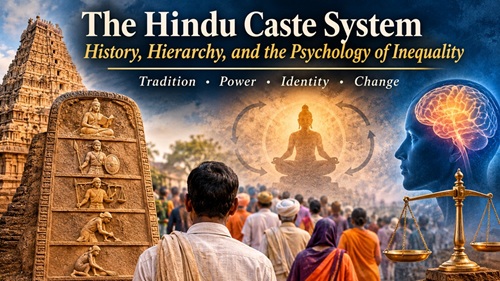 Frank Visser's essay "The Caste System" provides a valuable account of hereditary caste, its religious justifications and its enduring consequences. Its appendix also recognizes that Lawrence Taub's Caste Model differs from the historical Indian caste system. Nevertheless, the discussion needs to give greater weight to two features of Taub's approach: varna as a psychological typology and the succession of varnas as a prophetic account of history. Without these distinctions, Taub appears to take an oppressive social hierarchy and turn it into a metaphor for changing elites. His argument is more ambitious. He argued that the caste system is a corruption of a profound insight into human psychology. From inherited status to psychological orientationIn Taub's interpretation, the four varnas describe fundamental human orientations. They are not hereditary communities, occupational assignments or measures of personal worth. In modern terminology, they are psychological profiles. The spiritual type seeks understanding, knowledge and spiritual realization. The warrior emphasizes courage, protection, discipline and honor. The merchant recognizes opportunity and excels at exchange, organization and the accumulation of wealth. The worker values practical contribution, competence, cooperation and security. These categories describe what motivates a person, rather than merely identifying what that person does for a living. A religious official need not have a predominantly spiritual orientation; ambition, competition or commercial calculation may be stronger motivations. Conversely, a person without religious office may be deeply oriented toward spiritual understanding. As the fuller account of Taub's model explains, individuals usually combine traits of two or more types. A worker may have entrepreneurial inclinations; a warrior may also be a spiritual seeker. One orientation nevertheless typically predominates. The model proposes four recurring emphases within human nature, rather than four populations of psychologically identical people. Visser's appendix acknowledges this mixture, but its emphasis on “different types of social power and historical leadership” leaves the psychological foundation underdeveloped. For Taub, the orientations come first. Their expression in institutions and historical leadership is a further part of the theory. There is textual support for connecting varna with qualities and activities. The Bhagavad Gita associates the fourfold division with guna and karma, and relates its differentiated duties to qualities arising from people's nature. These passages provide resources for a psychological reading, although their interpretation and relationship to hereditary status remain contested. The corruption Taub sought to distinguishWithin Taub's interpretation, hereditary caste represents a corruption of the insight behind varna. An account of differing inclinations becomes an assignment of identity by birth. Complementary capacities become a hierarchy of inherited privilege. The difference is fundamental. Recognizing that people have different motivations does not entail that children must inherit their parents' occupation, marry within an assigned community or possess unequal rights. Nor does it entail that one orientation makes a person intrinsically superior to another. Taub's account treats the four types as mutually necessary. Societies need understanding, protection, exchange and practical work. The historical caste system turned distinctions of function and disposition into restrictions on people's possibilities. Calling that a corruption expresses Taub's understanding of the relationship between the philosophical concept and the social institution. Establishing exactly when and how such a transformation occurred requires a separate historical argument. We should neither treat the hereditary system as the inevitable meaning of varna nor assume that its entire history can be reconstructed from a modern psychological interpretation. Visser's criticism of caste oppression therefore need not be disputed. The question is whether that criticism also disposes of the different proposition Taub draws from varna. It does not. A prophecy of successive agesThe second distinction concerns time. Taub understood the fourfold scheme as more than a classification of people living together. He read it alongside an Indian account of successive ages: humanity passes through a Spiritual-Religious Age, a Warrior Age, a Merchant Age and a Worker Age, before returning to a spiritual orientation. On this reading, the sequence is prophetic. It describes an anticipated transformation of humanity's governing priorities. What begins as spiritual birth eventually becomes spiritual rebirth, after the development of military organization, commerce, productive skills and material capacities. The comparison with the Christian Second Coming is helpful at this level. Both anticipate a decisive spiritual renewal. They do not have identical doctrines, mechanisms or understandings of salvation. The analogy concerns the expectation of renewal, rather than theological equivalence. This temporal dimension changes the meaning of the categories. The spiritual type is not simply a priest standing permanently above a laborer. Each orientation has its historical period of prominence. The question becomes which values organize a civilization at a particular time. Taub then makes a distinctive move. He translates this account into a modern macrohistory, relating the succession to identifiable political, economic and cultural changes. His second Spiritual-Religious Age is not a restoration of prehistoric conditions. It retains capacities acquired during the intervening ages. The fuller account also distinguishes Taub from an endlessly repeating cosmology. Taub envisages a single human developmental passage from the first spiritual age to the second. Spirituality returns under transformed conditions; history does not simply start again. This is why his model cannot be adequately summarized as the succession of ruling occupational groups. It concerns changing purposes as well as changing power. 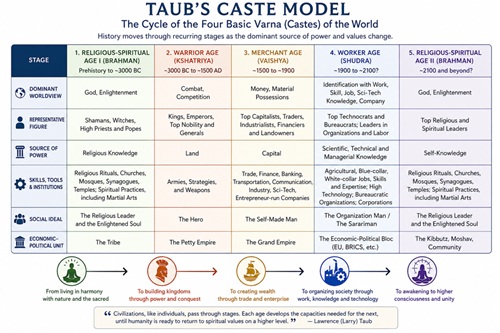 Dominance does not mean exclusivityVisser objects that religious, military, commercial and productive groups have coexisted throughout history. They certainly have. But coexistence does not by itself contradict a theory of predominance. A merchant-oriented society still requires soldiers, teachers and workers. Taub's question is whether commercial priorities shape its institutions, aspirations and definitions of success. Likewise, his Worker Age does not imply that merchants disappear or that every government is controlled by manual laborers. The worker category is broader than industrial labor. It encompasses people whose standing rests on practical knowledge, professional competence and useful contribution, including salaried specialists and administrators. Reducing it to a conventional class category obscures the model's psychological premise. But the model can shed light on contemporary development: Communism in its orthodox form failed because it sidelined the merchants. China became an economic powerhouse only after it reassimilated the merchants into the systems. Making the orientations visible: the Sarkar GameA practical application of a related typology is the Sarkar Game, developed in 2004 by Peter Hayward and Joseph Voros at Swinburne University of Technology in Melbourne. Based on P. R. Sarkar's theory of social change, the game has been described and explored through case studies by futures researcher Sohail Inayatullah. Participants are assigned to four groups: workers, warriors, intellectuals and capitalists. Each receives a short account of its priorities and a symbolic resource. Workers receive tools, warriors weapons represented by toys, intellectuals books, and capitalists money. The groups then interact, negotiating, forming alliances, asserting authority or resisting one another. The exercise makes different sources of power tangible. Workers provide the labor on which the others depend and can disrupt the arrangement by withdrawing it. Warriors offer protection and order but can turn coercive. Intellectuals provide knowledge, interpretation and legitimizing ideas but can use those resources to defend their own authority. Capitalists organize resources and pursue opportunities but can subordinate other purposes to accumulation. The important part comes afterward, when participants reflect on what happened. Which priorities did they recognize in themselves? Which did they dismiss in others? How did protection become domination, or knowledge become a claim to superior authority? What combination of capacities would have produced a better outcome? Because participants enact assigned roles, the game invites them to examine orientations beyond their habitual ones. It gives a concrete meaning to the proposition that people can express several tendencies, even when one usually dominates. Sarkar's categories and historical sequence should not be treated as identical to Taub's. In particular, the game's intellectual role overlaps with, but does not simply reproduce, Taub's spiritual-religious orientation. Its relevance is methodological: it demonstrates how a fourfold typology can become a tool for examining motivations, leadership and institutional power. The game does not prove that humanity must pass through a predetermined sequence of ages. Its reported usefulness as an exercise and the historical validity of a macrohistory are separate questions. But it shows that these categories can do more than rename hereditary groups or provide a decorative historical metaphor.
|