|
TRANSLATE THIS ARTICLE
Integral World: Exploring Theories of Everything
An independent forum for a critical discussion of the integral philosophy of Ken Wilber
  Frank Visser, graduated as a psychologist of culture and religion, founded IntegralWorld in 1997. He worked as production manager for various publishing houses and as service manager for various internet companies and lives in Amsterdam. Books: Ken Wilber: Thought as Passion (SUNY, 2003), and The Corona Conspiracy: Combatting Disinformation about the Coronavirus (Kindle, 2020).
Check out my other conversations with ChatGPT The Hindu Caste SystemHistory, Hierarchy, and the Psychology of InequalityFrank Visser / ChatGPT
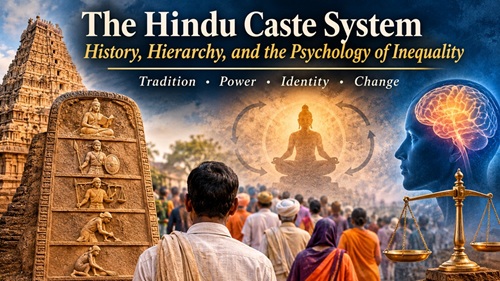 Introduction: A social hierarchy with a sacred historyThe Hindu caste system is one of the most enduring and controversial systems of social stratification in human history. It has organized large parts of Indian society for centuries, assigning people social positions, occupations, marriage partners, ritual status, and degrees of social privilege largely on the basis of birth. Although caste is commonly associated with Hinduism, its influence extends beyond Hindu religious communities and has also shaped social relations among Muslims, Christians, Sikhs, and other populations in South Asia. Caste is often presented as a religious institution, but that description is incomplete. It is simultaneously a social hierarchy, an economic arrangement, a system of inherited identity, a mechanism of political organization, and a psychological framework through which people learn to perceive themselves and others. Its history is complicated. The familiar fourfold classification of society into Brahmins, Kshatriyas, Vaishyas, and Shudras is not identical to the thousands of actual hereditary communities known as jatis. Nor has caste remained unchanged throughout Indian history. Its institutions have been shaped by religious traditions, regional customs, political powers, colonial administration, economic transformations, and modern democratic struggles. The central question is therefore not simply why Hinduism developed caste, but how a system of inherited inequality acquired religious legitimacy, survived major historical transformations, and continues to reproduce itself even in a society that formally rejects caste discrimination. A psychological interpretation adds another dimension: how do people come to internalize hierarchies that assign worth and social possibilities before an individual has done anything to deserve either? 1. The historical origins: Varna and jatiThe origins of caste are difficult to reconstruct because the institution developed over a long period rather than appearing in a single historical moment. Two concepts need to be distinguished. Varna refers to the idealized fourfold classification of society:
Outside or beyond this fourfold scheme were communities subsequently categorized as avarna, including groups subjected to untouchability. These communities have historically been associated with occupations regarded as ritually polluting, although their actual occupations and social circumstances varied considerably. Jati, by contrast, refers to the numerous hereditary, localized social communities into which people are born. These communities historically regulated marriage, occupation, social interaction, and collective identity. The distinction is crucial. The four varnas provide a broad ideological framework, whereas jati represents the much more complex social reality. There are thousands of jatis, and their relative status has varied across regions and historical periods. The earliest important textual reference to the four varnas appears in the Purusha Sukta, a hymn in the Rigveda. It describes the four social categories as emerging from different parts of a primordial cosmic person: Brahmins from the mouth, Kshatriyas from the arms, Vaishyas from the thighs, and Shudras from the feet. This imagery gives social differentiation a cosmic foundation. Society becomes an organic whole in which different groups have different functions. But a metaphor of functional differentiation can easily become a justification for inherited inequality. The problem arises when the supposed functions of social groups are treated as fixed characteristics of their members and when the hierarchy is represented as divinely ordained. The Manusmriti, or Laws of Manu, composed and compiled over several centuries around the beginning of the Common Era, provides a particularly influential normative articulation of caste hierarchy. It associates social status with birth, prescribes different duties for different varnas, and imposes severe restrictions and penalties on those who violate its rules. However, it would be misleading to regard the Manusmriti as a universally applied legal code throughout Indian history. Actual social practices were much more diverse, and Brahmanical prescriptions were not always followed. Different kingdoms, religious movements, and local communities maintained different arrangements. Caste was not simply invented by one religious authority. It developed through the interaction of social practices, political power, economic specialization, and religious legitimation. 2. The religious justification: Dharma, karma, and rebirthThree concepts have played particularly important roles in traditional explanations of caste: dharma, karma, and reincarnation. Dharma refers to duty, moral order, and appropriate conduct. In certain traditional interpretations, individuals are expected to fulfill the duties associated with their social position. A Brahmin has different obligations from a warrior, merchant, or laborer. The Bhagavad Gita famously associates social differentiation with qualities and activities, but its interpretation is contested. Some passages emphasize the relationship between varna and qualities (gunas) and actions (karma), while other traditional interpretations have reinforced hereditary social divisions. Karma provides a potentially powerful explanation for inherited circumstances. According to certain Hindu interpretations, one's present condition is partly the consequence of actions performed in previous lives. When combined with hereditary caste, this can produce a morally circular explanation of inequality: You occupy a particular social position because of your previous karma, and fulfilling the duties of that position may improve your prospects in a future existence. Such reasoning can transform an arbitrary social disadvantage into an apparently deserved cosmic outcome. Rebirth reinforces this temporal dimension. Inequality is no longer necessarily understood as a problem that must be corrected within one lifetime. It becomes part of an extended moral process across successive lives. There is, however, an important distinction between the philosophical concepts themselves and their use in defending social hierarchy. Karma does not logically require caste discrimination, and belief in rebirth does not necessarily entail acceptance of hereditary social status. Nevertheless, when these concepts are combined with a rigid interpretation of varna, they can provide a powerful religious justification for the existing distribution of privilege and disadvantage. This is one of the most consequential features of the traditional caste ideology: it can make a historically produced social arrangement appear to be part of the moral structure of the universe. 3. Caste as a system of social controlThe caste system was never merely a division of labor. It also became a division of laborers, to use the famous distinction made by the Indian social reformer and intellectual B. R. Ambedkar (1891-1956). In a simple division of labor, people perform different tasks according to their abilities, interests, and social needs. Such divisions can be flexible and mutually beneficial. In a caste-based division of labor, however, the occupation and social position of individuals are largely determined by birth. This has several consequences. Occupational restrictions. Certain communities were traditionally associated with particular occupations, including work considered ritually impure. These associations could become hereditary expectations, limiting opportunities for social and economic mobility. Endogamy. Marriage within one's caste or subcaste has been one of the principal mechanisms through which caste boundaries are maintained. Even when occupational restrictions weaken, marriage patterns can preserve inherited social identities. Purity and pollution. A particularly important dimension of caste ideology is the distinction between ritually pure and impure persons, occupations, and forms of contact. In its more extreme manifestations, this ideology justified untouchability: the exclusion of certain communities from temples, wells, schools, public facilities, and ordinary social interaction. Access to resources. Caste hierarchy has historically influenced access to land, education, political authority, religious institutions, and economic opportunities. These inequalities cannot be explained simply by differences in religious belief. They also reflect material relations of power. This last point is important. Caste is sometimes interpreted as a predominantly ritual hierarchy, but ritual status and material privilege have frequently reinforced each other. The higher-status groups were not simply regarded as spiritually superior. They could also possess disproportionate control over education, property, administration, and the interpretation of religious tradition. The result was a system in which social privilege could reproduce itself across generations. 4. Colonialism: invention or reinforcement?An interesting historical controversy concerns the extent to which British colonialism created or consolidated the modern caste system. One interpretation emphasizes the colonial contribution. British administrators attempted to classify Indian society through censuses, ethnographic surveys, legal categories, and administrative records. From the second half of the nineteenth century, these activities increasingly encouraged the treatment of caste identities as identifiable, stable, and comparable categories. The colonial administration often sought to fit diverse regional communities into a standardized hierarchy. Communities themselves responded strategically, sometimes campaigning for recognition at a higher position. The process was therefore not simply imposed from above. Indians also participated in the reconstruction of caste identities, using the new administrative categories to pursue political and social objectives. However, the idea that the British invented caste is historically untenable. Caste distinctions, hereditary communities, untouchability, and Brahmanical hierarchy predated colonial rule by centuries. The more defensible conclusion is that colonial administration standardized, documented, and sometimes hardened existing social distinctions, while also creating new opportunities for caste-based mobilization. Historical scholarship has increasingly moved beyond the simplistic opposition between an ancient, unchanging caste system and a colonial invention. Caste was continually reconstructed through interactions between local society, political authority, religious institutions, and economic change. Colonialism also had contradictory consequences. British rule helped institutionalize caste categories, but modern education, print culture, missionary activity, legal reforms, and new political organizations provided resources for challenging caste oppression. Among the most important figures in this resistance were Jyotirao Phule, Savitribai Phule, Periyar E. V. Ramasamy, and B. R. Ambedkar. 5. Ambedkar and the rejection of caste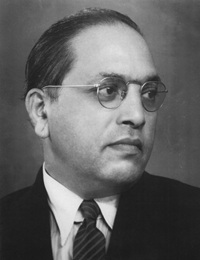 B. R. Ambedkar (1891-1956) Ambedkar was a jurist, economist, political thinker, and leading opponent of caste discrimination. Born into a Dalit community, he experienced caste exclusion personally and made its abolition a central political and intellectual objective. Ambedkar's 1936 work Annihilation of Caste remains one of the most important critiques of the Hindu caste system. His argument went considerably beyond the observation that caste produced inequality. He challenged the religious and intellectual foundations that made caste appear legitimate. For Ambedkar, caste was not simply a matter of social prejudice that could be corrected through better manners or individual goodwill. It was embedded in religious authority, social organization, marriage practices, and inherited collective identities. He therefore rejected the idea that the caste system could be substantially reformed while its underlying religious justifications remained intact. One of his most important observations concerned endogamy. The reproduction of caste depends upon controlling marriage and family formation. Caste boundaries survive because communities reproduce themselves as distinct hereditary groups. Ambedkar also rejected the romanticized image of the traditional Indian village as a harmonious community. He argued that the village could be a place where entrenched social inequalities were reproduced through everyday relations of dependence and exclusion. His position differed from reformers who wanted to preserve Hindu religious identity while removing its most objectionable social consequences. Ambedkar ultimately converted to Buddhism in 1956, together with many followers, as an explicit rejection of caste-based Hindu social organization. His contribution is particularly important because it shifts the discussion from the moral character of individual members of privileged castes to the institutional reproduction of inequality. The question is not whether every Brahmin discriminates against every Dalit. Clearly, they do not. The question is whether a social system can continue to reproduce inherited advantages and disadvantages even when many individuals reject its discriminatory practices. 6. The current status: caste in modern IndiaModern India is constitutionally committed to equality, but caste has not disappeared. The Constitution of 1950 established several important protections. Article 14 guarantees equality before the law, Article 15 prohibits discrimination on specified grounds including caste, Article 16 addresses equality of opportunity in public employment, and Article 17 abolishes untouchability. The state also introduced affirmative-action policies, commonly known as reservations, to improve access to education, public employment, and political representation for historically disadvantaged communities. Three major categories are particularly important:
These categories are not identical to the traditional four varnas. They are modern administrative and constitutional classifications designed to address historical disadvantage. Reservations have created opportunities for millions of people, particularly in education, public-sector employment, and political representation. They have also become a major subject of political debate concerning the relationship between historical injustice, social disadvantage, merit, and distributive justice. Yet formal equality does not automatically eliminate inherited inequality. Caste continues to influence marriage choices, residential patterns, social networks, political mobilization, educational opportunities, and access to economic resources. Discrimination and violence against Dalits remain serious concerns. A particularly revealing aspect is the persistence of caste endogamy. People may study at the same universities, work in the same companies, and participate in the same political institutions while still maintaining strong preferences for marriage within their own caste communities. This suggests that caste is not simply an institution maintained by religious authorities or rural economic arrangements. It is also reproduced through ordinary family decisions. The situation is not uniform. Urbanization, education, economic mobility, inter-caste relationships, constitutional protections, and social movements have weakened some traditional restrictions. At the same time, caste identities have become important instruments of electoral politics and collective organization. Nor is caste exclusively a Hindu phenomenon today. Caste-like distinctions and inherited status hierarchies are also found among South Asian Muslims, Christians, and Sikhs, although their religious doctrines differ. The result is a complex modern reality: caste is simultaneously challenged, adapted, politically mobilized, and reproduced. 7. The psychological interpretation: how caste becomes internalizedThe caste system becomes particularly interesting when examined through psychology. Its persistence cannot be explained exclusively by religious doctrine, economic interests, or political institutions. It also depends on how people learn to perceive social differences, develop group identities, and justify unequal treatment. Several psychological mechanisms help explain this process. 7.1 Social identity and group belongingSocial identity theory, associated particularly with psychologists Henri Tajfel and John Turner, explains how people derive part of their identity from membership in social groups. People distinguish between their own group (in-group) and other groups (out-groups). Such distinctions can generate solidarity, loyalty, and mutual support. They can also generate prejudice, stereotyping, and discrimination. Caste provides an unusually powerful framework for this process because group membership is inherited, socially visible in many contexts, and reinforced by family and community institutions. A person does not ordinarily choose their caste. They are born into it and encounter its expectations from childhood. Consequently, caste identity can become an important component of personal identity, even for individuals who reject the ideology of caste hierarchy. This creates a psychological paradox: people may oppose discrimination while continuing to identify strongly with the social group that historically benefited from the system. 7.2 Internalized inferiority and social stigmaFor individuals belonging to historically disadvantaged communities, caste discrimination can affect self-perception. Repeated experiences of exclusion, humiliation, and unequal treatment may contribute to internalized stigma. Individuals can begin to interpret externally imposed disadvantages as reflections of their own inadequacy. This is not an inevitable psychological consequence of belonging to a disadvantaged caste. Dalit movements, literature, political activism, and collective organization have also generated powerful forms of dignity, resistance, and positive identity. Nevertheless, the psychological burden of discrimination should not be underestimated. It can influence educational aspirations, social confidence, interpersonal relationships, expectations of success, and feelings of belonging. The consequences are not limited to individual encounters. If a child repeatedly experiences lower expectations from teachers, social exclusion from classmates, or discriminatory treatment in public settings, these experiences can become part of the child's understanding of what opportunities are realistically available. This is one reason why formal equality does not necessarily produce psychological equality. 7.3 Status anxiety and the defense of privilegeThe psychological effects of caste are not restricted to disadvantaged groups. Members of privileged communities can also develop a strong attachment to inherited status. Their social identity may be connected to family prestige, ritual purity, educational traditions, or assumptions about cultural superiority. This attachment can produce status anxiety when established hierarchies are challenged. Affirmative action, inter-caste marriage, and demands for social equality may be experienced not merely as political developments but as threats to an inherited social position. A psychological mechanism known as system justification helps explain why people sometimes defend social arrangements that distribute advantages and disadvantages unequally. People have a tendency to perceive existing institutions as legitimate, natural, or necessary, especially when those institutions provide security and a coherent understanding of the world. This does not mean that every defender of traditional social arrangements consciously endorses discrimination. People may sincerely believe that they are preserving cultural continuity, religious tradition, or social stability. But the distinction between consciously intended discrimination and the psychological defense of an unequal system is important. An institution can reproduce injustice without requiring every participant to be consciously malicious. 7.4 Purity, disgust, and moral exclusionPerhaps the most revealing psychological dimension of caste concerns purity and pollution. Human beings everywhere make distinctions between clean and dirty, sacred and profane, acceptable and unacceptable. Such distinctions can have practical origins in hygiene, disease avoidance, and social conventions. However, caste transforms these distinctions into inherited social identities. A person can be classified as ritually impure not because of anything they have done, but because of the community into which they were born. This is a remarkable transformation: a symbolic classification becomes a social reality with material consequences. Psychological research on disgust and moral cognition offers possible explanations for why purity-related beliefs can become emotionally powerful. Disgust is not simply an intellectual judgment. It can generate immediate reactions of avoidance and rejection. Once these reactions become culturally learned and socially reinforced, they can survive even when their original religious explanations lose credibility. But one should be careful not to reduce caste to a universal human tendency toward disgust. The specific classification of communities, the institutional enforcement of separation, and the unequal distribution of power are historically produced. Human psychology may help explain how such practices are sustained, but it does not explain why this particular hierarchy emerged. 7.5 Conformity and the reproduction of traditionAnother important mechanism is conformity. Individuals frequently follow social conventions because they fear disapproval, exclusion, or conflict with their families. Marriage is an especially revealing example. Even people who have little personal interest in caste distinctions may accept family expectations concerning marriage partners. The result is that caste boundaries can survive without requiring explicit ideological commitment. A parent may regard caste as unimportant in everyday life but still insist that a son or daughter marry within the community. The same person may oppose untouchability while maintaining a strong preference for caste endogamy. This illustrates the difference between explicit prejudice and implicit social reproduction. Caste survives partly because it is embedded in ordinary decisions that are rarely experienced as political acts. 8. Caste and modern psychological research: what does the evidence tell us?It is useful to distinguish between psychological explanations of caste and empirical research into its consequences. A 2023 review published in Frontiers in Psychology, for example, examines the relationships between caste-based categorization, social identity, discrimination, and psychological functioning. It discusses how inherited social labels can affect individual identity and how structural disadvantage can influence mental health. The broader psychological literature suggests several interconnected pathways:
These are explanatory possibilities, not universal outcomes. Nor should psychological mechanisms be confused with proof that every individual belonging to a particular caste behaves in a particular way. An especially important distinction concerns the direction of explanation. It would be a mistake to suggest that disadvantaged communities suffer because of some psychological deficiency. Their disadvantages are not primarily products of their psychology. They are produced and reinforced by social conditions, institutional practices, and unequal opportunities. Psychology is relevant because it helps explain how those conditions affect people and how social arrangements become reproduced through individual behavior. 9. Is caste uniquely Hindu?An interesting complication arises when we compare caste with other systems of inherited hierarchy. Caste is historically associated with Hindu civilization, but social stratification based on birth is certainly not unique to India. European feudal society divided populations into estates and inherited ranks. Aristocratic families maintained privileges through marriage, property, and political connections. Racial segregation in the United States and apartheid in South Africa created inherited distinctions that affected virtually every dimension of social life. There are similarities, but also important differences. Caste combines hereditary membership, endogamy, occupational associations, ritual ranking, and historically developed ideas of purity and pollution in a particularly elaborate configuration. The comparison is useful because it prevents two opposite errors. The first is to regard caste as an inexplicable Hindu peculiarity, disconnected from broader human tendencies toward hierarchy and social exclusion. The second is to treat caste as merely another form of class inequality or racism, overlooking its distinctive religious and cultural history. Caste is historically specific, but the psychological mechanisms that sustain it are not necessarily unique. Indeed, the tendency to regard one's own group as more deserving, more civilized, or more legitimate than others can be found in many societies. This also raises an uncomfortable question for Western critics: to what extent do modern societies reproduce caste-like distinctions through inherited wealth, educational privilege, social networks, and cultural capital? The answer is not that these systems are identical. Rather, the comparison reveals that inherited inequality is a broader human problem. 10. The paradox of modernity: why caste survives modernizationOne might expect industrialization, urbanization, scientific education, and democratic institutions to make caste increasingly irrelevant. There is some truth to this expectation. Modern economic activity has weakened traditional occupational restrictions, while education and urban mobility have opened opportunities previously unavailable to many communities. Yet modernization has not eliminated caste. One reason is that caste is not simply an economic institution. It is also a system of identity and social reproduction. A person can become a successful engineer, entrepreneur, academic, or government official while retaining a strong caste identity. Modern professional achievement does not necessarily dissolve traditional marriage preferences or inherited community loyalties. Furthermore, democratic politics can reinforce caste identification. Political parties and movements organize around caste constituencies, while demands for representation and reservations make caste categories administratively and politically consequential. This creates a complicated feedback loop. Caste discrimination produces demands for protective measures. Protective measures require the identification of disadvantaged communities. Political mobilization strengthens collective caste identities. Those identities can then remain important even when the original discriminatory practices are weakening. This does not mean affirmative action is responsible for caste discrimination. It means that policies designed to remedy historical inequality operate within a society in which caste remains socially and politically consequential. The challenge is to weaken the inequalities that make caste identity consequential without denying the historical disadvantages that justify remedial policies. 11. Can caste be abolished?The question of abolishing caste is more complicated than abolishing a discriminatory law or changing a religious doctrine. Caste is reproduced through several interconnected institutions: family, marriage, inheritance, education, religious authority, economic opportunity, and political organization. Consequently, reform in one area does not necessarily transform the others. Three broad approaches can be distinguished. First, legal and institutional reform. Constitutional equality, anti-discrimination legislation, affirmative action, educational access, and effective enforcement of existing laws remain essential. India has established an extensive legal framework, including the Protection of Civil Rights Act (1955) and the Scheduled Castes and Scheduled Tribes (Prevention of Atrocities) Act (1989). Second, social and cultural transformation. Caste boundaries need to become less important in everyday life. Inter-caste friendships, marriages, professional relationships, and shared public institutions can gradually weaken inherited divisions. Third, intellectual and religious reform. Religious traditions that justify hereditary inequality need to be critically examined. This does not require rejecting Hinduism as a whole. Hindu philosophical traditions are diverse, and many Hindu thinkers and reform movements have opposed caste discrimination. Nevertheless, a serious reform movement must confront the question of whether religious authority should ever be used to legitimize inherited social privilege. There is also a practical difficulty: abolishing caste as a social identity is not necessarily the same as abolishing caste discrimination. For as long as inherited disadvantages persist, identifying affected communities remains important for measuring inequality and implementing corrective policies. The objective should therefore be the elimination of caste-based domination, not the erasure of the historical identities of those who have suffered from it. 12. The wider philosophical question: hierarchy versus human equalityThe caste system raises a fundamental philosophical question: should human beings be evaluated according to inherited characteristics, or according to their individual qualities, actions, and contributions? A society necessarily contains functional differences. People have different abilities, occupations, interests, and responsibilities. There is nothing inherently objectionable about a division of labor. The problem begins when functional differences become hereditary rankings of human worth. A doctor, farmer, teacher, sanitation worker, and religious scholar perform different functions. Their contributions may differ in nature, but none of these occupations provides a legitimate basis for assigning their practitioners different degrees of human dignity. This distinction also exposes a weakness in traditional justifications of caste. Even if different social roles were once considered necessary for the functioning of society, it does not follow that these roles should be inherited or that some should be regarded as intrinsically superior. The transition from social differentiation to social domination requires an additional ideological justification. In the Hindu caste system, concepts of cosmic order, dharma, karma, and ritual purity have historically supplied parts of that justification. The deeper philosophical issue is therefore not whether society needs differentiation, but whether differentiation must entail inequality. A modern humanistic perspective would answer that social diversity and functional specialization are compatible with equal dignity, equal rights, and equal opportunities. Conclusion: The psychology of an inherited hierarchyThe Hindu caste system provides an extraordinary historical example of how social inequality can acquire religious legitimacy, become embedded in everyday practices, and survive major transformations in political and economic life. Its origins cannot be reduced to a single religious text or historical event. The relationship between varna and jati evolved over centuries, while regional traditions, political institutions, colonial administration, and modern democratic movements repeatedly reshaped caste identities. Its contemporary existence reveals the limitations of purely legal approaches to social reform. India has abolished untouchability constitutionally, established equality before the law, and introduced extensive affirmative-action policies. Yet inherited social identities continue to influence marriage, friendship, opportunity, and political organization. The psychological dimension is especially revealing. Caste is maintained not only through external coercion but also through internalized identities, family expectations, status anxieties, conformity, and culturally transmitted ideas of purity and pollution. This suggests a broader lesson about human society. Hierarchies do not necessarily survive because everyone consciously believes in their legitimacy. They can survive because people inherit them, organize their lives around them, and reproduce them through ordinary decisions. The caste system is therefore not simply a historical curiosity or a religious anomaly. It is a particularly elaborate example of a more general human tendency: turning socially constructed distinctions into apparently natural differences, and then using those differences to justify unequal treatment. The ultimate challenge is not merely to change people's opinions about caste. It is to transform the institutions and everyday practices through which inherited inequality continues to reproduce itself. A society becomes more genuinely egalitarian not when everyone occupies the same position, but when nobody's opportunities, dignity, or social worth are predetermined by the circumstances of their birth. Appendix: Lawrence Taub and the distinction between social caste and the Caste Model Lawrence Taub (1936-2018) Taub was an American futurist who developed a theory of historical development based on a reinterpretation of the Hindu concepts of caste and the four ages. Lawrence Taub deserves a place in this discussion, but with an important qualification: his Caste Model is not a theory of the historical Indian caste system itself. His work, particularly The Spiritual Imperative: Sex, Age, and The Last Caste (2002), and his earlier essay Sex, Age, and Caste: The Grandest Narratives of All (2009), attempts to extract a general theory of historical development from Hindu cosmological and social concepts. Taub distinguishes between the traditional Indian caste system and what he calls the universal Caste Model. He explicitly rejects the assumption that the two are identical. His argument is that the Hindu concepts of caste and the four ages contain a more general insight into the successive dominance of different social groups in human history. In this interpretation, the four castes become more than hereditary occupational categories. They represent different types of social power and historical leadership. Taub's four historical stages are:
Taub argues that these groups successively become dominant in world history. He interprets the rise of industrial labor and worker-oriented institutions as the transition from the Merchant Age to the Worker Age. He also anticipates a second Spiritual-Religious Age, which he associates with a future transformation of human consciousness. Importantly, Taub does not mean that all members of society literally belong to hereditary castes. In his model, everybody possesses characteristics of all four types, but one orientation predominates. 1. Where Taub's model is interestingTaub makes an interesting attempt to distinguish between the Indian caste system as a concrete institution and caste as a general historical metaphor. His model can be read as a theory of changing sources of social power. Religious authority, military force, economic wealth, and productive labor have all played important roles in different historical societies. It also invites comparison with other macrohistorical theories:
Taub's contribution is to combine these historical transformations with a spiritual-developmental narrative. 2. Where the model becomes problematicThere are several difficulties. First, historical periodization. It is difficult to establish that humanity has passed through four relatively distinct stages in the proposed order. Religious, military, commercial, and productive elites have coexisted throughout history. Their relative influence has varied considerably. Second, retrospective classification. Almost any historical development can be interpreted as evidence for one of the four ages. This creates a risk of selecting historical examples to fit the model rather than independently testing its explanatory power. Third, the problem of prediction. Taub makes substantial predictions about the future dominance of spiritual-religious societies and the emergence of a new human stage. These require independent evidence and clearly specified criteria for success or failure. Fourth, the exclusion of the outcastes. Perhaps most revealingly, Taub explicitly states that Dalits and other outcastes have no place in his Caste Model because they are outside the original fourfold philosophical classification. metafuture.org This is understandable as a distinction between his abstract model and the actual Indian caste system, but it also exposes a conceptual limitation. A theory borrowing its categories from caste should not overlook the historical experience of those who were excluded from the system's privileged categories. 3. Taub and the psychology of casteTaub's model is also relevant to the psychological discussion, but in a different way from social identity theory or psychoanalysis. He transforms caste categories into psychological and social orientations: spiritual, warrior-like, commercial, and worker-oriented. This makes his model potentially useful as a typology of dominant values and motivations. But it should not be confused with an empirically established psychological classification. There is no demonstrated reason why every individual must fit predominantly into one of these four categories, or why these orientations should succeed one another in a predetermined historical sequence. More importantly, Taub's model risks confusing three different things:
These processes may interact, but they are not interchangeable. 4. The relationship to WilberThere is an especially interesting comparison with Ken Wilber. Both Taub and Wilber interpret human history as a developmental process moving toward increasingly complex forms of consciousness. Both draw upon Eastern philosophical traditions while attempting to construct universal models of historical evolution. But their approaches differ. Wilber emphasizes developmental stages of consciousness and the increasing integration of perspectives, whereas Taub emphasizes successive dominant social groups and their associated worldviews. Both face a similar methodological challenge: how to distinguish a genuinely explanatory developmental theory from an attractive retrospective narrative. And both need to demonstrate that their proposed future stages are more than projections of their philosophical expectations. Conclusion: A useful metaphor, not an established theoryTaub belongs in the discussion as an example of the modern reinterpretation of Hindu caste philosophy into a universal theory of historical development. His distinction between the Indian caste system and his abstract Caste Model is important and should be respected. Nevertheless, the borrowing of caste terminology raises questions about historical accuracy, conceptual clarity, and the treatment of those excluded from the traditional hierarchy. I would therefore classify Taub's contribution as speculative macrohistory rather than established sociology or psychology. Its greatest value may lie in the questions it raises about changing sources of social power. Its greatest weakness is the temptation to turn a suggestive historical metaphor into a universal law of human development. For the Integral World essay, Taub offers an instructive example of how Hindu concepts can be extracted from their historical and social context, universalized, and incorporated into grand theories of human evolution. That process deserves the same critical scrutiny as Wilber's, Aurobindo's, and other spiritual-developmental interpretations of history.
Comment Form is loading comments...
|