|
TRANSLATE THIS ARTICLE
Integral World: Exploring Theories of Everything
An independent forum for a critical discussion of the integral philosophy of Ken Wilber
  Frank Visser, graduated as a psychologist of culture and religion, founded IntegralWorld in 1997. He worked as production manager for various publishing houses and as service manager for various internet companies and lives in Amsterdam. Books: Ken Wilber: Thought as Passion (SUNY, 2003), and The Corona Conspiracy: Combatting Disinformation about the Coronavirus (Kindle, 2020).
Check out my other conversations with ChatGPT The Importance of Standing StillStasis as a Neglected Force in EvolutionFrank Visser / ChatGPT
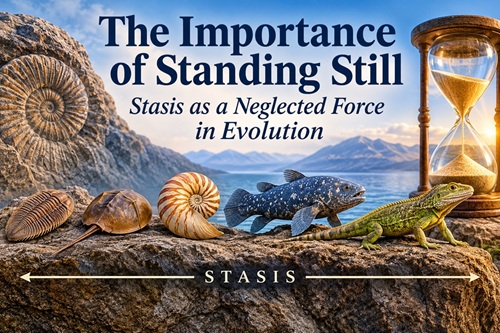 Introduction: Evolution is not synonymous with changeEvolution is commonly presented as the grand narrative of life's progressive transformation: simple organisms become more complex, primitive forms give rise to sophisticated ones, and biological innovation gradually fills the tree of life with an astonishing diversity of forms. Popular accounts tend to emphasize novelty, adaptation, competition, extinction and the emergence of new species. Evolution is, in this telling, primarily a story of change. But there is another side to this story that deserves considerably more attention: the remarkable persistence of life. Organisms, species and entire evolutionary lineages can retain their characteristic features for millions, sometimes hundreds of millions, of years. Evolution does not always produce visible transformation. Sometimes it appears to stand still. This phenomenon, known as evolutionary stasis, raises an important question: why does evolution sometimes proceed through dramatic transformations while at other times seemingly preserve the status quo? And what does this tell us about the mechanisms, constraints and possibilities of biological evolution? Taking stasis seriously also challenges a widespread misconception: that evolution necessarily means continuous improvement, increasing complexity or movement toward some predetermined destination. In reality, the history of life is as much a story of persistence as it is of innovation. 1. What exactly is evolutionary stasis?Evolutionary stasis refers to the long-term persistence of relatively stable morphological or other measurable characteristics within an evolutionary lineage. It does not mean that organisms stop reproducing, mutating, adapting or experiencing natural selection. Nor does it mean that their genomes remain unchanged. Rather, stasis describes a situation in which evolutionary change does not produce substantial directional alteration in the particular characteristics being studied. One famous example is the horseshoe crab, whose recognizable body plan has persisted for hundreds of millions of years. Another is the coelacanth, a lineage of lobe-finned fishes with an extensive fossil history and a body organization that has remained recognizable over immense geological periods. The nautilus provides another evocative example. Its distinctive chambered shell and general body organization have deep evolutionary roots, although the living species are not unchanged replicas of their fossil ancestors. These examples require a qualification. The popular expression "living fossil" can be misleading. No extant species has literally remained unchanged for hundreds of millions of years. Molecular evolution, ecological adaptation, physiological changes and genetic diversification have continued. What persists is a recognizable anatomical organization, not an entire organism frozen in geological time. This distinction is essential. Stasis is a statement about the relative stability of particular evolutionary characteristics, not the complete absence of evolution. 2. Stasis and punctuated equilibriumThe importance of stasis became particularly prominent through the work of paleontologists Niles Eldredge and Stephen Jay Gould, who introduced the theory of punctuated equilibrium in 1972. Their argument challenged the conventional expectation that evolutionary change should normally be gradual, continuous and relatively uniform. Examining fossil lineages, they observed that many species displayed prolonged periods of morphological stability, interrupted by comparatively brief episodes of evolutionary change associated with speciation. The central idea is straightforward: evolutionary history often consists of extended periods of stasis punctuated by relatively short intervals of morphological transformation. This was not a rejection of Darwinian evolution. Gould and Eldredge did not deny that natural selection could produce gradual change. Nor did they claim that every evolutionary transition was instantaneous. Their argument concerned the actual temporal distribution of evolutionary change in the fossil record. The distinction matters because the conventional gradualist picture can encourage us to imagine evolution as a continuously unfolding process in which small modifications accumulate at a more or less constant rate. Punctuated equilibrium suggests a more episodic pattern. Evolutionary change is not necessarily distributed evenly through time. This interpretation also had an important methodological implication: the apparent absence of transitional forms in a particular geological sequence need not automatically indicate a deficiency in the fossil record. It may sometimes reflect the actual evolutionary history of the lineage being examined. Nevertheless, punctuated equilibrium should not be turned into another universal formula. Some lineages exhibit gradual directional change, others fluctuating patterns, and still others prolonged stasis. Evolutionary tempo varies. 3. Why does evolution sometimes stand still?The most interesting question is not whether stasis exists, but how it is maintained. Several mechanisms can contribute to evolutionary stability. Stabilizing selection. Natural selection does not always favor novelty. Where an existing phenotype is well adapted to relatively stable environmental conditions, individuals displaying extreme deviations may have lower reproductive success. Selection consequently tends to preserve an existing range of characteristics. For example, a particular body shape may represent a successful compromise between locomotion, feeding, reproduction and protection. Changes in one feature might improve performance in one respect while creating disadvantages elsewhere. Developmental and structural constraints. Organisms are not infinitely malleable collections of independently adjustable parts. Their characteristics are integrated through complex developmental processes. Changing one feature can affect several others. Developmental architecture therefore constrains the range of viable evolutionary modifications. Ecological stability. When environmental conditions and ecological relationships remain relatively stable, existing adaptations may continue to work effectively. There may simply be no strong selective pressure for substantial morphological transformation. Gene flow and population structure. Genetic exchange between populations can counteract local differentiation, while population size and demographic processes influence the rate and direction of evolutionary change. Evolutionary trade-offs. An organism's existing characteristics may reflect compromises among competing functional demands. There may be no straightforward direction in which it can evolve without sacrificing something else. Taken together, these mechanisms help explain why evolutionary change is not an automatic consequence of the passage of time. Importantly, stasis need not have one single explanation. Different lineages may remain morphologically stable for different reasons, and several mechanisms can operate simultaneously. 4. Stasis does not mean genetic stagnationOne of the most important distinctions in evolutionary biology is between morphological stability and genetic stability. A lineage can preserve its general anatomical appearance while accumulating substantial genetic changes. Mutations continue to arise, genetic drift continues to operate, and populations can undergo molecular adaptation. This is particularly relevant in the context of molecular evolution. Comparisons of DNA sequences can reveal extensive genetic divergence between organisms whose overall body plans remain remarkably similar. The converse is also possible: relatively modest genetic changes can sometimes produce substantial morphological consequences, especially when they affect developmental regulation. Thus, the relationship between genetic and morphological evolution is not one of simple correspondence. The famous horseshoe crab, for example, is not a genetically unchanged survivor from the distant past. Its evolutionary history includes substantial diversification and genetic modification. Stasis therefore tells us something about the persistence of phenotypes, not necessarily about the absence of underlying evolutionary activity. This also raises a broader philosophical point: appearances can be remarkably stable while the processes maintaining them remain dynamic. 5. Stasis and the problem of evolutionary progressEvolutionary stasis has important implications for how we understand evolutionary progress. Popular presentations of evolution frequently imply that life is moving toward greater complexity, sophistication or intelligence. This impression is reinforced by the spectacular appearance of vertebrates, flowering plants, mammals and eventually human beings. But this is a highly selective reading of evolutionary history. Most organisms are not moving toward anything resembling human complexity. Bacteria remain extraordinarily successful. Many simple body plans have persisted for immense periods. Evolution has produced diversification, specialization, reduction and simplification, as well as increases in complexity. Stasis makes this especially clear. If evolution were an inherently progressive process, why would so many lineages retain their characteristic forms for millions of years? Why would natural selection repeatedly preserve existing structures rather than replace them with supposedly superior alternatives? The answer is that natural selection does not reward complexity for its own sake. It favors reproductive success under particular conditions. A bacterium does not need a nervous system to be evolutionarily successful. A parasite may prosper through the loss of anatomical structures that its ancestors once possessed. A successful organism is not necessarily one that is more complex than its predecessors. Evolution has no universal scoreboard on which complexity, intelligence or morphological novelty automatically count as improvements. This is a particularly important corrective to teleological interpretations of evolution, including attempts to identify an inherent cosmic direction toward greater consciousness or complexity. The existence of evolutionary trends does not establish that evolution as a whole is directed toward a predetermined destination. 6. The relationship between stasis and environmental changeStasis should not be confused with an organism's ability to survive every environmental transformation. A lineage can remain remarkably stable for millions of years under a particular set of ecological conditions, only to experience rapid change when those conditions are disrupted. Climate change, geological events, competition, new predators, habitat fragmentation and the arrival of invasive species can alter selective pressures dramatically. Sometimes existing adaptations provide sufficient flexibility to survive these changes. Sometimes populations must undergo substantial evolutionary modification. And sometimes they cannot adapt quickly enough and become extinct. The fossil record offers numerous examples of evolutionary success followed by disappearance. This points to an important qualification: stasis is conditional, not permanent. The persistence of a particular phenotype depends on the continued viability of the ecological and developmental circumstances that sustain it. A lineage can be evolutionarily successful for a very long time without possessing any guarantee of future survival. Indeed, the apparent stability of an organism can sometimes conceal a considerable vulnerability to environmental disruption. 7. Is stasis itself an evolutionary adaptation?Here we encounter a more subtle question. Is evolutionary stability simply the accidental result of selection and constraint, or can the capacity to maintain a relatively stable phenotype itself be an evolved characteristic? There is a growing field of research into developmental robustness, canalization and phenotypic plasticity that helps address this question. Canalization refers to the capacity of developmental systems to produce relatively consistent outcomes despite genetic or environmental disturbances. Such robustness can be advantageous because it reduces the likelihood that minor disturbances will disrupt successful development. Phenotypic plasticity, meanwhile, allows organisms to produce different phenotypes under different environmental conditions without necessarily requiring corresponding genetic changes. These concepts help explain how organisms can remain stable in some respects while responding flexibly in others. However, it would be misleading to conclude that every instance of stasis represents an adaptation specifically selected for the purpose of preserving a body plan. Sometimes stability is simply the consequence of stabilizing selection, developmental constraints or the absence of sufficiently strong directional selection. The distinction between an outcome of evolution and an adaptation produced by evolution should always be maintained. 8. What stasis tells us about the nature of evolutionary explanationPerhaps the most interesting lesson of evolutionary stasis concerns the way evolutionary explanations are constructed. We are naturally attracted to dramatic transformations: the emergence of feathers, wings, flowers, eyes, brains and new ecological strategies. These developments are visually compelling and seem to reveal the creative potential of life. But the persistence of existing structures is no less demanding of explanation. Why does a particular body plan remain viable? Which developmental mechanisms preserve it? What ecological conditions sustain it? Which variations are eliminated, and which remain possible without producing visible morphological transformation? These questions require us to investigate not only the production of novelty but also the maintenance of established forms. This is especially important when evaluating grand theories of evolution that emphasize an inherent drive toward novelty, complexity or self-transcendence. Such accounts often celebrate evolutionary innovation while treating continuity as an unremarkable background condition. But stasis is not merely the absence of evolutionary creativity. It is a major empirical feature of evolutionary history that any comprehensive account must explain. It also cautions against treating every evolutionary outcome as evidence of a general developmental tendency. A lineage that becomes more complex does not establish a universal trend toward complexity; a lineage that remains stable does not demonstrate an absence of evolutionary mechanisms. Evolutionary explanations must account for both. Conclusion: Evolution is also the art of persistenceEvolutionary history is neither a straight line of continuous improvement nor an endless succession of revolutionary transformations. It is a complex interplay of innovation, adaptation, diversification, constraint, persistence and extinction. Stasis reminds us that evolutionary success often consists not in becoming something radically different, but in remaining sufficiently well adapted to continue reproducing. This does not mean that evolution has stopped. Beneath a stable anatomical appearance, genetic, physiological and ecological changes may continue. What appears to be evolutionary inactivity can conceal considerable biological dynamism. The deeper lesson is that evolution has no obligation to produce novelty at every opportunity. Natural selection can favor change, but it can also preserve existing characteristics. Developmental systems can facilitate innovation, but they can also constrain it. Environmental conditions can encourage transformation, but they can also sustain long periods of morphological continuity. Perhaps the most important correction to popular evolutionary thinking is therefore this: evolution is not simply the history of how life changes. It is also the history of how life manages to persist. And any theory that celebrates the creative power of evolution while neglecting its remarkable capacity for stability offers only half the story.
Widget is loading comments...
|