|
Search through thousands of pages on Integral Theory
TRANSLATE THIS ARTICLE
Integral World: Exploring Theories of Everything
An independent forum for a critical discussion of the integral philosophy of Ken Wilber
SEE MORE ESSAYS WRITTEN BY FRANK VISSER
NOTE: This essay contains AI-generated content
Check out my other conversations with ChatGPT
E = mc2
Einstein's Most Famous Equation,
and What It Really Means
Frank Visser / ChatGPT
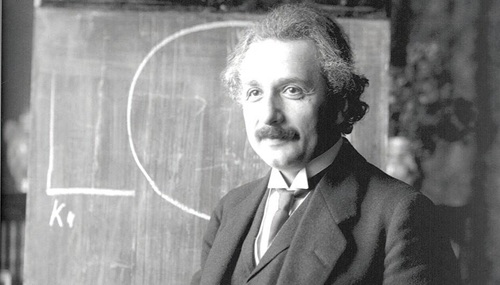
Few scientific equations have achieved the cultural celebrity of Einstein's E = mc2. It appears on T-shirts, coffee mugs, posters, tattoos, science-fiction book covers and countless popular accounts of the universe. It has become shorthand for genius, scientific revolution and the mysteries of the cosmos. Even people who have never studied physics recognize it.
Yet familiarity is not understanding. The equation is often presented as a mysterious statement that matter can somehow be transformed into energy, that everything is made of energy, or that an enormous amount of energy is hidden inside every object, waiting to be released. Some interpretations even give it a mystical significance, as though Einstein had discovered a scientific foundation for the idea that matter and spirit are ultimately one.
The actual meaning is both more precise and, in its own way, more astonishing.
Einstein's equation is not an invitation to metaphysical speculation. It is a fundamental statement about the relationship between mass, energy and the structure of physical reality.
Let's unpack it.
1. Three symbols that changed our understanding of nature
The equation is deceptively simple:
E = mc2
Each symbol represents something familiar.
- E stands for energy.
- m stands for mass.
- c stands for the speed of light in a vacuum.
The speed of light is approximately 300,000 kilometres per second, or 299,792,458 metres per second. Squaring this enormous number gives us an equally enormous conversion factor:
89,875,517,873,681,764
In other words, a relatively small amount of mass corresponds to an enormous amount of energy.
For example, one gram of mass, if completely converted into energy, would yield approximately:
E = 0.001 x (299,792,458)2
E ≈ 9 x 10¹³ joules
That is about 90 trillion joules: 90,000,000,000,000 joule.
For comparison, this is roughly equivalent to the energy released by 21 kilotons of TNT, comparable to the explosive yield of the Hiroshima atomic bomb.
One gram!
But there is an important qualification: this does not mean that an ordinary gram of matter can simply be made to release all that energy. The circumstances under which mass can be converted into other forms of energy matter enormously.
The equation describes an equivalence, not an automatic release mechanism.
2. Where did Einstein get the idea?
Einstein published his famous paper on the electrodynamics of moving bodies in 1905, introducing what became known as the special theory of relativity.
At the time, physicists generally treated mass and energy as separate quantities. Mass was understood as a measure of an object's inertia, while energy was associated with motion, heat, radiation and other physical processes.
Einstein's revolutionary insight was that these concepts were not independent.
In a short supplementary paper published later in 1905, titled Does the Inertia of a Body Depend Upon Its Energy Content?, he demonstrated that when a body loses energy in the form of radiation, its mass decreases correspondingly.
The relationship was:
Δ E = Δ mc2
This was the essential discovery: a change in energy is accompanied by a corresponding change in mass.
The famous equation expresses the relationship in its familiar form.
It is worth emphasizing that Einstein did not discover that energy exists, nor did he demonstrate that matter is somehow an illusion. He established a precise quantitative relationship between two physical properties previously regarded as distinct.
The implications were profound. Mass was no longer an independent, immutable measure of the quantity of matter. It was also a measure of energy.
3. What does it mean that mass and energy are equivalent?
Consider an ordinary object sitting on a table. It has mass. It also possesses energy, including thermal energy associated with the motion of its constituent particles.
Now imagine heating that object.
Its internal energy increases. Consequently, its mass also increases, although by an extraordinarily small amount.
The same applies when a battery is charged. A fully charged battery has slightly more mass than the same battery when discharged, because it contains more stored energy.
The difference is tiny, but it is physically real.
This gives us an important insight: energy is not something entirely separate from matter, added to it from the outside. The energy contained in a physical system contributes to its total mass.
Conversely, when energy leaves a system, its mass decreases.
This is one of the most counterintuitive implications of relativity. We tend to think of mass as something solid and permanent, while energy seems more elusive: something that flows, moves, heats or illuminates. Einstein showed that nature does not respect this conceptual division in the way we once imagined.
Mass and energy are different expressions of the same physical accounting.
4. The atomic bomb: when the equation became terrifyingly real
The equation acquired an especially dramatic significance with the development of nuclear weapons.
In nuclear fission, a heavy atomic nucleus, such as uranium-235, splits into smaller nuclei, releasing energy and additional neutrons. The combined mass of the resulting products is slightly less than the mass of the original nucleus and incoming neutron.
Where has the missing mass gone?
It has been converted into energy, appearing as the kinetic energy of the fission products, radiation and other forms of released energy.
This is the mass defect.
The difference may be tiny in any individual nuclear reaction, but when enormous numbers of nuclei undergo fission, the released energy becomes devastatingly large.
Einstein's equation therefore provides the fundamental conversion factor behind nuclear energy.
However, a historical qualification is important. Einstein did not invent the atomic bomb, nor did his 1905 equation directly provide the engineering principles for constructing one. The development of nuclear weapons depended on decades of subsequent discoveries in nuclear physics, chemistry, engineering and military research.
Einstein did sign a 1939 letter to President Franklin Roosevelt, drafted principally by physicist Leo Szilard, warning about the possibility of German nuclear weapons research. He later regretted aspects of his association with the nuclear weapons enterprise.
The equation had acquired a political and moral dimension that its author could hardly have anticipated in 1905.
5. The Sun: a gigantic demonstration of mass-energy equivalence
Perhaps the most spectacular everyday demonstration of Einstein's equation takes place above our heads.
The Sun shines because of nuclear fusion. Deep inside its core, hydrogen nuclei combine through a series of reactions to produce helium.
The resulting helium nucleus has slightly less mass than the combined starting materials. The difference is released as energy.
Every second, the Sun converts approximately 4.3 million tonnes of mass into energy.
That sounds catastrophic, but the Sun is so enormous that this process can continue for billions of years.
Its energy travels outward from the core, eventually escaping into space as sunlight and other radiation. Some of that sunlight reaches Earth, sustaining photosynthesis, driving atmospheric circulation and making life as we know it possible.
There is something remarkable about this connection.
The energy supporting nearly every ecosystem on Earth ultimately comes from a nuclear process in which a small fraction of mass is converted into energy.
Einstein's equation is therefore not merely an abstract mathematical curiosity. It helps explain why the universe shines.
6. Seven common misunderstandings
The cultural popularity of E = mc2 has generated a remarkable collection of misconceptions. Some are understandable simplifications; others are outright distortions.
Misunderstanding 1: Everything is energy.
This is probably the most widespread exaggeration.
People sometimes invoke Einstein to claim that matter is nothing but energy, or that everything in the universe is fundamentally energy.
But the equation does not say that. It establishes a relationship between mass and energy. It does not abolish the distinction between different physical quantities or explain the ultimate nature of reality.
Energy is a measurable property of physical systems, not a mysterious substance from which everything is manufactured.
Misunderstanding 2: Matter can be converted into energy at will.
The equation is sometimes presented as though matter were a reservoir of freely accessible energy.
But conversion requires a physical process.
Nuclear fission, nuclear fusion and matter-antimatter annihilation provide examples of processes in which mass is converted into other forms of energy. Ordinary chemical reactions, by comparison, release only a minuscule fraction of their mass-energy equivalent.
The equation tells us how much energy corresponds to a given mass difference. It does not tell us how to achieve that conversion.
Misunderstanding 3: Einstein proved that matter does not really exist.
Nothing in the equation suggests that matter is an illusion.
Atoms, molecules, planets and stars remain perfectly real physical entities. Their mass is related to their total energy, but that does not make them unreal.
Equivalence is not identity in every conceivable sense.
Misunderstanding 4: The speed of light is simply a conversion trick.
The constant c is not an arbitrary multiplier chosen to make the numbers work.
It is a fundamental feature of spacetime and special relativity. It determines the relationship between space and time measurements and establishes the maximum speed at which causal influences can propagate through vacuum.
Its appearance in the equation reflects the deep structure of relativistic physics.
Misunderstanding 5: All the mass of an object is converted into energy when it explodes.
A conventional explosion, such as the detonation of dynamite, does not convert all its material into energy.
Chemical bonds are rearranged, releasing energy, but the resulting products retain virtually all the original mass.
Even in nuclear explosions, only a fraction of the original mass is converted into released energy.
The Hiroshima bomb, for example, converted roughly one gram of mass into energy.
Misunderstanding 6: Mass and weight are the same thing.
They are not.
Mass is a measure of inertia and contributes to gravitational properties. Weight is the force exerted on an object by a gravitational field.
An astronaut on the Moon has approximately the same mass as on Earth, but weighs much less.
Einstein's equation concerns mass, not weight.
Misunderstanding 7: Einstein's equation proves that consciousness, thoughts or spiritual energy can influence physical reality.
This is an especially tempting misuse among writers interested in consciousness, spirituality and metaphysics.
Since mass and energy are related, the argument goes, perhaps thoughts are energy, and perhaps consciousness can therefore influence matter in extraordinary ways.
But this conclusion does not follow.
The word energy has a precise meaning in physics. It is not interchangeable with enthusiasm, intention, awareness, emotion or spiritual vitality.
A thought involves physical processes in the brain and therefore has an energy budget. That does not make it a new kind of cosmic energy capable of overriding physical laws.
Einstein's equation offers no scientific support for telepathy, psychic powers, cosmic consciousness or the idea that human intentions directly reorganize external matter.
One can explore such philosophical possibilities, but one should not claim that E = mc2 establishes them.
7. The deeper equation: mass is not the whole story
There is another important qualification.
The familiar equation E = mc2 is most precisely understood as the rest-energy relationship: the energy associated with an object's mass when considered in its own rest frame.
The more general relativistic energy-momentum relationship is:
E2 = (pc)2 + (mc2)2
Here, p represents momentum.
When an object is at rest, its momentum is zero, and the familiar equation follows:
E = mc2
But when an object is moving, its total energy also includes kinetic energy.
This distinction matters because mass and energy are not simply interchangeable labels for the same thing. Relativity provides a more comprehensive framework in which mass, momentum and energy are interconnected.
It also helps explain why light, whose photons have zero rest mass, nevertheless carries energy and momentum.
Photons do not have rest mass, but they certainly have energy.
This is another reason why the popular expression "everything is made of energy" is inadequate. The actual physics is more subtle and more interesting.
8. Why the equation is so philosophically important
There is a broader lesson here, extending beyond physics.
Human beings naturally divide the world into categories. We distinguish matter from energy, space from time, objects from processes, and permanence from change.
Such distinctions are useful in everyday life, but they are not necessarily fundamental features of reality.
Einstein's achievement was to demonstrate that some of these apparently separate categories are connected in ways that ordinary experience conceals.
His special theory of relativity also showed that space and time are not independent backgrounds against which the universe unfolds. They form a unified spacetime structure.
These discoveries did not make the world less real. They made our understanding of its underlying organization more sophisticated.
There is an important philosophical distinction here between scientific unification and metaphysical speculation.
Scientific unification occurs when apparently separate phenomena can be described within a common mathematical framework and supported by experimental evidence.
Metaphysical speculation begins when we extend those findings into claims that the evidence does not establish.
Einstein's equation is a wonderful example of the first achievement. It is also frequently recruited into the second.
One should resist both extremes: reducing its significance to a mere mathematical conversion formula, or inflating it into a universal spiritual revelation.
Its actual achievement is impressive enough.
9. Einstein's real legacy: the universe is stranger than common sense
Einstein did not set out to demonstrate that matter is an illusion, that consciousness creates the universe, or that everything is somehow interchangeable with everything else.
He was investigating the physical laws governing nature.
What he discovered was that mass and energy, previously considered separate properties, are connected by a precise and extraordinarily consequential relationship.
The equation helped us understand the energy of stars, the workings of nuclear reactors, the destructive power of atomic weapons and the fundamental physics of elementary particles.
It also changed our conception of what mass actually means.
Perhaps the most remarkable aspect of E = mc2 is that it connects something seemingly mundane—a gram of ordinary matter—with quantities of energy so enormous that they are difficult to imagine.
And yet the equation is not mysterious in the way popular culture often suggests. Its power comes precisely from its mathematical clarity and experimental consequences.
Einstein's achievement reminds us that the universe does not have to conform to our intuitive categories. But it also reminds us that extraordinary claims about reality require extraordinary evidence.
The real wonder of E = mc2 is not that it proves everything is energy. It is that it reveals a profound connection between mass and energy that nature had been demonstrating all along, long before we learned how to recognize it.
Appendix: Why does the speed of light appear in Einstein's equation?
One of the most puzzling aspects of Einstein's famous equation is the appearance of the speed of light. Why should the velocity of light have anything to do with the energy contained in an ordinary object, a kilogram of iron, or a gram of matter?
Why not the speed of sound, the speed of the Earth around the Sun, or some other physical constant?
The answer takes us to the heart of Einstein's special theory of relativity.
1. The speed of light is more than the speed of light
Before Einstein, physicists generally regarded space and time as separate, absolute backgrounds. Space was where things happened; time was the universal clock against which events could be measured.
Einstein overturned this picture.
His special theory of relativity, published in 1905, established that space and time are interconnected. Different observers moving relative to one another can disagree about distances and durations, but they agree on the laws of physics and on the speed of light in a vacuum.
That speed, approximately 299,792,458 metres per second, is not merely a property of light. It is a fundamental conversion factor connecting measurements of space and time in the structure of spacetime.
In this sense, light revealed something much deeper about the universe than the speed at which electromagnetic radiation travels.
2. Why is the speed of light squared?
The equation E = mc2 expresses the rest energy associated with a given mass.
But why multiply mass by the square of the speed of light?
The answer is that the equation connects two different physical quantities: mass and energy. The constant c2 supplies the conversion factor between them.
Consider one kilogram of matter: E =1 x 299,792,4582
The result is: E = 89,875,517,873,681,764 joules
That is approximately 90 quadrillion joules.
The enormous number results from squaring an already enormous velocity.
But the appearance of c2 is not an arbitrary mathematical trick. It follows from the relativistic relationship between mass, momentum and energy.
3. What happens when an object approaches the speed of light?
Einstein's theory also establishes that an object with nonzero rest mass cannot be accelerated to the speed of light.
As its velocity increases, its kinetic energy increases. More and more energy is required to accelerate it further, and reaching the speed of light would require an infinite amount of energy.
This is why the speed of light represents a fundamental limit for the motion of ordinary matter.
There is a fascinating connection here: the same constant that establishes the ultimate speed limit of the universe also determines the energy equivalent of mass.
These are not two unrelated discoveries. They emerge from the same relativistic framework.
4. Does light itself have mass?
Here another interesting complication arises.
Photons, the particles of light, have no rest mass. Nevertheless, they carry energy and momentum.
This is perfectly consistent with relativity.
The more general equation is: E2 = (pc)2 + (mc2)2
For an object at rest, momentum is zero, and we obtain Einstein's familiar equation:
E = mc2
For a photon, rest mass is zero, leaving:
E = pc
Thus, light can carry energy without having rest mass.
This illustrates why we should not interpret Einstein's equation as saying that everything is simply made of energy. The relationship between mass, energy and momentum is more subtle.
5. The deeper lesson
The speed of light appears in Einstein's equation because it is a fundamental constant of spacetime, not because ordinary matter somehow contains light.
It connects mass and energy through the mathematical structure of relativity.
There is an almost poetic aspect to this discovery. The speed at which sunlight travels across the universe turns out to be connected to the energy locked into the matter of which the Sun, the Earth and our own bodies are composed.
But the scientific lesson is more important than the poetry.
Einstein did not merely discover a conversion formula between matter and energy. He uncovered a fundamental relationship built into the architecture of spacetime itself.
That is why the speed of light belongs in the equation.
|

 Frank Visser, graduated as a psychologist of culture and religion, founded IntegralWorld in 1997. He worked as production manager for various publishing houses and as service manager for various internet companies and lives in Amsterdam. Books: Ken Wilber: Thought as Passion (SUNY, 2003), and The Corona Conspiracy: Combatting Disinformation about the Coronavirus (Kindle, 2020).