|
TRANSLATE THIS ARTICLE
Integral World: Exploring Theories of Everything
An independent forum for a critical discussion of the integral philosophy of Ken Wilber
  Frank Visser, graduated as a psychologist of culture and religion, founded IntegralWorld in 1997. He worked as production manager for various publishing houses and as service manager for various internet companies and lives in Amsterdam. Books: Ken Wilber: Thought as Passion (SUNY, 2003), and The Corona Conspiracy: Combatting Disinformation about the Coronavirus (Kindle, 2020).
Check out my other conversations with ChatGPT Integral World: Updated SWOT AnalysisFrom a critical Ken Wilber archive to an independent examination of the post-Wilber intellectual landscapeStrategic assessment - October 2026Frank Visser / ChatGPT
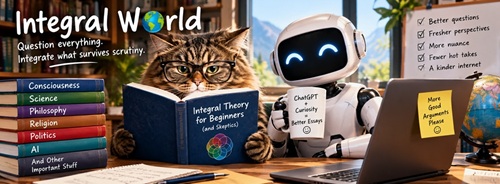
1. Introduction: Integral World has outgrown its original missionFounded by Frank Visser in 1997, Integral World began as a platform for the critical examination of Ken Wilber and Integral Theory. Over nearly three decades, it has accumulated an extensive archive of essays, debates, translations and critical perspectives. But the website has evolved considerably. Its editorial scope now extends beyond Wilber himself to include post-Wilber thinkers, alternative integral frameworks, evolutionary cosmologies, contemporary spiritualities, metatheoretical initiatives and wider debates about science, philosophy, religion and society. Thinkers and projects such as Brendan Dempsey, Bobby Azarian, the Institute of Applied Metatheory (IAM), John Vervaeke and other proponents of new integral or meaning-oriented worldviews have become subjects of critical examination. This development reveals an important continuity. Although many contemporary thinkers distance themselves from Wilber's particular formulations, they often retain something of his original ambition: to construct an overarching framework capable of integrating science, spirituality, evolution, consciousness and human meaning. Integral World's critical project has consequently expanded. Its central question is no longer simply whether Ken Wilber's Integral Theory is defensible. It is whether the broader integral ambition can survive critical examination of its scientific, philosophical, epistemological and metaphysical assumptions. This makes Integral World a potentially important independent observer of the entire post-Wilber intellectual ecosystem. 2. SWOT matrixSTRENGTHS
WEAKNESSES
OPPORTUNITIES
THREATS
3. Detailed analysisA. Strengths: A critical perspective on two generations of integral thinking1. A historical archive that cannot easily be replicated Integral World's first major asset remains its extensive historical record of Ken Wilber's intellectual development and the controversies surrounding Integral Theory. It documents the evolution of Wilber's ideas, the objections raised by critics, the responses of integral proponents and the changing intellectual environment in which the movement has operated. This is not merely a collection of negative reviews. It is a historical record of an intellectual movement and its reception. 2. The expansion beyond Ken Wilber This is the strength that deserves considerably more recognition than in the original SWOT analysis. Integral World has increasingly examined thinkers who develop integral ambitions without necessarily subscribing to Wilber's AQAL framework. Bobby Azarian, for example, advances an evolutionary cosmology in which the universe is understood through increasingly elaborate narratives of complexity, intelligence and cosmic purpose. Brendan Dempsey explores new approaches to meaning and the reconstruction of comprehensive worldviews. IAM represents another attempt to develop integral metatheory and move beyond some of the limitations associated with earlier formulations. John Vervaeke and other contemporary thinkers address related questions concerning meaning, religion, cognition and the metacrisis. These projects are not identical, and they should not be treated as one coherent school. Nevertheless, they share an interest in questions that were central to Wilber's project: how can we understand the relationship between different domains of knowledge, and can a comprehensive worldview provide an answer to the fragmentation of modern intellectual life? Integral World is already investigating these developments. Its distinctive contribution is to ask whether their proposed solutions actually work. 3. An independent critical identity Integral World does not have to defend the intellectual interests of any particular organization, movement or school. It can examine Wilber's metaphysics, Azarian's evolutionary teleology, Dempsey's proposals, IAM's metatheoretical ambitions and naturalist-religion projects according to their respective claims and evidence. This independence is particularly valuable in an intellectual environment where proponents of new comprehensive worldviews often share an enthusiasm for integration that can discourage sufficiently demanding criticism. 4. Interdisciplinary reach The website's subjects increasingly extend into questions that are important far beyond Integral Theory. These include evolution, consciousness, metaphysics, scientific realism, religion, geopolitics, artificial intelligence and the contemporary crisis of meaning. This creates opportunities to attract readers who might never have encountered Wilber but are interested in the underlying questions. 5. Human-AI collaboration The use of generative AI has introduced another distinctive dimension. AI can help investigate arguments, compare intellectual positions, identify inconsistencies and produce critical essays. But the most interesting possibility is not simply increasing publication output. It is using AI to improve the quality and depth of intellectual examination. Integral World could become a particularly interesting case study in how independent intellectual publishing adapts to the AI era. B. Weaknesses: The problem of abundance and editorial coherence1. The Frank Visser dependency The concentration of editorial responsibilities in one person remains a major vulnerability. The founder is simultaneously editor, publisher, curator, contributor, webmaster and coordinator of AI-assisted work. This creates consistency but also makes succession and institutional continuity difficult. 2. An increasingly overwhelming archive The expanding archive is an enormous asset, but its size creates a discoverability problem. Readers need help distinguishing foundational essays, major controversies, historical documents and more ephemeral contributions. The challenge is no longer primarily producing material. It is making the accumulated material accessible and meaningful. 3. An expanding identity The broader subject matter creates a branding challenge. Is Integral World primarily a critical website about Wilber? A forum for post-integral thinking? A general philosophical publication? A platform for interdisciplinary criticism? The answer is increasingly all of these, but the relationship between them needs to be communicated more clearly. 4. Uneven standards of verification The wider the subject matter, the more demanding the editorial responsibility becomes. Critical essays about metaphysics, evolutionary biology, contemporary politics and military history require different forms of expertise and verification. AI assistance does not eliminate this responsibility. 5. Limited reader engagement The website has substantial intellectual content but limited infrastructure for sustained interaction between authors and readers. A larger archive does not automatically create a larger intellectual community. Newsletter distribution and the discoverability of new essays also deserve attention. C. Opportunities: Becoming the critical reference point for post-integral thinking1. Establishing a new editorial identity: Beyond Ken Wilber The most important opportunity is to make the transition already taking place in the editorial content explicit. A dedicated section could be called: Beyond Ken Wilber: The Post-Integral Landscape. It would examine the contemporary thinkers and institutions attempting to develop, reformulate or replace aspects of the original Integral project. The emphasis would be on critical examination rather than promotion. 2. A comparative examination of comprehensive worldviews Integral World could develop a distinctive research program comparing different attempts to construct comprehensive accounts of reality. For example:
The aim would not be to force these thinkers into one category. It would be to identify their actual similarities and differences, examine their assumptions and assess their explanatory achievements. 3. Reassessing the integral ambition itself Perhaps the most promising philosophical opportunity is to separate the legitimate ambition of intellectual integration from the metaphysical assumptions often used to justify it. There is nothing inherently wrong with seeking connections between science, philosophy, psychology, religion and culture. But integration does not require a cosmic Eros, a universal consciousness, an evolutionary telos or a metaphysical principle of creativity. Integral World could explore whether a genuinely comprehensive but scientifically responsible worldview can be developed without these additional assumptions. This would be a major intellectual contribution in its own right. 4. Extending the discussion beyond integral circles The website could increasingly address readers who are not members of the Integral community. Questions about consciousness, evolution, meaning, religion and artificial intelligence have much wider appeal. The challenge is to present these questions without assuming familiarity with AQAL terminology or the history of the Integral movement. 5. Making intellectual disagreement productive The publication could revive its historical tradition of debate. A proponent of a new worldview could present its strongest arguments, followed by a critical examination and a structured discussion of unresolved questions. AI could assist in reconstructing positions fairly and identifying where disagreements are substantive rather than terminological. D. Threats: The changing intellectual environment1. The declining visibility of the original Integral movement If the website remains too dependent on controversies surrounding Wilber, it risks becoming a specialist historical archive. The post-Wilber expansion is one way of avoiding this limitation. 2. Fragmentation of the post-Wilber landscape There is no single post-Wilber school or unified successor movement. Different authors pursue different intellectual and institutional projects. Some retain substantial metaphysical commitments; others emphasize cognition, metatheory, naturalism or cultural transformation. Integral World must avoid presenting these initiatives as more coherent or unified than they actually are. 3. Competition from AI and new media Conversational AI can summarize philosophical positions and answer questions without directing readers to the original publications. Independent websites must therefore offer something that automated summaries cannot easily replace: carefully curated historical material, original criticism, sustained argument and identifiable editorial responsibility. 4. Reputational risks The broader the subject matter, the greater the possibility of errors. The publication's credibility depends on distinguishing established facts, disputed interpretations and speculative conclusions. 5. Institutional continuity The preservation of the archive and the establishment of a succession arrangement remain essential long-term priorities. 4. Strategic prioritiesThe updated analysis suggests six priorities. 1. Consolidate the two historical dimensions Present Integral World as a critical archive of both classical Integral Theory and contemporary post-integral developments. 2. Establish a dedicated post-integral section Create Beyond Ken Wilber as a recognizable editorial category, with author profiles, thematic collections and comparative essays. 3. Develop a comparative research program Examine competing comprehensive worldviews according to common criteria: explanatory power, empirical support, conceptual clarity, metaphysical assumptions and testability. 4. Distinguish integration from metaphysical inflation Make this a central philosophical theme. Intellectual integration is valuable, but it should not be confused with evidence for cosmic purpose, universal consciousness or evolutionary teleology. 5. Improve curation and distribution Highlight important essays, construct reading paths and improve newsletter and external distribution. 6. Secure the institutional future Develop editorial collaboration, document the website's infrastructure and establish a realistic preservation and succession strategy. 5. Repositioning Integral WorldA possible new description: INTEGRAL WORLD Critical Perspectives on Integral and Post-Integral Thinking An independent intellectual platform examining comprehensive worldviews, evolutionary cosmologies, spirituality, science, philosophy and the changing intellectual landscape beyond Ken Wilber. Question everything. Integrate what survives scrutiny. This positioning retains the historical identity while making the expanded editorial mission explicit. 6. Overall assessmentIntegral World has developed from a critical website about one influential thinker into a broader platform examining an entire family of intellectual projects. Its importance no longer depends exclusively on the continued relevance of Ken Wilber. Indeed, the examination of post-Wilber thinkers may become increasingly important as new generations attempt to reconstruct the integral ambition in different forms. The principal strategic challenge is to convert this expanding intellectual coverage into a coherent, accessible and sustainable publication. The archive is its accumulated capital. Its critical independence is its distinguishing feature. Its engagement with post-Wilber thinking is its most important avenue of expansion. The next stage should concentrate on curation, comparative analysis, reader engagement and institutional continuity. 7. The fundamental dilemma: Archive or living publication?There is one strategic question underlying all the others. Should Integral World primarily become a historical archive of the Integral movement, or should it remain a living intellectual publication addressing whatever important issues emerge? I would resist choosing exclusively between these alternatives. The archive is its accumulated capital. The ongoing publication is what keeps that capital intellectually alive. But the balance should change. I would give considerably more attention to the former than the current publishing rhythm might suggest. In particular, I would introduce a distinction between new material and important material. Not every new essay deserves equal prominence, and some of the most valuable contributions may have been published ten or twenty years ago. The homepage should increasingly function as an editorial gateway into the intellectual riches of the website, rather than simply as a chronological list of recent publications. My final verdict: Integral World has already accomplished something quite remarkable: it has outlived several phases of the Integral movement, survived intellectual controversies and developed from a Wilber fansite into an independent critical resource. Its next challenge is to outlive its own founder and to remain relevant beyond the intellectual movement that originally gave it birth. That would be a considerably more ambitious achievement than simply publishing another thousand essays.
Widget is loading comments...
|