|
TRANSLATE THIS ARTICLE
Integral World: Exploring Theories of Everything
An independent forum for a critical discussion of the integral philosophy of Ken Wilber
  Frank Visser, graduated as a psychologist of culture and religion, founded IntegralWorld in 1997. He worked as production manager for various publishing houses and as service manager for various internet companies and lives in Amsterdam. Books: Ken Wilber: Thought as Passion (SUNY, 2003), and The Corona Conspiracy: Combatting Disinformation about the Coronavirus (Kindle, 2020).
Check out my other conversations with ChatGPT The Quadrants, Computed: A Critical EvaluationMathematical ingenuity, conceptual overreach, and the problem of deriving metaphysics from algebraFrank Visser / ChatGPTMy overall assessment is that this essay "The Quadrants, Computed" is an intelligent, unusually well-presented essay that deserves serious consideration, but its most striking philosophical conclusions are considerably less secure than its mathematical language suggests. The author makes a potentially useful distinction between the structure of Wilber's four quadrants and the much more difficult problem of integrating perspectives. However, the essay repeatedly moves from mathematical properties of a model to claims about Integral Theory, and ultimately about Spirit, without establishing that these transitions are warranted. The central question is not whether the mathematics is correct. Much of the elementary mathematics appears sound. The question is what, exactly, has been demonstrated about Ken Wilber's philosophy by formalizing four categories as a mathematical structure? That distinction matters particularly for an Integral World audience. Wilber's quadrants are not merely a classification scheme. They are embedded in a much larger set of claims about consciousness, knowledge, development, ontology, and the relation between subjective and objective reality. A formal model of the diagram does not automatically validate those claims. Nor does it automatically refute them. My verdict: a promising exercise in formalization, a useful challenge to loose talk about integration, but an unproven philosophical argument disguised at several points as a mathematical result. 1. Theorem 1: Are the quadrants really a Boolean lattice?The first theorem is mathematically plausible, but its philosophical significance is overstated. A Boolean lattice B2 is a four-element structure consisting of a bottom element, two incomparable intermediate elements, and a top element. It can be represented as the power set of a two-element set, ordered by inclusion.
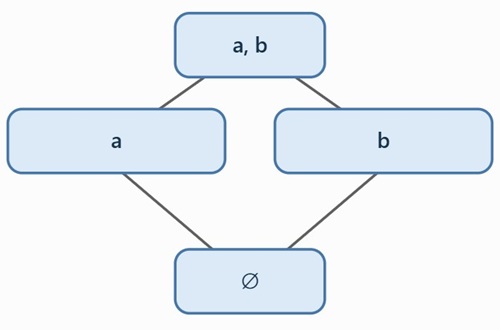
Standard Hasse diagram of the Boolean lattice B2. The elements are ordered by set inclusion.
The issue is not whether this diagram is mathematically valid. It is whether Wilber's four quadrants possess this ordering intrinsically. Wilber's quadrants distinguish the interior and exterior dimensions of the individual and collective. They are usually represented as four combinations:
These are four categories generated by two binary distinctions. But having four combinations does not, by itself, establish a Boolean lattice with a philosophically meaningful ordering. To obtain the standard Boolean lattice, we must specify which value on each axis counts as the lower value and which counts as the higher value. There is no obvious reason why interior should be mathematically below exterior, or why individual should be below collective, in a way that defines an intrinsic order of the quadrants. The author may simply be imposing a conventional mathematical structure on the four categories. That is perfectly legitimate as a modeling exercise, provided the conventions are made explicit. It is not yet a discovery about the intrinsic organization of reality. There is also a subtle tension with Theorem 2. A Boolean lattice distinguishes a bottom and a top element. The torsor structure discussed in the next theorem, by contrast, does not distinguish an origin. These structures can coexist on the same four-element set, but they encode different relationships and have different symmetries. The essay needs to explain which structure is relevant to which philosophical conclusion. Verdict on Theorem 1: A potentially useful formal representation, but not evidence that AQAL's underlying philosophical claims have been mathematically validated. 2. Theorem 2: The torsor and the claim that no perspective is privilegedThis is the essay's most interesting mathematical idea, and arguably its strongest philosophical section. The four quadrants can be represented by pairs of binary coordinates. Moving from one quadrant to another involves flipping the first coordinate, the second, both, or neither. These transformations form the Klein four-group, V4). The author then observes that the same four-element set can be treated as a torsor for this group. A torsor has the relevant group structure without a distinguished identity element among its points. One can specify the difference between any two points, but no point is inherently the origin. That is correct, provided the coordinate transformations and their action are defined as described. The philosophical interpretation, however, needs qualification. The author writes: No perspective is privileged. Not as a slogan — as a structural fact. This is stronger than the mathematics warrants. What the mathematical model establishes is that the four points are symmetric with respect to the chosen translation structure. It does not establish that the four quadrants are equally valid in every epistemological, methodological, or ontological respect. Consider the Upper Left quadrant, associated with individual experience, and the Upper Right quadrant, associated with individual behavior and the organism. They are formally interchangeable under certain coordinate transformations. But they are not interchangeable when investigating a particular question. First-person experience and third-person behavioral observation provide different kinds of evidence, with different limitations. Likewise, collective cultural interpretation and the study of social systems cannot simply substitute for one another. Their differences are precisely why the quadrants are useful in the first place. Nor does the absence of a mathematically distinguished origin imply that all perspectives have equal evidential authority. An observer's standpoint may be arbitrary in one formal sense while the observer's claims remain demonstrably mistaken in another. The essay's conclusion that anyone claiming to occupy the one true center of AQAL has been contradicted by the map is therefore too sweeping. It would be a strong argument against someone who claims that one quadrant is intrinsically the group's mathematical identity. It is not a refutation of every claim that some perspectives are more appropriate, more comprehensive, or better supported than others. There is a further complication: the four quadrants are not simply four interchangeable observers. They are also four domains of inquiry in Wilber's framework. Treating them as four equivalent standpoints is a substantive modeling decision, not an innocent translation. The author needs to justify that decision before using the torsor to make claims about the epistemological status of AQAL. Verdict on Theorem 2: Mathematically illuminating and philosophically suggestive, but the transition from symmetry among formal positions to equality among real-world perspectives is not established. 3. Theorem 3: Do perspectives necessarily lose information when combined?This is the most consequential part of the essay, and the part that requires the greatest scrutiny. The author explicitly acknowledges that AQAL does not define a formal operation for combining perspectives. This is an important admission. Rather than pretending that the mathematical operation already exists in Wilber's system, the authors construct two candidate operations and investigate their properties. That is a sensible research strategy. The difficulty lies in the conclusions drawn from these constructions. Perspectives as projectionsThe first model treats perspectives as projection operators. A projection retains some features of an object or system while excluding others. In many mathematical settings, projections are idempotent: applying the same projection twice produces the same result as applying it once. This makes the metaphor of information loss understandable. If a projection discards certain features, repeatedly applying that projection does not restore them. But this does not establish that combining perspectives is necessarily lossy in every meaningful sense. Suppose a researcher combines first-person reports, behavioral measurements, neuroimaging, and social-context data. Each source is selective, but their integration can recover information that none provides independently. Multiple imperfect measurements can jointly constrain a model more tightly than any individual measurement. In mathematics, moreover, a collection of projections can be used to reconstruct information about an underlying object, depending on the projections and the reconstruction procedure. The fact that individual projections are noninvertible does not mean that the collective set of observations is necessarily noninvertible. The essay's formulation therefore confuses two distinct operations:
The first is often lossy. The second can recover information, although it may also introduce uncertainty, inconsistency, or model dependence. The authors' result about their particular projection operators might be correct. But the conclusion depends on how those operators were defined. Without the definitions and code, readers cannot independently assess the claimed nine distinct functions, the identity element, or the assertion that only one operator is invertible. Perspectives as agreementsThe second model defines combination in terms of the overlap between perspectives. The author reports that the result is a meet-semilattice and that the viewer's coordinate cancels out. Again, the mathematical result may be correct for the specified operation. But intersection is a particularly restrictive model of integration. If two perspectives agree on only a small subset of claims, their intersection retains only that subset. This is a reasonable model of consensus. It is not a general model of knowledge integration. Scientific inquiry routinely combines perspectives without reducing them to their common denominator. One method may reveal a mechanism that another method cannot detect. A third may explain why the results appear contradictory. Integration can preserve disagreements and explain their sources rather than eliminate them. For example, a psychological description of depression, a neuroscientific account, and a sociological analysis need not agree on every proposition to contribute jointly to an explanation. Their value may lie precisely in the different aspects of the phenomenon they reveal. The author's model would be more persuasive if it distinguished consensus, information fusion, explanatory integration, and theoretical synthesis. These are not the same operation. The census of algebraic structuresThe claim that neither composition algebra contains a nontrivial copy of the quadrants' \(V_4\) or \(B_2\) is potentially interesting. So is the reported result that the largest group within either algebra has only one element. But these are results about the constructed algebras, not about every possible form of integration. The authors have examined two operations they regard as natural. They have not demonstrated that these are the only natural operations, nor that every alternative must share their limitations. Their final conclusion should therefore be narrower: Under the two proposed models of perspective composition, integration has specific algebraic limitations, and neither model reproduces the original quadrant structure as a nontrivial group. That would be a substantive and defensible result if the computations are correct. The stronger claim that combining perspectives is inherently lossy is not established. Verdict on Theorem 3: A worthwhile attempt to formalize a neglected problem, but the conclusions extend beyond what the two selected models can establish. 4. Where Spirit stands: the decisive philosophical leapThe section on Spirit is the essay's rhetorical climax. It is also its weakest philosophical inference. The authors argue that Spirit cannot be a fifth perspective because the torsor has no privileged origin. Nor can Spirit be the sum of perspectives because the proposed composition operations are lossy. They therefore propose that Spirit is the torsor as a whole: the structure of differences and translations among the quadrants. This is elegant as a metaphor. It is not a theorem. The reasoning makes three distinct moves. First, it assumes that Spirit must correspond either to a perspective, a sum of perspectives, or the structure that relates perspectives. These are not exhaustive possibilities. Spirit might be construed as an ontological principle, a feature of experience, a metaphysical hypothesis, or a name for the totality of existence. Whether any of those interpretations is defensible is a separate question. Second, it assumes that the mathematical structure of the quadrants can meaningfully identify the nature of Spirit. But nothing in the definition of a torsor entails consciousness, transcendence, immanence, or spiritual awareness. The algebra has no resources for deciding whether Spirit exists. Third, it treats the torsor's symmetry as though it supplied a positive account of Spirit. Yet a torsor is a set equipped with a group action, not a conscious subject or a metaphysical substance. Its points are related by transformations. That formal connectedness does not imply a spiritual unity. There is a subtle danger here. The author appears to reject the reification of a particular perspective while reifying the abstract structure that relates the perspectives. Instead of placing Spirit in one quadrant, the essay places Spirit in the mathematical relationships among quadrants. Why should this structure be spiritual rather than simply mathematical? The essay does not say. The Chan saying about stillness and everything getting through provides a contemplative resonance, but it adds no mathematical evidence. It is an interpretive analogy. A more defensible conclusion would be that the torsor offers a metaphor for a nonprivileged relational structure: no single standpoint is the whole, and the relations among standpoints are not reducible to any one of them. Whether that structure should be called Spirit remains an independent philosophical or contemplative commitment. For a naturalistic critic, the distinction is decisive. A mathematical model can describe relations among representations without establishing a metaphysical reality behind them. The structure of a map is not evidence that the territory possesses the map's algebraic properties. Verdict on the Spirit argument: Philosophically evocative, but the mathematical analysis does not establish the proposed interpretation of Spirit. 5. The deeper problem: formalizing AQAL is not the same as validating AQALThe essay's most important contribution may be the question it asks about integration. Wilber's framework is frequently presented as a way of honoring multiple perspectives while avoiding the limitations of any single perspective. But what does integration actually mean? Does it mean placing different descriptions side by side? Establishing correlations between them? Finding a common explanatory framework? Showing that they are compatible? Deriving one from another? Or demonstrating that they are complementary aspects of a single underlying reality? These are different intellectual achievements. A formal theory of integration would need to distinguish them. This is where the essay could make a real contribution to Integral Theory. Rather than simply celebrating the four-quadrant diagram, it could demand that AQAL specify its integration procedures, their inputs and outputs, the conditions under which information is preserved, and the criteria by which competing interpretations are evaluated. But there is a reciprocal obligation. The authors must not substitute their own formal constructions for AQAL and then treat the properties of those constructions as discoveries about Wilber's entire philosophy. A mathematical model earns its philosophical significance by demonstrating that it captures the relevant features of the subject being modeled. Mathematical elegance alone cannot do that work. There is also an important distinction between a framework that organizes questions and one that answers them. A quadrant diagram may help researchers notice neglected dimensions of a problem. That is a potentially useful heuristic achievement. It does not follow that the diagram constitutes a deep mathematical structure, much less a metaphysical map of reality. The authors deserve credit for asking for more precision. They should also apply that standard to their own argument. 6. Authorship, reproducibility, and the unknown laboratoryThe essay identifies Toto Tsai as an AI author and Gordon Tsai as a retired software engineer. It reports exhaustive computations in Wolfram Language 15.0, independent Python checks, and a policy of making scripts and reports public. These are useful claims, but the essay itself does not provide enough information to reproduce its most consequential results. I would not infer misconduct from that omission. The authors may have published the scripts elsewhere. Nevertheless, before treating the reported computations as verified, I would ask for:
These requests are not objections to using AI. AI-assisted mathematics can be valuable, especially when its outputs are transparent, testable, and independently reproducible. The relevant standard is the same one that applies to any mathematical argument: readers should be able to inspect the definitions and verify the derivations. The phrase "Reality Hacking Laboratory" is not itself evidence for or against the work. Nor does the use of an AI author invalidate it. The substance of the mathematics and the quality of the philosophical reasoning must decide its merits. 7. Final assessmentWhat the essay gets rightIt identifies the need to formalize what perspective integration means. Its use of group theory and torsors offers a potentially illuminating way to investigate symmetry and the absence of a distinguished origin. It also correctly acknowledges that its proposed composition operations are constructions of the authors, not operations already defined by AQAL. What remains unprovenThe mathematical ordering of the quadrants is not shown to be intrinsic. Symmetry does not establish equal epistemic authority. Two particular composition models cannot establish universal information loss. And the interpretation of Spirit as the total structure of relations is a metaphysical analogy, not an algebraic consequence. What should happen nextRequest the public scripts and full reports, verify the algebraic claims, and then assess whether the proposed operations capture anything essential about AQAL's conception of integration. Only after that should the authors' broader philosophical conclusions be considered.
Widget is loading comments...
|