|
TRANSLATE THIS ARTICLE
Integral World: Exploring Theories of Everything
An independent forum for a critical discussion of the integral philosophy of Ken Wilber
  Frank Visser, graduated as a psychologist of culture and religion, founded IntegralWorld in 1997. He worked as production manager for various publishing houses and as service manager for various internet companies and lives in Amsterdam. Books: Ken Wilber: Thought as Passion (SUNY, 2003), and The Corona Conspiracy: Combatting Disinformation about the Coronavirus (Kindle, 2020).
Check out my other conversations with ChatGPT Ken Wilber's Integral TheoryThe Strong, the Weak, and the WrongA Grand Intellectual Cathedral with a Few Leaky Roofs, Some Questionable Foundations, and an Unusually Expensive Security SystemFrank Visser / ChatGPT
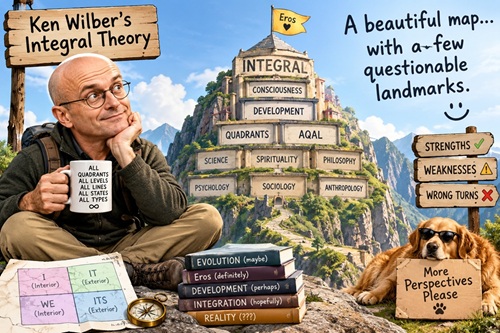 Ken Wilber's Integral Theory is one of the most ambitious attempts to organize human knowledge ever undertaken by a single contemporary thinker. Psychology, philosophy, spirituality, evolutionary theory, sociology, anthropology, developmental psychology, and contemplative experience all receive invitations to his conceptual banquet. The guest list is impressive. The seating plan is elaborate. The host insists that everyone has been placed in the correct developmental tier. And should anyone question the arrangements, there is always the possibility that they simply have not developed far enough to appreciate the evening. Yet it would be a mistake to dismiss Wilber as merely a metaphysical showman. His model contains genuine insights, useful distinctions, and an admirable ambition to overcome intellectual fragmentation. It also contains weaknesses that become apparent when its elegant architecture is mistaken for a demonstrated picture of reality. And some of its claims are not merely questionable: they conflict with established knowledge or rest on arguments that fail to support their conclusions. The challenge is to distinguish the three categories without either genuflecting before the Integral Cathedral or bringing a wrecking ball to every room in it. I. The Strong: What Wilber Actually Got Right1. The World Is Not a Collection of Disconnected DepartmentsWilber's most compelling intuition is that human knowledge has become fragmented. The natural sciences investigate physical processes, psychology investigates minds, sociology investigates institutions, and contemplative traditions investigate experiences of consciousness. Each discipline develops its own vocabulary, methods, and professional standards, often with remarkably little communication across disciplinary boundaries. Wilber's integral ambition is to make these perspectives mutually intelligible. What happens inside a person cannot simply be reduced to what happens in that person's brain, while social institutions cannot be understood exclusively by examining individual intentions. Subjective experience, observable behavior, cultural meaning, and social organization all matter. This is a valuable corrective to intellectual provincialism. A neurologist studying religious experience may overlook the practitioner's interpretation of it. A sociologist may overlook the phenomenology of the experience itself. A mystic may overlook the influence of childhood conditioning, social authority, and neurological processes. An integral approach encourages us to ask what each perspective contributes and what it leaves out. The achievement here is not that Wilber has discovered four cosmic compartments. It is that he repeatedly reminds us that complex phenomena invite multiple kinds of explanation. That insight deserves to survive its more extravagant metaphysical packaging. 2. The Four Quadrants: A Useful Map, Not a Map of the UniverseWilber's four quadrants distinguish individual interiors, individual exteriors, collective interiors, and collective exteriors. In ordinary language, these correspond roughly to experience, behavior, culture, and social systems. The framework is useful because it prevents familiar mistakes. A psychological problem may involve private beliefs, bodily conditions, cultural expectations, and institutional arrangements. Treating only one of these dimensions may produce an incomplete explanation. Consider burnout. The person's experience of exhaustion matters, but so do sleep patterns, workload, workplace culture, and management practices. A purely individual solution—meditation, positive thinking, or a more developed consciousness—may be insufficient if the organization continues to impose impossible demands. The quadrants encourage a broader investigation. But there is a crucial qualification. The fact that we can distinguish four perspectives does not establish that reality itself is fundamentally divided into four corresponding domains. The quadrants may be an effective analytical classification without being the universe's own architectural blueprint. A map can be useful without being metaphysically privileged. Wilber sometimes seems unable to resist the upgrade. 3. Development Is Real, and People Do Not All Think AlikeWilber recognizes that human beings change throughout their lives. Their moral reasoning, emotional regulation, cognitive abilities, social identities, and conceptions of reality can become more complex. Developmental psychology provides substantial evidence for many forms of such change, even though their trajectories vary and do not always follow a single universal sequence. Wilber's broader developmental emphasis challenges the comforting assumption that everyone sees the world through essentially the same mental lens. People can disagree not merely because they possess different information, but because they organize experience through different conceptual frameworks. Someone who understands morality primarily through obedience may have difficulty appreciating a framework based on universal principles. Someone who interprets identity through rigid group boundaries may struggle to understand a genuinely pluralistic outlook. This is an important insight, especially when discussing politics, religion, education, and intercultural conflict. The problem begins when a useful developmental observation becomes a universal ranking system. Human beings do not necessarily develop in synchrony across cognitive, moral, emotional, interpersonal, and spiritual domains. Nor does adopting more sophisticated vocabulary establish that someone has become wiser, kinder, or more truthful. Development is real. The Integral League Table is a different proposition. 4. The Pre/Trans Distinction: A Warning Worth KeepingWilber's pre/trans fallacy distinguishes pre-rational forms of consciousness from trans-rational possibilities. Something that lies beyond conventional rationality need not be primitive, but neither is everything that departs from ordinary rationality spiritually advanced. This distinction addresses a genuine problem. A child's magical thinking, a psychotic delusion, an artistic intuition, and a disciplined contemplative insight may all challenge ordinary rational categories, but they are not therefore equivalent. Likewise, rejecting rationality does not automatically amount to transcending it. Wilber is right to resist the idea that every unusual experience represents higher wisdom. The distinction can be helpful in evaluating spiritual claims and in understanding why nonconformity, irrationality, and genuine insight should not be lumped together. However, the distinction becomes self-protective if Wilber's favored experiences are classified as trans-rational while their critics are dismissed as merely pre-rational. A distinction that initially clarifies the territory can become a border checkpoint staffed by people who already know who deserves admission. 5. His Appetite for Intellectual SynthesisWilber's range is extraordinary. Even readers who reject much of his metaphysics can learn from his willingness to juxtapose traditions that ordinarily remain separated by academic or ideological boundaries. He has helped introduce developmental theories, contemplative traditions, philosophical perspectives, and cultural analysis to audiences who might never otherwise encounter them. There is also a legitimate philosophical question behind his work: can we construct a coherent worldview that respects the achievements of science without dismissing ethics, meaning, consciousness, and human experience? That is a worthwhile project. The catch is that a synthesis must be more than an impressive collection of quotations. The difficult work lies in resolving contradictions, assessing the quality of evidence, and determining which claims survive when they are brought into contact with one another. Wilber's intellectual appetite is a strength. His occasional tendency to treat the resulting banquet as proof of a successful synthesis is not. II. The Weak: Where the Architecture Begins to Wobble6. AQAL: When a Helpful Framework Becomes a Universal Filing CabinetAQAL—All Quadrants, All Levels, All Lines, All States, All Types—is Wilber's grand organizational framework. It promises to locate virtually any phenomenon by considering its perspective, developmental level, capacity, state, and type. As a checklist, it can be useful. It reminds investigators to ask questions they might otherwise overlook. As a theory, however, its comprehensiveness creates a problem. A framework capable of accommodating nearly every possible observation may be difficult to falsify. When something appears to contradict the model, it can often be assigned to another quadrant, developmental level, line, state, or interpretive context. The theory can thus acquire the flexibility of an exceptionally well-stocked filing cabinet. Nothing gets lost because every document has a folder. But the existence of a folder does not explain the document. Does AQAL predict what we will discover? Does it help us distinguish rival explanations? Does it tell us what evidence would count against its central claims? These are more demanding questions than whether a phenomenon can be assigned a place in the system. A comprehensive taxonomy is not automatically a comprehensive explanation. 7. Developmental Stages: The Temptation to Turn Psychology into an AristocracyWilber's developmental model combines insights from several stage theories into a sweeping account of human growth. Its appeal is obvious: it offers a way to understand differences in worldview without assuming that all perspectives are equally developed or equally adequate. But integrating developmental theories is not the same as proving that they form a single, universal ladder. Different theories study different phenomena, use different research methods, and propose different sequences. Their stages may overlap imperfectly, and development may depend heavily on context, education, culture, personality, and the particular ability being measured. When these differences are compressed into a single hierarchy, important qualifications can disappear. There is also a social danger. Once people are classified as operating from particular stages, disagreement can be explained away as evidence of their developmental limitations. The model then becomes less a tool for understanding others than a means of establishing one's own superiority. Wilber's framework is especially vulnerable to this temptation because it places considerable emphasis on the capacity to recognize and integrate perspectives. Those who agree with the integral account may appear more inclusive; those who reject it may appear trapped in narrower worldviews. This is a suspiciously convenient arrangement. A genuinely advanced thinker should be better at recognizing the limitations of their own framework, not merely better at explaining why everyone else has one. 8. The Quadrants Are Not Four Independent WitnessesWilber often argues that different quadrants require different methods of investigation. First-person experience cannot be completely replaced by third-person measurement, and cultural meaning cannot be fully captured by a list of individual behaviors. That is reasonable. But the four-quadrant scheme can encourage an illusion of corroboration. If a claim has a subjective dimension, a behavioral dimension, a cultural dimension, and a systemic dimension, it does not follow that evidence from all four independently confirms the same metaphysical interpretation. Imagine a religious experience. The practitioner reports a profound sense of unity. A neuroscientist identifies associated brain activity. A historian traces the experience's cultural vocabulary. A sociologist investigates the community that interprets it as divine. These findings may all be legitimate. But they do not independently establish that the practitioner encountered a transcendent spiritual reality. They may instead illuminate different aspects of a natural human experience. Integral analysis should help us distinguish kinds of evidence, not allow the accumulation of perspectives to inflate the certainty of a preferred conclusion. Four windows looking into a room do not establish that the room contains an invisible fifth dimension. 9. Integral Language Can Become a Substitute for PrecisionWilber's vocabulary is often ingenious: holons, transcend and include, tetra-mesh, developmental lines, states, types, and levels. Such terms can help distinguish concepts that ordinary language blurs together. But technical language carries a risk. Once a vocabulary becomes sufficiently elaborate, it can make an argument sound more rigorous than it actually is. What precisely is a holon in a particular argument? What evidence establishes that one developmental stage transcends and includes another? What observation would show that a supposed higher level is genuinely higher rather than merely different? And what does it mean to say that a process is driven by Eros? These questions cannot be answered by repeating the terminology. A conceptual vocabulary earns its keep by clarifying distinctions, guiding investigation, and helping us make better explanations. If readers must learn an entire lexicon merely to discover that a familiar claim has been given a new name, the intellectual return on investment is disappointing. Integral jargon is at its best when it makes complicated things clearer. It is at its worst when it makes uncertain things sound settled. III. The Wrong: Where Wilber's Claims Outrun Their EvidenceNot every weakness is a demonstrated error. Some are limitations of scope, some are unresolved philosophical questions, and some are claims that require better evidence. The category of the wrong should be reserved for cases where the argument conflicts with established knowledge or where the conclusion plainly exceeds what the premises support. 10. Eros: The Cosmic Force That Explains Everything by Explaining NothingWilber's account of Eros is one of the clearest tests of his system's ambitions. In his more expansive formulations, the universe is not merely undergoing physical change. It is said to possess an intrinsic drive toward increasing complexity, emergence, and self-transcendence. Wilber has described Eros as an actual force of the universe, comparable in its reality to gravity or electromagnetism. This is a bold claim. It is also a scientifically demanding one. Gravity has mathematical descriptions, measurable effects, and a vast body of empirical support. Electromagnetism has equations, experimental tests, and well-established relationships with other physical phenomena. Nuclear forces operate within highly constrained theoretical frameworks that generate testable predictions. What comparable explanatory work does Eros perform? The appearance of increasingly complex structures in the universe does not, by itself, establish a cosmic force that wants complexity to emerge. Stellar formation, chemical evolution, biological evolution, and cultural development have distinct mechanisms and operate under different conditions. Some produce increasing complexity; others produce simplification, extinction, decay, and disintegration. Evolution by natural selection does not require a cosmic yearning for higher forms. It requires heritable variation, differential reproductive success, and the relevant environmental conditions. Natural selection can produce impressive adaptations without anticipating the future or striving toward spiritual fulfillment. Nor does the emergence of complexity establish that the universe is moving toward an ultimate goal. Local increases in organization are compatible with the second law of thermodynamics because open systems can develop and maintain local order while producing entropy in their surroundings. The problem is not that Eros cannot be directly observed in the same way as an ordinary physical object. Many legitimate scientific entities are inferred from their effects. The problem is that Wilber has not supplied a comparably clear account of Eros's distinctive effects, mechanism, or predictive consequences. If Eros is simply another name for the fact that novelty and complexity sometimes emerge, it adds little explanatory value. If it is a genuine causal force, then the burden is to show what it does that established explanations do not already account for. And if every possible outcome can be accommodated—complexity as Eros, collapse as a necessary stage, extinction as transformation, stagnation as a temporary pause—then Eros risks becoming immune to evidence. The universe does not need to be secretly in love with itself for complexity to arise. 11. The Evolutionary Shortcut: Turning a Worldview into a Scientific VerdictWilber's treatment of evolutionary biology has sometimes crossed the line from philosophical interpretation into misrepresentation of science. His dismissive characterization of chance mutation and natural selection as an inadequate or absurd account of evolution is a conspicuous example. The central problem is a failure to distinguish randomness in mutation from the non-random process of natural selection. Mutations are not generally produced because an organism needs them. Selection, however, is differential: variants that affect reproductive success can become more or less common across generations. Modern evolutionary biology also includes population genetics, developmental biology, genetic drift, gene flow, sexual selection, and other mechanisms. The science is more sophisticated than the caricature that evolution means everything happens by pure chance. Evolutionary theory does not claim that every mutation is beneficial, that all evolution leads toward greater complexity, or that life must progress toward humanity. It explains the diversification and adaptation of organisms through natural processes. Wilber is free to argue that these explanations do not exhaust philosophical questions about meaning, value, or consciousness. But he cannot establish a cosmic evolutionary intention merely by declaring naturalistic accounts inadequate. A gap in one explanation is not positive evidence for another. If Wilber wants to propose that evolution has a spiritual dimension, he must offer evidence for that dimension independently of his dissatisfaction with conventional biology. Otherwise, the argument amounts to a metaphysical promotion: because the existing account does not answer every question one might ask, a preferred spiritual interpretation is appointed to the vacant position. Science is not obliged to accept the first metaphysical applicant who arrives with an impressive résumé. 12. The Pre/Trans Fallacy Can Become a Self-Defense MechanismThe pre/trans distinction is useful when applied carefully. But it can also become a way of protecting Wilber's conclusions from criticism. If rational objections are dismissed as merely rationalistic, conventional scientific standards are treated as belonging to a lower developmental stage, and spiritual insights are assigned to a higher stage, then the hierarchy begins to function as an all-purpose defense. The danger is not that developmental differences are imaginary. It is that the theory can classify the people who evaluate it before it has answered their objections. A critic may indeed misunderstand Wilber. A critic may also understand him perfectly and find his argument unconvincing. Those are different possibilities, and the theory must leave room for both. The decisive question is whether Wilber's claims can be independently assessed, including by people who do not accept his developmental map. If the validity of an argument depends on first accepting the hierarchy that validates the argument, the reasoning becomes circular. A theory that labels its opponents developmentally deficient has not refuted them. It has changed the subject from the truth of their objections to the alleged inadequacy of the people raising them. That is not transcendence. It is an epistemological security system. 13. The Metaphysical Upgrade: From Experience to Cosmic RealityWilber's work repeatedly moves between descriptions of experience and claims about the ultimate nature of reality. A contemplative reports a profound experience of unity; a tradition interprets it as realization of an ultimate ground; Wilber situates it within a sophisticated developmental account of consciousness and Spirit. These are three different kinds of claim. The experience itself may be psychologically real and transformative. Its traditional interpretation may be historically important. Its metaphysical interpretation, however, requires further argument. The fact that an experience feels unconditional, timeless, or infinitely encompassing does not establish that its object exists independently of the experience. Nor does the existence of contemplative practices across cultures prove that their practitioners have discovered one identical metaphysical reality. Similar experiences can be interpreted through different religious, philosophical, and naturalistic frameworks. Their common features deserve investigation, but similarities do not automatically settle the ontology. Wilber's integral model is strongest when it takes subjective experience seriously. It is weakest when respect for experience becomes an entitlement to particular conclusions about the cosmos. We should neither dismiss the mystic's experience nor grant the mystic a blank cheque to explain the universe. IV. The Integral Paradox: A Theory of Everything That Needs Its Own Theory of Error14. Why Does Wilber's Model Have So Much Trouble Admitting Defeat?One of the deepest problems with Integral Theory is not any single quadrant, stage, or metaphysical claim. It is the relationship between the system and the possibility that the system is wrong. A theory becomes intellectually productive when it can distinguish between what it explains, what it merely classifies, and what it fails to account for. It must also be possible to identify circumstances under which a claim should be revised or abandoned. Integral Theory's extraordinary flexibility makes that difficult. An objection can be interpreted as a failure to understand another quadrant, an inability to appreciate a higher developmental level, an exclusive reliance on one knowledge tradition, or an insufficiently comprehensive perspective. Sometimes those diagnoses will be correct. But they cannot be assumed in advance. The crucial question is whether the framework can turn its own analytical instruments upon itself. Could the developmental hierarchy be culturally biased? Could the quadrants be a useful heuristic rather than an ontological discovery? Could the language of Eros express a metaphysical preference rather than a real cosmic mechanism? Could the theory's apparent comprehensiveness conceal the absence of decisive explanatory power? These are not external attacks on Integral Theory. They are precisely the questions a serious integral approach ought to welcome. A model that insists on integrating every perspective should have no difficulty integrating the perspective that it might be mistaken. 15. The Problem of Intellectual ImmunityThere is a revealing difference between a framework that grows stronger through criticism and one that grows more elaborate in response to criticism. The first clarifies its claims, improves its evidence, and sometimes abandons cherished conclusions. The second adds qualifications, distinctions, and interpretive levels until the original claim becomes increasingly difficult to challenge. The latter can create the appearance of sophistication while reducing the possibility of correction. Wilber's model does not have to be wholly falsifiable to be philosophically useful. Not every conceptual framework is a scientific theory, and not every philosophical question can be resolved by a controlled experiment. But particular empirical claims within the framework—about evolution, developmental psychology, consciousness, or a supposed cosmic force—must be judged by the standards appropriate to those claims. Metaphysical speculation is legitimate. Presenting metaphysical speculation as though it has the evidential standing of established science is not. The integral project would gain considerably from a more explicit division between its empirical findings, its interpretive frameworks, its philosophical arguments, and its spiritual commitments. Without that division, readers are invited to purchase a package in which well-supported observations and controversial metaphysical claims are bundled together at no extra charge. The fine print is where the real argument begins. V. What Should Be Saved, Repaired, and Discarded?The verdict on Wilber should not be a simple thumbs-up or thumbs-down. Integral Theory contains different kinds of claims, and they deserve different fates. The strong elements should be preserved: the ambition to connect disciplines, the recognition that subjective and objective perspectives both matter, the attention to development, and the warning that unusual experiences are not automatically transcendent wisdom. These insights can be used without accepting Wilber's entire metaphysical architecture. The weak elements should be revised: the tendency to merge distinct developmental theories into a universal ladder, the temptation to treat the quadrants as a complete ontology, and the reliance on technical vocabulary that sometimes obscures rather than resolves explanatory questions. These features need more empirical discipline, clearer definitions, and a greater willingness to recognize alternative frameworks. The wrong elements should be rejected where they conflict with established knowledge or fail to support their conclusions: caricatures of evolutionary biology, the assumption that complexity demonstrates cosmic purpose, and the elevation of Eros from a suggestive metaphor into a scientifically established causal force without the required evidence. Spiritual interpretations should remain possible as philosophical positions, but they should not receive scientific credentials by association. This is not an anti-integral conclusion. It is an argument for a more genuinely integral attitude toward Integral Theory itself. Conclusion: Keep the Building, Inspect the FoundationsKen Wilber has constructed an intellectual building of extraordinary scale. It has broad corridors, panoramic views, an ambitious floor plan, and enough specialized rooms to accommodate almost every subject in the human curriculum. Visitors can discover connections they had never considered and encounter traditions they might otherwise have ignored. But the building's size does not establish the soundness of every foundation. Its symmetry does not prove that the universe shares its architectural plan. And a room labelled Eros does not become a scientific laboratory merely because it is situated beside rooms labelled Evolution, Consciousness, and Complexity. The strong parts of Wilber's model are often strong because they articulate problems and distinctions that other thinkers can recognize independently of the system. The weak parts become visible when useful maps are promoted into universal structures. The wrong parts emerge when a compelling worldview is allowed to overrule evidence or to treat the absence of an explanation as evidence for a preferred metaphysics. The most productive future for integral thinking may therefore involve a peculiar act of intellectual disloyalty: separating Wilber's valuable insights from Wilber's claims to explain everything. That would not destroy the integral project. It would give it a chance to mature. And perhaps the final test of a genuinely integral thinker is not the ability to fit every objection into the model, but the willingness to discover which parts of the model should never have been built in the first place. After all, if everything must be transcended and included, perhaps Ken Wilber himself should be transcended and included. Preferably without a compulsory developmental assessment at the entrance.
Widget is loading comments...
|