|
TRANSLATE THIS ARTICLE
Integral World: Exploring Theories of Everything
An independent forum for a critical discussion of the integral philosophy of Ken Wilber
  Frank Visser, graduated as a psychologist of culture and religion, founded IntegralWorld in 1997. He worked as production manager for various publishing houses and as service manager for various internet companies and lives in Amsterdam. Books: Ken Wilber: Thought as Passion (SUNY, 2003), and The Corona Conspiracy: Combatting Disinformation about the Coronavirus (Kindle, 2020).
Check out my other conversations with ChatGPT Jeffrey Sachs and the Geopolitics of GrievanceA Critical Examination of America's Role in the WorldFrank Visser / ChatGPT
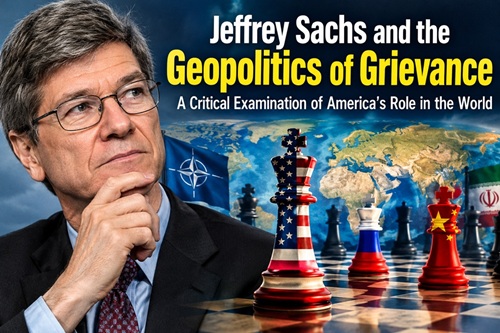 Introduction: The economist who became a geopolitical prosecutorJeffrey Sachs is an unusual figure in contemporary geopolitical debate. An internationally prominent economist, former adviser to governments and the United Nations, and director of Columbia University's Center for Sustainable Development, he has increasingly become known for his outspoken criticism of American foreign policy. He argues that Washington's pursuit of global primacy, its expansion of NATO, its treatment of Russia, and its interventions abroad have helped create the very international insecurity that American leaders claim to oppose. Sachs deserves to be taken seriously. He challenges the comforting assumption that the United States is principally a stabilizing force whose adversaries are responsible for international disorder. He reminds Western audiences that other countries have security interests, that military alliances have consequences, and that the history of international conflict cannot be reduced to a morality play in which Washington invariably represents the good side. But taking Sachs seriously does not mean accepting his interpretation wholesale. His geopolitical commentary often displays a striking asymmetry: American actions receive extensive historical scrutiny, while the ambitions, ideological commitments and independent choices of America's adversaries can receive considerably less. The result is an analysis that is frequently illuminating about Western mistakes but less convincing when it tries to explain the full range of motives behind international conflict. The central question is not whether the United States has behaved hypocritically. It has. The question is whether exposing American hypocrisy is sufficient to explain the world. It is not. 1. The strongest part of Sachs's argument: American power is not innocentSachs's most important contribution is his insistence that American foreign policy must be judged by the same standards Washington applies to its rivals. The invasion of Iraq in 2003, the disastrous consequences of the intervention in Libya in 2011, and the long history of American support for authoritarian governments make it impossible to sustain a completely innocent account of US global leadership. His criticism becomes particularly forceful when he questions whether Washington has learned anything from these failures. In his recent commentary on Iran, Sachs draws parallels with Iraq and warns that military escalation, executive overreach and the absence of a credible diplomatic strategy can turn a regional conflict into a much wider catastrophe. This is a legitimate concern. Military superiority does not guarantee political wisdom. The ability to destroy a government is not the ability to construct a stable political order afterward. Nor does possessing a powerful military confer moral authority on the decisions made with it. Sachs is also right that Western governments sometimes confuse their own strategic preferences with universal principles. When Washington invokes sovereignty in one conflict but disregards it in another, its credibility suffers. When European governments condemn Russian coercion but appear reluctant to scrutinize American coercion, they weaken their own moral position. Yet there is a crucial distinction between demonstrating that American policy is hypocritical and demonstrating that American policy is the principal cause of a particular conflict. The former does not automatically establish the latter. Sachs is most persuasive when he demands consistency. He becomes less persuasive when his criticism of American power develops into a comprehensive explanation of world affairs. 2. NATO expansion: a real historical controversy, but not a complete explanationSachs has repeatedly argued that NATO's eastward expansion after the Cold War helped create the conditions for the confrontation between Russia and the West. He views the failure to construct a genuinely inclusive European security order as one of the great strategic mistakes of the post-Cold War era. There is substance to this argument. Russian objections to NATO expansion were hardly invented in February 2022. Western policymakers knew that extending the alliance toward Russia's borders could provoke a hostile response. The decision to leave Ukraine's long-term relationship with NATO strategically ambiguous created expectations in Kyiv while reinforcing fears in Moscow. A more imaginative diplomatic policy might have reduced tensions. Serious negotiations over arms control, military exercises, conventional forces and European security guarantees could have tested whether a less confrontational settlement was possible. But Sachs's interpretation encounters a major difficulty when geopolitical explanation slides toward geopolitical justification. Russia's security concerns do not give Russia ownership of Ukraine's foreign policy. Ukraine is not merely a geographical buffer between two great powers. It is a country with its own political history, competing domestic interests and citizens who have repeatedly demonstrated that their orientation toward Europe is not simply an invention of Washington. The central problem with a purely great-power interpretation is that it risks treating smaller countries as objects rather than agents. If Ukraine's aspiration to seek Western integration is regarded principally as an American geopolitical operation, the preferences of Ukrainians themselves disappear from the analysis. The same reasoning can become circular. Russia opposes NATO expansion; therefore, NATO expansion threatens Russia. Russia invades Ukraine; therefore, the invasion demonstrates how dangerous NATO expansion was. But this leaves an essential question unanswered: how much of the Russian response was driven by genuine defensive anxiety, and how much by the Kremlin's unwillingness to accept Ukraine's independent political trajectory? Those motivations are not mutually exclusive. A government can perceive a security threat while also pursuing territorial ambitions, domestic political objectives or an imperial conception of its historical role. Sachs's framework gives insufficient weight to this combination. Nor should NATO's enlargement be treated as a mechanical process imposed on an unwilling Eastern Europe. Poland, the Baltic states and other countries sought NATO membership partly because of their own historical experiences of Russian and Soviet domination. Their desire for protection was not necessarily less genuine than Russia's objections. The resulting security dilemma was real, but it had more than one participant. 3. Explaining Putin is not the same as excusing PutinSachs's geopolitical reasoning belongs broadly to the realist tradition, which emphasizes power, geography, national interests and the limits of ideological foreign policy. Realism offers a useful corrective to the tendency to imagine that international politics can be managed through declarations of democratic solidarity alone. However, realism becomes impoverished when it treats the ambitions of powerful states as natural facts to which everyone else must accommodate themselves. Consider Vladimir Putin's invasion of Ukraine. A serious explanation must consider NATO, the breakdown of post-Cold War security arrangements, Russian perceptions of vulnerability and the history of Western intervention. But it must also examine the Kremlin's own choices, its treatment of Ukrainian sovereignty and its willingness to use military force to achieve political objectives. Putin was not simply a billiard ball propelled across the geopolitical table by American decisions. He was an actor making choices under particular constraints and according to his own understanding of Russian power and national destiny. This distinction matters because causal explanation and moral responsibility answer different questions. American policy may have contributed to the circumstances in which the war became more likely. It does not follow that Washington compelled Putin to launch a full-scale invasion in February 2022. Alternative choices remained available, even if some carried strategic costs. A geopolitical analysis that emphasizes structural pressures while underestimating political agency can inadvertently turn aggression into something resembling a natural disaster: regrettable, perhaps predictable, but ultimately nobody's responsibility. That is an unsatisfactory account of human affairs. The same principle applies to Washington. American leaders cannot escape responsibility by claiming that their actions were dictated by the logic of great-power competition. If realism is to be more than a sophisticated vocabulary for excusing powerful states, it must hold all of them accountable for their decisions. 4. The problem of selective skepticismOne of the recurring weaknesses of Sachs's commentary is an imbalance in the distribution of skepticism. American declarations of good intentions are subjected to intense scrutiny. Official claims about democracy, humanitarian intervention and the defense of the international order are examined for concealed interests. This is often entirely justified. But comparable scrutiny must also be applied to Russian, Chinese and Iranian declarations. Russia's invocation of historical unity and security concerns deserves examination. So does China's language of peaceful development when considered alongside its military pressure on Taiwan and its expansive maritime claims. Iran's opposition to American intervention does not remove the need to scrutinize its own regional policies and treatment of political dissent. No state should be presumed truthful merely because it opposes the United States. A useful test is straightforward: would Sachs accept the same argument if the countries were reversed? If Washington claimed that a neighboring country's prospective military alignment threatened American security, would that justify invading the country, annexing its territory or installing a government more congenial to Washington? Sachs would presumably reject such a conclusion. Yet that same standard must apply when Russia invokes its own security interests. The point is not to equate every country or every action. States differ in their conduct, capabilities and responsibilities. The point is to establish a consistent standard of judgment. Selective skepticism can produce a curious inversion: American official narratives are treated as propaganda until proven otherwise, while the counter-narratives of America's adversaries are treated as neglected truths awaiting recognition. That is not independent analysis. It is an inversion of conventional bias. 5. Multipolarity is not synonymous with peaceSachs frequently presents the emerging multipolar world as an alternative to American dominance. His broader argument is that Washington must recognize the growing influence of China, Russia and other major powers rather than attempt to preserve an increasingly unsustainable position of primacy. Recent commentary has similarly emphasized the dangers of confrontation with Russia and China and the need for a more diplomatic approach. There is a strong case for questioning the assumption that the United States should remain the unquestioned manager of global affairs. The economic and political weight of countries outside the Western alliance has grown, and international institutions must better reflect that reality. But multipolarity is a distribution of power, not a moral philosophy. A world with several powerful centers can be more representative and less vulnerable to unilateral American decisions. It can also become more dangerous if competing powers pursue spheres of influence, build rival military blocs and interpret every regional development as a test of credibility. The nineteenth-century European balance of power did not prevent major wars. The twentieth-century multipolar order did not prevent the First World War. The Cold War's bipolar structure did not prevent proxy wars, coups, nuclear brinkmanship or devastating regional conflicts. Why should a multipolar order automatically produce a more peaceful world today? The answer depends on institutions, restraint, diplomacy, economic interdependence and the willingness of states to accept limits on their own behavior. Without these conditions, multipolarity may simply distribute the capacity for coercion more widely. The danger is that a critique of American hegemony becomes romanticized into a celebration of its decline. The weakening of one dominant power does not necessarily liberate the world. It can create opportunities for other powers to exercise dominance over their own neighbors. For smaller countries, the question is not whether Washington or Beijing has the more attractive geopolitical philosophy. It is whether they can preserve their sovereignty without becoming pawns in someone else's strategic competition. 6. Diplomacy is indispensable, but what kind of diplomacy?Sachs is right to emphasize diplomacy. Nuclear-armed states cannot afford to treat every disagreement as a test of national resolve. Communication, arms control and negotiated compromises are essential to reducing the risk of catastrophic escalation. Yet the word diplomacy can conceal as much as it reveals. Negotiations are not automatically successful because they take place. Their value depends on their terms, the parties' incentives, the credibility of commitments and the mechanisms available to enforce an agreement. A settlement that ends active fighting by rewarding territorial conquest may reduce violence in the short term while increasing the incentive for future aggression. Conversely, insisting on maximalist objectives without regard to military realities can prolong a war at enormous human cost. The difficult task is to identify a settlement that is both attainable and durable. In Ukraine, this requires acknowledging that Russia has legitimate security interests without accepting that it possesses a veto over Ukrainian sovereignty. It requires considering realistic arrangements for military deployments and future security guarantees while recognizing that Ukraine must have a meaningful voice in determining its own future. It also requires asking what happens if negotiations fail. What would discourage a renewed invasion? What commitments would be credible? What concessions would be reciprocal rather than simply imposed on the weaker party? Sachs's emphasis on diplomacy is valuable, but calls for negotiation need to be accompanied by a convincing account of how a negotiated peace can survive. Otherwise, diplomacy risks becoming a synonym for asking the victim of aggression to accommodate the aggressor's demands. 7. The danger of turning geopolitics into a grand conspiracySachs sometimes describes American strategy in sweeping terms, suggesting that Washington pursues a persistent effort to weaken or contain Russia, Iran and China. In a July 2026 interview, for example, he framed US policy toward these countries as part of a long-standing strategy for Eurasian primacy. There are historical grounds for examining such strategic continuity. American policymakers have long worried about the emergence of a dominant power in Eurasia, and administrations of different political orientations have maintained some overlapping strategic objectives. But the existence of recurring strategic interests does not prove the existence of a single, coherent master plan. American foreign policy is produced by competing institutions, political factions, presidents, military establishments, intelligence agencies, commercial interests and allied governments. These actors frequently disagree. Strategies change, policies contradict one another, and tactical decisions can undermine the very long-term objectives they were intended to advance. The Trump administration provides an especially revealing example. A president who speaks of peace and dealmaking can simultaneously alienate allies, threaten military escalation and undermine diplomatic credibility. Such behavior may be dangerous without being part of a brilliantly coordinated plan. Indeed, geopolitical disorder is often the product of inconsistent objectives rather than a hidden strategic design. The more expansive the explanation, the greater the burden of proof. If every American action against a rival is interpreted as evidence of an overarching plan to destroy that rival, the theory becomes difficult to falsify. Even diplomatic engagement can be reinterpreted as a tactic of containment. At that point, geopolitics risks becoming a narrative that explains everything because it is structured to exclude inconvenient counterevidence. A rigorous analysis should distinguish between documented policy, inferred strategic intention and speculation about hidden motives. 8. Europe cannot outsource its strategic thinkingOne of the most consequential implications of Sachs's argument concerns Europe. His criticism of the absence of European diplomacy and the danger of a direct NATO-Russia confrontation raises an important question about the continent's strategic independence. Europe has often depended on American military power while struggling to formulate a coherent policy toward Russia. That dependence has created a structural problem: European governments may bear many of the consequences of confrontation without exercising equivalent influence over the decisions that produce it. But European strategic independence should not mean simply adopting Sachs's preferred interpretation of Russia's concerns. Europe has its own security interests, and the countries closest to Russia have reasons to fear both American abandonment and Russian coercion. Their concerns cannot be dismissed as the result of anti-Russian propaganda or historical irrationality. A viable European strategy must combine deterrence with diplomacy. It must preserve the capacity to resist military aggression while keeping open channels for negotiation, arms control and eventual political accommodation. It must also recognize that appeasement and confrontation are not the only alternatives. Between them lies the difficult work of calibrated pressure, credible defense, limited agreements and sustained communication. The real failure of European strategy would be to replace one form of dependence with another: first dependence on Washington's strategic judgment, then dependence on a simplified theory of what Moscow wants. Europe needs independent analysis, not merely a different geopolitical orthodoxy. 9. What Sachs gets right—and what his critics should learnIt would be a mistake to dismiss Sachs as merely an apologist for America's adversaries. His warnings about military escalation, the limitations of American power and the dangers of ignoring rival states' security concerns address genuine weaknesses in Western foreign policy. His critics should answer his arguments rather than retreat into the assertion that any criticism of Washington amounts to support for Moscow or Beijing. He is also right that international politics cannot be understood solely through the language of democratic versus authoritarian states. Democracies can behave aggressively, violate international norms and support repressive governments. Authoritarian states can sometimes cooperate constructively. Moral labels do not eliminate the need for strategic analysis. But Sachs's critics have a legitimate counterargument of their own: the fact that Washington has repeatedly violated its professed principles does not mean that the international order it helped construct is worthless, that American power is uniquely malign or that its opponents would create a more peaceful alternative. The international system contains both genuine institutions of cooperation and mechanisms through which powerful states protect their interests. It is neither an immaculate liberal achievement nor merely a disguise for Western domination. A mature critique of American hegemony must be able to defend international law even when it constrains Washington, Moscow, Beijing or any other major power. It must be able to criticize NATO policy without denying Ukraine's agency, and to advocate negotiations without assuming that every demand made by Russia is reasonable. Most importantly, it must distinguish between understanding a government's motives and endorsing its actions. That is the standard to which Sachs should be held—and the standard his own critics should meet. Conclusion: Beyond the morality play of geopoliticsJeffrey Sachs performs a useful service by challenging the comforting assumptions of Western foreign policy. His insistence that Washington examine its own conduct, take other powers' interests seriously and return to diplomacy deserves attention. But his geopolitical commentary is less convincing when American strategic failures become the organizing principle of almost every international crisis. That approach risks understating the agency of other governments, the legitimate interests of smaller states and the possibility that conflicts arise from multiple interacting decisions rather than a single dominant cause. The alternative is not a return to American triumphalism. It is a more demanding realism, one that applies the same analytical and moral standards to every major power. The United States should not be allowed to invoke security as a universal justification for its actions. Neither should Russia, China or any other state. NATO's mistakes deserve scrutiny, but so do the decisions of the Kremlin. Diplomacy should be pursued energetically, but peace must be more than the temporary suspension of violence on terms dictated by the stronger party. Above all, we should resist the temptation to divide the world into those who expose American hypocrisy and those who defend American power. Both camps can be wrong, and both can overlook inconvenient facts. The ultimate test of geopolitical analysis is not whether it exposes the crimes of one's preferred adversary. It is whether it explains the behavior of all the relevant actors, acknowledges uncertainty, and applies its principles consistently. Sachs is right to ask the West to look in the mirror. But a mirror that shows only Western failures is not a complete picture of the world.
Widget is loading comments...
|