|
TRANSLATE THIS ARTICLE
Integral World: Exploring Theories of Everything
An independent forum for a critical discussion of the integral philosophy of Ken Wilber
  Frank Visser, graduated as a psychologist of culture and religion, founded IntegralWorld in 1997. He worked as production manager for various publishing houses and as service manager for various internet companies and lives in Amsterdam. Books: Ken Wilber: Thought as Passion (SUNY, 2003), and The Corona Conspiracy: Combatting Disinformation about the Coronavirus (Kindle, 2020).
Check out my other conversations with ChatGPT The Cosmic Miracle MachineKen Wilber's Eros Doctrine and the Abdication of Scientific ExplanationFrank Visser / ChatGPT
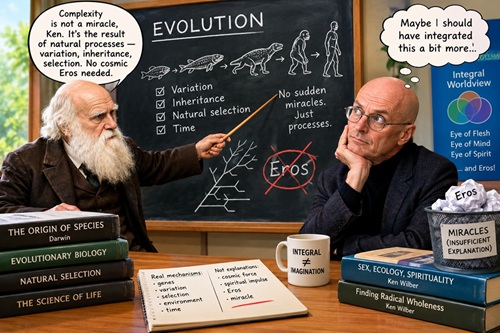 1. Darwin's Boundary: Where Explanation Ends, Miracle BeginsCharles Darwin's final paragraph of Chapter VII of On the Origin of Species remains a remarkably effective test of scientific reasoning. Darwin challenged those who invoked sudden, unexplained transformations to account for complex biological structures. Such proposals, he argued, could not explain the intricate coordination of organisms with their environments, nor account for the absence of a corresponding developmental history. To accept them was “to enter into the realms of miracle, and to leave those of science.”[1] Darwin was not demanding that nineteenth-century biology possess answers to every question. He was demanding something more fundamental: that proposed explanations earn their explanatory status. A gap in scientific knowledge is not evidence for a supernatural mechanism. Neither is the sheer wonder of nature an argument for one. Enter Ken Wilber, the self-appointed architect of an integral worldview that claims to reconcile science, philosophy, psychology, and spirituality. His doctrine of Eros, presented most systematically in Sex, Ecology, Spirituality (1995) and reiterated in Finding Radical Wholeness (2024), proposes that evolution is driven by an immanent spiritual impulse toward increasing complexity, consciousness, and integration. Wilber does not merely suggest that evolutionary history can inspire spiritual reflection. He makes a much stronger claim: that the evolutionary process itself is Spirit in action, and that Eros supplies the deeper explanation for its apparent directionality. In Finding Radical Wholeness, he describes Eros or self-organization as an inherent drive, an actual force present in the universe, as real as gravity, electromagnetism, and the nuclear forces. He further attributes to this force the production of galaxies, organisms, and progressively more encompassing forms of human consciousness. See Visser's review of Finding Radical Wholeness.[2] This is an extraordinary claim. Where is the extraordinary evidence? Wilber's Eros doctrine commits precisely the kind of explanatory substitution against which Darwin warned us. Where scientific investigation should identify mechanisms, specify causal relations, and establish empirical constraints, Wilber introduces a cosmic principle whose existence is inferred from the very phenomena it is supposed to explain. He has not solved the problem of evolution. He has given the problem a spiritual name. 2. From Evolutionary Patterns to Cosmic PurposeLet us begin with a concession. Evolution has produced spectacular increases in complexity in certain lineages and under particular environmental conditions. The emergence of life, multicellular organisms, nervous systems, cognition, language, and scientific culture presents legitimate questions about the conditions under which such developments become possible. But the word evolution does not mean universal progress toward greater complexity, let alone the progressive manifestation of Spirit. Evolutionary history includes diversification and extinction, elaboration and simplification, adaptive specialization and loss. Parasites can lose complex structures. Organisms can thrive by becoming less complicated. Lineages may persist for immense periods without any obvious movement toward greater cognitive sophistication. Evolution has no obligation to culminate in human beings, much less in enlightened integral theorists. There are genuine statistical and physical asymmetries in cosmic and biological history. The growth of complexity can depend on energy flows, thermodynamic constraints, self-organization, ecological interactions, developmental processes, and natural selection. None of this requires the universe to possess an intrinsic destination. The crucial distinction is between identifying conditions under which complexity can arise and claiming that complexity is being pulled toward existence by a cosmic intention. Wilber repeatedly slides from the first proposition to the second. He observes a pattern and interprets it as evidence for an underlying spiritual agency. But an observed pattern does not automatically reveal its own ultimate cause. Still less does it establish that the cause possesses the metaphysical character Wilber assigns to it. Why should increasing complexity indicate an immanent spiritual drive rather than the contingent consequences of ordinary physical and biological processes? Why should the emergence of consciousness imply that consciousness was somehow present as a potential spiritual destination from the beginning? Why should the appearance of human self-reflection be interpreted as the universe awakening to itself rather than as the contingent outcome of particular evolutionary histories? These are not rhetorical questions that can be answered by repeating the word Eros. They require arguments and evidence. Wilber's answer effectively reverses the burden of proof. Instead of demonstrating that a spiritual force exists, he treats the existence of evolutionary novelty as evidence that such a force must exist. The conclusion has been smuggled into the premise. 3. The Metaphysical SubstitutionThe most revealing feature of Wilber's argument is his treatment of Eros as both a metaphor and a real causal force. When challenged, Eros can be described poetically as the universe's creative impulse, a philosophical interpretation of nature, or a spiritual intuition of evolutionary directionality. But when Wilber wants to explain what ordinary evolutionary theory supposedly cannot, Eros becomes something stronger: an actual force operating throughout the Kosmos. These are different claims, and they require different standards of justification. As a metaphor, Eros may express a person's sense of wonder at the emergence of complexity. As a metaphysical interpretation, it may situate evolutionary history within a broader account of meaning and value. Neither use is inherently illegitimate. Philosophers are entitled to explore interpretations that go beyond the immediate findings of empirical science. But as a causal hypothesis, Eros incurs a debt that Wilber has not paid. What does it do, precisely? By what process does it operate? How does it interact with known physical and biological mechanisms? Under what conditions should it produce greater complexity, and under what conditions should it not? What observation would count against its existence? If no possible empirical outcome could disconfirm Eros, then it is not functioning as a scientific hypothesis. If it makes no predictions beyond those already available from established scientific explanations, its explanatory contribution remains unestablished. Calling Eros a force does not make it one. Calling it self-organization does not establish that it is a mechanism of self-organization. Calling it Spirit-in-action merely adds a metaphysical interpretation to the claim. Gravity, electromagnetism, and the nuclear interactions are not accepted as physical forces because scientists find the universe beautiful or because these concepts make a satisfying philosophical narrative. Their properties are investigated through mathematical models, experimental results, and measurable consequences. Wilber's analogy borrows the authority of established physics without supplying a comparable evidential foundation. This is not integration. It is the appropriation of scientific prestige. 4. The Misappropriation of Self-OrganizationWilber's position becomes particularly problematic when he appeals to self-organization and the work of scientists such as Stuart Kauffman. Self-organization is a legitimate and important subject of scientific investigation. Under appropriate conditions, interacting components can generate organized patterns without a central controller. Physical and chemical systems can develop ordered structures; biological development involves complex interactions between genetic, cellular, and environmental processes; ecological and evolutionary systems exhibit feedback, constraint, and emergent behavior. But a scientific account of self-organization is not automatically an endorsement of Wilber's Eros. To say that a system can generate order through its own dynamics is not to say that it is being driven by Spirit toward a predetermined spiritual culmination. The former is a research program involving specific processes and conditions. The latter is a metaphysical interpretation that must be justified independently. Wilber's maneuver is to move from the existence of self-organizing processes to the claim that self-organization expresses a universal spiritual drive. Yet the evidence for the former does not establish the latter. This is a textbook case of equivocation. The same expression, self-organization, first refers to scientifically investigated processes and then acquires the much more ambitious meaning of cosmic Eros. The credibility earned by the scientific concept is transferred to the metaphysical one without a sufficient argument connecting them. The situation becomes even more revealing when we consider the history of evolutionary theory. Darwin's decisive contribution was not simply to notice that nature changes or that organisms become adapted. It was to provide a framework in which heritable variation and differential reproductive success could explain adaptation without invoking a guiding purpose. Subsequent evolutionary research has expanded our understanding of development, genetic constraints, ecological interactions, symbiosis, niche construction, and self-organizing processes. The details remain subjects of active research. But the existence of unresolved questions does not license an unrestricted metaphysical supplement. Indeed, the more science discovers about the actual processes producing biological organization, the less justified it becomes to treat our remaining ignorance as positive evidence for Eros. Wilber is entitled to argue that scientific explanations are incomplete. He is not entitled to infer from their incompleteness that his preferred spiritual explanation is therefore correct. That is the difference between a research problem and a metaphysical free pass. 5. Wilber's Reversal of DarwinDarwin's warning concerned the substitution of unexplained transformations for an account of how complex adaptations arise. Wilber's Eros doctrine is not literally the same hypothesis Darwin was criticizing: Wilber does not simply propose that every complex organism appeared through a sudden miracle. The deeper similarity lies in the explanatory strategy. Both approaches risk treating what requires explanation as evidence for a cause that has itself not been adequately explained. Darwin's solution was to develop a naturalistic account of adaptation. Wilber's solution is to posit a spiritual impulse underlying the evolutionary process. Darwin asks how variation, inheritance, selection, and other natural processes generate the diversity of life. Wilber asks us to recognize the same process as the self-unfolding of Spirit. But these are not equivalent answers to the same question. A metaphysical reinterpretation may coexist with a scientific explanation, provided it does not pretend to replace that explanation. One might regard the universe as meaningful, sacred, or spiritually significant while accepting evolutionary biology without qualification. That would be a philosophical or religious attitude toward science. Wilber, however, wants Eros to do explanatory work. He has claimed that his is “the only theory that can actually explain the mysteries of evolution,” as quoted in my earlier analysis of his relationship to science.[3] Such a claim raises the obvious question: what, exactly, does his theory explain that evolutionary science cannot explain, and by what means does it explain it? If the answer is that Eros accounts for the existence of novelty, the emergence of complexity, or the apparent directionality of evolution, then the relevant scientific literature must be engaged in detail. If the answer is that Eros gives these processes a spiritual meaning, then the claim belongs to metaphysics and should be presented as such. Wilber cannot have it both ways. He cannot invoke the authority of science when describing Eros as a real cosmic force and retreat into spiritual interpretation when asked to demonstrate its causal efficacy. Darwin's distinction exposes the problem with brutal simplicity: an explanation that merely redescribes the mystery in elevated language has not explained it. 6. The Three Eyes Cannot Be Used as Three ExemptionsWilber's integral framework distinguishes the Eye of Flesh, the Eye of Mind, and the Eye of Spirit. In principle, this pluralism might help distinguish empirical observation, rational interpretation, and contemplative experience. Different questions may require different methods, and science need not exhaust every legitimate form of human inquiry. But these distinctions cannot be used to immunize a causal claim against criticism. A contemplative practitioner may experience profound unity, interconnectedness, or an overwhelming sense that reality is moving toward greater wholeness. Such experiences may be psychologically significant and worthy of careful investigation. They can inform a person's worldview, ethical commitments, or philosophical reflection. They do not, by themselves, establish that a cosmic force drives biological evolution. The experience of spiritual significance and the existence of a physical or biological cause are different epistemic matters. Moving from one to the other requires an argument. An inwardly compelling intuition does not become an empirically established account of nature simply because it is interpreted through the Eye of Spirit. Nor does the language of integral pluralism resolve the problem. Different modes of knowing can complement one another, but they cannot automatically validate one another's claims. Contemplative insight cannot establish a biological mechanism any more than a laboratory measurement can, by itself, settle every question of moral value. If Wilber wishes to present Eros as a contemplative interpretation of evolutionary history, he should say so. If he wishes to claim that Eros is an actual force that helps cause evolution, he must accept the evidential obligations that accompany such a claim. The Eye of Spirit is not an exemption from intellectual accountability. 7. The Integral IronyHere lies the irony. Wilber's project is explicitly committed to transcending and including: preserving the legitimate achievements of earlier perspectives while incorporating them into a more comprehensive framework. Science is supposedly included, not dismissed. Yet his treatment of evolution threatens to reverse that relationship. Instead of allowing evolutionary biology to constrain his metaphysical claims, he treats evolutionary biology as an incomplete exterior description of a process whose true spiritual significance is supposedly disclosed by integral philosophy. Science is granted a place at the table, but Wilber reserves the right to tell it what its discoveries ultimately mean. This is a particularly convenient arrangement. When science succeeds, its findings can be incorporated into the integral worldview as evidence of cosmic development. When science leaves questions unanswered, those gaps become opportunities for Eros. And when the spiritual interpretation itself is challenged for lacking empirical support, it can be defended as belonging to a different domain of knowing. What kind of integration is this? A framework that can absorb every scientific success, reinterpret every unresolved question as confirmation, and evade every demand for independent evidence is not demonstrating its comprehensiveness. It is demonstrating its immunity to correction. A genuine integration of evolutionary science and philosophy would begin by respecting the difference between empirical explanation and metaphysical interpretation. It would distinguish established findings from open research questions and philosophical conjectures. It would engage seriously with the relevant scientific literature and revise its claims when the evidence demanded it. Above all, it would recognize that comprehensiveness is not the same as explanatory power. A theory that claims to explain everything but cannot identify what would count against it may offer a grand vision of reality. It has not thereby provided a scientific explanation of reality. 8. Conclusion: Spirit Is Not a Substitute for MechanismWilber's Eros doctrine may retain value as a poetic expression of wonder, a metaphysical interpretation of evolutionary history, or an articulation of the spiritual significance that some people find in the emergence of life and consciousness. Those possibilities need not be dismissed merely because they exceed the scope of empirical science. But the moment Wilber presents Eros as an actual cosmic force that explains evolution, the burden of proof changes. He must demonstrate that this proposed force has explanatory content beyond the phenomena it redescribes. He must show how it relates to known mechanisms, what it predicts, and what evidence could count against it. Until then, Eros remains a metaphysical commitment, not an established scientific explanation. The problem is not that Wilber believes in Spirit. The problem is that he wants Spirit to perform scientific work without accepting the constraints that make scientific explanations accountable to evidence. Darwin's warning therefore applies with remarkable force. When an unexplained spiritual agency is introduced to do the work of a missing causal account, one risks leaving science behind while claiming to have transcended its limitations. Wilber's integral philosophy promises to include the best of modern knowledge. Yet on the question of evolution, it risks doing the opposite: subordinating scientific explanation to a metaphysical narrative that has not earned its explanatory authority. The final verdict is straightforward: Eros may be a philosophy of evolution, but it has not been established as a scientific theory of evolution. To confuse those two claims is not to integrate science and spirituality. It is to mistake a cosmic story for a causal explanation. Darwin knew the difference between acknowledging a mystery and explaining it. Wilber, in his enthusiasm for an all-encompassing spiritual vision, too often blurs that distinction. His Eros doctrine does not take evolutionary science to a higher level. It takes a step beyond what the evidence warrants—and then calls that step integral. Appendix: Does Wilber Echo Mivart's Fierce Criticism of Darwin?There is a striking historical parallel between Ken Wilber's doctrine of Eros and the nineteenth-century objections to Darwin advanced by the English zoologist St. George Jackson Mivart (1827-1900). In his 1871 book On the Genesis of Species, Mivart accepted evolution but argued that natural selection was insufficient to explain its most significant features. His challenge was not simply that evolution occurred too slowly or that particular transitional forms were missing. He believed that organic development expressed inherent powers and tendencies that natural selection alone could not account for. Mivart identified several difficulties: the initial stages of useful structures, similar structures arising through different evolutionary pathways, apparently sudden changes, gaps in the fossil record, and patterns of geographical distribution. He argued that these problems collectively pointed beyond natural selection as a sufficient explanation of evolutionary change. The resemblance to Wilber is unmistakable at the level of explanatory strategy. Both accept evolution while arguing that familiar evolutionary mechanisms do not tell the whole story. Both appeal to something more fundamental within nature to account for its creative possibilities. And both risk moving from the observation that a scientific explanation has limitations to the assertion that a deeper, less readily testable principle must be at work. But the differences matter. Mivart was a trained comparative anatomist who raised specific objections to natural selection, many of which Darwin addressed in subsequent editions of The Origin of Species. Darwin did not dismiss every objection out of hand: he investigated evidence, consulted specialists, and expanded his discussion of transitional structures and evolutionary mechanisms. The historical exchange was a scientific controversy, even though Mivart's Catholic commitments also shaped his understanding of human origins. Wilber's Eros doctrine goes further in a different direction. Rather than merely proposing that natural selection is insufficient, he interprets the emergence of complexity and consciousness as expressions of an immanent spiritual drive. Eros is not simply a proposed biological mechanism; it is a cosmic principle intended to connect physical evolution with the emergence of mind and spirituality. That additional claim requires independent justification. Mivart's objections to natural selection do not establish the existence of such a principle, any more than gaps in nineteenth-century evolutionary knowledge could establish Wilber's particular conception of Spirit. There is also a crucial difference in scientific context. Mivart wrote when evolutionary biology was still developing its understanding of inheritance, variation, and the mechanisms of adaptation. Modern evolutionary biology incorporates genetics, population biology, developmental biology, and other disciplines that were unavailable to him. Some of his questions remain relevant to research, but they cannot simply be recycled as evidence that Darwinian evolution has failed. Contemporary research into self-organization and evolutionary development does not, by itself, validate a cosmic Eros. The most revealing parallel, then, is not that Wilber repeats Mivart's individual arguments. It is that both seek a deeper principle to supplement evolutionary explanation, while the existence of explanatory problems does not establish the truth of the proposed supplement. Mivart's challenge forced Darwin to clarify and defend his theory. Wilber's challenge should face the same demand for clarity. If Eros is a metaphor for the creative possibilities of nature, it belongs to philosophical interpretation. If it is a real causal force that drives evolution toward greater complexity and consciousness, Wilber must explain how it operates and what evidence supports it. Otherwise, his appeal to Eros repeats the central weakness of many historical objections to evolutionary theory: treating what remains unexplained as positive evidence for a preferred alternative. Darwin's lesson remains pertinent. Scientific theories can be challenged, refined, and extended. But an unexplained phenomenon does not become evidence for a spiritual force simply because that force promises to make the universe more intelligible—or more meaningful. NOTES[1] Here's the full last paragraph of Chapter VII "Miscellaneous Objections to the Theory of Natural Selection" of The Origin of Species (1873, sixth edition): He who believes that some ancient form was transformed suddenly through an internal force or tendency into, for instance, one furnished with wings, will be almost compelled to assume, in opposition to all analogy, that many individuals varied simultaneously. It cannot be denied that such abrupt and great changes of structure are widely different from those which most species apparently have undergone. He will further be compelled to believe that many structures beautifully adapted to all the other parts of the same creature and to the surrounding conditions, have been suddenly produced; and of such complex and wonderful co-adaptations, he will not be able to assign a shadow of an explanation. He will be forced to admit that these great and sudden transformations have left no trace of their action on the embryo. To admit all this is, as it seems to me, to enter into the realms of miracle, and to leave those of science. (p. 204) Earlier in the same chapter we find this relevant statement: At the present day almost all naturalists admit evolution under some form. Mr. Mivart believes that species change through "an internal force or tendency," about which it is not pretended that anything is known. That species have a capacity for change will be admitted by all evolutionists; but there is no need, as it seems to me, to invoke any internal force beyond the tendency to ordinary variability, which through the aid of selection, by man has given rise to many well-adapted domestic races, and which, through the aid of natural selection, would equally well give rise by graduated steps to natural races or species. The final result will generally have been, as already explained, an advance, but in some few cases a retrogression, in organisation. (p. 201) St. George Jackson Mivart was a Catholic biologist who believed in the human soul (like the later A.R. Wallace). He published On the Genesis of Species in 1871, to which Darwin replied in his sixth edition with a point-by-point refutation. Sidenote: when was the last time Ken Wilber devoted a whole chapter to "Objections to Integral Theory"? [2] Frank Visser, "The Search for a 'Big Wholeness', Review of Ken Wilber's Finding Radical Wholeness", www.integralworld.net, July 2024. [3] Frank Visser, "Ken Wilber's Problematic Relationship to Science", www.integralworld.net, August 2020. Reposted from Integral Review, vol. 16, nr. 2, August 2020.
Widget is loading comments...
|