|
TRANSLATE THIS ARTICLE
Integral World: Exploring Theories of Everything
An independent forum for a critical discussion of the integral philosophy of Ken Wilber
  Frank Visser, graduated as a psychologist of culture and religion, founded IntegralWorld in 1997. He worked as production manager for various publishing houses and as service manager for various internet companies and lives in Amsterdam. Books: Ken Wilber: Thought as Passion (SUNY, 2003), and The Corona Conspiracy: Combatting Disinformation about the Coronavirus (Kindle, 2020).
Check out my other conversations with ChatGPT From Seven Spheres to OneAn appreciative but critical review of Jim Loving and Alethic AI's response to my intellectual journeyFrank Visser / ChatGPT
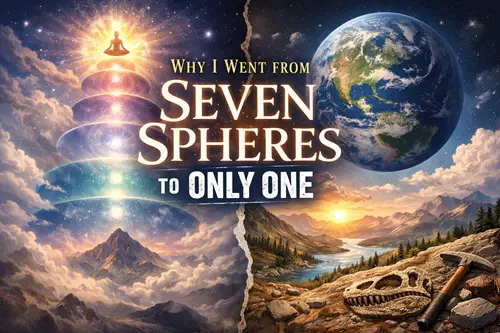 Introduction: A Serious Response Deserves a Serious ReplyJim Loving's From Seven Spheres to One: An Integrative Metatheoretical Response to Frank Visser's Intellectual Journey is a welcome contribution to the ongoing discussion about the limits of Integral Theory, the meaning of intellectual honesty, and the relationship between scientific naturalism and broader philosophical worldviews. It does not simply dismiss my journey from a spiritually layered cosmos to scientific naturalism as a loss of depth. Instead, it attempts to reconstruct the philosophical commitments underlying that journey and to identify what might have been gained—and lost—along the way. That deserves appreciation. Too many intellectual movements treat departures from their worldview as evidence of spiritual decline, developmental failure, or an inability to appreciate their supposedly higher insights. Loving and Alethic AI take a more sophisticated approach. They recognize that my skepticism toward Integral Theory has a principled basis, acknowledge the history of metaphysical overreach within integral thinking, and argue that intellectual honesty requires more than simply replacing one comprehensive worldview with another. Nevertheless, I believe their response mischaracterizes an important part of my intellectual history, overstates the philosophical difficulties facing scientific naturalism, and does not adequately distinguish between recognizing different dimensions of human experience and claiming that these dimensions require an expanded metaphysical ontology. The central issue is not whether human life encompasses matter, consciousness, relationships, values, and meaning. Of course it does. The question is what follows from that recognition. Must we interpret these dimensions as evidence for a multilayered spiritual reality? Or can we investigate them without committing ourselves to metaphysical structures that have yet to earn their place in our account of the world? That distinction is crucial to understanding both my intellectual journey and the strengths and limitations of IAM's response. 1. The First Correction: My Earlier Worldview Was Not AQALBefore examining the philosophical argument, I need to correct a historical misrepresentation in the introduction and in Alethic AI's reconstruction of my intellectual journey. The introduction describes my trajectory as a movement away from Ken Wilber's AQAL framework, with its various levels and dimensions of reality, toward scientific naturalism. Alethic AI subsequently refers to Wilber's AQAL cosmology as the framework from which my earlier worldview developed. That is not historically accurate. The worldview I held decades ago was an esoteric conception of higher spheres, not Wilber's AQAL model. My earlier outlook belonged to a more traditional spiritual and esoteric picture of reality, in which existence was understood as comprising higher and lower planes or spheres. The cosmos was not simply the physical universe described by science. It possessed a spiritual architecture, and human development could be interpreted against the background of that larger, vertically ordered reality. Wilber's work subsequently became important to my intellectual development, but his AQAL model should not be retroactively substituted for the worldview I originally held. These systems have family resemblances, particularly in their hierarchical conceptions of reality, but they are not identical. This matters because it changes the interpretation of my journey. I was not simply moving from one version of Integral Theory to another, nor was I abandoning AQAL after having adopted it as my original metaphysical foundation. I was gradually reconsidering a more general esoteric conviction: that the world we encounter through ordinary experience and scientific inquiry is embedded in a larger spiritual order. That conviction eventually became difficult to sustain. The relevant question is not whether my earlier esoteric worldview was sufficiently sophisticated, or whether a more elaborate framework could have preserved its intuitions. It is whether the claims about higher spheres were adequately justified in the first place. Loving's response would have been stronger had it begun with this distinction. A sympathetic reconstruction of someone's intellectual journey must preserve the historical particulars rather than translating them immediately into the categories of the framework doing the interpreting. This is not a trivial biographical correction. It illustrates a more general methodological danger: an integrative framework can assimilate another person's experience into its own conceptual vocabulary so successfully that it inadvertently distorts the very experience it intends to understand. That is a problem for IAM to consider as much as for Wilber. 2. The Appreciable Strength of IAM's ResponseHaving made that correction, I want to acknowledge what Loving and Alethic AI accomplish. They take my intellectual development seriously. They do not assume that skepticism is necessarily a defensive reaction, that scientific naturalism must be a spiritually impoverished position, or that abandoning a metaphysical system amounts to abandoning the questions that originally made it attractive. The response also correctly identifies a genuine philosophical tension. There is a difference between claiming that science has explained everything and arguing that scientific inquiry provides our most reliable means of investigating claims about the natural world. I have no reason to claim that science has solved every problem of consciousness, that moral philosophy can be replaced by neuroscience, or that every meaningful human experience can be exhaustively described in the language of physics. Those would be much stronger claims than scientific naturalism requires. Loving is also right to invoke intellectual honesty as something more demanding than merely adopting a preferred worldview. It requires acknowledging uncertainty, recognizing the limitations of one's knowledge, and being willing to revise cherished beliefs when the evidence warrants it. I appreciate, too, the willingness to acknowledge the shortcomings of integral and other grand metaphysical systems. The response concedes that spiritual structures and developmental hierarchies have sometimes been presented with greater confidence than the available evidence justifies. It recognizes the danger of constructing an encompassing cosmology whose coherence is purchased at the expense of epistemic discipline. These are important concessions. Indeed, the strongest parts of the response are those in which it approaches my position without immediately attempting to overcome it. Its recognition that the higher spheres might not have the metaphysical status their proponents assign them is a promising starting point. But the argument becomes less convincing when this legitimate caution is turned into a claim that my naturalistic position is itself guilty of premature closure. 3. Does Scientific Naturalism Exclude First-Person Experience?One of the response's central objections is that my commitment to scientific naturalism risks privileging third-person knowledge at the expense of first-person experience and second-person relations. Alethic AI argues that subjective experience cannot simply be dismissed because it resists third-person reduction. It also emphasizes the normative dimension of intellectual honesty: the fact that we make judgments about what we ought to believe and how we ought to conduct inquiry. These are legitimate concerns. But the conclusion drawn from them is too strong. I do not need to deny the reality of subjective experience to maintain that it belongs within the natural world. Nor must I deny the reality of moral obligations, interpersonal relationships, or shared meanings simply because these phenomena are not physical objects in the ordinary sense. The crucial distinction is between recognizing different dimensions of human experience and treating those dimensions as evidence for different metaphysical realms. Pain is experienced subjectively. Its causes can nevertheless be investigated physiologically. The experience of love involves first-person feelings, relationships between persons, and biological processes. None of these descriptions automatically cancels the others. Likewise, moral reasoning occurs within a normative practice, but that fact does not establish the existence of a separate normative sphere in the metaphysical sense. We need not choose between denying these phenomena and granting them an independent ontological status. This is where the response risks conflating epistemology with ontology. We can have different ways of knowing, describing, and evaluating the world without concluding that reality must therefore consist of corresponding metaphysical domains. The first-person, second-person, and third-person distinctions can be immensely useful. They direct our attention toward different questions and different kinds of evidence. But they do not, by themselves, establish that these perspectives disclose three irreducible ontological dimensions. The existence of multiple perspectives on reality does not automatically imply a reality divided into corresponding metaphysical compartments. Loving is right to insist that we take experience seriously. He has not shown that doing so requires the additional metaphysical commitments he wishes to preserve. 4. The Hard Problem Is Not a License for Higher SpheresThe response gives particular attention to the problem of consciousness. It correctly notes that a complete explanation of subjective experience remains elusive and argues that intellectual honesty requires us to acknowledge this unresolved question rather than dissolve it by definition. I agree with the caution. Consciousness is a difficult problem, and I would not claim that contemporary neuroscience has settled every philosophical question about subjective experience. But an explanatory gap is not evidence for a spiritual realm. The fact that we do not yet have a satisfactory explanation of why or how subjective experience arises does not establish that consciousness originates in a higher sphere, that mind possesses a nonphysical foundation, or that spiritual metaphysics offers a better explanation. We must distinguish between a genuine problem and a proposed solution to that problem. The hard problem of consciousness remains a legitimate subject of philosophical debate. But its existence does not automatically favor dualism, idealism, panpsychism, or any particular version of integral metaphysics. Those positions must still make their respective cases. The same applies to the nature of selfhood. If the ordinary sense of being a unified, enduring self turns out to be partly constructed by the brain, this may have profound philosophical implications. It does not follow that the dissolution of the self reveals a higher ontological dimension. Nor does the subjective experience of transcendence establish that the individual has gained access to a reality beyond nature. Such experiences may be psychologically transformative, phenomenologically distinctive, and culturally significant. Their interpretation remains a separate question. This is precisely where I think my intellectual journey differs from the one Alethic AI appears to reconstruct. My movement away from esoteric metaphysics was not a declaration that the mysteries of consciousness had been solved. It was a growing reluctance to treat mysteries as evidence for the particular explanations that spiritual traditions had attached to them. The honest response to an unresolved problem may simply be to leave it unresolved. 5. The Normative Challenge: Can Naturalism Account for Intellectual Honesty?Perhaps the most philosophically interesting part of Loving's response concerns normativity. The argument is that intellectual honesty is not merely a physical event. It involves standards of reasoning, obligations to truth, and judgments about how one ought to conduct inquiry. These belong to what philosophers call the space of reasons, rather than simply the space of causes. The observation is sound. But the inference that follows requires more argument. To say that intellectual honesty is not identical to a neural firing pattern is not to establish that it exists in a separate ontological sphere. A norm can be real as a standard governing human reasoning without being a supernatural entity or a fundamental ingredient of the cosmos. Consider the rules of logic. We can investigate how people reason, how cognitive biases influence their judgments, and how logical standards are taught and applied. We can also debate the justification of particular standards of inference. None of this requires us to populate the universe with a separate realm of logical objects in the sense implied by a metaphysical interpretation of higher spheres. The same applies to intellectual honesty. It is a normative ideal that can be defended through arguments about truth-seeking, consistency, evidence, and the consequences of self-deception. Its justification is not reduced to a description of brain activity, but neither does it require a spiritual foundation. Of course, this leaves difficult questions about the ultimate grounding of normativity. Philosophers disagree about moral realism, constructivism, expressivism, and other approaches. Scientific naturalism does not automatically resolve these debates. But neither does integral metatheory. If Loving wants to argue that normative obligations cannot be adequately understood within a naturalistic worldview, he needs to establish that claim. Simply pointing out that norms are not physical objects does not suffice. There is a further irony here. The response uses intellectual honesty to challenge my naturalism, while also insisting that we should not make unwarranted metaphysical claims. I welcome the latter principle. But it should apply symmetrically. If we do not know how normativity fits into a comprehensive naturalistic account, we should acknowledge that uncertainty. We should not treat the unresolved question as a reason to reinstate a larger metaphysical architecture. An unexplained feature of nature is not automatically evidence for something beyond nature. 6. The Problem with Calling Naturalism “Deficient Rationality”The response invokes Jean Gebser's distinction between an adequate and a deficient mode of mental-rational consciousness. In this interpretation, rationality becomes deficient when it mistakes its own methods and perspectives for the whole of reality. This is a familiar criticism of scientific reductionism, and it can be useful when directed at genuinely overconfident claims. If someone argues that only what can be measured immediately is real, or that the natural sciences have already resolved every philosophical question, criticism is warranted. But that is not the only possible interpretation of scientific naturalism. A methodological commitment to evidence does not require the dogmatic assertion that every real phenomenon must already be measurable with current instruments. Nor does it entail that every meaningful question must be answerable by a laboratory experiment. Scientific inquiry has repeatedly expanded its conceptual and observational reach. It has also benefited from philosophical criticism, mathematical reasoning, historical investigation, and the careful study of subjective reports. The question is not whether rationality has limitations. It plainly does. The question is what we should do when we encounter those limitations. Gebser's vocabulary can help us reflect on the dangers of intellectual rigidity. But it can also become a way of assigning an elevated developmental status to a preferred worldview and a deficient status to its critics. If scientific naturalism is dismissed as deficient rationality simply because it demands evidence for higher metaphysical claims, the developmental framework has begun to protect those claims from criticism rather than examine them. That would be a particularly unfortunate outcome for an intellectual movement that professes epistemic pluralism. A skeptical position should not be diagnosed as developmentally deficient merely because it declines to endorse the ontology of the framework doing the diagnosing. The decisive question is whether a position is justified, not whether it can be assigned a flattering or unflattering place on a developmental map. 7. Emergence Is Not Spiritual EvolutionLoving also appeals to emergence. Life arises from nonliving chemistry, mental capacities develop in biological organisms, and culture depends on human capacities for communication and social organization. These transitions involve novelty, new forms of organization, and properties that cannot always be understood by examining isolated components. I agree that emergence is an important subject for naturalistic inquiry. A simplistic reductionism that assumes the behavior of every complex system can be understood merely by listing its elementary parts would be inadequate. But the concept of emergence does not establish the metaphysical picture that integral thinkers sometimes attach to it. The emergence of life does not demonstrate that the universe was directed toward life. The emergence of consciousness does not establish that consciousness was an implicit cosmic purpose. The emergence of human moral reasoning does not prove that evolution is guided toward higher spiritual values. Emergence describes the appearance of new properties or forms of organization under particular conditions. Whether those developments exhibit a larger direction, purpose, or spiritual significance is an additional question. This distinction matters because spiritual cosmologies often move from an uncontroversial observation about complexity to a much more ambitious claim about the direction of reality. Evolution produces novel forms. Therefore, the argument goes, evolution expresses a deeper drive toward consciousness, complexity, or Spirit. But the conclusion does not follow from the premise. Evolutionary history includes increasing complexity in some lineages, simplification in others, extinction, stagnation, and enormous contingent variation. There is no general guarantee that greater complexity means greater moral worth, greater consciousness, or a closer approximation to a cosmic goal. Naturalistic accounts of emergence can recognize genuine novelty without interpreting it as evidence of spiritual ascent. This is a point on which I would welcome further discussion with IAM. The challenge is not to deny emergence or insist that reality is nothing but an inventory of elementary particles. It is to distinguish claims about organization and causation from claims about purpose and metaphysical direction. The former can be investigated through scientific and philosophical inquiry. The latter require independent justification. 8. Intellectual Honesty Requires SymmetryThe most constructive principle in Loving's essay is that intellectual honesty requires us to remain open to evidence and resist premature closure. I agree. But this principle must apply equally to the positions being compared. Alethic AI suggests that my movement toward scientific naturalism risks closing off possibilities before they have been adequately explored. That is a legitimate concern to raise. Any worldview can become dogmatic, including a naturalistic one. But the same criticism applies to the presumption that the limitations of naturalistic explanations point toward a broader integrative ontology. If consciousness remains difficult to explain, we should investigate it. If the justification of moral norms remains contested, we should examine the arguments. If contemplative practices produce unusual experiences, we should study their phenomenology, psychological effects, and possible mechanisms. None of these investigations needs to begin with the assumption that the findings will support a particular metaphysical worldview. Nor should we decide in advance that all significant phenomena must eventually be integrated into one comprehensive framework. A genuinely open inquiry must permit several possible outcomes. It might vindicate a naturalistic explanation, establish the need for new concepts, reveal the limitations of existing theories, or leave an issue unresolved. In some cases, competing explanations may remain viable for a long time. The important thing is that the investigation should not be structured so that every result confirms the framework's basic assumptions. This is especially relevant to IAM's interest in integrative metatheory. A framework that can accommodate multiple perspectives is not necessarily a framework that can adjudicate between them. And a framework that can reinterpret every objection as evidence of a partial perspective may be comprehensive without being sufficiently discriminating. I would therefore turn Loving's own challenge around. Can integrative metatheory discover that a spiritual interpretation is unnecessary? Can it conclude that a supposedly higher developmental level has not been demonstrated? Can it acknowledge that a naturalistic explanation is superior in a particular case, without insisting that the result must eventually be incorporated into a larger metaphysical synthesis? If the answer is yes, then IAM has an opportunity to demonstrate the intellectual honesty it advocates. If the answer is no, its openness risks becoming a form of protected comprehensiveness. 9. The Difference Between Taking Experience Seriously and Believing Its InterpretationOne of the persistent difficulties in discussions of spirituality is the tendency to move too quickly from the reality of an experience to the truth of its interpretation. Mystical experiences are real as experiences. Feelings of unity, transcendence, selflessness, sacredness, and contact with something greater than oneself can be profound and consequential. Contemplative practices may alter attention, emotion, self-perception, and one's relationship to the world. These phenomena deserve careful study. A naturalistic perspective need not dismiss them as illusions merely because it questions their metaphysical interpretation. The experience of encountering a higher sphere, for instance, can be psychologically real without establishing that such a sphere exists independently of the experience. A feeling of unity with the universe does not, by itself, establish that the universe possesses a unified spiritual consciousness. The disappearance of the ordinary sense of self does not prove that one has accessed a universal Self. To make these distinctions is not to deny the significance of spiritual experience. It is to separate phenomenological description from ontological interpretation. That separation is especially important when spiritual experiences are embedded in elaborate traditions that supply ready-made explanations. A practitioner trained to understand consciousness through a hierarchy of spiritual planes may interpret an unusual experience in terms of that hierarchy. Someone with a different conceptual background may interpret a similar experience differently. This does not mean that all interpretations are equally plausible. It means that the experience alone cannot settle the dispute. IAM's emphasis on multiple perspectives could be valuable here. A comparative framework might help distinguish what is shared across contemplative traditions from what is culturally specific, and what can be independently investigated from what remains a metaphysical interpretation. But the framework must not simply preserve every interpretation as a valid contribution to a larger whole. It must also be able to ask which interpretations are best supported and which add assumptions without explanatory benefit. That would be a productive form of integration: not the indiscriminate inclusion of every worldview, but the disciplined comparison of competing claims. 10. From Esoteric Altitude to Intellectual AccountabilityMy own intellectual journey is sometimes presented as a contraction: I once inhabited a richer, multilayered reality and now accept a more restricted one. Loving's response draws attention to the possible costs of that contraction, particularly the risk of overlooking dimensions of experience that cannot be captured by a narrowly third-person account. I understand the concern. But I would describe the journey differently. What changed was not my willingness to recognize complexity, consciousness, meaning, or the richness of human experience. What changed was my willingness to interpret those phenomena through an esoteric cosmology whose additional claims I could no longer adequately justify. The old worldview offered a coherent picture of existence. It connected the human condition to a larger spiritual architecture and situated personal development within a cosmic story. Such a picture can be deeply attractive. It provides orientation, significance, and a sense that the world is intelligible at a higher level. But coherence and consolation are not the same as truth. The fact that a worldview makes sense of many experiences does not establish that its underlying ontology is correct. A system may be comprehensive because it has discovered something fundamental, or because it has developed enough conceptual flexibility to accommodate almost anything. The task is to distinguish these possibilities. My movement toward scientific naturalism therefore represents less a rejection of depth than a change in the standards by which claims about depth are evaluated. I am willing to acknowledge that there may be aspects of reality we do not yet understand. I am less willing to treat that uncertainty as a reason to endorse a particular spiritual explanation. This position has its own limitations and must remain open to criticism. But it does not follow that it is deficient merely because it declines to preserve the metaphysical architecture of my earlier worldview. Intellectual honesty sometimes requires relinquishing an attractive explanation without having a complete replacement for it. 11. What IAM Could Learn from This ExchangeLoving's response offers IAM an opportunity to clarify what its integrative ambitions are meant to achieve. If the project is primarily about improving communication among disciplines, comparing conceptual frameworks, and identifying recurring patterns across bodies of knowledge, it has a potentially useful role. There is value in discovering where theories complement one another, where they conflict, and where they operate with different assumptions. A well-designed metatheoretical inquiry could help researchers avoid unnecessary disputes, identify neglected questions, and improve the coordination of specialized knowledge. But these achievements should not be confused with establishing a comprehensive ontology. IAM would be more persuasive if it clearly distinguished its comparative methods from its substantive claims about reality. It should specify which findings are empirical, which are philosophical interpretations, which are heuristic proposals, and which remain speculative. It should also demonstrate that its framework can discriminate between competing explanations. Where two theories conflict, does IAM have criteria for deciding between them? When a spiritual interpretation adds no explanatory value, can it say so? When a simpler or more specialized framework works better, can IAM acknowledge that result without treating it as merely one partial contribution to an eventual synthesis? These are not hostile questions. They are the questions that any ambitious intellectual project must eventually answer. The same standard applies to claims about developmental complexity and civilizational fragmentation. Such concepts may prove useful, but their usefulness depends on how clearly they are defined, how they guide inquiry, and whether they help us explain or anticipate outcomes better than competing approaches. A grand framework should not receive credit merely for accommodating a large number of perspectives. It should demonstrate what its distinctive perspective enables us to discover. The most interesting outcome of this exchange would therefore not be a compromise in which my naturalism and IAM's integrative outlook are declared equally valid poles. It would be a clearer account of where their methods differ, what each can establish, and which claims remain unresolved. Pluralism is valuable when it enables critical comparison. It becomes less valuable when it prevents critical judgment. Conclusion: Appreciation Without SurrenderI appreciate Jim Loving's willingness to engage my intellectual journey seriously, and I welcome Alethic AI's attempt to reconstruct the philosophical issues involved. The response is thoughtful, recognizes genuine difficulties in integral metaphysics, and raises important questions about consciousness, normativity, and the limitations of scientific explanation. My main objections are nevertheless substantial. First, the introduction misrepresents my intellectual history by treating my earlier esoteric worldview as though it were Wilber's AQAL model. My original commitment was to a spiritual conception of higher spheres, and that distinction should be preserved. Second, the response moves too quickly from the reality of first-person experience and normative practices to the claim that naturalism inadequately accounts for them. Recognizing different dimensions of experience does not automatically establish separate metaphysical domains. Third, unresolved problems in consciousness and normativity do not, by themselves, justify an expanded spiritual ontology. Ignorance is a reason for continued inquiry, not a warrant for whichever metaphysical explanation happens to be available. Finally, the appeal to intellectual honesty must be applied symmetrically. If naturalism should remain open to revision, so should integrative metatheory. Its claims must be evaluated by standards that can distinguish successful explanations from attractive but unsupported interpretations. I do not expect IAM to abandon its integrative ambitions. Nor do I think it needs to choose between a simplistic reductionism and an all-encompassing spiritual cosmology. There is ample room for sophisticated naturalism, emergentist thinking, philosophical pluralism, and careful attention to subjective experience. What I resist is the assumption that these concerns must ultimately be gathered into a larger metaphysical whole. My journey from esoteric spheres to scientific naturalism has not resolved every philosophical question. It has, however, changed what I consider an acceptable answer. Where I once found reassurance in a picture of a spiritually ordered cosmos, I now ask what justifies that picture, what it explains, and how we could discover that it is mistaken. That is not necessarily a retreat from intellectual depth. It may be a refusal to confuse depth with altitude. And perhaps this is where IAM and I can agree on something fundamental: intellectual honesty requires us to follow the inquiry wherever it leads, including toward conclusions that our preferred frameworks cannot easily accommodate. For IAM, the test is not whether it can find a place for my naturalism within a comprehensive integrative map. The test is whether it can engage that naturalism on its own terms, identify its actual strengths and limitations, and discover something that neither of us had adequately understood before. I would welcome that kind of engagement. It would be more valuable than another attempt to rescue my intellectual journey by interpreting it as a case of premature philosophical contraction. The point is not to return to seven spheres, nor to declare that one sphere exhausts every possible question. It is to distinguish what we have good reason to believe from what we remain free to imagine. That distinction, rather than any preferred altitude of consciousness, is where intellectual honesty begins.
Widget is loading comments...
|