|
TRANSLATE THIS ARTICLE
Integral World: Exploring Theories of Everything
An independent forum for a critical discussion of the integral philosophy of Ken Wilber
  Frank Visser, graduated as a psychologist of culture and religion, founded IntegralWorld in 1997. He worked as production manager for various publishing houses and as service manager for various internet companies and lives in Amsterdam. Books: Ken Wilber: Thought as Passion (SUNY, 2003), and The Corona Conspiracy: Combatting Disinformation about the Coronavirus (Kindle, 2020).
Check out my other conversations with ChatGPT The Mystification of BeingHas Spirituality Overrated the Eternal at the Expense of the World?Frank Visser / ChatGPT
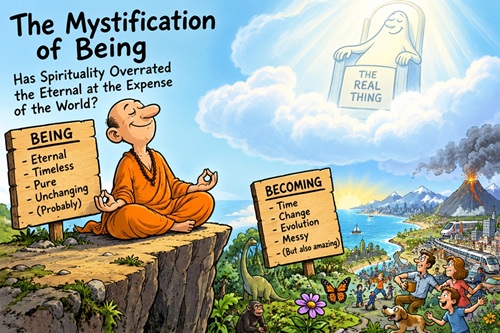 The Promise of a Reality Beyond BecomingOne of the most persistent claims in mystical spirituality is that beneath the changing surface of existence lies a deeper, unchanging reality: Being itself. The world we ordinarily inhabit is a realm of Becoming, characterized by time, change, impermanence, birth, decay, and death. Beneath this restless flux, mystics claim, lies an eternal dimension that neither comes into existence nor passes away. It is variously called the Absolute, the Ground of Being, pure Consciousness, the Unborn, the One, or simply Spirit. In mystical experience, this dimension is often said to be more real than the world we ordinarily perceive. The individual self dissolves, the boundaries between subject and object disappear, and a sense of timeless presence may emerge. The experience can be profound, sometimes life-changing. But a question deserves more attention than it usually receives in spiritual circles: why should an experience of timelessness be interpreted as contact with a superior dimension of reality? Perhaps Being has been overrated. Perhaps an important feature of human consciousness has been elevated into a cosmic principle, and perhaps the resulting metaphysics tells us more about the human desire for permanence than about the ultimate structure of the universe. This is not an argument against mystical experiences. It is an argument against the automatic promotion of such experiences into a privileged ontology. From an Experience to a MetaphysicsWe should begin by distinguishing three claims that are frequently run together in mystical discourse. The first is experiential: people can experience moments in which ordinary temporal awareness recedes. The constant mental commentary may fall silent, the sense of a separate self may weaken, and the present moment may seem unusually vivid, expansive, or timeless. The second is interpretive: these experiences reveal something fundamental about consciousness or reality. What feels like an escape from the ordinary self is interpreted as the discovery of a deeper identity, a universal awareness, or an underlying ground of existence. The third is metaphysical: this timeless ground is more fundamental, more real, or more spiritually significant than the changing world of everyday life. The first claim is entirely plausible. The second is open to investigation and philosophical debate. The third requires an argument of its own. Yet mystical traditions frequently move from the first to the third as if no significant inferential gap existed between them. A person experiences a state in which time seems to disappear and concludes that timelessness is the ultimate nature of reality. But an experience in which time is absent from awareness is not necessarily an experience of a reality outside time. The disappearance of temporal awareness does not establish the disappearance of time itself. We know that our perception of time is variable. It can accelerate, slow down, become fragmented, or temporarily lose its ordinary structure. Intense concentration, aesthetic absorption, meditation, fatigue, and other altered states can transform our experience of temporal duration. None of this requires the conclusion that consciousness has escaped the temporal order of the universe. The central problem is therefore one of interpretation. Mystics may accurately report what they experience while overestimating what their experiences establish. Is Timelessness Really More Real?Why should the unchanging be considered more real than the changing? The assumption is ancient and philosophically influential. In Plato's metaphysics, the changing world of sensory experience is contrasted with the more stable realm of Forms. In some interpretations of Advaita Vedanta, Brahman is the ultimate reality, while the plurality and change of the phenomenal world belong to the domain of appearance, ignorance, or dependent reality. Buddhist traditions, despite their substantial differences from one another, have also explored the unconditioned and the cessation of ordinary forms of attachment. In Western mysticism, the soul's ascent toward the eternal has often been understood as a movement beyond the transient world. These traditions should not be treated as interchangeable. Their understandings of ultimate reality differ considerably, and Buddhism in particular cannot simply be classified as teaching an eternal metaphysical Being. Nevertheless, a recurring pattern can be identified: the changing world is assigned a lower status, while something unchanging or unconditioned is treated as more fundamental. But what justifies this hierarchy? Change is not a defect in reality. It is one of the most obvious characteristics of the world we inhabit. Stars form and die. Galaxies evolve. Chemical elements are forged in stellar interiors. Life emerges, diversifies, and disappears. Organisms develop through time, and human consciousness depends on biological systems that are themselves products of evolutionary history. Nothing about this makes the world unreal. Indeed, the distinction between a supposedly inferior world of Becoming and a superior realm of Being may reflect an understandable psychological preference rather than a discovery about the universe. Human beings are vulnerable creatures. We age, suffer, lose loved ones, and anticipate our own deaths. The idea of an eternal reality offers an attractive counterweight to this instability. It promises that beneath the turbulence of existence, something remains untouched. The appeal is obvious. The evidence for the metaphysical conclusion is another matter. To prefer permanence is not to demonstrate its superiority. To find the unchanging consoling is not to establish that it constitutes a deeper order of existence. The Confusion Between Stability and EternityThere is, moreover, a conceptual ambiguity at the heart of the idea of Being. What exactly is supposed to be unchanging? If Being means simply that something exists, then the concept is unobjectionable but hardly mysterious. A tree exists while it grows. A star exists while it burns. A person exists while changing physically and psychologically. Existence does not require immobility. If Being means the fact that anything exists at all, the concept becomes more philosophically demanding. Why is there something rather than nothing? What does it mean for anything to exist? These are legitimate metaphysical questions. But they do not establish the existence of a timeless spiritual dimension. And if Being means an eternal, self-sufficient reality standing behind or beyond the world, the claim becomes stronger still. It now requires some account of what this reality is, how we know it exists, and what explanatory work it performs. Mystical writing often slides between these meanings. Being begins as a name for the fact of existence, becomes an experience of immediate presence, and ends as the ultimate ground of the cosmos. The apparent continuity of the word conceals a substantial change in meaning. There is a further difficulty. An unchanging reality, if understood as completely devoid of differentiation, internal relations, or events, would seem to lack many of the features through which we ordinarily identify and understand anything. How could such a reality be distinguished from nothing? What would it mean for it to be conscious? How could it explain a changing universe without introducing some relationship between itself and that universe? Theologians and philosophers have offered sophisticated responses to such questions, including accounts of timeless knowledge, emanation, manifestation, and the dependence of finite existence on an absolute ground. These responses deserve consideration. But naming the ultimate reality "Being" does not itself solve the problems. A concept can be profound without being explanatory. Does the Eternal Explain the Temporal?The decisive question is not whether mystical experience is meaningful. It is whether the metaphysics derived from it explains anything that would otherwise remain unexplained. Suppose we observe a universe in which matter forms increasingly complex structures under appropriate physical conditions. Stars produce heavier elements; planets develop; chemical systems acquire new properties; biological evolution generates organisms with increasingly elaborate capacities; nervous systems give rise to forms of cognition and consciousness. These processes are not uniform, inevitable, or directed toward a single predetermined goal. They nevertheless provide a substantial research program for explaining how complexity and novelty arise. Now introduce an eternal Being underlying all these developments. What does this addition explain? Does it specify the conditions under which stars form? Does it account for the origin of biological variation? Does it identify the mechanisms through which consciousness emerges? Does it make a prediction that could distinguish a universe permeated by spiritual Being from one in which no such principle exists? If it does none of these things, its explanatory contribution remains uncertain. A defender might respond that Being is not intended to explain particular events. It explains why anything exists at all, or why the universe is intelligible, or why consciousness is possible. These are different and potentially legitimate philosophical projects. But they must be evaluated on their own terms. They cannot simply borrow the authority of mystical experience. There is a difference between offering an ultimate explanation and assigning an ultimate name to the mystery. An eternal Being that is compatible with every possible state of affairs risks explaining none of them. If the universe develops, Being manifests through development. If the universe remains stable, Being expresses itself through stability. If life arises, Being is said to express itself as life; if life disappears, its eternal ground remains untouched. Whatever happens can be accommodated after the fact. Such a principle may provide a spiritual interpretation of reality, but it does not thereby become an empirically established explanation of reality. The problem is particularly acute when Being is described as a force, intelligence, or source of evolutionary development. The moment it is credited with producing effects in the changing world, questions arise about how those effects occur and how the proposed agency can be distinguished from known physical, chemical, biological, and psychological processes. If Being does not act, it is unclear how it explains Becoming. If it does act, we need an account of its action. The World as an Inferior RealityThe spiritual privileging of Being can also have practical consequences. When the changing world is regarded as a lower order of reality, ordinary existence becomes something to transcend rather than understand and inhabit. The body is treated as a temporary vehicle. Personal identity becomes an illusion to be overcome. Emotional attachments are interpreted as obstacles to liberation. Historical struggles, political institutions, and ecological crises can appear secondary to the realization of an eternal dimension that supposedly transcends them all. Not every mystical tradition adopts these attitudes, and many contemplative practitioners have been deeply engaged in social and ethical life. Nevertheless, the hierarchy between Being and Becoming creates a recurrent temptation: the more attention we give to the eternal, the less seriously we take the contingent conditions of our existence. There is an obvious danger here. A person may attain equanimity while remaining indifferent to injustice. A community may celebrate transcendence while neglecting material suffering. A teacher may describe the world as an expression of absolute consciousness while treating ordinary criticism as evidence that the critic remains trapped in a lower state of awareness. The problem is not contemplation itself. It is the assumption that a state of consciousness grants privileged authority over the problems of the world. Indeed, the opposite conclusion is also possible. If life is finite, relationships are vulnerable, and suffering occurs within the actual conditions of existence, then the changing world deserves more attention, not less. Its impermanence makes care urgent. Its vulnerability gives ethical action its significance. One need not believe in an eternal ground to recognize the value of compassion, courage, beauty, or understanding. Being as a Psychological RefugePerhaps the most sobering interpretation is that the metaphysics of Being often functions as a response to existential insecurity. This does not mean that all mystical experiences are merely wish fulfillment. Nor does it mean that a belief is false because it serves a psychological need. Those would be genetic fallacies: the origins or functions of a belief do not, by themselves, determine its truth. But psychological motives matter when evaluating why certain interpretations become attractive and resistant to criticism. The promise of an unchanging ground addresses some of our deepest fears. If the individual self is transient, perhaps our true identity is eternal. If the world is unstable, perhaps reality itself is secure. If death ends our personal existence, perhaps what we fundamentally are was never born and cannot die. These ideas can transform a person's relationship to fear and mortality. That is a genuine psychological possibility. But psychological effectiveness and metaphysical truth are different questions. A belief may reduce anxiety without accurately describing the universe. Conversely, an unsettling view of reality may be true despite offering little consolation. The distinction matters because spiritual traditions sometimes treat the felt certainty of realization as proof of its content. The experience seems self-authenticating: one does not merely believe in Being but feels that one has directly encountered it. Yet the intensity of conviction does not guarantee the correctness of an interpretation. People can experience equally powerful states and draw incompatible conclusions about their ultimate meaning. The experience may be authentic as an experience. Its interpretation remains open to criticism. Is Being Even the Opposite of Becoming?The opposition between Being and Becoming may itself be misleading. It encourages us to imagine two separate domains: one eternal and unchanging, the other temporal and mutable. But perhaps this contrast arises partly from the limitations of our concepts. Everything we ordinarily call a being exists through processes. An organism maintains itself through metabolism. A flame persists through combustion. A river retains its identity while its water continually changes. A person remains recognizably the same individual through the replacement of cells, the acquisition of memories, and transformations in character. In such cases, persistence does not require the absence of change. It emerges through organized change. This observation does not settle the deepest metaphysical questions about existence. But it undermines the assumption that stability and process must belong to categorically different orders of reality. What endures may endure through transformation rather than by escaping it. Contemporary science reinforces this process-oriented perspective. The universe has a history. Space and time are integral to physical theories, matter participates in dynamic interactions, and living organisms are historically evolved systems. Even apparently stable objects depend on ongoing processes and relationships. This does not prove that no timeless metaphysical reality exists. Science is not a universal instrument for deciding every philosophical question. But it provides no general warrant for elevating the timeless over the temporal, and it gives us compelling reasons to investigate persistence, identity, and organization within the changing world itself. The eternal may be a useful concept in some philosophical arguments. It is not an established destination to which science is gradually leading us. The Integral Compromise: Transcend and Include?Integral spirituality offers a potentially more accommodating formula: transcend and include. The higher does not simply reject the lower but preserves and incorporates it within a more comprehensive perspective. In this framework, Being and Becoming can be understood as complementary dimensions of reality rather than mutually exclusive alternatives. This is more attractive than a straightforward flight from the world. It acknowledges that timeless awareness, if it is a meaningful description of certain experiences, need not invalidate embodied life or historical development. Yet the formula does not resolve the underlying epistemological problem. Calling Being and Becoming complementary does not demonstrate that Being exists as an independent cosmic principle. Nor does placing both within a comprehensive metaphysical scheme establish that the scheme is true. An integral theory can acknowledge the value of contemplative experience while remaining agnostic about its ultimate interpretation. It can recognize that people sometimes experience a diminished sense of self and an unusually immediate awareness of the present without concluding that they have discovered the universe's eternal foundation. The language of transcendence becomes less problematic when it describes a transformation in perspective rather than a literal escape into a superior dimension of existence. A person may transcend egocentrism without transcending biology. One may loosen attachment to one's thoughts without ceasing to depend on a brain. One may experience the present without believing oneself to have exited time. And one may discover a powerful sense of unity without concluding that the cosmos is literally a single, eternal consciousness. Such interpretations do not diminish contemplative life. They simply refuse to grant it an automatic metaphysical privilege. A Naturalistic Revaluation of the PresentWhat would happen if we stopped treating Being as the spiritual opposite of Becoming and instead regarded existence as inseparable from the processes through which things arise, persist, and disappear? The result need not be a bleak or disenchanted worldview. A naturalistic understanding of reality can recognize the extraordinary character of the universe without positing a supernatural dimension behind it. It can regard consciousness as a remarkable development in the history of life, even while acknowledging that its nature remains incompletely understood. It can find beauty in a transient world without requiring that beauty to be secured by eternity. On this view, impermanence is not a spiritual defect. It is a condition of life. The fact that a flower fades does not make its flowering unreal. The fact that a human relationship can end does not make its intimacy illusory. The fact that civilizations rise and fall does not render their achievements insignificant. Nor must meaning be guaranteed by a timeless cosmic source. Meaning can arise through the activities of beings who care, remember, create, discover, and cooperate. Its historical and relational character does not make it meaningless. It makes it something we participate in producing and sustaining. This is a more demanding position than the promise of an eternal refuge. It offers no assurance that the universe has humanity in mind, that evolution is directed toward spiritual fulfillment, or that individual consciousness survives bodily death. But it does not follow that life is therefore empty. It follows that meaning must be understood in relation to the lives and worlds in which it occurs. The universe does not need to be eternal in the mystical sense for its history to be astonishing. Conclusion: Bringing Being Back Down to EarthThe mystical idea of Being deserves neither automatic reverence nor automatic dismissal. It points toward genuine philosophical questions about existence, identity, consciousness, and the experience of timelessness. It also expresses a recognizable human desire to find stability amid change. But these legitimate concerns have too often been fused into a grand metaphysical claim: that an eternal, spiritual reality is more fundamental than the world of time and evolution, and that mystical experience provides direct access to it. That conclusion is not established merely by the depth of the experience, the authority of a tradition, or the elegance of a philosophical system. We should distinguish the experience of timelessness from the assertion of timeless reality, the feeling of unity from the claim of cosmic oneness, and existential consolation from explanatory knowledge. We should ask what the concept of Being contributes, what evidence supports it, and whether it illuminates the world or merely redescribes it in sacred language. Above all, we should question the assumption that what does not change must be more real than what does. The universe we know is a history of transformations. Its stars have histories; its living creatures have histories; human minds and cultures have histories. We ourselves are temporary participants in this unfolding process. There is no obvious reason why this should be considered a lesser form of existence than an imagined eternity beyond it. Perhaps the real spiritual challenge is not to escape Becoming but to understand how to live within it: without demanding permanence where there is none, without mistaking consolation for truth, and without devaluing the world because it changes. Being need not be abolished. It needs to be brought back down to earth. For if Being is simply another name for the fact that reality exists, it requires no mystification. And if it is meant to designate a timeless spiritual realm standing behind the world, it must do more than inspire awe. It must earn its metaphysical status. Until then, the changing universe has a stronger claim on our attention than the eternal ground we have imagined beneath it.
Widget is loading comments...
|