|
TRANSLATE THIS ARTICLE
Integral World: Exploring Theories of Everything
An independent forum for a critical discussion of the integral philosophy of Ken Wilber
  Frank Visser, graduated as a psychologist of culture and religion, founded IntegralWorld in 1997. He worked as production manager for various publishing houses and as service manager for various internet companies and lives in Amsterdam. Books: Ken Wilber: Thought as Passion (SUNY, 2003), and The Corona Conspiracy: Combatting Disinformation about the Coronavirus (Kindle, 2020). Frank Visser, graduated as a psychologist of culture and religion, founded IntegralWorld in 1997. He worked as production manager for various publishing houses and as service manager for various internet companies and lives in Amsterdam. Books: Ken Wilber: Thought as Passion (SUNY, 2003), and The Corona Conspiracy: Combatting Disinformation about the Coronavirus (Kindle, 2020).
Check out my other conversations with ChatGPT Living Fossils: The Myth of Evolutionary StagnationWhat the Coelacanth Really Tells Us About Evolution<Frank Visser / ChatGPT
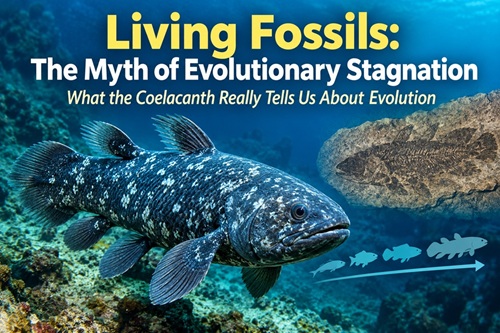 The Rediscovery of a Supposedly Extinct FishFew discoveries in modern zoology have captured the public imagination as powerfully as the rediscovery of the coelacanth. In December 1938, a strange fish caught off the coast of South Africa attracted the attention of Marjorie Courtenay-Latimer, curator of a small museum in East London. Recognizing that the specimen was unusual, she contacted the South African ichthyologist J. L. B. Smith, who eventually identified it as a living representative of a group previously known only from fossils. The discovery was extraordinary: coelacanths were thought to have disappeared approximately 66 million years ago, near the end of the Cretaceous period. The fish was not, in fact, a surviving individual from the age of dinosaurs. It was a member of a lineage whose fossil record extended deep into geological history. Nevertheless, the discovery was so surprising that the coelacanth soon acquired an almost mythical status. Here was a creature that appeared to have survived for hundreds of millions of years with remarkably little change. It seemed to offer a living window into the distant past, perhaps even a challenge to the idea that evolution necessarily transforms organisms over time. But the coelacanth's real significance is more interesting than the popular story suggests. It illustrates both the extraordinary continuity of life and the ease with which that continuity can be misunderstood. The concept of the living fossil is scientifically useful, but it can also encourage misleading ideas about evolution, progress, and the relationship between an organism's present form and its evolutionary history. What Exactly Is a Living Fossil?The expression living fossil is generally associated with organisms that closely resemble ancient fossil relatives and belong to lineages with long histories in the fossil record. Besides the coelacanth, familiar examples include horseshoe crabs, the ginkgo tree, the tuatara of New Zealand, and the nautilus. The term is evocative, but it is not a precise scientific category. There is no universally accepted threshold for how much morphological similarity or evolutionary continuity makes a species a living fossil. Nor does the expression mean that the modern organism is literally unchanged from its ancient ancestors. This distinction matters. A fossil representing an ancient coelacanth and a modern coelacanth may share a recognizable body plan, but that does not establish that they are identical in anatomy, physiology, genetics, development, or behavior. Modern species have their own evolutionary histories. Even when external features remain broadly similar, less visible characteristics may change substantially. The expression can therefore create a false impression of evolutionary suspension. An organism that looks ancient is not necessarily an organism that has stopped evolving. Evolution is not a conveyor belt on which every lineage must continually acquire new outward features. It is a process of changes in heritable characteristics across generations, shaped by mutation, genetic drift, natural selection, gene flow, and other mechanisms. Those processes continue whether or not the resulting organism looks dramatically different from its ancestors. A living fossil is thus not an exception to evolution. It is an invitation to investigate why some evolutionary lineages retain recognizable characteristics over long periods. The Coelacanth: An Ancient Lineage, Not an Unchanged SpeciesThe evolutionary history of coelacanths extends back hundreds of millions of years. Their fossil relatives once occupied a much wider range of environments than their living representatives do today. The fossil record contains numerous coelacanth species, many of which differed from modern forms in body shape and other anatomical features. The two living species currently recognized are the West Indian Ocean coelacanth, Latimeria chalumnae, and the Indonesian coelacanth, Latimeria menadoensis. Both inhabit deep marine environments, although their distributions differ. They are not the same species that swam in ancient seas hundreds of millions of years ago. Rather, they represent surviving branches of a once more diverse evolutionary lineage. The distinction between the age of a lineage and the age of a species is fundamental. A family, order, or broader group may persist through enormous stretches of geological time while individual species arise and disappear within it. Saying that coelacanths are hundreds of millions of years old is broadly defensible when referring to the lineage. Saying that the modern coelacanth species have remained unchanged for that entire period is not. The coelacanth's distinctive fleshy, lobed fins have also encouraged comparisons with the fins of ancient vertebrates associated with the evolutionary history of land vertebrates. But the modern coelacanth is not a direct ancestor of humans, nor is it an evolutionary intermediate that somehow remained frozen while other vertebrates moved onward. Coelacanths and tetrapods belong to different branches of the larger lobe-finned vertebrate lineage. Both have continued along their own evolutionary trajectories. The popular image of a fish that has remained untouched since the age of dinosaurs therefore compresses a complicated evolutionary history into a dramatic but misleading slogan. Why Would Evolution Preserve an Ancient Body Plan?The persistence of a recognizable body plan raises a legitimate question. If evolution has been operating throughout the history of life, why do some organisms change so little in certain visible characteristics while others undergo dramatic transformations? One answer is that evolution has no general obligation to produce novelty. Natural selection favors inherited variations that improve reproductive success in particular environments, given the relevant ecological circumstances. If an existing structure continues to function adequately, there may be no consistent selective pressure to replace it with something radically different. This does not mean that organisms are perfectly adapted or that their environments never change. It means that evolutionary change is contingent. Some traits remain relatively stable because the conditions maintaining them persist, because alternatives offer no sufficient advantage, or because developmental and functional constraints limit the available possibilities. Genetic drift can also influence evolutionary trajectories, particularly in populations where its effects are substantial. The coelacanth's deep-sea environment may help explain the persistence of certain features of its general body plan. Its slow life history, specialized ecology, and distinctive anatomy make it an intriguing subject for evolutionary research. But the exact reasons for the long-term persistence of particular characteristics require evidence specific to those characteristics. It would be premature to attribute the whole phenomenon to one factor. The broader lesson is that evolutionary stability is itself an outcome to be explained. Evolutionary theory is concerned not only with the origins of new adaptations and the diversification of species but also with the persistence of established forms. A lineage that changes relatively little in its overall anatomy can be just as interesting as one that undergoes spectacular morphological diversification. Evolution Is Not a March Toward PerfectionThe living-fossil concept is often misunderstood because it invites us to imagine evolution as a ladder. On this picture, primitive organisms occupy the lower rungs, advanced organisms climb higher, and living fossils appear to have become stranded somewhere near the bottom. This image is deeply misleading. Evolution does not have a predetermined destination. There is no universal scale on which every organism can be ranked from primitive to advanced. Bacteria are not failed attempts at becoming mammals, and a coelacanth is not an unfinished version of a land vertebrate. Organisms are products of particular evolutionary histories. Their characteristics reflect the interaction of inherited structures, environmental conditions, ecological relationships, and the opportunities and constraints encountered by their ancestors. Some lineages diversify into many forms; others persist with relatively conservative anatomy. Neither outcome represents a universal measure of evolutionary success. Indeed, the coelacanth's survival should not be confused with evolutionary superiority. Its lineage has persisted, but many other ancient lineages have disappeared. The fossil record is full of organisms that once flourished and subsequently became extinct. Longevity alone does not establish that an organism is better adapted in every relevant respect, still less that it possesses some special evolutionary wisdom. Nor does the existence of a living fossil undermine the fact of common descent. The diversity of living organisms is precisely what evolutionary theory seeks to explain. Different rates and patterns of change are expected in a branching history of life. The real alternative to the ladder metaphor is a branching tree, with branches that diversify, persist, change direction, or terminate. The coelacanth is a surviving branch, not a rung on a ladder. The Fossil Record and the Illusion of StasisThe phrase living fossil also exposes a problem of perception. We encounter the modern organism directly, while its ancient relatives are known through fragmentary remains. The contrast between a living fish and a fossilized skeleton can make continuity appear more absolute than the evidence warrants. The fossil record is incomplete. Fossilization requires unusual conditions, and the likelihood that an organism will be preserved varies across environments, body types, and geological periods. Entire populations and species may have existed without leaving fossils that we have yet discovered. Consequently, the apparent disappearance of a lineage from the fossil record does not necessarily mark its actual extinction. This is part of the story behind the coelacanth's rediscovery. Its lineage was not resurrected from extinction in 1938. Rather, scientists discovered that representatives of a group known from fossils had survived into the modern world, despite the absence of previously known living specimens. The distinction between an actual extinction and an apparent extinction is important. The fossil record gives us an indispensable but incomplete account of life's history. New discoveries can revise our understanding of when and where lineages survived. Yet incompleteness should not be turned into a license for speculation. The absence of a fossil does not establish that an organism survived somewhere unseen, just as the discovery of a living representative does not prove that its lineage was unchanged. Scientific interpretations must remain proportionate to the evidence. The coelacanth's story is therefore a striking example of how new evidence can transform an established picture without overturning the underlying theory of evolution. Molecular Evolution: The Changes We Cannot SeeOne of the most important limitations of the living-fossil label is its emphasis on outward appearance. Organisms can retain a familiar morphology while undergoing changes in their genomes, gene regulation, physiology, and development. Molecular evolution provides tools for investigating these less visible histories. By comparing DNA sequences among related organisms, researchers can identify patterns of genetic divergence, estimate relationships, and investigate the evolutionary processes responsible for differences between lineages. Studies of coelacanth genomes have helped clarify their position among vertebrates and the history of genetic changes associated with the evolution of land vertebrates. They have also provided opportunities to investigate how developmental and regulatory systems evolved. Such research does not support the idea that coelacanths are genetically frozen relics of the distant past. However, caution is necessary here as well. Genetic change does not occur at a uniform rate across every gene, every population, or every lineage. Some sequences evolve relatively rapidly; others are constrained by their biological functions and remain conserved. The rate of molecular evolution also depends on the process being measured and the assumptions used to estimate it. It is therefore possible for an organism to exhibit considerable continuity in gross anatomy while showing substantial molecular divergence from its distant ancestors. Conversely, some genetic characteristics may remain conserved over very long periods because changes to them are harmful or because their functions strongly constrain variation. The lesson is not that external appearance is irrelevant. Morphology is a central source of evolutionary evidence. Rather, morphology represents only one dimension of evolutionary history. To understand a living fossil, we must examine what has persisted, what has changed, and the mechanisms that produced both outcomes. Does the Coelacanth Challenge Darwinism?Occasionally, living fossils are presented as awkward facts for evolutionary theory. If evolution is always occurring, the argument goes, why have some organisms remained recognizable for hundreds of millions of years? Shouldn't evolution have transformed them beyond recognition? This objection rests on a mistaken premise: that evolution predicts continuous, conspicuous transformation in every lineage. It does not. Evolutionary theory predicts changes in populations over generations, but it does not require every trait to change at the same rate or in the same direction. Nor does it imply that every lineage must become more anatomically complex. The theory of evolution by natural selection is entirely compatible with long periods of morphological stability. Evolutionary biologists study such patterns under concepts including stabilizing selection, developmental constraint, and evolutionary stasis. These explanations are not interchangeable, and their relevance must be assessed in particular cases. In some circumstances, selection may favor a relatively narrow range of trait values. In others, environmental conditions may remain sufficiently similar that major changes in a particular body plan are not consistently favored. Developmental systems can also constrain which variations arise or remain viable. In still other cases, the apparent stability may reflect limitations in the fossil record or the coarseness of the anatomical features being compared. None of these possibilities means that a lineage has ceased to evolve in every respect. Nor should they be invoked as automatic explanations whenever a fossil organism resembles a living one. The scientific task is to test which mechanisms best account for the observed pattern. The coelacanth is therefore not an embarrassment for evolutionary biology. It is a reminder that the theory must explain both transformation and persistence. A comprehensive evolutionary account needs to explain why some lineages diversify spectacularly while others retain recognizable anatomical features over vast periods. The Danger of Turning Survival into a MysteryThe coelacanth's popular reputation also reflects a broader human tendency to interpret survival as evidence of something exceptional. We are impressed by an organism that has apparently endured through geological upheavals, mass extinctions, and enormous environmental changes. Its continued existence seems almost miraculous. But the survival of a lineage is not the same as uninterrupted survival under identical conditions. Ancient coelacanths lived in a range of environments and included many species that are now extinct. The modern representatives occupy a much narrower ecological setting. What survives today is one part of a far larger evolutionary history, not the whole lineage preserved intact. The same qualification applies to other living fossils. Horseshoe crabs have a very ancient evolutionary history, but modern species are not identical to their distant fossil relatives. Ginkgo trees belong to a lineage with a rich fossil record, yet the survival of the modern species does not mean that the entire group has remained unchanged. The tuatara resembles ancient reptilian forms in important respects, but it too has undergone evolution since its lineage diverged from its relatives. Calling these organisms survivors can be appropriate, provided we understand the term historically rather than teleologically. They have persisted through changing circumstances, but their persistence does not reveal an inherent purpose or a predetermined strategy written into evolution. Their stories are remarkable precisely because they are contingent. Had ecological circumstances, competition, climate, or chance events been different, these lineages might not exist today. Their survival should inspire investigation rather than invite the assumption that nature intended to preserve them. What Living Fossils Really Teach UsThe coelacanth is an extraordinary animal, but its importance does not depend on the claim that it has escaped evolution. On the contrary, it is scientifically valuable because it allows researchers to investigate evolutionary continuity in a living organism whose relatives are extensively represented in the fossil record. It also illustrates the distinction between a lineage and a species, between morphology and genetic history, and between evolutionary change and evolutionary progress. These distinctions are essential if we want to move beyond popular caricatures of evolution. The phrase living fossil remains useful as a descriptive expression, provided it is not mistaken for a literal biological condition. It captures the striking resemblance between certain living organisms and their ancient relatives. But it should not imply that evolution has stopped, that a modern species is identical to its ancestors, or that evolutionary history follows a ladder of progress. The deeper scientific question is not why a fish has somehow avoided evolution. It is why particular features have persisted while other characteristics changed, and how the lineage survived despite the extinction of so many of its relatives. Answering that question requires fossils, comparative anatomy, molecular biology, ecology, and evolutionary theory. It requires careful distinctions between what is observed and what is inferred. Above all, it requires resisting the temptation to turn an arresting discovery into a misleading story. The coelacanth does not stand outside evolution. It belongs to evolution's branching history, carrying forward a recognizable body plan while representing a lineage that has changed, diversified, and suffered extinction among its relatives. Its continued existence is not evidence that evolution has failed to act. It is evidence that evolution does not always produce conspicuous anatomical novelty. The real lesson of the living fossil is that evolutionary history contains both change and continuity. The natural world is not a parade of organisms marching toward an appointed destination. It is a branching, contingent history in which some forms disappear, some diversify, and some retain recognizable features for extraordinary lengths of time. The coelacanth is fascinating not because it escaped that history, but because it allows us to see one of its surviving branches more clearly. Appendix: A More Precise VocabularyThe expression living fossil is memorable, but several more precise concepts help clarify what scientists mean when they use it. Morphological conservatism refers to the persistence of recognizable anatomical characteristics over time. Evolutionary stasis describes a pattern in which measured traits show relatively little net change across a particular interval, although this does not necessarily mean that nothing evolves. Phylogenetic persistence refers more generally to the survival of a lineage through time. These concepts describe different aspects of evolutionary history and should not be treated as synonyms. The distinction is especially important when comparing the coelacanth with other organisms commonly called living fossils. A lineage may be ancient without its modern species being equally ancient. An organism may retain a recognizable body plan while undergoing substantial genetic change. And a lineage may exhibit long periods of morphological stability without being completely unaffected by selection, drift, or environmental change. The most defensible use of living fossil is therefore descriptive rather than explanatory. It identifies a striking pattern that needs to be explained; it does not itself explain that pattern. Once this distinction is recognized, living fossils cease to be supposed exceptions to evolutionary theory. They become valuable subjects for investigating one of evolution's most important questions: under what circumstances does biological form change, and under what circumstances does it persist?
Widget is loading comments...
|