|
TRANSLATE THIS ARTICLE
Integral World: Exploring Theories of Everything
An independent forum for a critical discussion of the integral philosophy of Ken Wilber
  Frank Visser, graduated as a psychologist of culture and religion, founded IntegralWorld in 1997. He worked as production manager for various publishing houses and as service manager for various internet companies and lives in Amsterdam. Books: Ken Wilber: Thought as Passion (SUNY, 2003), and The Corona Conspiracy: Combatting Disinformation about the Coronavirus (Kindle, 2020). Frank Visser, graduated as a psychologist of culture and religion, founded IntegralWorld in 1997. He worked as production manager for various publishing houses and as service manager for various internet companies and lives in Amsterdam. Books: Ken Wilber: Thought as Passion (SUNY, 2003), and The Corona Conspiracy: Combatting Disinformation about the Coronavirus (Kindle, 2020).
Check out my other conversations with ChatGPT The Realist's AlibiHow John Mearsheimer's Analysis of the Ukraine War Provides Implicit Support for Vladimir PutinFrank Visser / ChatGPT
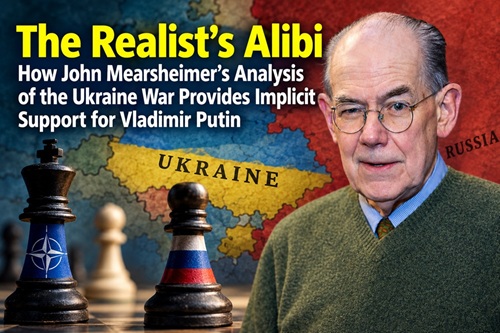 Introduction: Explaining Russia Without Excusing RussiaJohn J. Mearsheimer, the prominent American political scientist and leading proponent of offensive realism in international relations, has become one of the most influential Western critics of NATO's eastward expansion and Western policy toward Ukraine. His argument is familiar: great powers are acutely sensitive to threats near their borders, Russia regards the prospect of Ukraine's integration into Western political and military structures as an unacceptable strategic danger, and the United States and its European allies underestimated the consequences of pushing NATO toward Russia. Mearsheimer's analysis deserves serious consideration. The expansion of military alliances, the security dilemmas they generate, and the tendency of great powers to pursue regional dominance are legitimate subjects of geopolitical analysis. Western policymakers can make mistakes, and it is entirely possible to criticize NATO's post-Cold War strategy without endorsing Russian foreign policy. Yet Mearsheimer's realism raises a difficult question: when does explaining a great power's behavior become a way of legitimizing it? His analysis can provide implicit support for Vladimir Putin even when Mearsheimer does not explicitly endorse the invasion of Ukraine. This support arises not necessarily from a desire to justify Russian aggression, but from the way his explanatory framework distributes responsibility, defines legitimate security interests, and constrains the range of politically acceptable responses. The central criticism is not that Mearsheimer is secretly a Putin supporter. It is that his framework can reproduce important elements of the Kremlin's own justification for the war, while giving insufficient weight to Ukrainian agency, Russian imperial ambitions, and the distinction between a perceived threat and a legitimate entitlement to control another country. 1. From Explanation to JustificationThe first problem concerns the relationship between causal explanation and moral responsibility. Mearsheimer argues that NATO expansion and the prospect of Ukraine becoming part of the Western security system helped provoke Russia. In his account, Western policymakers bear substantial responsibility for creating the conditions that made war likely. Russia, meanwhile, acted as a great power typically acts when it perceives a hostile alliance approaching its borders. There is a coherent realist argument here. States worry about their security, military alliances can provoke countermeasures, and policies intended to increase one country's security can reduce another country's sense of security. Ignoring these dynamics would be intellectually irresponsible. But the argument becomes problematic when the explanation of Russian behavior starts to function as an exoneration of Russian choices. Even if NATO expansion contributed to the deterioration of relations, it does not follow that Russia was compelled to invade Ukraine. The Kremlin retained alternatives, including diplomacy, arms-control negotiations, economic engagement, and a willingness to accept Ukraine as an independent state outside a hostile military alignment. The distinction is fundamental. A policy can be strategically provocative without making the resulting aggression inevitable or justified. An actor's perception of danger can explain its conduct without establishing that its perception is accurate, that its response is proportionate, or that it has the right to impose its preferred solution on others. Mearsheimer's emphasis on structural pressures can obscure these distinctions. When Russia's invasion is presented as the predictable response of a great power to Western encroachment, the agency of the Russian leadership recedes into the background. Putin appears less as a political leader making choices and more as the representative of an impersonal geopolitical necessity. That is where realism risks becoming an alibi. What begins as an explanation of why Russia acted can turn into an argument that Russia could hardly have acted otherwise. 2. The Kremlin's Narrative, Reproduced in Academic LanguagePutin has repeatedly portrayed NATO enlargement as a fundamental threat to Russian security. He has also challenged Ukraine's historical and political separateness, questioned the legitimacy of aspects of its statehood, and presented the conflict as part of a broader struggle against Western domination. Mearsheimer's argument overlaps with the Kremlin's narrative on one important point: it places Western policy at the center of the explanation for the war. NATO expansion becomes the principal causal variable, while Russia's own political ambitions, ideological outlook, and willingness to use military force receive comparatively less explanatory weight. This overlap does not mean that Mearsheimer accepts Putin's entire worldview. Nor does it mean that every argument critical of NATO is propaganda. The question is what happens when a partial explanation becomes the dominant explanation. If Western policy is presented as the fundamental cause of the war, Russia's own account of its motives receives a degree of intellectual validation. The Kremlin can point to a respected Western academic and claim that even critics in the United States recognize that the West brought the conflict upon itself. This is a form of implicit support rather than necessarily explicit endorsement. An analysis can strengthen a political actor's public narrative without sharing all of that actor's goals or beliefs. The relevant test is not whether Mearsheimer intends to assist Putin. It is whether the consequences of his argument are to normalize the Kremlin's security claims, minimize the significance of Russian decisions, and shift the burden of responsibility toward the countries Russia attacked. There is also a danger of selective realism. If Russia's security concerns are treated as decisive because Russia is powerful, the security concerns of smaller states become secondary. The result is an international order in which great powers are granted a special privilege to define the strategic limits of their neighbors. That is precisely the kind of principle that Moscow has sought to establish in its relationship with Ukraine. 3. The Disappearance of Ukrainian AgencyOne of the most serious weaknesses of great-power realism is its tendency to treat smaller states as objects of competition between larger powers rather than as political communities with their own interests and choices. In a simplified realist narrative, the United States expands its influence, Russia reacts, and Ukraine becomes the territory over which the two powers compete. The country itself risks becoming little more than a geopolitical prize. But Ukrainians are not merely pieces on a chessboard. Their political orientation has been shaped by domestic struggles, historical experience, national identity, and their own assessments of Russian power. Many Ukrainians have sought closer integration with European institutions partly because they feared domination by Moscow. Russia's coercive policies have themselves contributed to the desire for Western protection. This creates a crucial problem for Mearsheimer's interpretation. If Ukraine's movement toward the West is treated primarily as the product of American manipulation, Ukrainian preferences are discounted. If those preferences are recognized as genuine, the causal story becomes more complicated: Western influence and Ukrainian agency interact with Russian pressure, rather than one side simply manufacturing the conflict. The same problem appears in the question of NATO membership. Russia may regard a neighboring country's alliance choices as strategically threatening. But a Russian objection does not establish that Ukraine has no legitimate interest in choosing its own security arrangements. Nor does Ukraine's desire for Western integration automatically establish that NATO was obliged to admit it. These are separate questions. One concerns Ukraine's political agency; the other concerns the strategic judgment of NATO members. Mearsheimer's framework can blur them by treating Western restraint as the principal solution to the problem. The implied bargain is troubling: Ukraine should be denied or discouraged from pursuing certain relationships because Russia objects to them. Its security becomes conditional on satisfying the strategic preferences of a more powerful neighbor. That is not a neutral conclusion. It is a distribution of political rights according to military power. 4. Spheres of Influence: Realism's Undemocratic PremiseMearsheimer's argument belongs to a long tradition of geopolitical thinking in which great powers seek dominant positions in their respective regions. From this perspective, Russia's desire to prevent hostile military infrastructure from moving closer to its borders is not exceptional. It is an expression of the logic of great-power competition. But there is a difference between recognizing that great powers seek spheres of influence and accepting that their neighbors should be required to live within them. A sphere of influence is not simply a geographic fact. It is a political relationship in which one state claims a privileged role in determining another state's strategic orientation. In its more coercive forms, it limits the sovereignty of smaller countries, restricts their diplomatic choices, and exposes them to pressure whenever they deviate from the preferences of the dominant power. Realism can describe this arrangement with considerable clarity. It is less successful at explaining why the arrangement should be considered legitimate or why its costs should be borne by the smaller states concerned. The contradiction becomes especially visible when the same principle is applied universally. If Russia is entitled to insist that Ukraine remain outside Western military structures because of its proximity to Russian territory, what prevents China from demanding comparable privileges over Taiwan or other neighboring territories? What prevents any regional power from declaring the political independence of nearby states incompatible with its own security? A theory that treats the security preferences of powerful states as overriding considerations risks legitimizing an international hierarchy in which sovereignty becomes a privilege enjoyed most securely by the strongest. Mearsheimer need not endorse every consequence of that hierarchy for his analysis to lend it intellectual support. Once the logic of spheres of influence becomes the primary measure of strategic reasonableness, the rights of smaller states tend to appear as variables to be adjusted rather than principles to be defended. The realist may reply that this is how international politics actually works. Sometimes it does work that way. But describing the prevalence of coercive power is not the same as demonstrating that its victims should accommodate it. 5. The Counterfactual Problem: Was the Invasion Really Inevitable?Mearsheimer's account also invites scrutiny of its counterfactual assumptions. He argues that a different Western policy, particularly a decision not to pursue NATO enlargement toward Ukraine, could have avoided the confrontation. That possibility cannot be dismissed out of hand. Western governments might have pursued more effective diplomacy, maintained greater strategic ambiguity, or invested more seriously in European security arrangements acceptable to a wider range of states. The consequences of these alternatives deserve examination. But the claim that a less expansionist NATO policy would have prevented the war is difficult to establish. It depends on assumptions about what Russia ultimately wanted and what concessions would have satisfied the Kremlin. Would a permanent Ukrainian commitment to neutrality have been sufficient? Would Moscow have accepted an independent Ukraine with strong European economic ties and a capable military? Or would Russian leaders have continued to demand political influence over Kyiv, regardless of NATO membership? These questions matter because Russia's conduct cannot be understood exclusively through the lens of military alliances. Its annexation of Crimea in 2014, its support for separatist forces in eastern Ukraine, and its full-scale invasion in February 2022 demonstrate that the conflict has involved more than the abstract question of NATO membership. Putin's own statements about Russian and Ukrainian history also raise questions about whether the Kremlin's objectives have been limited to defensive security. His repeated challenges to the distinctiveness of Ukrainian nationhood suggest that questions of identity, historical entitlement, and political control have been important as well. These statements do not by themselves establish the precise motives behind every Russian decision. But they make it inadequate to assume that a change in NATO policy would necessarily have removed the underlying conflict. A sound realist analysis should consider competing explanations and identify evidence that could distinguish them. If every Russian action is interpreted as a reaction to Western behavior, Russian agency becomes nearly impossible to test independently. The theory risks becoming self-sealing: Russian aggression is evidence of insecurity, and any objection to Russian aggression becomes further evidence of Western hostility. A more convincing account would compare the NATO-centered explanation with alternative hypotheses involving Russian imperial ambition, regime security, the domestic political incentives of authoritarian rule, and the Kremlin's fear that a politically independent and democratic Ukraine might undermine its preferred regional order. 6. The Asymmetry of ResponsibilityMearsheimer's critics often argue that his analysis places a disproportionate burden of responsibility on the United States and NATO. This is not simply a dispute over which events came first. It concerns the standards by which the actions of different states are evaluated. Western governments are treated as strategic actors whose decisions can provoke predictable reactions. Russia, by contrast, is frequently analyzed as a power responding to pressures created elsewhere. The West is expected to anticipate Russian sensitivities; Russia's own responsibility for anticipating the consequences of its actions receives less attention. Yet Russia, too, had choices. It could have recognized that coercing Ukraine might strengthen Ukrainian national identity, deepen hostility toward Moscow, and encourage the very Western alignment it opposed. It could have pursued security arrangements that did not require Ukraine's subordination. It could have refrained from treating military force as an instrument for determining its neighbor's political future. The invasion was not a natural disaster. It was a decision made by Russian leaders, followed by decisions to continue and expand the war despite its enormous human costs. Acknowledging Western errors does not require assigning the West primary responsibility for every subsequent development. Nor does acknowledging Russian security concerns mean that Russia was entitled to resolve them through invasion. Responsibility can be distributed without being dissolved. The United States may have pursued unwise policies; European governments may have underestimated the risks; Ukrainian leaders may have made strategic miscalculations. None of these possibilities eliminates Russia's responsibility for launching its full-scale invasion. The danger in Mearsheimer's framing is that causal responsibility and moral responsibility can become conflated. If the West is identified as the actor that created the conditions for the war, Russia's decision to initiate it can appear secondary. But the fact that an actor responds to an unfavorable environment does not absolve it of responsibility for the means it chooses. 7. The Policy Consequences: Peace on Whose Terms?Mearsheimer's analysis is not merely a historical explanation. It has implications for what the West should do now. If NATO expansion was the fundamental cause of the conflict, then the logical policy prescription is to recognize Russian security interests, limit Ukraine's integration into Western security structures, and seek a negotiated settlement that takes Moscow's concerns seriously. There is a legitimate argument for diplomacy. Wars often end through negotiations that require difficult compromises, and no responsible strategy should ignore the costs of prolonged conflict. Nuclear escalation, military exhaustion, civilian suffering, and the wider dangers of European instability all make diplomacy essential. But realism does not determine what a fair or durable settlement must look like. It cannot establish, by itself, that Ukraine should surrender territory, accept permanent restrictions on its sovereignty, or remain militarily vulnerable in order to reassure Russia. A settlement that rewards invasion may create incentives for future coercion. If the use of force enables a great power to secure concessions that diplomacy could not deliver, other governments may conclude that aggression is an effective way to revise the international order. Conversely, a policy that disregards Russia's security concerns entirely may also make a stable settlement more difficult. The challenge is to negotiate without accepting the principle that military power grants a state the right to dictate its neighbor's political future. The relevant question is therefore not simply whether the West should accommodate Russia. It is what forms of accommodation could reduce the risk of war while preserving Ukraine's ability to survive as an independent political community. Mearsheimer's framework is useful in reminding policymakers that military alliances have consequences. It is less adequate as a complete guide to settlement if it gives insufficient weight to deterrence, Ukrainian security, and the long-term consequences of rewarding territorial conquest. A peace that merely freezes the current distribution of power is not necessarily a durable peace. It may instead create the conditions for another round of coercion. Conclusion: Realism Without Moral SurrenderJohn Mearsheimer's analysis provides implicit support for Putin in several connected ways. It foregrounds Western responsibility for the conflict, treats Russian security concerns as unusually decisive, risks reducing Ukrainian agency to great-power competition, and normalizes the idea that powerful states are entitled to privileged influence over their neighbors. None of this proves that Mearsheimer intends to defend Putin, endorses the invasion, or accepts the Kremlin's entire account of the conflict. His work raises legitimate questions about NATO expansion, strategic miscalculation, and the dangers of ignoring great-power politics. Those questions should not be dismissed merely because Russian officials find some of his arguments useful. But the critical issue is whether realism becomes a complete moral and political framework rather than a limited tool of explanation. When strategic necessity is treated as the overriding principle, the interests of smaller states can be sacrificed to the preferences of larger ones. Aggression becomes predictable, accommodation becomes prudent, and the sovereignty of the victim becomes negotiable. The deepest problem is not that Mearsheimer takes Russian security concerns seriously. It is that his framework can make those concerns appear more politically authoritative than Ukraine's right to determine its own future. A more adequate analysis would combine realist attention to power with an equally serious examination of agency, ideology, international law, and the consequences of coercion. It would ask not only why Russia opposed Ukraine's Western orientation, but also why Ukrainians sought that orientation, why the Kremlin chose invasion, and what kind of European order would prevent similar conflicts in the future. Realism can help explain why the strong seek to control their surroundings. It cannot, without additional moral and political arguments, establish that the weak should submit. To confuse those two propositions is to turn geopolitical analysis into an alibi for power—and to provide an aggressor with an intellectual justification that it did not earn through the legitimacy of its actions. Sources and further readingThese works provide contrasting perspectives on Mearsheimer's argument and its implications. 1. John J. Mearsheimer, “Who Caused the Ukraine War?”—Mearsheimer's own defense of the claim that NATO expansion was the principal cause. Aug 05, 2024 2. “Offensive ideas: structural realism, classical realism and Putin's war on Ukraine,” International Affairs—An academic examination of how realist theories explain the invasion and how different strands of realism treat Russian nationalism and Putin's worldview. 02 November 2022 3. Matthew Specter, “Realism after Ukraine: A Critique of Geopolitical Reason from Monroe to Mearsheimer”—A critique of realism's treatment of Ukrainian agency, political contingency, and great-power spheres of influence. November 11, 2022 4. “Putin's article: 'On the historical unity of Russians and Ukrainians',” Centre for Eastern Studies—A detailed analysis of Putin's historical claims and their implications for Ukrainian sovereignty. 2021-07-13 5. Isaac Chotiner, “John Mearsheimer on Putin's Ambitions After Nine Months of War,” The New Yorker—An interview that clarifies Mearsheimer's interpretation of Putin's motives and the limits of his argument. November 17, 2022 (paywall)
Widget is loading comments...
|