|
TRANSLATE THIS ARTICLE
Integral World: Exploring Theories of Everything
An independent forum for a critical discussion of the integral philosophy of Ken Wilber
  Frank Visser, graduated as a psychologist of culture and religion, founded IntegralWorld in 1997. He worked as production manager for various publishing houses and as service manager for various internet companies and lives in Amsterdam. Books: Ken Wilber: Thought as Passion (SUNY, 2003), and The Corona Conspiracy: Combatting Disinformation about the Coronavirus (Kindle, 2020). Frank Visser, graduated as a psychologist of culture and religion, founded IntegralWorld in 1997. He worked as production manager for various publishing houses and as service manager for various internet companies and lives in Amsterdam. Books: Ken Wilber: Thought as Passion (SUNY, 2003), and The Corona Conspiracy: Combatting Disinformation about the Coronavirus (Kindle, 2020).
Check out my other conversations with ChatGPT 9/11: Inside Job or Opportunistic Exploitation?Why the U.S. Government Didn't Need to Orchestrate the Attacks to Benefit From ThemFrank Visser / ChatGPT
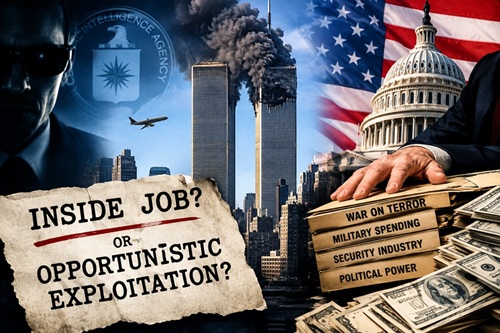 The terrorist attacks of September 11, 2001, changed the course of American foreign policy and reshaped international relations for decades. They provided the political justification for the invasion of Afghanistan, helped create the climate in which the invasion of Iraq became possible, expanded the national security state, and gave the United States a new organizing principle for its global military presence: the War on Terror. Given these consequences, it is understandable that people ask whether the American government merely responded to the attacks or had some role in bringing them about. But a crucial distinction is often lost in the debate. A government can exploit a catastrophe without having caused it, and it can benefit from a disaster without having foreseen it. The claim that 9/11 was an American "inside job" is much stronger than the claim that American leaders exploited the attacks for their own purposes. The first requires evidence of deliberate orchestration or complicity in the operation itself. The second is supported by the publicly documented political decisions that followed the attacks. The more productive question, therefore, is not simply who benefited from 9/11. It is what would have had to happen for the American government to have secretly organized, enabled, or deliberately permitted the attacks—and whether that hypothesis explains the evidence better than the alternative that al-Qaeda carried them out and Washington subsequently seized the opportunity. 1. What an "Inside Job" Would Actually RequireThe phrase "inside job" is ambiguous. It can refer to several quite different allegations: that American officials organized the attacks; that they knowingly allowed them to happen; that they facilitated the operation; or that they had warning of a general threat but failed to act adequately. These hypotheses should not be treated as interchangeable. The first claim—that the U.S. government deliberately organized the attacks—is the most demanding. It requires a plausible account of how the operation was planned, executed, and concealed, supported by evidence that connects American decision-makers to the plot. Consider what such an operation would entail. First, the government would have to arrange or control a complex, multinational terrorist operation. The attacks involved nineteen hijackers, four commercial aircraft, flight training, travel documents, financial transfers, communications, and coordination with al-Qaeda's leadership. A conspiracy theory must explain how the perpetrators were recruited or manipulated, how their activities were directed, and how their real objectives were concealed from the numerous intelligence, law-enforcement, aviation, and financial institutions that encountered them. Second, the government would have to manage the attacks' extraordinary uncertainty. The plan depended on the hijackers successfully boarding four aircraft, overcoming or bypassing security, and reaching their targets. The consequences were not entirely predictable. Buildings might have survived differently, passengers might have resisted, flights might have been delayed, and emergency responses might have disrupted the operation. A government capable of controlling such an operation would have to accept enormous uncertainty about the outcome, including the deaths of thousands of people on live television. Third, it would have to maintain secrecy across a large number of people and institutions. A conspiracy of this magnitude would require some combination of planners, operatives, intelligence personnel, aviation insiders, logistical facilitators, and those responsible for suppressing evidence afterward. Not every participant would need to know the whole plan, and compartmentalization can protect covert operations. Nevertheless, the larger and more complicated the conspiracy, the more opportunities there are for documentary evidence, credible testimony, or demonstrable contradictions to emerge. Secrecy is not impossible. Governments have conducted covert operations, concealed wrongdoing, and lied to their populations. But the existence of past conspiracies does not establish any particular conspiracy. The relevant question is whether the available evidence supports this one. Fourth, the government would have to anticipate the political consequences without knowing exactly how events would unfold. The attacks did create extraordinary opportunities for American military action, but they also inflicted massive casualties, destroyed a major financial complex, damaged the Pentagon, disrupted air travel, and created profound economic and political uncertainty. The United States had to improvise its immediate response. The 9/11 Commission documented serious failures in the national defense response, including breakdowns in communication and coordination. None of these points proves that an inside job was impossible. Nor does the number of people involved, by itself, disprove a conspiracy. They do, however, raise the evidentiary burden. A theory must explain the operation more convincingly than the available alternative; it cannot merely point to unanswered questions and declare them proof of a cover-up. There is also a fundamental distinction between evidence of incompetence and evidence of complicity. Officials who overlook warnings, fail to connect intelligence, or respond disastrously may be culpable. But their culpability does not establish that they intended the catastrophe. 2. The Less Spectacular Explanation: Intelligence FailureThe documented record offers a more prosaic, but still disturbing, explanation for how 9/11 occurred. The United States had accumulated substantial intelligence about Osama bin Laden and al-Qaeda before September 2001. The threat was not entirely unknown. There had been previous attacks against American targets, and intelligence agencies had received warnings that al-Qaeda intended to strike U.S. interests. The problem was that this information was not converted into an effective preventive strategy. The CIA and FBI suffered from institutional rivalries, inadequate information sharing, analytical shortcomings, and failures to appreciate the significance of particular intelligence. The 9/11 Commission described these problems as failures of imagination, policy, capabilities, and management. The distinction matters. It is possible for an intelligence service to know many individual facts without understanding their collective significance. It is possible for one agency to possess a relevant piece of information while another agency fails to act on it. It is possible for senior officials to receive warnings without grasping the nature, imminence, or scale of the threat. These are familiar problems in large bureaucracies. Institutions have routines, priorities, rivalries, and assumptions. They tend to interpret new threats through familiar categories until events force them to reconsider. The attacks exposed precisely these weaknesses. The commission found that the government had failed to mobilize effectively against al-Qaeda, even though warnings and opportunities to disrupt the plot existed. This explanation is not an exoneration. Intelligence failures can be catastrophic, and officials should be held accountable for decisions and omissions within their control. But the explanation does not require a secret master plan, a perfectly coordinated conspiracy, or thousands of people knowingly participating in mass murder. It requires something less extraordinary and, unfortunately, more familiar: a dangerous adversary, an inadequately prepared state, fragmented intelligence, and leaders who failed to recognize the danger in time. There remains a separate question about whether particular officials possessed more specific advance knowledge than they acknowledged, or whether particular warnings were deliberately disregarded. Such claims deserve investigation on their own evidence. A general warning of an impending attack is not the same as foreknowledge of the date, targets, methods, and identities of the perpetrators. The distinction between what officials knew, what they could reasonably have inferred, and what they actually did is essential to any serious assessment of responsibility. 3. Afghanistan: A War With a Direct Connection to 9/11Afghanistan was the most immediate target of the American response. Al-Qaeda operated from Afghan territory under the protection of the Taliban, and the Bush administration demanded that the Taliban hand over bin Laden and dismantle al-Qaeda's sanctuary. Here the causal connection is relatively straightforward. The attacks were carried out by al-Qaeda; its leadership was based in Afghanistan; and the United States invaded Afghanistan in October 2001 after the Taliban failed to meet American demands. But the political significance of the invasion extended beyond the pursuit of the perpetrators. The attacks transformed the domestic political environment. Military intervention that had previously seemed unlikely became publicly acceptable, and a broad campaign against international terrorism acquired the status of a national mission. The 9/11 Commission noted that officials in both the Clinton and pre-9/11 Bush administrations had regarded a full-scale invasion of Afghanistan as practically inconceivable before the attacks. This is an important historical observation. A catastrophe can radically alter the range of politically available options. Leaders who previously faced public resistance, institutional obstacles, or political indifference may suddenly find themselves empowered to act. The invasion of Afghanistan was not simply an arbitrary war invented to exploit public grief. Al-Qaeda's presence there provided a direct connection between the attacks and the military response. Nevertheless, the scale, duration, and eventual objectives of the war went well beyond the immediate disruption of the organization responsible. The initial justification was intelligible. The subsequent twenty-year war, culminating in the Taliban's return to power in 2021, raises a different question: how did a legitimate security objective evolve into an open-ended military and political project whose costs vastly exceeded its original promise? We do not need to believe that Washington orchestrated 9/11 to ask that question. Indeed, the question becomes more useful when separated from the inside-job hypothesis. It allows us to examine actual decisions, strategic assumptions, institutional incentives, and failures without making the entire analysis depend on an unproven conspiracy. 4. Iraq: The More Damning Case of Political ExploitationThe case of Iraq is more revealing because the connection between Saddam Hussein's regime and the September 11 attacks was not established. Immediately after the attacks, elements within the Bush administration explored the possibility of striking Iraq. The 9/11 Commission's account records Donald Rumsfeld's interest in obtaining information that might support attacks beyond empty training camps. It also documents the administration's subsequent examination of possible Iraqi involvement. This was not an innocent analytical question. The invasion of Iraq had been advocated by some American policymakers before 9/11. The attacks created a new political environment in which regime change could be presented as part of a broader struggle against terrorism and hostile states. The problem was that the evidence did not establish that Saddam Hussein's government had planned or carried out the attacks. A September 18, 2001, memorandum prepared by counterterrorism official Richard Clarke for National Security Adviser Condoleezza Rice concluded that there was no compelling case that Iraq had planned or perpetrated 9/11. It described the evidence linking Iraq to al-Qaeda as anecdotal and noted the ideological antagonism between bin Laden and Saddam Hussein's secular regime. The 9/11 Commission later found no credible evidence that Iraq and al-Qaeda had cooperated in attacks against the United States. Nevertheless, the Bush administration increasingly associated Iraq with the larger threat of terrorism and weapons of mass destruction. The invasion began in March 2003. The anticipated Iraqi stockpiles of active chemical and biological weapons were not found, and the case for war had rested on intelligence assessments that proved profoundly misleading. This is where the distinction between causing a catastrophe and exploiting one becomes decisive. The attacks on New York and Washington gave the administration an opportunity to present a war against Iraq within the emotional and political framework of national self-defense. The public was understandably frightened and angry. The distinction between the perpetrators of 9/11 and other governments portrayed as dangerous became easier to blur. But Iraq was not Afghanistan. The Iraqi government was not the government sheltering al-Qaeda's operational leadership, and no credible evidence established that Saddam Hussein's regime had collaborated with al-Qaeda in carrying out the attacks. The invasion of Iraq therefore illustrates how a genuine national trauma can be used to advance a policy that is only tenuously connected—or not credibly connected at all—to the original event. That is a serious charge. It does not require secret demolition charges, controlled aircraft, fabricated hijacker identities, or an elaborate plan to murder thousands of Americans. It requires examining public statements, internal memoranda, intelligence assessments, policy preferences, and the decisions that led to war. The evidence for political exploitation is considerably stronger than the evidence for deliberate orchestration of the attacks. 5. Cui Bono? Who Benefited From 9/11?The Latin question cui bono?—who benefits?—is often used in conspiracy arguments. If a government benefits from a crime, the reasoning goes, perhaps it committed the crime. But this is a weak inference when used on its own. A government might benefit from an event it did not cause. A political party might exploit a crisis it did not anticipate. A corporation might profit from a disaster without having engineered it. Conversely, the people who benefit from an event are not necessarily the people who caused it. To establish culpability, we need evidence of a connection between the beneficiary and the act. In the case of 9/11, several institutions and political constituencies gained from the aftermath: - The executive branch acquired greater political authority to conduct military operations and pursue an expansive national security agenda. - The intelligence and security apparatus received increased resources, broader investigative powers, and a central role in government. - The military and defense industry operated in an environment of expanding security expenditure and prolonged overseas deployments. - Advocates of regime change gained an opportunity to pursue policies that had encountered substantial obstacles before the attacks. These outcomes do not establish that these actors planned the attacks. They identify incentives and consequences worth investigating. The distinction is particularly important when discussing the expansion of surveillance and executive power. The USA PATRIOT Act, enacted in October 2001, broadened several government investigative authorities. The creation of the Department of Homeland Security in 2002 reorganized major elements of the federal security apparatus. Such measures can be assessed on their merits: Did they improve security? Were they proportionate to the threat? Did they unnecessarily compromise civil liberties? Were temporary emergency powers allowed to become permanent features of government? These are legitimate political and constitutional questions. They do not become less legitimate because one rejects the inside-job theory. Indeed, the exploitation hypothesis explains an important feature of political power: leaders do not have to manufacture every crisis. Sometimes history delivers a crisis that enables them to pursue objectives that would otherwise be difficult to achieve. The most effective political opportunists may not be those who secretly create disasters, but those who recognize their possibilities and act quickly while public attention is concentrated and opposition is weakened. 6. What About Foreknowledge?There is an intermediate hypothesis between total innocence and deliberate orchestration: perhaps some officials knew more than they admitted, or perhaps the government deliberately failed to prevent the attacks. This possibility should not be dismissed simply because the strongest inside-job claims are unsubstantiated. Nor should it be accepted simply because intelligence agencies have a history of secrecy and misconduct. The relevant questions are specific. What information was available to which officials? When did they receive it? How credible and detailed was it? What action did the information reasonably warrant? Were warnings ignored through negligence, bureaucratic dysfunction, political calculation, or deliberate intent? These questions require distinctions between several levels of knowledge: 1. General threat awareness: Officials knew that al-Qaeda wanted to attack American interests. 2. Specific warning: Officials received information suggesting an impending attack, perhaps even involving aircraft. 3. Operational foreknowledge: Officials knew enough about the actual plot, its timing, or its targets to anticipate the attacks. 4. Deliberate nonintervention: Officials possessed actionable knowledge and intentionally refrained from stopping the plot. The first two are well supported by the historical record. The 9/11 Commission and the congressional joint inquiry documented significant warnings, missed opportunities, and failures to connect intelligence. The third and fourth claims require more specific evidence. The existence of warnings does not establish that officials knew the full operational plan, and a failure to act does not by itself establish a deliberate decision to permit mass murder. Could particular officials have been more culpable than the official investigations established? In principle, yes. Investigations can be incomplete, institutions can protect themselves, and official reports should not be treated as infallible. But the possibility of undiscovered evidence is not itself evidence that the strongest allegation is true. A rigorous inquiry should remain open to new evidence while assigning confidence in proportion to what is actually known. There is also a danger in treating the alternatives as exhaustive. The choice is not limited to a perfectly innocent government or a government that planned the entire operation. Officials could have been negligent, politically distracted, overconfident, or unwilling to prioritize a threat. Particular agencies or individuals could have mishandled intelligence for different reasons. Responsibility might be distributed unevenly. The historical reality may be complicated without being conspiratorial. 7. Why the Inside-Job Theory Is So AttractiveWhy, then, do elaborate 9/11 conspiracy theories persist? Part of the answer lies in the disproportion between the event and its consequences. Nineteen hijackers associated with a non-state terrorist organization inflicted enormous damage on the world's most powerful country. The subsequent wars lasted decades, cost vast sums, and produced consequences far beyond what most Americans could have anticipated on September 10, 2001. It is psychologically difficult to accept that such a consequential historical transformation began with a relatively small terrorist organization exploiting vulnerabilities in an immensely powerful state. A conspiracy theory offers a different kind of explanation. It replaces institutional failure and historical contingency with a single controlling intelligence. Nothing is accidental; every anomaly becomes a clue, every inconsistency evidence of concealment, and every beneficiary a potential perpetrator. This gives the theory a seductive coherence. It also makes it difficult to falsify. If an official denies involvement, the denial can be interpreted as proof of a cover-up. If evidence is missing, its absence can be attributed to successful concealment. If an explanation is complicated, the complexity itself can be taken as evidence of deception. Such reasoning reverses the normal burden of proof. Rather than asking what evidence would distinguish an inside job from a terrorist attack followed by intelligence failure, it interprets virtually any possible observation as support for the conspiracy. A sounder approach is to compare explanations according to their evidentiary support, explanatory power, and the number of additional assumptions they require. The established account is not flawless, and specific failures deserve scrutiny. But an alternative theory must do more than identify anomalies. It must explain the attacks, the available intelligence, the physical evidence, the identities and activities of the perpetrators, and the subsequent investigations more convincingly than the existing account. Skepticism should apply to official explanations, but it should apply equally to alternative explanations. Distrust of authority is not a substitute for evidence. 8. The More Important Lesson: Follow the Political ConsequencesThe lasting significance of 9/11 lies not only in how the attacks were carried out, but also in how the United States and its allies responded. The attacks helped establish a new era of American foreign policy. Military intervention became a central instrument of the War on Terror. Surveillance expanded. Executive power grew. The distinction between conventional warfare, counterterrorism, intelligence operations, and domestic security became increasingly blurred. Afghanistan became a long war against al-Qaeda, the Taliban, and eventually a wider insurgency. Iraq became a war of regime change that was justified in part through claims about weapons of mass destruction and the wider terrorist threat, despite the absence of credible evidence that Saddam Hussein's regime had carried out 9/11. These wars had immense human and financial costs. They also illustrate how a policy justified by an emergency can acquire a momentum of its own. Once military forces are deployed, institutions develop interests in continuing their missions, political leaders face reputational costs for admitting failure, and the original objectives can become entangled with new ones. The result is not necessarily a centrally directed conspiracy. It can emerge from the interaction of political ambition, bureaucratic incentives, ideological commitments, strategic misjudgments, and the difficulty of reversing decisions once they have been made. This is a more complicated explanation than the idea of a secret cabal, but it is also more useful. It directs attention toward identifiable actors, documented choices, and institutional mechanisms that can be investigated and criticized. It also raises a difficult moral question. Even if the government neither caused nor knowingly permitted 9/11, what responsibility did it bear for using the attacks to justify a war against a country that had not carried them out? How should we judge leaders who took a legitimate demand for justice and national security and attached it to a broader political project? Those questions are not peripheral to the history of 9/11. They are central to it. Conclusion: Exploitation Does Not Require OrchestrationThe hypothesis that 9/11 was an inside job asks us to believe that elements of the American state secretly organized or enabled a vast terrorist operation against their own population, managed the resulting uncertainty, concealed their involvement, and successfully suppressed decisive evidence of their complicity. Such a scenario is not logically impossible. Governments have committed crimes and concealed them. But possibility is not probability, and suspicion is not proof. The publicly documented evidence supports al-Qaeda's responsibility for the attacks and reveals major failures in American intelligence and preparedness. It does not establish that the U.S. government orchestrated the operation. A more persuasive interpretation is that the United States failed to prevent an attack by a known adversary and then used the resulting catastrophe to pursue a much broader agenda. In Afghanistan, the connection between the perpetrators and the initial military response was direct, even if the subsequent war became strategically and politically problematic. In Iraq, the case for exploitation is stronger: the administration pursued regime change in a climate created by 9/11, despite the absence of credible evidence that Saddam Hussein's government had collaborated with al-Qaeda in carrying out the attacks. The distinction is fundamental. The government did not have to create the emergency to benefit from it. It only had to recognize the political opportunities the emergency presented. This explanation does not absolve the Bush administration of responsibility for its decisions. On the contrary, it focuses criticism where the evidence is strongest: on intelligence failures, misleading public arguments, the expansion of state power, and the decision to invade Iraq. We should neither accept official accounts uncritically nor embrace conspiracy theories simply because they challenge official accounts. We should ask which explanation best fits the evidence and which claims can be independently substantiated. The central scandal of 9/11 may not be that the American government secretly engineered the attacks. It may be that a genuine terrorist atrocity was transformed into a political instrument for wars whose justifications, consequences, and human costs demand sustained scrutiny. That is a sufficiently serious indictment of political power. It needs no unsupported conspiracy to make it compelling.
Widget is loading comments...
|