|
TRANSLATE THIS ARTICLE
Integral World: Exploring Theories of Everything
An independent forum for a critical discussion of the integral philosophy of Ken Wilber
  Frank Visser, graduated as a psychologist of culture and religion, founded IntegralWorld in 1997. He worked as production manager for various publishing houses and as service manager for various internet companies and lives in Amsterdam. Books: Ken Wilber: Thought as Passion (SUNY, 2003), and The Corona Conspiracy: Combatting Disinformation about the Coronavirus (Kindle, 2020). Frank Visser, graduated as a psychologist of culture and religion, founded IntegralWorld in 1997. He worked as production manager for various publishing houses and as service manager for various internet companies and lives in Amsterdam. Books: Ken Wilber: Thought as Passion (SUNY, 2003), and The Corona Conspiracy: Combatting Disinformation about the Coronavirus (Kindle, 2020).
Check out my other conversations with ChatGPT Donald Trump The Worst President in American History?Frank Visser / ChatGPT
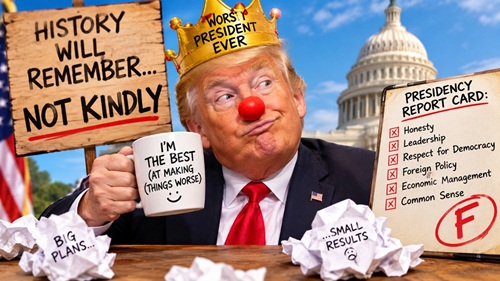 Introduction: When the Presidency Becomes a Threat to the RepublicCalling Donald Trump the worst president in the history of the United States is a sweeping judgment. American history contains presidents who presided over catastrophic failures, including James Buchanan, whose ineptitude helped pave the way for the Civil War; Andrew Johnson, whose opposition to Reconstruction undermined the emancipation of formerly enslaved people; and Herbert Hoover, whose administration failed to respond adequately to the Great Depression. Abraham Lincoln, by contrast, is generally regarded as one of the greatest presidents precisely because he confronted a national crisis while preserving the Union and ending slavery. Yet Trump's claim to the dubious distinction of being America's worst president rests on something different from ordinary incompetence, misguided economic policy, or even disastrous foreign affairs. His most consequential failure concerns the presidency itself: he has repeatedly treated an office constitutionally designed to serve the republic as though it were a personal possession, and he has challenged the legitimacy of democratic institutions whenever they frustrate his ambitions. The strongest case against Trump is therefore not that every policy he has pursued has been wrong, or that every previous president was better in every respect. It is that he has combined personal authoritarianism, contempt for democratic constraints, attacks on independent institutions, habitual dishonesty, political vindictiveness, and a willingness to undermine confidence in elections in a way that threatens the foundations of American constitutional government. The question is not simply whether Trump is a bad president. It is whether his conception of presidential power is compatible with the survival of a functioning democracy. 1. January 6: The Unforgivable Assault on DemocracyThe defining episode of Trump's first presidency was the attempt to overturn the result of the 2020 presidential election. After losing to Joe Biden, Trump refused to accept the outcome, repeatedly promoted allegations of widespread election fraud that failed to establish a basis for reversing the result, and pressured officials to challenge or obstruct the certification of the vote. On January 6, 2021, as Congress met to certify Biden's victory, a mob of Trump's supporters violently breached the Capitol. The constitutional process was interrupted, lawmakers were forced to flee or shelter, and police officers were assaulted. The attack was not simply an outbreak of spontaneous public disorder detached from the president's conduct. The House committee investigating January 6 concluded that Trump was the central cause of the events that culminated in the attack. The distinction between a president who makes serious mistakes and one who attempts to remain in power after losing an election is fundamental. Democratic government depends on the principle that political authority is temporary and conditional. A president is entrusted with power by the electorate; he does not own that power and cannot legitimately retain it merely because he refuses to leave. Trump's defenders may point to the fact that he eventually left office, that his supporters had legitimate concerns about some electoral procedures, or that political rhetoric is often inflammatory. None of these considerations answers the central objection. There are lawful mechanisms for challenging election results, and Trump was entitled to use them. What he was not entitled to do was treat his personal conviction that he deserved to win as a substitute for evidence and constitutional procedure. The historical significance of January 6 lies in the precedent it threatens to establish. If a defeated president can undermine confidence in elections, pressure officials, encourage resistance to certification, and then return to office without the episode disqualifying him politically, the peaceful transfer of power becomes less secure. A president's most basic constitutional responsibility is to preserve the system that makes his own authority legitimate. On this test, Trump's record is extraordinarily damning. 2. The Cult of Personality: Loyalty to Trump Above Loyalty to the ConstitutionAmerican presidents have always cultivated public images, rewarded allies, and sought to shape their parties. Trump has taken personal loyalty to a different level. His political movement is organized around an unusually strong identification between the leader, the party, and the nation. Criticism of Trump is frequently portrayed not as legitimate democratic opposition but as hostility toward America itself. Public officials who support him are praised as patriots; those who oppose him risk being branded enemies, traitors, or participants in conspiracies. This is a dangerous inversion of constitutional democracy. In a republic, citizens may love their country while opposing its government. Public officials may serve their constituents while disagreeing with their president. Courts may rule against an administration without becoming enemies of the state. The legitimacy of these institutions does not depend on their personal loyalty to whoever occupies the White House. Trump's approach instead encourages a politics in which institutional independence becomes suspect whenever it obstructs the leader. The danger is not merely that one individual possesses an oversized ego. It is that an entire political movement becomes accustomed to treating that ego as a source of political authority. The distinction between patriotism and personal allegiance matters here. Patriotism means a commitment to the country, its people, and its constitutional principles. Loyalty to a politician is conditional and should never supersede those commitments. A president who cannot tolerate dissent is poorly suited to lead a pluralistic democracy. A president who treats dissent as betrayal is more dangerous still. 3. The Assault on TruthTrump's political career has been characterized by an extraordinary willingness to make false or misleading claims, repeat allegations after they have been discredited, and present personal assertions as though they were established facts. Dishonesty in politics is hardly unique to Trump. Presidents have misled the public about wars, concealed misconduct, exaggerated economic achievements, and defended policies through selective presentations of evidence. The problem with Trump is the scale, persistence, and political function of his relationship with truth. His false claims about the 2020 election were particularly consequential because they did not remain ordinary campaign exaggerations. They undermined confidence in the electoral system itself. Once citizens are persuaded that elections are fundamentally fraudulent whenever their preferred candidate loses, the basis for accepting democratic outcomes begins to disappear. This is not simply a matter of fact-checking individual statements. It concerns the possibility of maintaining a shared public reality. Democratic debate requires citizens to disagree about values, interests, and policies while retaining some common understanding of what has happened. If facts are subordinated to personal loyalty, political argument becomes increasingly futile. Trump's communication style also rewards spectacle over substance. Provocation, insult, exaggeration, and the constant manufacture of controversy can dominate the news cycle, leaving less room for sustained examination of policy. Attention becomes a political resource in its own right. The result is a form of leadership in which the president's ability to command attention can become more important than his ability to explain, defend, or responsibly implement decisions. A democracy cannot function well if its highest office continually weakens the distinction between verified evidence and politically convenient fiction. 4. The Presidency as an Instrument of Personal RevengeThe American constitutional system was designed in part to prevent public power from becoming the private instrument of an individual ruler. The separation of powers, judicial independence, legislative oversight, and legal accountability are intended to ensure that no president stands above the law. Trump's rhetoric and governing approach repeatedly challenge this principle. He has portrayed political opponents and critics as enemies who deserve punishment, while presenting investigations involving himself as inherently illegitimate. His preference for loyalty and his hostility toward independent scrutiny raise a fundamental concern: whether the powers of government are being used to serve the public interest or to protect the president and penalize those who oppose him. The danger is not confined to any single appointment, prosecution, pardon, or executive order. It lies in the broader normalization of a retaliatory conception of government. In a constitutional republic, the Department of Justice is not supposed to function as the president's personal legal department. Law enforcement should not be directed by a desire for vengeance. Nor should public officials be expected to demonstrate personal allegiance in exchange for professional security. There is also an important distinction between accountability and persecution. Presidents can legitimately criticize investigations they consider politically motivated, and misconduct by prosecutors or officials should be examined. But a blanket assumption that every investigation of the president is illegitimate, while every investigation of his opponents is justified, substitutes personal preference for a consistent rule of law. The principle at stake is simple: a government that punishes enemies and protects friends is not administering justice impartially. 5. Attacking the Institutions That Limit Presidential PowerThe American system deliberately divides authority among the executive, legislative, and judicial branches. This arrangement can be frustrating. It produces delays, compromise, and occasional paralysis. Yet these inconveniences are part of the price of preventing the concentration of power. Trump has often treated institutional constraints as obstacles to be overcome rather than safeguards to be respected. His conflicts with judges, attacks on independent oversight, hostility toward critical media, and efforts to expand presidential control over the federal government reflect a broader impatience with limits on executive authority. This does not mean every dispute between Trump and a court is evidence of authoritarianism. Presidents have a legitimate right to contest judicial decisions, challenge the constitutionality of laws, and pursue reforms of federal agencies. The critical question is whether they accept the authority of independent institutions to reach decisions they dislike. That question has become especially urgent during Trump's second presidency. In May 2026, a joint survey by Bright Line Watch and UCLA Law reported that federal judges, lawyers, and law professors perceived significant deterioration in the rule of law under his administration, including concerns about politicized law enforcement, executive overreach, and a dysfunctional separation of powers. The broader lesson is that democracy cannot be measured solely by whether elections continue to take place. Elections are essential, but a functioning democracy also requires constraints on the winners. Courts must be able to rule against the government. Legislatures must be able to investigate it. Journalists must be able to criticize it. Civil servants must be able to administer the law without becoming instruments of personal loyalty. When these institutions are weakened, the formal machinery of democracy may survive while its substantive protections erode. 6. Immigration and the Politics of CrueltyImmigration is a legitimate subject of democratic debate. Governments have a responsibility to manage borders, enforce immigration law, protect public safety, and establish workable procedures for asylum and residency. Criticizing Trump's immigration policies does not require denying any of these responsibilities. The objection concerns the methods, rhetoric, and moral priorities through which immigration enforcement is pursued. Trump has repeatedly presented immigrants as a collective threat, using sweeping language that blurs distinctions between undocumented workers, asylum seekers, legal immigrants, and people convicted of crimes. Such rhetoric encourages the public to view a diverse population primarily through the lens of danger and national decline. This kind of political communication has consequences. When groups of people are portrayed as inherently criminal, diseased, or alien to the nation, harsh treatment becomes easier to justify and individual circumstances become less visible. The distinction between enforcing immigration law and treating human beings as disposable can become dangerously blurred. A defensible immigration system should combine border management with due process, humane detention standards, fair asylum procedures, and accountability for abuses. It should distinguish between individual responsibility and collective blame. Nor is it necessary to assume that every enforcement action is cruel or unlawful to criticize an administration's priorities. The relevant questions include whether policies are effective, proportionate, legally sound, and consistent with the country's obligations to human dignity. Trump's politics too often suggest that the appearance of toughness is itself a sufficient measure of success. But harshness is not the same as competence, and humiliation is not a substitute for a workable immigration policy. A government should be judged not only by the promises it makes to its own citizens but also by how it exercises power over people who have little political influence to defend themselves. 7. Economic Nationalism and the Costs of Personal RuleTrump's economic message combines protectionism, tax reduction, deregulation, restrictions on immigration, and a promise to restore American industrial power. Some of these objectives are legitimate subjects for policy debate. Industrial decline has harmed communities, trade can produce uneven gains, and governments can reasonably support strategic industries. The problem is the tendency to present complex economic relationships as simple contests of national will, in which tariffs, threats, and personal negotiations supposedly allow a president to compel favorable outcomes. Tariffs can protect selected domestic producers, but they can also increase costs for businesses and consumers, provoke retaliation, and disrupt supply chains. Their overall effects depend on their design, the behavior of trading partners, the responses of firms, and the wider economic environment. They are not a magic instrument for making a country richer. Likewise, promises to restore manufacturing cannot be assessed solely by announcements of investment or individual factory openings. Productivity, wages, employment, consumer prices, fiscal sustainability, and long-term competitiveness matter as well. Trump's preference for dramatic declarations and apparent personal victories can obscure these trade-offs. Economic policy becomes a sequence of performances in which the president claims credit for favorable developments and assigns blame for unfavorable ones, often without adequate attention to the evidence. There is also a broader institutional cost. Businesses and investors need reasonably predictable rules. When policy changes are driven by personal disputes, abrupt announcements, or threats that are later modified, uncertainty itself becomes an economic burden. The strongest criticism is therefore not that protectionism can never work or that all Trump's economic policies must fail. It is that economic management requires expertise, consistency, realistic expectations, and a willingness to acknowledge unintended consequences. Presidential confidence cannot replace those qualities. 8. Foreign Policy: Alliances Are Not Business DealsTrump's approach to international relations reflects a recurring feature of his worldview: the tendency to interpret relationships primarily through immediate personal advantage. He frequently evaluates alliances in transactional terms, emphasizing what the United States receives in return for its commitments. There is a legitimate argument that NATO members should contribute adequately to collective defense and that American foreign policy should account for domestic priorities. Previous presidents have made similar demands. But an alliance is not merely a commercial contract. It is a structure of shared expectations, strategic coordination, deterrence, and trust. Its value cannot be measured only by the immediate financial contribution of each participant. When an American president repeatedly casts doubt on whether the United States will honor its commitments, allies have reason to question the reliability of American protection. Adversaries may interpret those doubts as opportunities to test the resolve of the alliance. Even if no formal withdrawal occurs, uncertainty can weaken deterrence. Trump's admiration for displays of personal strength also raises concerns about the relationship between diplomacy and authoritarian leadership. Diplomacy requires dealing with governments whose values differ from one's own, but there is a distinction between pragmatic engagement and treating authoritarian rulers as objects of personal fascination or political flattery. A president need not be hostile to every autocrat, nor must American foreign policy be governed by moral purity. Strategic interests sometimes require negotiations with unpleasant regimes. The question is whether policy is guided by a coherent assessment of American interests and international stability or by personal affinity, theatrical gestures, and the pursuit of short-term publicity. The United States acquired much of its postwar influence not simply through military power but through the institutions, alliances, and international expectations it helped establish. A president who weakens those relationships without a credible replacement risks sacrificing durable strategic advantages for temporary political satisfaction. The paradox is that a leader who promises to put America first can diminish American influence by making other countries less willing to trust it. 9. Climate Change and the Rejection of Long-Term ResponsibilityClimate change presents a particularly revealing test of presidential leadership because its causes and consequences extend beyond a single election cycle. Effective responses require scientific assessment, technological innovation, international cooperation, and a willingness to weigh immediate economic costs against longer-term risks. Trump's hostility toward climate policies and his preference for fossil-fuel expansion place him at odds with the broad scientific conclusion that human activities, especially greenhouse-gas emissions, are warming the planet. Disagreements about the best policy response are entirely legitimate. There are real questions about energy reliability, affordability, industrial competitiveness, and the distribution of transition costs. But acknowledging these trade-offs is different from minimizing the underlying problem or treating climate action principally as an ideological enemy. A responsible president should evaluate the evidence, compare the costs and benefits of alternative approaches, support innovation, and prepare the country for foreseeable risks. The United States has considerable scientific, financial, and technological capacity to contribute to that effort. The danger of short-term political thinking is that it rewards visible immediate benefits while postponing less visible costs. Energy production and employment gains may be politically attractive today, while the consequences of accumulated emissions, extreme weather, and infrastructure vulnerability are distributed across decades and generations. Nor is climate responsibility incompatible with economic growth. The challenge is to design policies that encourage technological progress while protecting workers and communities exposed to economic change. Trump's approach illustrates a wider weakness in his political philosophy: the preference for immediate, tangible demonstrations of power over the management of slow-moving, complex, and cumulative problems. Yet some of the most important responsibilities of government involve precisely those problems that cannot be solved within the emotional horizon of a campaign rally. 10. The Degradation of Political Language and Public LifeA president is not merely an administrator. He is also a public representative whose words influence the tone of political life. Trump has made personal insult a routine instrument of political communication. Opponents are mocked, journalists are vilified, and individuals who challenge him are frequently subjected to attacks on their intelligence, loyalty, appearance, or character. His style turns public disagreement into a spectacle of humiliation. Political language need not be polite at all times. Satire, anger, and fierce criticism have their place in democratic life. Nor should civility become an excuse for concealing injustice or avoiding difficult arguments. But there is a difference between forceful criticism and a sustained effort to degrade one's opponents. When political argument is reduced to ridicule and accusations of treachery, the possibility of recognizing legitimate disagreement becomes harder to sustain. The president's example matters because political behavior is contagious. Supporters learn which forms of conduct receive approval, which insults generate attention, and which institutions can be dismissed without engaging their arguments. Political opponents, in turn, may imitate the same style, deepening the cycle of hostility. The result is a public sphere in which outrage is rewarded more reliably than understanding, loyalty more reliably than intellectual honesty, and humiliation more reliably than persuasion. This degradation has practical consequences. Democracies depend on citizens accepting that their opponents are fellow citizens, not necessarily enemies who must be destroyed. Compromise becomes possible when disagreement is treated as a normal feature of politics rather than proof of moral corruption. A president who continually inflames divisions may gain short-term political advantages while weakening the civic culture on which democratic government depends. 11. The Personal Character ProblemPresidential performance cannot be reduced to personality. A quiet, courteous president can pursue disastrous policies, while a combative president can sometimes achieve useful results. Historical judgment must consider outcomes, not merely manners. Nevertheless, character matters when it shapes how power is exercised. Trump's repeated self-promotion, apparent inability to accept defeat gracefully, vindictiveness toward critics, and tendency to portray personal setbacks as national injustices suggest a conception of leadership centered on the leader's own status. His political narrative frequently divides the world into winners and losers, loyalists and enemies, people who admire him and people who supposedly seek his destruction. This outlook is particularly troubling in a president because the office requires qualities that do not always come naturally to someone motivated primarily by personal victory. It requires restraint when one has the power to retaliate, honesty when a lie would be convenient, humility when one's judgment is challenged, and patience when institutions refuse to move at one's preferred speed. The question is not whether a president should be personally virtuous in every respect. No president is. The question is whether his character provides sufficient safeguards against the misuse of the enormous powers entrusted to him. Trump's record gives ample reason for doubt. His political instincts repeatedly appear to favor escalation over reconciliation, domination over persuasion, and personal vindication over institutional stability. The presidency magnifies the consequences of such traits. An ordinary citizen's vanity is usually a private inconvenience. A president's vanity can influence appointments, foreign relations, law enforcement, public trust, and the stability of constitutional government. That is why character is not a superficial concern. It becomes a matter of public consequence when it determines how a president understands the limits of his own authority. 12. Why Historians Have Ranked Him So PoorlyThe judgment that Trump belongs among the worst American presidents is not merely a partisan slogan. It has received substantial support in surveys of presidential scholars. In the 2024 Presidential Greatness Project survey, 154 political scientists and other presidential specialists placed Trump last among the presidents evaluated. Earlier assessments also ranked him near the bottom. These surveys are not infallible, and historians may revise their judgments as the long-term consequences of a presidency become clearer. Nevertheless, the convergence of scholarly assessments is significant. What makes Trump's position especially striking is that presidential rankings normally consider a broad range of qualities: crisis management, economic leadership, administrative competence, international relations, moral authority, and respect for constitutional government. A president can perform poorly in some areas while achieving lasting accomplishments in others. Trump's weakness is that his failings extend across several of these dimensions, while his most serious offense concerns the constitutional system itself. James Buchanan's failure to prevent the national crisis that led to the Civil War, Andrew Johnson's obstruction of Reconstruction, and Herbert Hoover's response to the Great Depression remain formidable grounds for historical condemnation. It would be simplistic to pretend that these presidents caused less suffering or that their failures are unimportant. But Trump's case raises a different question: what happens when a president actively undermines the democratic procedures through which presidential power is granted and transferred? A catastrophic policy failure can sometimes be corrected by a successor. A weakened democratic norm may be much harder to restore because its erosion changes what political actors consider acceptable. Once a leader demonstrates that attacking election legitimacy, vilifying independent institutions, and demanding personal loyalty can be electorally rewarded, future politicians may be tempted to repeat the strategy. The long-term significance of Trump's presidency may therefore lie not only in the policies he enacted but also in the precedents he established and the behavior he normalized. 13. The Second Presidency: From Warning Sign to Constitutional TestTrump's return to the White House in January 2025 changed the historical assessment of his political movement. His first presidency might once have been interpreted as a disruptive episode followed by a return to political normality. His re-election demonstrated that the forces behind his leadership were more durable. It also made the question of institutional resilience more urgent. Would the American system of checks and balances prove capable of constraining a president who had already challenged the legitimacy of an election he lost? Or would the accumulated power of the executive branch, combined with partisan loyalty and a weakened commitment to institutional independence, allow the presidency to become increasingly personal? The concerns are no longer limited to retrospective judgments about January 6. The 2026 assessment by legal experts cited earlier suggests that the condition of the rule of law under Trump's second administration deserves serious scrutiny. The ultimate verdict on the second presidency must remain open to further evidence. Its consequences will depend on the implementation of policies, the responses of Congress and the courts, the behavior of federal agencies, and the willingness of citizens to defend constitutional principles. A critical assessment should not pretend to know every future outcome in advance. But one conclusion is already warranted: Trump's second term makes the issue of democratic norms more consequential, not less. The return of a leader who refused to accept his previous electoral defeat tests whether constitutional government can withstand sustained pressure from within. There is a fundamental difference between winning an election and receiving an unlimited mandate. Electoral victory authorizes a president to exercise the powers of the office within constitutional limits. It does not authorize him to redefine those limits according to his personal preferences. The danger is that each successful challenge to an institutional constraint may make the next challenge easier. Political norms often depend on voluntary restraint as much as on formal rules. Laws can prohibit certain actions, but the system also requires officeholders who recognize that not everything they can attempt is something they should attempt. A president who treats every constraint as an enemy can gradually transform a constitutional republic without formally abolishing it. Conclusion: The Worst President Is the One Who Endangers the Presidency ItselfDonald Trump may ultimately be remembered as the worst president in American history, although the final judgment belongs to history and depends partly on the consequences of his second term. The case for that distinction does not rest on the claim that every policy he supports is mistaken, that every criticism of him is justified, or that his political opponents are beyond reproach. It rests on a more fundamental indictment. Trump has demonstrated an extraordinary willingness to place personal ambition above constitutional responsibility. His refusal to accept the 2020 election result culminated in an assault on the peaceful transfer of power. His political style encourages personal loyalty over independent judgment, treats opponents as enemies, and repeatedly undermines confidence in institutions that should remain independent of presidential preferences. His governing philosophy too often substitutes displays of dominance for the patient exercise of public responsibility. These failings reinforce one another. Dishonesty helps delegitimize elections. Personal loyalty weakens institutional independence. Attacks on independent institutions make retaliation easier. Political polarization discourages supporters from holding their own leader accountable. And the normalization of such conduct makes it more difficult for future presidents to recognize limits on their authority. The deepest problem is therefore not simply Trump the individual. It is the political system that enabled his rise, rewarded his behavior, and returned him to office after his attempt to overturn an election result. His supporters have legitimate concerns about economic insecurity, immigration, cultural change, political elites, and the responsiveness of government. Those concerns deserve serious consideration. Dismissing every Trump voter as ignorant or malicious would be analytically lazy and politically counterproductive. Understanding why people support him, however, does not require excusing the conduct of the president they elected. A democracy must be able to distinguish between the grievances of its citizens and the ambitions of the politicians who claim to represent them. The central question is whether America will continue to regard constitutional limits as essential safeguards or increasingly treat them as obstacles to the will of a powerful leader. That question transcends party politics. It concerns the survival of a system in which power is temporary, accountability is possible, and no individual is entitled to rule simply because he considers himself indispensable. Abraham Lincoln's greatness is inseparable from his recognition that the presidency existed to preserve the Union and serve a constitutional order larger than himself. Trump's defining weakness is the recurring impression that the constitutional order should serve him. That contrast provides the strongest argument for ranking Trump among the worst, and potentially the very worst, American presidents. A president does not have to be a great man to serve a great republic. But he must understand that the republic is greater than the man. Trump's record gives Americans compelling reasons to fear that he does not.
Widget is loading comments...
|