|
TRANSLATE THIS ARTICLE
Integral World: Exploring Theories of Everything
An independent forum for a critical discussion of the integral philosophy of Ken Wilber
  Frank Visser, graduated as a psychologist of culture and religion, founded IntegralWorld in 1997. He worked as production manager for various publishing houses and as service manager for various internet companies and lives in Amsterdam. Books: Ken Wilber: Thought as Passion (SUNY, 2003), and The Corona Conspiracy: Combatting Disinformation about the Coronavirus (Kindle, 2020). Frank Visser, graduated as a psychologist of culture and religion, founded IntegralWorld in 1997. He worked as production manager for various publishing houses and as service manager for various internet companies and lives in Amsterdam. Books: Ken Wilber: Thought as Passion (SUNY, 2003), and The Corona Conspiracy: Combatting Disinformation about the Coronavirus (Kindle, 2020).
Check out my other conversations with ChatGPT Mars Is Not an Escape PlanWhy Elon Musk's Vision of Colonizing Mars Is Fundamentally MisguidedFrank Visser / ChatGPT
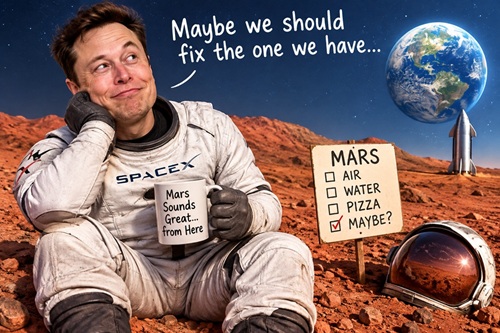 Introduction: The Wrong Planet to Save HumanityElon Musk's ambition to make humanity a multiplanetary species is one of the most audacious technological visions of our time. By developing reusable rockets, building a permanent settlement on Mars, and eventually establishing a self-sustaining civilization beyond Earth, Musk hopes to reduce humanity's vulnerability to extinction. Should Earth become uninhabitable through nuclear war, a catastrophic asteroid impact, an engineered pandemic, or some other global disaster, a population living on Mars might preserve the human species. At first glance, the argument has an appealing logic. A species confined to a single planet is vulnerable; a species distributed across several worlds is more resilient. Why not spread our existential risks across the solar system? Yet this apparently straightforward argument conceals a fundamental problem. It treats the expansion of humanity into space as a solution to existential vulnerability without adequately confronting the extraordinary costs, practical limitations, and political assumptions of the project. More importantly, it encourages us to imagine that humanity's future depends on escaping the planet we inhabit rather than learning to live sustainably on it. The central objection to Musk's Mars dream is not that space exploration is pointless, that technological innovation should stop, or that humans should never set foot on Mars. Scientific exploration can yield enormous benefits, and establishing a permanent human presence elsewhere may eventually become feasible. The objection is to the grandiose transformation of Mars colonization into a civilizational insurance policy, a destiny for humanity, and a technological substitute for solving the problems we have created on Earth. Mars colonization is fundamentally misguided when it is presented as a credible escape from humanity's problems rather than as a difficult scientific undertaking that must remain subordinate to the preservation of our actual home. 1. Mars Is Not a Second EarthThe first problem is physical. Mars is not an alternative Earth waiting to be occupied. It is a hostile environment in which almost every condition necessary for ordinary human life is missing or severely compromised. The Martian atmosphere consists predominantly of carbon dioxide and has less than one percent of Earth's surface atmospheric pressure. Temperatures are generally far below freezing, liquid water is unstable at the surface under present conditions, and the planet lacks a global magnetic field comparable to Earth's. Its surface is exposed to substantial radiation, while its gravity is only about 38 percent of Earth's. Humans cannot simply land on Mars, build houses, grow crops outdoors, and establish communities that function like terrestrial settlements. They would need pressurized and shielded habitats, reliable energy supplies, carefully managed water systems, oxygen production, food cultivation, waste recycling, medical facilities, and sophisticated industrial infrastructure. Even routine maintenance could become a matter of life and death. The distinction between visiting Mars and colonizing it is therefore crucial. A scientific expedition can bring supplies from Earth, depend on a relatively small crew, and return home. A self-sustaining colony would have to survive without depending indefinitely on shipments of food, medicine, machinery, electronics, spare parts, and other essentials from Earth. That is an entirely different level of difficulty. A settlement may appear to be functioning independently while remaining dependent on an enormous industrial system located millions of kilometers away. Producing some oxygen or extracting some water from Martian resources does not establish economic or biological independence. The more complicated the technology on which the settlement depends, the more demanding the task of reproducing that technology locally becomes. A genuinely self-sustaining Martian civilization would require not merely a rocket company and a collection of habitats, but an industrial ecosystem capable of manufacturing increasingly complex components, maintaining its energy infrastructure, supporting agriculture, and sustaining a population across generations. We have not demonstrated that such a system can be built economically or reliably on Mars. Musk's ambition is not proof that it can be done. 2. The Insurance Policy That Cannot Insure Us Soon EnoughThe strongest argument for Mars colonization is existential risk. Earth could suffer a catastrophe so severe that human civilization collapses or humanity becomes extinct. A sufficiently independent Martian population might survive and preserve our species. This is a legitimate consideration. It is also an argument that becomes much weaker when examined in terms of timing and probability. A small outpost dependent on Earth would not constitute meaningful insurance against the destruction of Earth. If the terrestrial industrial system collapsed, the outpost might lose its supply of essential components, replacement equipment, specialized medicines, and technical expertise. If Earth became uninhabitable, a colony whose life-support systems depended on regular resupply would face its own potentially fatal emergency. The relevant question is therefore not whether humans can reach Mars, but whether we can establish a population that can survive indefinitely without terrestrial assistance. Such a population would have to be sufficiently large and genetically diverse, maintain reproductive health across generations, preserve extensive technical knowledge, and possess the means to replace its own industrial infrastructure. Even if these challenges were eventually overcome, the timescale matters. A self-sufficient Martian civilization is not an immediately available refuge. It is a speculative future achievement requiring decades of development at a minimum, and potentially much longer. No one can responsibly treat its eventual success as assured. Meanwhile, the existential risks we face on Earth are already with us. Nuclear conflict, climate change, biodiversity loss, pandemics, and potentially dangerous technologies demand attention now. Some of these threats could be reduced substantially through international cooperation, improved institutions, scientific research, and better governance. Mars colonization may eventually diversify humanity's long-term survival prospects. But it cannot substitute for reducing the risks that threaten us in the meantime. There is an uncomfortable irony here. The more serious we are about preserving humanity, the more we must concentrate on the planet where virtually all human beings live, where our entire civilization's industrial capacity resides, and where the ecological foundations of our existence remain available. 3. A Technological Solution to a Political and Moral ProblemMusk's vision also reflects a characteristic technological habit of mind: the tendency to approach problems primarily through engineering, even when their underlying causes are political, social, or moral. Some existential threats are technological in origin. An asteroid impact, for example, may be mitigated through planetary defense. But many of our most serious dangers arise from how human beings organize themselves, distribute power, pursue economic interests, and respond to collective problems. Nuclear weapons do not threaten us because Earth lacks sufficient room. They threaten us because political conflicts can escalate into catastrophic violence. Climate change is not caused by an absence of habitable planets. It results largely from the way we produce and consume energy, organize economies, and distribute the costs of environmental damage. Moving a fraction of humanity to Mars does not resolve these underlying problems. It does not make terrestrial societies more peaceful, democratic, ecologically responsible, or equitable. Nor does it guarantee that a future Martian civilization will avoid reproducing the conflicts, inequalities, and destructive incentives of its parent society. Indeed, the history of human civilization gives us little reason to assume that a new geographical frontier automatically produces a better political order. Settlements beyond Earth would still involve questions of ownership, labor, governance, access to resources, and the distribution of risks and benefits. Under extreme environmental conditions, control over oxygen, water, energy, and life-support infrastructure could become a particularly powerful instrument of domination. A Mars colony could become a remarkable experiment in human cooperation. It could also become a highly unequal society in which the people who control essential infrastructure exercise extraordinary power over those who depend on it. Technology creates possibilities. It does not determine the moral character of the society that uses it. The idea that humanity can escape its problems by changing planets is therefore not simply technologically optimistic. It risks confusing the expansion of our capabilities with the improvement of our civilization. 4. The Opportunity Cost: What Could We Do Instead?The question is not simply whether Mars colonization is possible. It is whether the enormous resources required to pursue it are being allocated wisely. Rocket development, spacecraft, launch facilities, life-support systems, radiation protection, surface habitats, and the infrastructure required to transport and sustain people on Mars will demand extraordinary investment. Some of these expenditures will generate valuable technological advances. Others may produce knowledge with applications far beyond space exploration. The economic case should therefore not be dismissed by simply comparing the price of a Mars mission with the cost of solving poverty or climate change. Nevertheless, opportunity costs remain real. Capital, skilled labor, political attention, scientific talent, and industrial capacity devoted to one objective cannot simultaneously be devoted to others. Consider what humanity might accomplish by directing a comparable degree of ambition toward terrestrial challenges. We could accelerate the development of clean energy, modernize electrical grids, improve energy storage, restore damaged ecosystems, develop more resilient agricultural systems, strengthen pandemic preparedness, and invest in technologies that make cities more sustainable. We could also improve our capacity to detect asteroids, monitor dangerous environmental changes, and protect civilization against catastrophic risks without requiring millions of people to live on another planet. These are not mutually exclusive goals. Space exploration can contribute directly to some of them. Satellite observations are indispensable to climate science, communications, weather forecasting, and disaster management. Planetary defense is a legitimate global priority. Research conducted in space can also produce scientific insights that would otherwise be difficult to obtain. The relevant distinction is between space exploration as a means of expanding knowledge and solving problems, and Mars colonization as an end in itself. The former has a strong justification. The latter needs a much more demanding defense. Musk's enormous personal and corporate investment in space technology does not establish that colonization is the best use of the resulting capabilities. Nor does the spectacular nature of the goal make it more important than less glamorous projects whose benefits are more immediate, more widely distributed, and better supported by evidence. A civilization should be judged not by the distance its richest entrepreneurs can travel from Earth, but also by the quality of life it can secure for the people who remain behind. 5. The Billionaire's Escape FantasyThere is also a political dimension to the Mars dream that deserves scrutiny. Who, exactly, is expected to colonize Mars? The language of becoming a multiplanetary species invokes humanity as a whole. It suggests a collective undertaking in which the survival of our species transcends national borders, social classes, and individual interests. But the practical reality of early Mars settlement would almost certainly be very different. The first permanent inhabitants would be a small, highly selected population: astronauts, engineers, scientists, technicians, and other specialists. Participation would depend on physical capabilities, technical skills, financial resources, and the willingness to accept extraordinary risks. Over time, a larger settlement might become possible, but there is no reason to assume that access would be distributed equally. The rhetoric of saving humanity thus conceals an important question: which humanity? A Mars settlement would initially be an elite undertaking, while the overwhelming majority of human beings would remain on Earth, exposed to the very risks that the project supposedly exists to overcome. If the settlement were to become a refuge during a terrestrial catastrophe, access to it would necessarily be limited by transportation capacity, habitat space, supplies, and the time available for evacuation. There is no plausible scenario in which Mars could serve as an emergency destination for billions of people. Even a successful colony would be a refuge for a small minority, not an alternative home for humanity as a whole. This does not make every elite-funded scientific project illegitimate. Many important advances begin with expensive experiments accessible to relatively few people. But it does undermine the suggestion that Mars colonization straightforwardly constitutes a collective insurance policy. The political question becomes especially troubling if the language of escape distracts from the responsibilities of those who possess disproportionate economic and technological power. It is one thing to develop the capacity to survive a catastrophe. It is another to devote enormous resources to a possible refuge while neglecting preventable dangers affecting billions of people. Musk's personal motivations cannot simply be inferred from his ambitions, and his space program should not be reduced to a psychological diagnosis. Yet his project embodies a recognizable cultural fantasy: that sufficiently wealthy and technologically capable individuals can transcend the limitations that bind ordinary human beings. Mars becomes the ultimate frontier of private autonomy, a place where existing institutions might be left behind and a new social order constructed from scratch. But no one escapes dependence on others merely by traveling to another planet. A Martian settlement would depend on collective labor, shared knowledge, complex supply chains, and institutions capable of coordinating an exceptionally fragile social system. The rhetoric of individual technological mastery sits uneasily with this unavoidable dependence. 6. The Ecological ContradictionPerhaps the deepest irony of Mars colonization is that the planet we would leave behind is incomparably more hospitable to human life than the planet we hope to inhabit. Earth offers a breathable atmosphere, abundant liquid water, fertile soils, a protective magnetic field, a relatively stable climate, and an extraordinary diversity of living organisms. These conditions are not independent conveniences. They form an interconnected ecological system upon which human civilization depends. Mars offers none of these advantages at anything approaching Earth's scale. On Earth, we inherit the results of billions of years of planetary evolution. On Mars, we would have to manufacture or maintain the conditions necessary for survival through technological intervention. Earth provides an enormous range of environments in which organisms can live and adapt. A Martian settlement would depend on carefully controlled environments in which relatively small failures could have catastrophic consequences. The contrast is not merely practical. It exposes a conceptual problem in the idea that technological development enables us to transcend nature. Human beings are not independent of the biosphere. We are products of it, and our capacities for science, engineering, and technological innovation emerged within its evolutionary history. The technological civilization that makes Mars exploration possible was itself built on the resources, organisms, and environmental conditions of Earth. To imagine that we can escape our dependence on nature by constructing artificial habitats elsewhere is to confuse our ability to modify particular environmental conditions with the ability to dispense with ecological dependence altogether. Of course, Earth is not invulnerable. Human activity can damage the biosphere, and natural catastrophes can threaten civilization. The answer is not to pretend that the planet will take care of us regardless of what we do. It is to understand that maintaining the conditions of habitability is among the most important responsibilities of an intelligent species. The ecological lesson of Mars should therefore be the opposite of the one often drawn from it. Rather than inspiring indifference toward Earth's future, the hostile Martian environment should deepen our appreciation of how unusual and valuable Earth's conditions are. The difficulty of making Mars habitable should remind us how fortunate we already are to inhabit a habitable planet. 7. Can Mars Really Become Self-Sustaining?A serious defense of Musk's project cannot stop at the claim that the technological challenges are difficult but eventually surmountable. It must specify what success would mean. A settlement can be operationally independent for a period without being genuinely self-sustaining. It might produce oxygen and water, grow some of its own food, and manufacture selected construction materials while still relying on Earth for sophisticated electronics, industrial machinery, precision instruments, medical equipment, and replacement components. Modern technological civilization rests on extraordinarily complex global supply chains. Semiconductor manufacturing, for example, requires specialized equipment, ultrapure materials, precision control systems, and highly developed industrial processes. A civilization capable of producing a limited range of consumer goods cannot automatically reproduce the industrial system that makes those goods possible. Replicating this system on Mars would be exceptionally demanding. The colony would need to establish mining and refining operations, chemical industries, machine shops, energy infrastructure, manufacturing facilities, and the means to maintain all of them. These industries would themselves require equipment and spare parts, which would have to be manufactured locally or imported from Earth. Agriculture presents another set of challenges. Producing food in controlled environments requires energy, water, nutrients, pollination or equivalent cultivation techniques, disease management, and the maintenance of biological diversity. A resilient agricultural system must withstand crop failures and other disruptions without collapsing into food shortages. Then there is the human dimension. What would low gravity do to human development, pregnancy, childhood growth, and aging across multiple generations? How would a small population maintain genetic diversity? Could the psychological stresses of confinement, isolation, and dependence on fragile infrastructure be managed over decades? These are open questions, not objections that can be dismissed simply by invoking future technological progress. None of this proves that a self-sufficient Mars settlement is impossible. It does show that the objective is far more ambitious than transporting people and constructing a permanent base. The crucial distinction is between a technologically supported outpost and an autonomous civilization. The first is a plausible extension of present space exploration. The second remains an unproven aspiration. A responsible program should make that distinction explicit rather than allowing the achievement of intermediate milestones to be presented as evidence that the ultimate vision is inevitable. 8. Terraforming: A Solution Looking for a PlanetThe most expansive versions of the Mars vision go beyond settlements in enclosed habitats. They imagine transforming the planet itself, making it warmer, thickening its atmosphere, and eventually creating conditions in which humans could live with far less technological protection. This is usually called terraforming. It is an intellectually fascinating concept, but it should not be confused with an engineering project whose feasibility has been demonstrated. Mars has a thin atmosphere, a cold surface, and limited accessible reservoirs of carbon dioxide. Scientific assessments have indicated that the readily available carbon dioxide on Mars is insufficient to produce the substantial atmospheric pressure needed through conventional release methods alone. More radical proposals would require technologies, resources, and timescales far beyond present capabilities. Warming the planet would not automatically create a breathable atmosphere. Even a substantially thickened carbon-dioxide atmosphere would remain unsuitable for unprotected human respiration. A long-term terraforming project would also have to address radiation exposure, water availability, nutrient cycles, and the stability of whatever new environmental conditions were created. The timescale could be centuries or much longer, and the ultimate feasibility remains uncertain. There is also an ethical question. If Mars contains indigenous microbial life, terraforming could destroy or irreversibly alter a second example of biology. Even if Mars proves lifeless, its scientific value as a record of planetary evolution should not be casually sacrificed to an ambitious human project. This does not mean Mars must remain untouched forever. It means that planetary transformation should be considered only after careful scientific assessment, serious evaluation of alternatives, and international deliberation. Terraforming currently functions more convincingly as an expression of technological imagination than as a practical solution to human vulnerability. 9. The Myth of Humanity's Cosmic DestinyBeneath the engineering and economic arguments lies a philosophical assumption: that humanity's future naturally involves expansion beyond Earth. This assumption is frequently expressed through the language of destiny. Humanity is portrayed as a species that must spread into space, establish new worlds, and continue an evolutionary journey toward ever-greater technological power. Remaining on Earth can then appear timid, provincial, or even irresponsible. But why should expansion be regarded as an overriding measure of progress? Biological evolution does not have a predetermined destination. Natural selection produces adaptations to particular environments; it does not guarantee continuous increases in complexity, intelligence, geographical range, or technological capability. Species can flourish for millions of years without expanding beyond their ecological niches, and highly successful species can become extinct when their environments change. Humanity's technological achievements are extraordinary, but they do not establish that the universe has assigned us a cosmic mission. Nor does the possibility of space settlement demonstrate that it is necessary for human flourishing. Scientific curiosity, exploration, and the desire to understand our place in the universe are valuable human motivations. But they need not be converted into a doctrine according to which the expansion of our species is inherently superior to the preservation and improvement of life where it already exists. There is a danger here of replacing religious ideas of providence with a secularized mythology of technological transcendence. Where older narratives promised salvation in another realm, the new narrative promises survival on another planet. Where traditional eschatologies anticipated a transformed world, technological futurism anticipates a transformed solar system. The comparison should not be taken too far. Musk's project is a technological undertaking, not necessarily a religious belief system. Nevertheless, its cultural appeal draws on a familiar human desire to overcome finitude, escape vulnerability, and imagine a future beyond the limitations of present existence. Mars becomes more than a destination. It becomes a symbol of transcendence. The problem is that no technological achievement abolishes the basic conditions of existence. A Martian civilization would still be vulnerable to accidents, resource shortages, political conflict, disease, and environmental disruption. It would remain dependent on the physical laws of the universe. It would not escape mortality or the need for cooperation. Human maturity might consist less in transcending our planetary origins than in recognizing the conditions that make our existence possible and accepting responsibility for maintaining them. 10. A More Defensible Vision of Space ExplorationRejecting Mars colonization as a grand civilizational imperative does not require rejecting an ambitious space program. On the contrary, it permits a more realistic and intellectually defensible account of what space exploration can achieve. Robotic exploration should remain a central priority. Uncrewed missions can investigate Mars, search for evidence of past or present life, study planetary geology, and expand our understanding of the solar system without exposing human crews to the same risks or requiring the same life-support infrastructure. Human missions may also be justified where the scientific, technological, or exploratory benefits warrant the additional expense and danger. Research into closed-loop life-support systems, radiation protection, autonomous manufacturing, and long-duration human spaceflight could generate useful knowledge even if a permanent colony never becomes viable. Planetary defense deserves particular attention because it directly addresses the problem of existential risk. Detecting potentially hazardous asteroids, improving our ability to predict their trajectories, and developing tested methods of deflection would provide benefits to humanity regardless of whether anyone ever settles Mars. International cooperation should be another priority. Space exploration is already a domain in which scientific knowledge can be shared across national boundaries. A program oriented toward common scientific goals could help develop institutions for managing shared risks and resources beyond Earth. Finally, the environmental and technological lessons of space exploration should be brought back to Earth. Closed-loop systems, efficient energy use, resource recycling, and resilient infrastructure are relevant to the long-term sustainability of terrestrial civilization. The proper question is not whether we should explore Mars, but what we hope to learn, what capabilities we need to develop, and what benefits we can reasonably expect. These questions permit genuine ambition without requiring us to endorse the much stronger claim that humanity must colonize another planet to secure its future. Conclusion: First Learn to Live on EarthElon Musk's ambition to make humanity a multiplanetary species expresses a genuine and understandable concern: a civilization confined to one planet remains vulnerable to catastrophe. Establishing a self-sufficient settlement elsewhere might eventually provide some protection against the extinction of terrestrial humanity. But the distance between that possibility and the promise of Mars as a viable refuge is enormous. A permanent outpost is not an autonomous civilization. A colony dependent on Earth is not insurance against Earth's destruction. And the capacity to build sophisticated machines does not establish that we can reproduce the ecological and industrial foundations of human civilization on another world. The more immediate objection is that the Mars project risks distorting our priorities. It directs attention toward a speculative technological escape while the environmental, political, and social conditions of our actual home demand sustained attention. It invites us to imagine that humanity's future depends on geographic expansion rather than on the difficult work of reducing existential risks, protecting the biosphere, and improving the institutions through which we govern ourselves. There is also a philosophical mistake in treating expansion as an unquestionable measure of progress. Humanity has no demonstrated cosmic obligation to colonize other planets. Our technological abilities create opportunities, not commands. The fact that we may eventually be able to settle Mars does not establish that doing so is the best use of our resources, our intelligence, or our collective imagination. A limited, scientifically justified human presence on Mars may one day be worthwhile. A self-sufficient Martian civilization may even become possible. These possibilities deserve open-minded investigation, but neither should be treated as inevitable or as a substitute for terrestrial responsibility. The deepest lesson of Mars is not that we should prepare to abandon Earth. It is that a planet capable of supporting human civilization without artificial life-support systems is an extraordinary achievement of natural history. We did not create Earth's atmosphere, its oceans, its soils, or its intricate web of life. We inherited them. Our scientific and technological accomplishments depend on that inheritance, however much we may come to reshape it. Before declaring ourselves a species destined for the stars, we should demonstrate that we are capable of maintaining the conditions of our existence here. The ultimate test of an intelligent civilization is not whether it can escape its home planet, but whether it can learn to inhabit that planet wisely.
Widget is loading comments...
|