|
TRANSLATE THIS ARTICLE
Integral World: Exploring Theories of Everything
An independent forum for a critical discussion of the integral philosophy of Ken Wilber
  Frank Visser, graduated as a psychologist of culture and religion, founded IntegralWorld in 1997. He worked as production manager for various publishing houses and as service manager for various internet companies and lives in Amsterdam. Books: Ken Wilber: Thought as Passion (SUNY, 2003), and The Corona Conspiracy: Combatting Disinformation about the Coronavirus (Kindle, 2020). Frank Visser, graduated as a psychologist of culture and religion, founded IntegralWorld in 1997. He worked as production manager for various publishing houses and as service manager for various internet companies and lives in Amsterdam. Books: Ken Wilber: Thought as Passion (SUNY, 2003), and The Corona Conspiracy: Combatting Disinformation about the Coronavirus (Kindle, 2020).
Check out my other conversations with ChatGPT Brendan Dempsey's The Evolution of MeaningCan the Cosmos Teach Us What Meaning Means?Frank Visser / ChatGPT
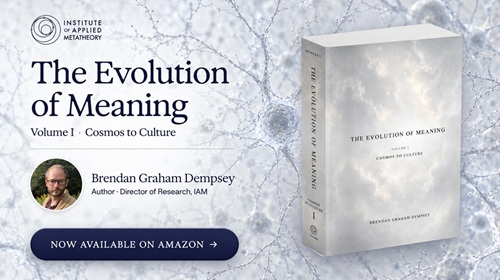 From Cosmic Evolution to the Meaning CrisisBrendan Graham Dempsey's The Evolution of Meaning: A Universal Learning Process is an ambitious attempt to reconnect the human search for meaning with the larger history of the universe. Rather than treating meaning as something that appeared suddenly with human consciousness, language, or religion, Dempsey traces its roots through the emergence of matter, life, mind, and culture. His central proposal is that meaning can be understood in terms of information processing: systems acquire information that helps them maintain themselves, respond to their environments, and develop increasingly sophisticated forms of organization. In this account, human meaning-making is not an inexplicable addition to an otherwise meaningless universe, but an extension of processes that have a much longer evolutionary history. This is a fascinating starting point. It also places Dempsey squarely within a contemporary intellectual movement seeking to overcome the perceived deficiencies of both reductive materialism and traditional religion. The former is accused of stripping the world of value and significance; the latter of grounding meaning in supernatural realities that modern science can no longer straightforwardly accept. Dempsey hopes to find a third option: a naturalistic yet spiritually hospitable worldview in which meaning emerges from the evolutionary organization of reality itself. The question, however, is whether this approach actually explains meaning or merely extends the vocabulary of meaning to increasingly remote corners of the universe. Does information processing in physical systems already constitute meaning? Does biological adaptation amount to learning? And even if increasingly complex organisms develop richer forms of meaning, does this tell us anything about whether cosmic evolution as a whole possesses meaning or direction? These questions are especially important because Dempsey's project is not merely a scientific account of how complex systems emerge. It is also part of a broader attempt to rehabilitate a meaningful, potentially sacred cosmos without returning to conventional supernaturalism. The intellectual ambition is considerable. So is the danger of moving too quickly from scientific description to philosophical interpretation. The New Book: A Much Larger AmbitionThe book now presented on Dempsey's website is The Evolution of Meaning, Volume I: Cosmos to Culture, published by IAM Press on October 1, 2026. At 746 pages, it is the opening volume of a planned three-volume project. The first volume establishes the theoretical framework, while the subsequent volumes will trace the historical development of humanity's sacred worldviews, from animism and ancient metaphysics to modernity and an anticipated integrative worldview. This is a substantially more ambitious undertaking than a conventional book about the psychology of meaning. Dempsey proposes a Universal Development Theory that synthesizes thermodynamics, evolutionary biology, cognitive science, developmental psychology, cultural history, and theology. He also integrates ideas from Ken Wilber's Integral Theory, Gregg Henriques's Unified Theory of Knowledge, and the Unifying Theory of Reality. The website advertises 165 scored historical texts, more than 540 scored developmental performances, and over 40 figures. Dempsey is therefore not merely proposing a philosophical narrative. He is attempting to give his evolutionary account an empirical foundation through quantitative measures of complexity. The critical question becomes more precise as a result. It is not enough to ask whether evolution produces increasing complexity. We already know that it can. Nor is it enough to demonstrate that human beings develop increasingly sophisticated forms of reasoning, morality, or symbolic expression. The real issue is whether these developments can be placed within one explanatory framework without confusing different kinds of processes, measures, and meanings. Dempsey's project is most interesting precisely where it attempts to bridge those differences. It is also most vulnerable there. 1. The Fundamental Problem: What Does It Mean to Call Something Meaningful?Dempsey's starting point is a definition of semantic information developed by Artemy Kolchinsky and David Wolpert. In broad terms, information is meaningful to a physical system when it concerns aspects of the environment that causally contribute to the system's continued existence. This is a serious scientific proposal, not simply an appeal to spiritual intuition. It provides a way to distinguish information that matters to a system's viability from information that makes no relevant difference. A bacterium's sensitivity to a chemical gradient, for example, can contribute to its survival. A nervous system can extract environmental information that supports adaptive behavior. Human beings can process information through language, institutions, and shared cultural representations. The problem begins when this specialized concept of semantic information is treated as the foundation for meaning in its full human sense. Consider the difference between a bacterium responding to a chemical gradient and a person wondering whether life is worth living. Both may involve information relevant to the organism's persistence, but the latter question concerns much more than survival. It involves self-understanding, commitments, moral obligations, relationships, mortality, and the possibility that a meaningful life might require sacrificing one's own survival. A soldier who dies protecting others, a scientist who risks everything to discover the truth, or a dissident who refuses to cooperate with an oppressive regime may act in ways that undermine their immediate viability while remaining deeply meaningful to them and to others. Meaning, in human life, is not exhausted by information that keeps a system alive. Dempsey can certainly respond that he is proposing a layered account: basic viability is the foundation upon which richer forms of meaning emerge. But that response makes the distinction between the levels more important, not less. The fact that one form of meaning depends historically and materially on another does not establish that they are instances of precisely the same phenomenon. There is a difference between identifying a common underlying condition and explaining a higher-level property. Oxygen is necessary for ordinary human thought, but oxygen chemistry does not, by itself, explain what a philosophical argument means. Likewise, survival-relevant information may be a necessary foundation for some forms of meaning without being a sufficient explanation of meaning as experienced, interpreted, and evaluated by human beings. Dempsey's foundational move is therefore promising as a theory of biologically relevant information, but it cannot simply be assumed to constitute a general theory of meaning. The transition from one to the other requires its own argument. 2. The Universe Is Not Necessarily LearningThe book's promotional language announces its central thesis in memorable form: the universe has been learning for 13.8 billion years, and meaning is what it learns. This is rhetorically effective, but it introduces a problem that should not be concealed by the elegance of the formulation. Learning normally involves a system whose states or responses change as a consequence of experience or interaction. In biological organisms, learning can involve behavioral modification. In nervous systems, it can involve changes in neural connections and internal models. In cultures, it can involve the retention and transmission of knowledge across generations. What does it mean, however, to say that matter itself learns? Dempsey distinguishes four forms of learning. Matter exhibits structural learning, life exhibits genetic learning, mind exhibits cognitive learning, and culture exhibits symbolic learning. The proposed continuity is that each level retains configurations or information that contribute to persistence, while allowing more complex forms of organization to emerge. This is an interesting analogy, and it may be useful in identifying similarities among processes that are often studied separately. But the use of a common word does not establish that the processes share all the properties normally associated with that word. A crystal that forms under particular physical conditions does not thereby learn in the same sense as an animal that modifies its behavior after experience. A genetic population that changes through natural selection does not necessarily learn in the cognitive sense. And a culture that preserves knowledge through language possesses forms of memory, interpretation, and correction that cannot simply be read off the behavior of matter. There are genuine connections between these phenomena, but there are also important differences. One could call the persistence of stable physical configurations a primitive form of learning, provided one explicitly defines the term in that way. Yet the resulting concept would be considerably broader than ordinary learning. It would describe a general pattern of selective persistence, not necessarily the acquisition of knowledge by a learning subject. The danger is that an illuminating analogy becomes an ontological assertion. Once matter, organisms, minds, and cultures are all described as learners, the entire history of the universe begins to resemble the development of a single learner. The universe appears to acquire knowledge, become increasingly sophisticated, and eventually reflect upon itself. But this appearance may arise partly from the language used to describe the process. The question is not whether the analogy is evocative. It is whether the analogy explains something that could not be explained more precisely through the distinct mechanisms of physical self-organization, natural selection, neural learning, and cultural transmission. 3. Thermodynamics: The Physics of Meaning?Dempsey's appeal to thermodynamics is one of the most scientifically interesting features of the project. Living organisms and other organized systems maintain themselves far from thermodynamic equilibrium by exchanging energy and matter with their environments. Their persistence depends on physical conditions and processes that can be studied scientifically. This provides a powerful naturalistic starting point for understanding how organized systems remain viable in a changing environment. Yet thermodynamics does not independently establish that the universe is moving toward greater meaning. The second law concerns the behavior of entropy in the relevant thermodynamic system, not a universal drive toward complexity, consciousness, or value. Local organization can emerge and persist while the total entropy of a larger system increases. Complex structures can develop under appropriate conditions, but they do not emerge everywhere, at every time, or in a single predetermined direction. Dempsey's proposal is stronger when understood as an attempt to identify conditions under which increasingly complex forms of information processing become possible. It becomes more questionable when thermodynamic persistence is treated as the foundation for a universal developmental trajectory. The distinction matters because the universe's capacity to generate complex structures is not equivalent to a cosmic tendency toward ever-greater significance. Stars form and die. Organisms evolve and become extinct. Ecosystems flourish and collapse. Civilizations develop elaborate systems of knowledge and then sometimes lose them. Evolution has produced extraordinary complexity, but it has also produced dead ends, simplifications, and mass extinctions. A scientifically responsible evolutionary narrative must account for these processes as well as for the spectacular instances of increasing organization. Nor does the existence of a physical basis for information establish that information is meaningful in every sense in which human beings use that word. Thermodynamics can help explain the energetic conditions of persistence. It cannot, without additional theoretical steps, tell us why a particular moral commitment is justified or why a work of art matters to someone. The physics of a phenomenon and the significance of that phenomenon are related questions, but they are not interchangeable. 4. Complexity Is Not the Same as ProgressDempsey's theory depends heavily on the idea that increasingly complex forms of organization emerge across cosmic, biological, psychological, and cultural history. His website describes four distinct registers of learning, each building on earlier levels while introducing new capacities. There is a defensible evolutionary story here. Life depends on physical processes, nervous systems depend on biological organization, and symbolic culture depends on organisms capable of communication and social learning. Later developments can incorporate and reorganize capacities that were unavailable at earlier levels. But a developmental sequence is not automatically a story of progress. The distinction is familiar from evolutionary biology. Natural selection does not work toward a predetermined endpoint. It favors traits that confer reproductive advantages in particular environments. A more complex organism is not necessarily more successful than a simpler one, and evolutionary success does not imply greater moral worth or greater wisdom. The same caution applies to human societies. More sophisticated bureaucracies, technologies, symbolic systems, and intellectual frameworks can increase a society's capacities without making it more humane. A modern state may possess scientific knowledge and administrative sophistication while committing atrocities on an unprecedented scale. Technological and organizational development can expand both our ability to care for others and our ability to destroy them. Dempsey acknowledges that later cultural systems should not automatically be considered more virtuous. That qualification is important. It shows an awareness that developmental complexity and moral improvement are not identical. Nevertheless, the larger narrative retains a strong directional emphasis. The universe develops increasingly complex forms of organization; these forms permit richer meaning-making; and human cultures eventually become capable of reflecting on the sacred in increasingly comprehensive ways. The question is whether the evidence demonstrates a general developmental trend or whether a particular selection of historical examples has been arranged to reveal one. The answer depends partly on how complexity is measured, which systems are included, and how the relevant developmental categories are constructed. A historical account that concentrates on the emergence of more sophisticated philosophical or theological texts may well discover increasing conceptual complexity. But this does not establish that human history as a whole is moving toward greater wisdom, freedom, compassion, or existential fulfillment. Indeed, the most important human achievements may sometimes consist of simplifying an unnecessarily complicated worldview, rejecting an elaborate ideological system, or recognizing that an apparently higher synthesis has become detached from reality. Development can involve differentiation and integration, but it can also involve correction, loss, resistance, and reversal. Any adequate theory of cultural evolution must explain those possibilities without treating them as mere temporary deviations from an underlying upward trajectory. 5. The Problem of Measuring Cultural EvolutionOne of the book's distinctive features is its attempt to quantify the development of meaning. Dempsey reports scoring 165 historical texts associated with different worldview structures and identifies a trend toward increasing complexity across the selected material. He also draws on more than 540 developmental performances assessed through the Lectical Assessment System, which measures hierarchical complexity in human thinking and communication. This empirical ambition deserves serious attention. Developmental theories often rely on broad descriptions of stages without sufficiently clear criteria for comparing performances or testing whether their proposed sequences are supported by evidence. Quantitative methods can make these theories more explicit and expose them to criticism. However, measurement does not eliminate theoretical assumptions. It relocates some of them. First, what exactly is being measured when a historical text receives a complexity score? The answer depends on the construct being assessed and the properties the scoring system is designed to recognize. A text can be syntactically intricate, conceptually differentiated, historically influential, morally perceptive, or emotionally profound. These are not necessarily the same quality. A sophisticated philosophical argument may display greater hierarchical complexity than a traditional story, but the story might convey a moral or existential insight with unusual clarity. A text may also be complex because it is obscure, internally contradictory, or designed to exclude outsiders. Complexity is not an all-purpose measure of intellectual merit. Second, which texts are selected to represent each worldview? Dempsey's website describes relatively small corpora for each category, with approximately 25 to 32 texts per corpus. It also notes that the historical dating of the tribal corpus relies on oral narratives recorded in the modern era, used as proxies for much earlier periods. This creates an obvious methodological challenge. Oral traditions are not transparent time capsules of prehistoric consciousness. They have their own histories of transmission, reinterpretation, and interaction with surrounding cultures. The date at which a story was recorded is not necessarily the date at which its constituent ideas originated. Nor can a handful of texts adequately represent the full intellectual diversity of an entire historical period or civilization without a carefully justified sampling strategy. Third, the relationship between the measurement procedure and the developmental theory requires close scrutiny. The fact that an assessment system can score the complexity of a text without explicitly assigning it to a predefined developmental stage is a methodological advantage. But the resulting scores must still be interpreted within a theory of what constitutes development, and the selection and classification of texts remain consequential. A convincing empirical case would therefore need to establish not merely that the selected texts show a rising trend, but that the trend is robust across alternative samples, classification schemes, historical interpretations, and measures of complexity. It would also need to distinguish a genuine historical change in cultural capacities from the effects of the kinds of documents that happen to survive. Literate societies leave different records from predominantly oral societies, and the surviving philosophical or theological works of an era may not represent the ordinary thinking of its population. The quantitative project is promising, but its conclusions should remain proportional to the evidence. Measuring a pattern is not the same as proving the interpretation placed upon it. This is especially important when the measured pattern is subsequently used to support a general theory of the evolution of meaning and the sacred. 6. Developmental Psychology and the Temptation of Integral HierarchiesDempsey's framework also seeks to update integrative models of psychology by bringing together developmental research and quantitative assessments of hierarchical complexity. The website presents this work as a way to compare developmental models with greater precision, including at finer-grained levels than broad stage classifications. Here the project enters a field where empirical research, philosophical interpretation, and integral metatheory have long interacted uneasily. Developmental psychology has produced substantial evidence that people's reasoning, perspective-taking, and ability to coordinate competing considerations can change over time. It is reasonable to investigate whether some forms of thinking are more differentiated or hierarchically organized than others. But the inference from greater complexity to a generally higher developmental level requires care. A person may reason with great sophistication in one domain while displaying considerable rigidity in another. Abstract reasoning does not guarantee emotional maturity. The capacity to coordinate multiple perspectives does not automatically confer moral courage. A person may understand a complex moral dilemma and still act selfishly. Development is multidimensional. Its different aspects can reinforce one another, but they can also diverge. This is where an integral framework can become both useful and misleading. By insisting that reality has multiple dimensions, it reminds us not to reduce human beings to a single measure. Yet when those dimensions are assembled into a comprehensive developmental map, the resulting model can suggest a unity and order that the evidence does not independently establish. Ken Wilber's Integral Theory offers a familiar example of this temptation. Its appeal lies partly in the promise of locating diverse phenomena within one encompassing architecture. Dempsey's Universal Development Theory explicitly draws on Wilber's work, while also incorporating other metatheoretical systems. The critical question is whether the synthesis yields new, testable explanations or primarily provides a common vocabulary for arranging existing ideas. A map can be intellectually illuminating without being a literal representation of the world's underlying structure. The danger arises when the usefulness of a framework is taken as evidence that reality itself follows the framework's particular divisions and developmental sequence. The strongest version of Dempsey's project would treat its integral architecture as a revisable model. Its weakest version would allow the architecture to determine in advance what the data are expected to show. 7. From Complexity to the Sacred: The Most Controversial TransitionThe most philosophically ambitious part of Dempsey's project is its attempt to develop a naturalistic theory of the sacred. His proposal is not simply that religious ideas evolve as human societies change. He suggests that the sacred can be understood as emerging from what cultures regard as vital to their flourishing, and that the development of cultural meaning systems may involve genuine maturation. The website describes a movement from violent, authoritarian images of divinity toward more encompassing conceptions, such as Love itself. It also presents God as an emergent, participatorily enacted, causally efficacious process rather than simply a supernatural person. This is an intriguing attempt to preserve the significance of religious experience while avoiding a straightforward return to traditional theism. It also contains several distinct claims that should be separated. The first is historical: religious representations change over time. This is indisputable. The second is psychological and sociological: religious symbols and practices can help communities organize their values, sustain collective identities, and respond to existential needs. This is also defensible, although the effects vary considerably across contexts. The third is evaluative: some religious worldviews represent a more mature understanding of reality or human flourishing than others. This requires explicit criteria of maturity and evidence that those criteria are justified. The fourth is ontological: the object of religious concern may itself develop, so that the historical evolution of human conceptions of God could reflect not merely changes in human imagination but something real about the development of the sacred. This final move is the most difficult to defend. Suppose a culture moves from imagining its deity as a jealous tribal ruler toward understanding divinity in terms of universal compassion. We can investigate the historical, psychological, and ethical factors that contributed to this transformation. We can ask whether the newer conception better supports human flourishing or more adequately addresses moral problems. But what would it mean to say that the object of theology itself has matured? If God is understood as a cultural process, then the claim may refer to a genuine change in the social practices and institutions through which people enact their highest values. Such a claim can be investigated without assuming that a divine being exists independently of those practices. If, however, the claim means that the universe itself is becoming more divine or that a deeper sacred reality is progressively disclosing itself through cultural evolution, an additional argument is required. The historical development of religious representations does not by itself demonstrate a corresponding development in their supposed object. This distinction is crucial because the same historical evidence can be interpreted in quite different ways. A believer may understand changing conceptions of God as progressive revelation. A secular historian may understand them as changes in human societies and institutions. A naturalistic philosopher may treat religious symbols as evolving cultural constructions that can nevertheless possess real psychological and social consequences. These interpretations are not equivalent, and evidence for one does not automatically establish the others. Dempsey's naturalistic theology will therefore stand or fall on how carefully it distinguishes the evolution of sacred meanings from claims about the independent reality of the sacred. 8. Can the Sacred Be Naturalized Without Being Reintroduced Through the Back Door?Dempsey's project belongs to a broader movement attempting to recover existential depth after the disenchantment associated with modern science. It shares territory with the work of thinkers such as John Vervaeke, who has investigated the meaning crisis, and with contemporary proposals for emergentist or naturalistic spirituality. The attraction is understandable. A worldview in which the universe is described exclusively in terms of impersonal physical processes can seem inadequate to the human need for significance, orientation, and belonging. Yet traditional religious cosmologies often depend on claims that are difficult to reconcile with modern scientific knowledge. A naturalistic account of the sacred promises to preserve what is valuable in religion while abandoning its more problematic metaphysical commitments. But there is a potential equivocation here. If the sacred means whatever a community regards as most important, then a naturalistic account can explain how sacred values arise, change, and shape behavior. The term need not refer to a supernatural reality. However, if the sacred is supposed to designate something objectively deeper than ordinary human values, something that the universe is gradually revealing through evolution, then the theory has moved beyond a straightforward sociological or psychological account. The word sacred is doing different work in these two interpretations. In the first, it describes the highest-order commitments through which human beings organize their lives. In the second, it implies that these commitments connect us with a reality that transcends their human origins. Dempsey appears interested in retaining room for the second possibility without insisting on conventional supernaturalism. This is philosophically legitimate as a research program, but it leaves the central question unresolved: what evidence would distinguish an emergent sacred reality from the human discovery, creation, or reinterpretation of values? Calling the sacred an emergent process does not, by itself, settle the issue. Emergence is a way of describing how new properties or patterns arise through interactions among underlying components. It does not automatically establish that whatever emerges possesses the metaphysical status attributed to it. Money, legal institutions, scientific disciplines, and moral norms all emerge through human interaction. Their consequences are real, but their reality does not require us to posit an additional cosmic dimension in which their significance was waiting to unfold. Likewise, the emergence of profound religious experiences and transformative cultural values may be entirely real without demonstrating that the cosmos has an intrinsic spiritual purpose. A naturalistic religion can be valuable as a human practice without being a discovery of the universe's hidden religious character. That possibility deserves more consideration than it often receives in integral and metamodern discussions. 9. A New Cosmic Story, or a New Explanation?Dempsey's undertaking inevitably recalls earlier attempts to unite cosmology, evolution, consciousness, and spirituality in a single narrative. Pierre Teilhard de Chardin interpreted evolution as a movement toward increasing complexity and consciousness, culminating in his conception of the Omega Point. Wilber developed an encompassing account of evolution and development in which increasing complexity and depth occupy a central place. Alfred North Whitehead's process philosophy offered another way of understanding reality as becoming rather than as a collection of static objects. Dempsey's approach differs in important respects. His emphasis on information theory, thermodynamics, developmental assessment, and the measurement of historical texts gives the project an empirical dimension that cannot simply be dismissed as metaphysical speculation. Nevertheless, the underlying temptation remains familiar: to interpret the emergence of increasingly complex systems as part of one continuous process that eventually produces consciousness, culture, and reflection on the sacred. The narrative has considerable intellectual appeal. The universe begins with physical processes; life emerges; organisms develop nervous systems; human beings create symbolic worlds; and those symbolic worlds become capable of interpreting the entire cosmic history from which they arose. But we should distinguish the extraordinary fact that the universe has produced creatures capable of contemplating it from the stronger claim that the universe's history is intrinsically directed toward that outcome. The first is a fact about what has happened. The second is an interpretation of why it happened or what it ultimately means. There is no contradiction in acknowledging the remarkable emergence of human consciousness while rejecting the idea that the cosmos was somehow striving toward it. Evolutionary history can be fascinating without being a cosmic autobiography. Its outcome can be meaningful to us without having been the universe's purpose from the beginning. This distinction also clarifies the status of Dempsey's universal learning process. As a broad conceptual framework, it may help us identify structural similarities among physical persistence, biological adaptation, cognitive learning, and cultural development. As a claim that these processes constitute one universal trajectory toward increasingly comprehensive meaning, it carries a much greater burden of proof. A unifying theory should not merely redescribe different processes in a common vocabulary. It should explain the relationships among them, identify the mechanisms responsible for their transitions, and generate insights that would be difficult to obtain without the unification. That is the standard against which Dempsey's theory should ultimately be assessed. 10. The Alternative: Meaning Without Cosmic TeleologyThere is a possibility that the search for a universal theory of meaning is being driven by an unnecessary assumption: that human meaning must somehow be grounded in the intrinsic direction or purpose of the universe. Why should it? Meaning can be understood at several levels without assuming that they form a single cosmic intention. Physical systems possess states and interactions that can be described in terms of information and energy. Living organisms exhibit forms of organization that make certain environmental conditions relevant to their survival and reproduction. Minds develop experiences, goals, and interpretations. Human beings create shared meanings through language, relationships, institutions, and cultural practices. These levels are connected. Higher-level phenomena depend on lower-level conditions, and new capacities emerge through evolutionary processes. Yet the connections do not require us to attribute meaning to the universe in precisely the same sense that people attribute meaning to their lives. A naturalistic account can acknowledge that human beings are products of cosmic and biological evolution while recognizing that the significance of their lives arises through the relationships, commitments, achievements, and interpretations that matter to them. Such an account need not reduce meaning to subjective whim. Human meanings can be evaluated against evidence, ethical considerations, the experiences of others, and the practical consequences of our commitments. Some beliefs are false, some values are destructive, and some forms of life are more conducive to human flourishing than others. Meaning can therefore be both humanly created and open to rational criticism. Nor does the absence of a predetermined cosmic purpose imply that everything is equally meaningful or that nothing matters. The fact that the universe does not appear to prescribe our values does not prevent us from developing defensible ethical commitments, cultivating relationships, pursuing knowledge, or reducing suffering. In fact, abandoning the assumption of a cosmic trajectory may make it easier to acknowledge the contingency of our achievements and the fragility of the conditions that sustain them. We need not imagine that evolution is trying to produce wisdom in order to recognize that wisdom is worth pursuing. We need not believe that the cosmos is moving toward compassion to conclude that compassion is preferable to cruelty. And we need not regard human culture as the universe's latest developmental achievement to appreciate its remarkable capacities. This alternative is not a denial of evolutionary continuity. It is a refusal to confuse continuity with cosmic purpose. Conclusion: A Serious Research Program with an Unresolved Philosophical BurdenBrendan Dempsey's The Evolution of Meaning, Volume I: Cosmos to Culture is an ambitious attempt to construct a comprehensive naturalistic framework connecting thermodynamics, biological evolution, cognition, cultural development, and the sacred. Its attention to empirical measurement and its effort to distinguish multiple levels of organization make it a more substantial undertaking than a purely speculative cosmic narrative. The most promising aspect of the project is its insistence that meaning-making has an evolutionary history. Human beings did not appear outside nature, bringing meaning into an otherwise unrelated universe. Our capacities for understanding, valuing, and interpreting the world emerged through physical, biological, psychological, and cultural processes. Any adequate theory of human meaning must take that history seriously. Yet the explanatory gains become less certain when the theory moves from information relevant to persistence to meaning in the human sense, from increasing complexity to developmental progress, and from the historical evolution of sacred representations to the possibility that the sacred itself is evolving. Each transition requires independent justification. A common vocabulary is not sufficient, and an encompassing conceptual map is not proof that reality follows the map's proposed developmental trajectory. The empirical component also deserves a cautious reception. Quantifying developmental complexity is valuable, but the interpretation of scores depends on the measures used, the selection of historical texts, and the assumptions connecting complexity with development. The reported trends are potentially illuminating, but they cannot by themselves establish a universal direction toward greater meaning, wisdom, or sacredness. Dempsey's larger project will therefore depend on whether he can maintain a clear distinction between scientific findings, theoretical extrapolations, and philosophical commitments. The fact that meaning emerges through evolution does not demonstrate that evolution itself has a meaning. The fact that religious values change does not demonstrate that their object is developing. And the fact that complexity can increase does not establish that the universe is progressing toward a more comprehensive realization of itself. These are not minor qualifications. They are the central philosophical problems of the enterprise. The decisive test is whether Dempsey's framework explains the emergence of meaning without assuming the cosmic significance it seeks to establish. Can it account for the evolution of information processing while preserving the distinctions between physical persistence, biological adaptation, conscious understanding, and cultural value? Can it explain the development of religious worldviews without interpreting history in advance as a maturation of the sacred? And can it recognize the genuine achievements of evolution without turning them into evidence of a universal purpose? If Dempsey succeeds, his work could make a valuable contribution to the naturalistic study of meaning and to the effort to reconcile scientific knowledge with existential seriousness. If he does not, the result may be an impressive synthesis that offers a new vocabulary for an old metaphysical hope: that the universe is not merely the setting in which meaning arises, but is itself moving toward meaning. That hope is understandable. It is not, however, a scientific conclusion that follows automatically from thermodynamics, information theory, or developmental psychology. The universe may have produced beings capable of asking what it means. Whether the universe itself means anything is a different question. Distinguishing these two questions is the essential task that Dempsey's ambitious project still has to accomplish. NOTESReview note: This essay critically assesses the book's publicly presented thesis, methodology, and claims on its official website. It is not a chapter-by-chapter review based on an independent examination of the complete 746-page volume.
Widget is loading comments...
|