|
TRANSLATE THIS ARTICLE
Integral World: Exploring Theories of Everything
An independent forum for a critical discussion of the integral philosophy of Ken Wilber
  Frank Visser, graduated as a psychologist of culture and religion, founded IntegralWorld in 1997. He worked as production manager for various publishing houses and as service manager for various internet companies and lives in Amsterdam. Books: Ken Wilber: Thought as Passion (SUNY, 2003), and The Corona Conspiracy: Combatting Disinformation about the Coronavirus (Kindle, 2020). Frank Visser, graduated as a psychologist of culture and religion, founded IntegralWorld in 1997. He worked as production manager for various publishing houses and as service manager for various internet companies and lives in Amsterdam. Books: Ken Wilber: Thought as Passion (SUNY, 2003), and The Corona Conspiracy: Combatting Disinformation about the Coronavirus (Kindle, 2020).
Check out my other conversations with ChatGPT Consciousness and IntelligenceThe Primitive Ground and the Elaborate Machinery of MindFrank Visser / ChatGPT
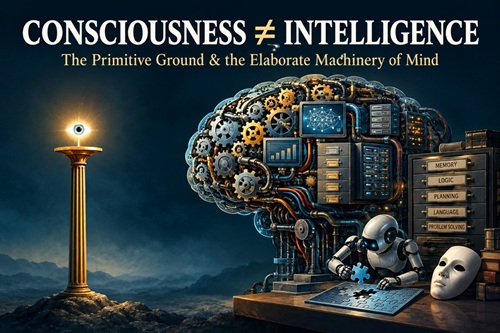 The Paradox of ConsciousnessConsciousness occupies a peculiar position in contemporary discussions of the human mind. On the one hand, it can appear remarkably simple, even primitive, compared with intelligence. To be conscious, in the minimal sense, is to have an experience: to feel pain, see a color, hear a sound, or register some change in one's surroundings. Intelligence, by contrast, involves a far more elaborate collection of capacities: learning, reasoning, remembering, predicting, planning, solving problems, recognizing patterns, and adapting one's behavior to changing circumstances. Consciousness seems to require little beyond the occurrence of experience, whereas intelligence appears to depend on complex forms of information processing. On the other hand, consciousness is frequently elevated to the very center of existence. Spiritual traditions identify it with our deepest nature, contemplative teachers describe it as the fundamental reality obscured by ordinary thought, and some contemporary philosophers entertain the possibility that consciousness is more fundamental than matter itself. Intelligence, meanwhile, is generally treated as a capacity that organisms possess to varying degrees. We can become more or less intelligent, acquire new skills, or lose cognitive abilities through injury and disease. Yet we are often encouraged to regard consciousness as something more essential: not merely something we do, but something we fundamentally are. How should we assess this apparent asymmetry? Why should a phenomenon that seems comparatively elementary be accorded such profound ontological significance? And what exactly is the relationship between consciousness and intelligence? The first step toward answering these questions is to distinguish the concepts carefully. Consciousness and intelligence are not interchangeable terms, nor do they necessarily develop together. Much of the confusion surrounding them arises from treating consciousness as an all-purpose explanation for mental life, rather than as one phenomenon among several that require investigation. Consciousness Is Not IntelligenceIntelligence refers broadly to capacities for acquiring, processing, and applying information in ways that support successful adaptation, inference, and problem-solving. Although there is no universally accepted definition of intelligence, its manifestations can be studied through learning performance, reasoning, memory, generalization, prediction, and other measurable capacities. Consciousness is a different matter. In its most widely discussed philosophical sense, phenomenal consciousness refers to the fact that there is something it is like to undergo an experience. Pain hurts. Red looks a certain way. A melody sounds a certain way. These experiences possess a subjective character that is not captured simply by describing the information a nervous system processes or the behavior an organism produces. The distinction becomes clearer when we consider hypothetical and actual cases. A person may be awake and conscious but severely impaired in reasoning. Someone experiencing intense pain may have little capacity for sophisticated thought at that moment. Conversely, many cognitive operations appear to occur without conscious awareness. The brain can process visual information, recognize familiar patterns, regulate bodily functions, and initiate aspects of behavior without making all these operations available to introspection. Artificial intelligence provides another useful comparison. A system may outperform humans in chess, mathematical calculation, language processing, or strategic planning. Such performance demonstrates particular forms of intelligence, although the extent to which a system possesses general intelligence remains a separate question. None of these achievements, by itself, establishes that the system has subjective experiences. Whether artificial systems can be conscious is an open scientific and philosophical question, not something settled by their performance. We therefore have good reason to distinguish intelligent behavior from conscious experience. But this distinction should not be exaggerated into the claim that consciousness is necessarily independent of cognitive complexity. Human consciousness, in its familiar forms, depends on an extraordinarily elaborate biological system. The capacity to experience may be conceptually distinguishable from intelligence while remaining deeply dependent on the neural mechanisms that support perception, attention, memory, and the integration of information. Is Consciousness Really Primitive?Calling consciousness primitive can mean at least two different things. It can mean that consciousness is cognitively elementary, requiring little sophisticated information processing. Alternatively, it can mean that consciousness is ontologically fundamental, belonging to the basic furniture of reality. These are very different claims, and arguments for the first do not automatically support the second. In one sense, consciousness does appear elementary. A simple organism might have some rudimentary capacity for sensation without possessing anything resembling human reasoning. A creature need not formulate propositions, recognize abstract principles, or contemplate its own existence in order for a stimulus to matter to it. Even in humans, immediate experience often precedes interpretation. We hear a sudden noise before identifying its source, feel pain before explaining its cause, and experience an emotion before constructing a coherent narrative about it. But this apparent simplicity can be misleading. What we experience as a single, unified moment of awareness may depend on numerous interacting processes. Visual experience, for example, involves the processing of color, shape, motion, spatial relationships, and other features. Attention selects some information over other information, memory connects the present with the past, and predictive processes help the brain interpret incomplete or ambiguous sensory input. The resulting experience may feel immediate and indivisible, but the mechanisms supporting it are anything but simple. There is also a distinction between minimal sentience and reflective self-consciousness. The capacity to experience something is not the same as the capacity to recognize oneself as the experiencer, reflect on one's own mental states, construct an autobiographical identity, or ask what consciousness is. These additional capacities involve different levels of cognitive organization. Human beings frequently confuse the immediacy of experience with the simplicity of its underlying processes. Because consciousness is directly present to us, it can seem more basic than the mechanisms that produce and sustain it. But immediacy is a feature of how experience is given to the subject, not evidence that the phenomenon itself is simple in its biological organization. The same caution applies to claims about the evolutionary origins of consciousness. Some forms of sensitivity and information processing may have appeared long before the emergence of sophisticated cognition. Yet the evolutionary history of sentience remains difficult to reconstruct, partly because subjective experience cannot be observed directly in other organisms. Behavioral flexibility, neural organization, learning, and responses to potentially painful stimuli can provide evidence, but no single criterion settles every case. We should resist both the assumption that consciousness requires human-like intelligence and the opposite assumption that it must be present wherever information is processed. Intelligence as an Evolutionary AchievementIntelligence is not a single substance or faculty that suddenly appears in finished form. It is a collection of capacities that have evolved, diversified, and become differently organized across biological lineages. Perception, memory, learning, navigation, social cognition, communication, planning, and abstract reasoning have different evolutionary histories and do not necessarily occur together. From this perspective, intelligence is not merely an ornament added to consciousness. It changes what an organism can do with its experiences. Sensation can provide information about the immediate environment, but learning allows an organism to modify its responses on the basis of previous encounters. Memory enables the past to influence present behavior. Prediction makes it possible to prepare for events that have not yet occurred. Reasoning and planning extend this process further by allowing the organism to evaluate alternatives and pursue more complex goals. Consciousness and intelligence may therefore be understood as overlapping but distinguishable dimensions of mental life. Conscious experience provides one aspect of the organism's engagement with the world, while intelligence concerns its capacities to exploit information, learn from circumstances, and organize behavior adaptively. In humans, these dimensions interact continuously, but neither concept should simply be reduced to the other. Nor should intelligence be equated with consciousness merely because human intelligence is often accompanied by conscious deliberation. Much of our cognitive work occurs outside awareness, and conscious thought itself depends on processes that are not consciously accessible. We may experience the result of a complicated inference without knowing how it was reached. We may confidently report why we acted in a particular way while overlooking the unconscious influences that helped determine our behavior. Intelligence, then, is not necessarily the more superficial phenomenon. It is often the more differentiated and functionally elaborate one. But this does not mean consciousness is an evolutionary afterthought or a dispensable illusion. It means that we must investigate what each contributes rather than assume that one is the foundation of the other. The Myth of the Inner WitnessThe claim that consciousness is the core of our being often rests on a compelling introspective observation. Thoughts change, emotions come and go, bodily sensations fluctuate, and our self-image evolves throughout life. Yet throughout these changes, there seems to be an enduring capacity to witness them. We can observe a thought without accepting it, notice an emotion without immediately acting on it, or recognize that a particular self-image is only one interpretation of who we are. Contemplative traditions have often interpreted this observation as evidence that our deepest identity is not the changing contents of experience but the awareness in which those contents appear. In some forms of Advaita Vedanta, for example, consciousness is identified with the ultimate Self, while the individual personality is treated as a more limited or misleading identification. Similar themes appear in certain Buddhist meditation traditions, although Buddhist accounts generally resist the idea of a permanent, independent self. Contemporary nondual teachings frequently present awareness as the ever-present background of all experience. These approaches can offer useful psychological insights. People can become less entangled in compulsive thinking by learning to observe thoughts as events rather than unquestionable truths. Decentering from emotion can create space for more deliberate responses. Meditation may help some people recognize that the narrative self is not as unified, stable, or transparent as it ordinarily appears. But a therapeutic or phenomenological insight does not automatically establish an ontological conclusion. Discovering that one can observe thoughts does not prove that the observer is a separate entity. Experiencing awareness as spacious, timeless, or impersonal does not establish that consciousness exists independently of the brain. And the fact that the contents of experience change does not demonstrate that the capacity for experience is an immutable substance underlying them. The metaphor of an inner witness can itself be misleading. If we search for the observer as though it were an object inside the mind, we encounter further thoughts, sensations, bodily feelings, and representations. Each can, in turn, become an object of awareness. The attempt to locate a final, independently existing observer may therefore generate an infinite regress or simply confuse the activity of awareness with a hidden entity that supposedly performs it. This does not make the experience of witnessing unreal. It means that its interpretation requires care. The ability to attend to one's own mental states is a genuine capacity, but it does not follow that there is an unchanging metaphysical Self behind those states. Why Consciousness Feels More Fundamental Than IntelligenceThere is an important asymmetry between consciousness and intelligence that may help explain their different philosophical reputations. Intelligence can be assessed, at least partially, from the outside. We can observe whether a system learns, solves problems, predicts outcomes, or adjusts its behavior. We can compare performance across individuals and tasks, identify impairments, and investigate the mechanisms involved. Consciousness presents a different epistemic problem. We have direct access to our own experiences, but our access to the experiences of others is indirect. Other people can describe their pain, express their feelings, and behave in ways that strongly support the conclusion that they are conscious. Yet their subjective experiences are not available to us in the same immediate way as our own. This asymmetry is central to the so-called problem of other minds and to the contemporary problem of consciousness. It helps explain why consciousness can appear more mysterious than intelligence. We can describe many of the functions performed by a cognitive system without having fully explained why, or under what conditions, those functions are accompanied by subjective experience. The philosopher David Chalmers famously distinguished the functional problems of explaining cognition from the so-called hard problem of explaining why physical processes are accompanied by experience at all. Whatever one thinks of his proposed distinction, it identifies a genuine source of philosophical difficulty. A description of information processing does not automatically satisfy our intuition that something remains to be explained about the felt character of experience. However, the difficulty of explaining consciousness should not be mistaken for evidence that consciousness is metaphysically prior to everything else. An unresolved explanatory problem is not a license to elevate its subject into the ultimate reality. The history of science contains many phenomena that seemed irreducible or mysterious before better theories and methods became available. We should not assume that consciousness will be explained in precisely the same way, but neither should we infer that its apparent mystery proves that it cannot be explained scientifically. Consciousness feels fundamental partly because every observation we make is encountered through experience. Even the scientific study of the brain involves observations, measurements, interpretations, and theoretical judgments available to conscious investigators. We cannot step outside all experience to compare it with an entirely experience-free view of reality. Yet an epistemic starting point is not necessarily an ontological foundation. That all our knowledge is mediated by experience does not prove that all reality consists of experience. The distinction between how we know the world and what the world is remains essential. Does Consciousness Have Explanatory Power?A useful way to assess any proposed concept is to ask what it explains. Intelligence earns its explanatory role by helping us understand differences in learning, reasoning, prediction, and problem-solving. We can investigate the mechanisms that support these capacities and examine how they contribute to behavior. Although intelligence remains a contested construct, it connects with a substantial body of empirical research. Consciousness can also have explanatory relevance, but the nature of that relevance depends on which sense of consciousness we mean. Wakefulness, attention, phenomenal experience, access to information, and self-awareness are related but distinct phenomena. Research can investigate how they vary, how they depend on neural processes, and how they relate to perception, action, memory, and report. Problems arise when consciousness is invoked as a universal explanation without specifying the work it is supposed to perform. Saying that the universe evolves because it is conscious, or that consciousness is the source of intelligence, does not explain much unless the claim generates distinctions, mechanisms, or predictions that can be evaluated. If consciousness is simply defined as the presence of experience, it cannot automatically serve as the explanation for every complex capacity associated with experience. The same criticism applies to claims that consciousness is the ground of all being. Such a proposition may function as a metaphysical interpretation of existence, but it is not equivalent to a scientific explanation of how conscious organisms arise, how their experiences vary, or why particular mental capacities depend on particular neural structures. A worldview can be meaningful to its adherents without thereby becoming an empirically established theory. We should also avoid the reverse error of assuming that whatever cannot yet be explained must be unreal or unimportant. Subjective experience is an undeniable feature of our lives, and its scientific explanation remains incomplete. The responsible position is neither to dismiss consciousness as an illusion nor to declare it the ultimate substance of the cosmos. It is to recognize the phenomenon while remaining cautious about the theories built around it. The Brain, the Self, and the Limits of IntrospectionThe relationship between consciousness and the brain provides an important test of competing interpretations. An extensive body of evidence shows that conscious states vary with changes in brain function. Anesthesia can eliminate ordinary responsiveness and, in many cases, conscious experience. Brain injuries can alter perception, memory, emotion, personality, and the capacity to maintain awareness. Sleep, neurological disorders, psychoactive substances, and stimulation of particular neural systems can produce systematic changes in experience. These findings do not, by themselves, settle every metaphysical question about consciousness. Correlation is not a complete theory of subjective experience, and a dependence relation does not automatically tell us how to interpret the relation philosophically. Nevertheless, the evidence places a substantial burden on theories that treat human consciousness as entirely independent of the biological systems with which it is so closely associated. The ordinary sense of being a continuous, unified self is also more complicated than introspection suggests. Memory is reconstructive, perception is selective, and our sense of agency can diverge from the processes that actually produce behavior. Neuroscience and psychology have revealed numerous dissociations between what people experience, what they can report, and what their cognitive systems are doing. These discoveries do not show that there is no self in any meaningful sense. They suggest that the self is better understood as a collection of interacting capacities and processes than as a single, indivisible entity. Bodily regulation, memory, social relationships, emotional dispositions, language, and autobiographical narrative all contribute to the person we experience ourselves to be. Consciousness is integral to much of this self-experience, but it is not identical to the entire person. A person is not merely a detached awareness observing the world from behind the eyes. We are embodied, socially situated, developmentally shaped organisms whose conscious lives depend on a vast range of processes that are not themselves continuously conscious. The idea that awareness is the essence of the self may therefore capture one aspect of our subjective lives while obscuring the biological and psychological complexity of the person. Artificial Intelligence as a Conceptual Stress TestThe development of increasingly capable artificial intelligence makes the distinction between intelligence and consciousness more pressing. Machines can now perform tasks that were once considered clear signs of distinctively human intelligence. They can generate fluent language, solve complex problems, recognize patterns, produce images, and respond flexibly to instructions. Their achievements challenge the assumption that sophisticated intelligent behavior must always arise from human-like cognition. But what do these capacities tell us about consciousness? Not as much as either enthusiasts or skeptics sometimes suggest. The ability to produce convincing language about feelings does not establish that a system feels anything. Equally, the absence of a biological brain does not, by itself, prove that artificial consciousness is impossible. The question requires a theory of what consciousness depends on and evidence that can distinguish conscious from nonconscious systems. Artificial intelligence also exposes ambiguities in the word understanding. A system may manipulate representations, extract statistical regularities, and produce appropriate responses without possessing human-like understanding in every relevant sense. Whether this constitutes a form of understanding depends partly on how the concept is defined. Consciousness raises a related but separate question: even if a system processes information intelligently, does anything appear to it from its own point of view? This distinction matters because human beings often infer consciousness from intelligent behavior. In ordinary social life, that inference is generally useful. We recognize other people as conscious partly because they behave, communicate, and respond as we do. But when we encounter systems that reproduce some of these outward signs, we can no longer treat the inference as self-evident. The converse also deserves attention. A creature may possess forms of sentience without displaying the sophisticated reasoning that humans associate with intelligence. If consciousness matters morally, then intelligence cannot be the sole criterion for moral consideration. The capacity to suffer, where it exists, may matter independently of an organism's ability to reason, speak, or reflect on its own existence. Artificial intelligence therefore reinforces the need to separate the capacities that systems display from the subjective states we attribute to them. Intelligence is not proof of consciousness, and the absence of human-level intelligence is not proof of its absence. From Metaphysical Privilege to Scientific InquiryThe most productive approach is to resist the temptation to rank consciousness and intelligence on a single scale of importance. They answer different questions. Intelligence concerns capacities for learning, reasoning, adaptation, and the effective use of information. Consciousness concerns the presence and character of subjective experience, although the term is also used for related phenomena such as wakefulness, awareness, and access to information. Both concepts are multidimensional, and neither is adequately captured by a single everyday definition. Intelligence encompasses different cognitive abilities that need not develop together. Consciousness encompasses different forms and levels of awareness, from relatively basic sensory experience to reflective self-consciousness. The relationship between these dimensions is an empirical and philosophical question rather than something that can be settled by declaring one more fundamental than the other. There is also no reason to assume that the more elementary phenomenon must be the more important one. Basic sensory capacities can be indispensable to complex cognition without explaining everything cognition accomplishes. Conversely, sophisticated intelligence may transform conscious life without explaining why experience exists in the first place. Dependence, complexity, and explanatory priority are distinct relations. The same caution applies to spiritual and philosophical interpretations. Consciousness may serve as a useful focus for meditation, self-inquiry, and reflection on the limits of the ego. These practices can reveal important features of subjective experience. But the psychological value of a practice does not establish the truth of the metaphysics attached to it. An experience of pure awareness, however compelling, cannot by itself establish that awareness existed before the universe, survives the death of the brain, or constitutes the ultimate nature of reality. A scientific approach need not deny the first-person character of experience. It must instead investigate how first-person phenomena relate to third-person observations, neural mechanisms, behavior, and cognitive organization. First-person reports provide indispensable evidence about experience, but they must be combined with other methods and interpreted cautiously. Neither subjective certainty nor external measurement is sufficient on its own to settle every question. Conclusion: Consciousness Is Not the Whole StoryConsciousness and intelligence occupy different positions in our understanding of mind. Intelligence is the more visibly elaborate phenomenon, encompassing capacities that support learning, reasoning, planning, and adaptation. Consciousness can appear comparatively elementary because even a simple experience does not require the reflective sophistication of human thought. Yet the biological mechanisms supporting conscious experience may themselves be highly complex, and the explanation of its subjective character remains a major scientific and philosophical challenge. The fact that consciousness is central to our experience of the world does not make it the ultimate substance of the world. Nor does its apparent simplicity make it primitive in every meaningful sense. We must distinguish the immediacy of experience from the complexity of its mechanisms, the capacity to experience from the ability to reason, and the epistemic importance of consciousness from claims about its ontological primacy. The idea that awareness is the core of our being can be interpreted in a modest and defensible way: experience is central to how life is lived, and reflective awareness can help us understand our thoughts, emotions, and habits without being wholly governed by them. But the stronger claim that awareness is an eternal, independent Self requires arguments that introspective experience alone cannot supply. Perhaps the most revealing conclusion is that intelligence and consciousness illuminate different aspects of the same broad problem: how living systems engage with the world and, in at least some cases, experience that engagement from a point of view. Intelligence helps explain what organisms can learn, infer, anticipate, and accomplish. Consciousness raises the further question of what it is like for an organism to undergo some of those processes. Neither concept should be reduced to the other, and neither should be turned into a metaphysical trump card. Consciousness is not automatically more fundamental because it is more intimate, just as intelligence is not automatically more important because it is more complex. The challenge is to understand how the two are related, which aspects of each can be explained empirically, and which questions remain genuinely unresolved. That approach offers a more demanding and ultimately more fruitful alternative to both the reduction of consciousness to a dismissive label and its elevation into a universal spiritual explanation. Consciousness deserves serious investigation precisely because it is a real problem, not because we have already established that it is the answer to everything.
Widget is loading comments...
|