|
TRANSLATE THIS ARTICLE
Integral World: Exploring Theories of Everything
An independent forum for a critical discussion of the integral philosophy of Ken Wilber
  Frank Visser, graduated as a psychologist of culture and religion, founded IntegralWorld in 1997. He worked as production manager for various publishing houses and as service manager for various internet companies and lives in Amsterdam. Books: Ken Wilber: Thought as Passion (SUNY, 2003), and The Corona Conspiracy: Combatting Disinformation about the Coronavirus (Kindle, 2020). Frank Visser, graduated as a psychologist of culture and religion, founded IntegralWorld in 1997. He worked as production manager for various publishing houses and as service manager for various internet companies and lives in Amsterdam. Books: Ken Wilber: Thought as Passion (SUNY, 2003), and The Corona Conspiracy: Combatting Disinformation about the Coronavirus (Kindle, 2020).
Check out my other conversations with ChatGPT Erwin Schrödinger's What Is Life?The Book That Helped Launch Molecular BiologyFrank Visser / ChatGPT
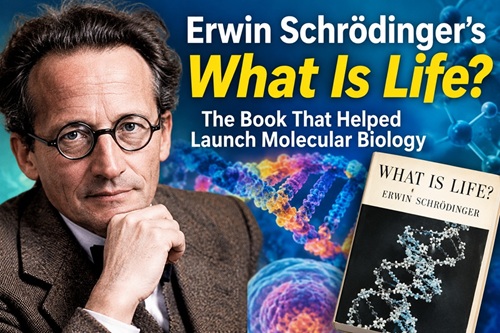 Introduction: A Physicist Confronts the Mystery of LifeIn 1944, the Austrian physicist Erwin Schrödinger published a small book that would have an influence far beyond its modest size. What Is Life? The Physical Aspect of the Living Cell was not a biology textbook, nor did it offer a comprehensive theory of living organisms. Instead, it posed a deceptively simple question: How can the extraordinary order, stability, and apparent purposefulness of living systems be reconciled with the laws of physics? Schrödinger approached this question at a time when the chemical foundations of heredity remained obscure. Genes were known to exist, chromosomes had been identified as their cellular carriers, and Mendelian inheritance had become a cornerstone of biology. Yet nobody knew the precise molecular structure responsible for storing and transmitting hereditary information. The gene remained, in important respects, a black box. Schrödinger brought the conceptual resources of theoretical physics to bear on this problem. He asked how an organism could preserve its organization despite the relentless tendency of physical systems toward disorder, how hereditary information could be encoded in a microscopic structure, and why living matter behaved so differently from the relatively simple systems studied by classical physics. His answers were necessarily speculative, and some have aged better than others. Nevertheless, What Is Life? became one of the most influential scientific books of the twentieth century. Its importance lies less in having solved the problem of life than in having helped formulate the questions that molecular biology would subsequently answer. The Historical Context: Biology Before the Molecular RevolutionBy the early twentieth century, biology had established powerful principles of heredity, evolution, physiology, and cellular organization. Darwinian evolution explained how populations could change through natural selection, while Mendelian genetics described the transmission of discrete hereditary factors across generations. But the physical basis of heredity was still unknown. What, precisely, was a gene? How could a microscopic structure preserve its identity while directing the development of an organism? And how could hereditary characteristics remain stable over generations while still allowing the variations on which evolution depends? Physicists had recently transformed their understanding of matter through quantum mechanics. Schrödinger himself was one of its principal architects. He wondered whether the stability of hereditary structures might depend on quantum-level properties that conventional biological explanations had not yet adequately incorporated. This was an attractive question. Living organisms are made of ordinary matter, yet they exhibit a remarkable combination of stability and change. An organism develops according to inherited constraints, repairs many forms of damage, maintains internal conditions, and produces offspring resembling itself. At the same time, organisms vary, mutations occur, and evolutionary lineages change over time. How could such a system emerge from molecules governed by physical laws? Schrödinger did not believe that life required a suspension of physics. Rather, he suspected that the organization of living matter depended on physical principles that had not yet been fully understood in their biological context. The book was an attempt to identify the nature of the missing explanation. The Aperiodic Crystal: A Prescient Picture of HeredityOne of Schrödinger's most famous contributions was his proposal that hereditary material might resemble an aperiodic crystal. Ordinary crystals possess regular, repeating molecular arrangements. Their order derives from a structure that recurs throughout the material. Such regularity is excellent for producing stable physical structures, but it seems poorly suited to encoding the enormous variety of hereditary information required to build organisms. A hereditary molecule, Schrödinger reasoned, would need something different. It would have to be stable enough to preserve information across generations, yet sufficiently complex to encode many different instructions. Its molecular arrangement could not consist merely of a simple repeating pattern. It would need an elaborate, nonrepeating structure in which different arrangements corresponded to different hereditary possibilities. This was a remarkable anticipation of the role later assigned to DNA. The sequence of nucleotides in DNA can vary along the molecule, providing a physical medium for storing genetic information. Its complementary structure also helps explain how information can be copied with high fidelity, while occasional errors and other changes introduce variation. Schrödinger did not discover DNA's structure, and his proposed aperiodic crystal was not a detailed molecular model. The double helix was identified in 1953 through work involving James Watson, Francis Crick, Rosalind Franklin, Maurice Wilkins, and others. Nevertheless, Schrödinger helped make the search for a molecular carrier of genetic information a compelling problem for physicists and chemists. The importance of the aperiodic crystal idea was conceptual. Heredity did not need to be explained through an immaterial blueprint or a mysterious life force. Information could be embodied in the specific arrangement of atoms in a molecule. That shift in perspective was fundamental to the development of molecular biology. Negative Entropy: How Life Maintains Its OrganizationAnother celebrated argument in What Is Life? concerns the relationship between living organisms and the second law of thermodynamics. In an isolated system, entropy tends to increase. Energy becomes less available to perform useful work, and spontaneous processes generally lead toward equilibrium. Living organisms, by contrast, maintain highly organized structures far from thermodynamic equilibrium. Schrödinger famously described organisms as feeding on “negative entropy.” The expression was intended to capture the idea that organisms must continually obtain something from their environments that allows them to sustain their organization rather than simply disintegrating toward equilibrium. The underlying insight remains important, but the terminology can be misleading. Life does not violate the second law of thermodynamics, nor does it literally consume a mysterious substance called negative entropy. Living systems are open systems. They exchange energy and matter with their surroundings, using energy gradients to maintain internal organization while producing heat and waste. The total entropy of the organism and its environment increases in accordance with thermodynamic principles. A plant, for example, captures energy from sunlight and uses it to build and maintain complex organic molecules. An animal obtains chemical energy from food, uses that energy to sustain cellular processes, and releases heat and metabolic waste. Neither organism escapes thermodynamics. Both depend on it. Modern biology has greatly elaborated this picture through bioenergetics, statistical mechanics, and nonequilibrium thermodynamics. Metabolism, membrane transport, protein synthesis, cellular repair, and the maintenance of concentration gradients all require energy. When these processes cease, the organism loses its capacity to preserve its organization. Schrödinger's lasting contribution was to insist that the order of living matter must be understood in physical terms. His language of negative entropy was suggestive rather than a complete quantitative theory, but it helped place the thermodynamics of life at the center of scientific discussion. Why Life Is Not Simply a Complicated MachineSchrödinger also explored the apparent stability of biological systems at microscopic scales. Classical statistical reasoning suggested that a small collection of molecules should be vulnerable to fluctuations. Yet organisms preserve highly specific structures and functions despite being composed of enormous numbers of interacting molecular components. Part of the answer lies in the way biological systems are organized. Living cells do not depend on isolated molecules operating independently. They contain networks of interacting components, feedback mechanisms, compartments, and processes that regulate one another. Some fluctuations are damped, others are amplified, and still others contribute to adaptation or variation. The distinction between a living organism and a machine is therefore not that the organism somehow escapes physical causation. Both are subject to physical laws. The difference is that organisms are self-maintaining chemical systems whose components participate in the production, regulation, and repair of the larger system to which they belong. This organization makes life a particularly challenging subject for reductionist science. It does not render life irreducible in principle, but it means that identifying the constituent molecules is only the beginning. Scientists must also explain how these molecules interact, how their activities are coordinated, and how the resulting organization persists over time. In retrospect, Schrödinger's book anticipated a central concern of systems biology: the properties of living organisms arise not merely from their molecular ingredients but from the structured interactions among those ingredients. The Influence on James Watson and Francis CrickThe influence of What Is Life? is most often associated with the development of molecular biology. James Watson later described Schrödinger's book as an important inspiration for his interest in genetics. Francis Crick was also part of the generation of scientists drawn toward biological problems by the possibility that heredity could be understood through fundamental physical and chemical principles. Their careers illustrate the growing attraction of biology to researchers trained in physics. The structure of DNA, elucidated in 1953, transformed the study of heredity by providing a molecular explanation for how genetic information could be stored and copied. Subsequent discoveries clarified the roles of DNA replication, transcription, translation, and the genetic code. The resulting molecular revolution was not a direct execution of Schrödinger's research program. Many scientists, experimental traditions, and earlier discoveries contributed to it. Nor did the discovery of DNA's structure, by itself, explain the entire living cell. But Schrödinger helped establish a powerful research ambition: to identify the physical structures and chemical processes responsible for biological organization. His book also encouraged a broader movement of physicists and chemists into biology. Max Delbrück, for example, had already begun applying ideas from physics to the study of genes and viruses before Schrödinger's book appeared. His subsequent work in bacteriophage research became important to the development of molecular genetics. Schrödinger's influence was thus part of a larger intellectual migration, rather than its sole cause. The historical significance of What Is Life? lies in the way it helped make molecular explanations of heredity seem both possible and intellectually urgent. The Book's Limits: What Schrödinger Did Not KnowThe reputation of What Is Life? can sometimes obscure the extent to which its scientific picture was incomplete. Schrödinger wrote before the structure of DNA had been established, before the genetic code was understood, and before the molecular machinery of protein synthesis had been elucidated. He could formulate important questions, but he lacked much of the experimental evidence required to answer them. His account of genetic stability, for instance, emphasized the special properties of molecular structures but could not anticipate all the mechanisms by which cells replicate, repair, regulate, and express genetic information. DNA is not a self-sufficient blueprint that independently constructs an organism. Its functions depend on cellular machinery, including proteins and RNA, as well as on the chemical and physical environment in which it operates. Likewise, the idea of negative entropy should not be mistaken for a complete explanation of biological organization. Thermodynamics constrains what organisms can do, but it does not by itself explain why particular metabolic pathways evolved, how developmental programs arise, or how natural selection produces adaptations. These questions require biochemical, genetic, ecological, and evolutionary explanations alongside thermodynamic analysis. Schrödinger also gave considerable attention to the possibility that quantum mechanics might be relevant to heredity. Quantum mechanics is indeed indispensable to understanding chemical bonds, molecular structure, and the electronic properties of biological molecules. But this does not mean that life depends on some special quantum principle unavailable to ordinary chemistry, or that quantum mechanics supplies a shortcut to explaining consciousness, purpose, or biological complexity. Modern research investigates quantum effects in specific biological contexts, including certain aspects of photosynthesis, enzyme activity, and magnetic sensing. The significance of these effects varies by system, and their existence does not validate sweeping claims that life as a whole is a uniquely quantum phenomenon. The lesson is not that Schrödinger was wrong to look toward physics. It is that the success of a research program must be distinguished from the correctness of every speculation that helped inspire it. The Question of Purpose: Does Life Have an Inner Direction?One of the most philosophically interesting aspects of Schrödinger's book is its discussion of the apparent purposiveness of living organisms. Organisms do not merely undergo physical changes; they develop, maintain themselves, reproduce, and respond to their environments in ways that appear directed toward ends. A bacterium moves toward a nutrient source. A damaged tissue initiates repair. An embryo develops into an organized body. Schrödinger was interested in how this apparent order could arise from physical processes. But the distinction between purposeful behavior and purpose built into the universe is crucial. The former can be investigated scientifically; the latter requires an additional philosophical argument. Evolutionary biology provides a powerful explanation for much of the apparent purposefulness of life. Natural selection favors heritable variations that, in particular environments, contribute to reproductive success. Over generations, this process can produce structures that look as though they were designed to achieve particular ends, without requiring a conscious designer or a cosmic intention. Biologists call this phenomenon teleonomy: the appearance of goal-directed organization generated by natural processes. The heart pumps blood, the kidneys regulate bodily fluids, and the immune system responds to pathogens because organisms possessing these functions evolved through histories of variation and selection. Their functions are real, but they need not have been planned in advance. This does not mean that natural selection explains every aspect of biological organization. The origin of life, the emergence of the first self-maintaining systems, and the evolution of increasingly complex forms remain substantial scientific problems. But acknowledging these difficulties does not establish that life is driven by an intrinsic cosmic purpose. Schrödinger's book is best understood as an attempt to clarify the physical conditions under which living organization becomes possible, not as proof that the universe itself strives toward life or consciousness. From What Is Life? to the Origin of LifeAlthough Schrödinger concentrated on the physical basis of living organization and heredity, his questions naturally lead to a more fundamental one: how did life originate in the first place? Modern biology distinguishes between explaining how existing organisms function and explaining how the earliest living systems emerged from nonliving chemistry. Molecular biology has made enormous progress in the first task, but the second remains unresolved in important respects. Researchers investigating the origin of life study such possibilities as prebiotic chemical reactions, the formation of self-organizing molecular systems, the emergence of catalytic networks, and the evolution of mechanisms for storing and copying information. One influential research direction concerns the possibility that RNA played an early role in both heredity and catalysis. Other approaches emphasize metabolism, mineral surfaces, membrane formation, or combinations of these processes. No single account has yet established a complete, universally accepted pathway from early Earth chemistry to the first living systems. Schrödinger's emphasis on hereditary information and the physical stability of complex molecular structures remains relevant to this research. Nevertheless, the aperiodic crystal addresses only part of the problem. A hereditary molecule is not equivalent to a living system. Information must be copied, interpreted, and integrated into chemical processes that maintain and reproduce the system itself. The origin-of-life problem therefore involves more than discovering the right molecule. It concerns the emergence of an organized network of processes capable of persistence, reproduction, and evolution. Here, too, Schrödinger's greatest contribution was to help formulate the problem in a way that encouraged physical and chemical investigation. Beyond Molecular Biology: A Cultural and Philosophical InfluenceThe influence of What Is Life? extends beyond its direct impact on scientific research. Its compact formulation of the relationship between life, information, order, and physics made it attractive to philosophers, physicists, biologists, and writers concerned with the place of life in the natural world. The book helped establish a broad intellectual expectation: if organisms are physical systems, then their distinctive properties should ultimately be open to scientific investigation. Biology did not have to remain a domain in which vital forces or irreducible life principles were invoked whenever ordinary physical explanations seemed inadequate. This was not an entirely new position. Mechanistic explanations of living processes had a long history, and nineteenth-century physiology had already undermined many traditional versions of vitalism. Schrödinger nevertheless gave the project renewed prestige by showing how questions about heredity and biological organization could be approached from the standpoint of modern physics. His book also contributed to the rise of information-centered ways of thinking about life. The idea that a molecular structure could store a complex hereditary message became central to molecular genetics. In later decades, information theory, cybernetics, and systems biology developed distinct approaches to the analysis of communication, regulation, and organization in living systems. These fields should not be collapsed into one another. Biological information is embodied in physical structures, and the functioning of genetic information depends on specific chemical mechanisms. Information theory can describe aspects of these processes, but it does not automatically explain their origin or biological significance. Still, Schrödinger helped create an intellectual climate in which the question of life could be framed in terms of matter, organization, and information rather than an opposition between inert matter and an immaterial vital principle. Schrödinger's Other Book: My View of the WorldSchrödinger's scientific legacy is sometimes entangled with his philosophical and spiritual speculations. In My View of the World, published in English in 1964, he explored questions concerning consciousness, the unity of experience, and the relationship between the experiencing subject and the world. Drawing on philosophical traditions that included Vedanta, Schrödinger entertained the idea that the apparent multiplicity of individual minds might conceal a deeper unity of consciousness. These reflections are often cited in contemporary discussions of nonduality, panpsychism, and the possibility that consciousness is more fundamental than conventional physicalism allows. It is important, however, to distinguish this philosophical outlook from the scientific arguments of What Is Life? The fact that Schrödinger was a pioneering physicist does not confer scientific authority on every metaphysical position he entertained. His interest in the unity of consciousness does not establish that individual minds are manifestations of a single universal subject. Nor does the success of quantum mechanics imply that consciousness creates physical reality or that living organisms participate in a cosmic mind. These are philosophical interpretations that require arguments of their own. They cannot be established merely by appealing to the reputation of one of the founders of quantum mechanics. Schrödinger's example is instructive precisely because it demonstrates that a scientist can make outstanding contributions to empirical research while also holding philosophical views that remain debatable. Scientific achievement and metaphysical insight are not interchangeable credentials. What Is Life Today? A More Complete Scientific PictureMore than eighty years after the publication of What Is Life?, biology has moved far beyond Schrödinger's initial framework. Genome sequencing, molecular genetics, structural biology, evolutionary developmental biology, and systems biology have transformed our understanding of living organisms. We now know that DNA stores hereditary information in nucleotide sequences, that cellular machinery copies and expresses this information, and that gene regulation connects molecular processes with the development and functioning of organisms. We can investigate how proteins fold, how cells communicate, how metabolic networks operate, and how evolutionary changes alter biological systems over time. We also understand that life cannot be adequately characterized by a single molecular feature. DNA alone is not alive. Neither are proteins, membranes, or metabolic reactions considered individually. Life emerges from the organization and interaction of many components within systems that maintain themselves, exchange energy and matter, and participate in evolutionary processes. Even this characterization has boundaries and complications. Viruses, for example, reproduce only by exploiting the machinery of host cells, while some artificial and laboratory systems exhibit selected properties associated with life without satisfying all conventional criteria. There is no universally accepted definition that resolves every borderline case. Nevertheless, the scientific study of life has become increasingly precise. Rather than postulating a special life substance, researchers investigate the mechanisms through which living systems arise, function, reproduce, and evolve. This progress has not eliminated every mystery. The origin of life remains incompletely understood, the relationship between biological organization and consciousness remains contested, and the emergence of complex forms continues to generate important research questions. But these open problems are not evidence that life must ultimately be explained through supernatural intervention or an unknown cosmic force. They are reasons to continue investigating. Conclusion: The Achievement Was to Make Life a Physical ProblemErwin Schrödinger's What Is Life? remains an extraordinary example of scientific cross-fertilization. A theoretical physicist turned toward biology, identified some of its deepest unresolved questions, and helped inspire a generation of researchers to investigate the molecular foundations of heredity and living organization. His proposal of the aperiodic crystal anticipated important features of the molecular conception of genetic information. His discussion of negative entropy helped popularize the thermodynamic perspective on biological organization. His broader argument encouraged the search for physical and chemical explanations of phenomena that had often seemed uniquely biological. Yet the book should not be treated as a prophetic revelation containing all the answers to life's mysteries. Schrödinger did not discover the structure of DNA, explain the genetic code, solve the origin of life, or demonstrate that the universe possesses an intrinsic drive toward complexity. Some of his proposals were speculative, and some of his formulations require substantial qualification in light of modern science. His enduring achievement was more modest and more important: he helped make life a problem that physicists and chemists could regard as their own. The living cell ceased to appear as a mysterious exception to the natural order and increasingly became an object of molecular investigation. Its complexity was not a reason to abandon physical explanation, but a challenge to develop better ones. The title question, What Is Life?, has not received a final answer. But we are in a much stronger position to investigate it than Schrödinger was in 1944. We can examine genomes, track molecular interactions, reconstruct evolutionary histories, and experimentally test hypotheses about biological organization. Each discovery reveals further questions, but the questions become increasingly specific and experimentally tractable. Perhaps that is the most valuable lesson of Schrödinger's little book. Scientific progress does not always begin with a correct theory. Sometimes it begins when a powerful mind identifies the right questions, proposes a fruitful way of thinking about them, and inspires others to find answers that the original author could not have anticipated. Life remains remarkable. It no longer needs to be inexplicable.
Widget is loading comments...
|