|
TRANSLATE THIS ARTICLE
Integral World: Exploring Theories of Everything
An independent forum for a critical discussion of the integral philosophy of Ken Wilber
  Frank Visser, graduated as a psychologist of culture and religion, founded IntegralWorld in 1997. He worked as production manager for various publishing houses and as service manager for various internet companies and lives in Amsterdam. Books: Ken Wilber: Thought as Passion (SUNY, 2003), and The Corona Conspiracy: Combatting Disinformation about the Coronavirus (Kindle, 2020). Frank Visser, graduated as a psychologist of culture and religion, founded IntegralWorld in 1997. He worked as production manager for various publishing houses and as service manager for various internet companies and lives in Amsterdam. Books: Ken Wilber: Thought as Passion (SUNY, 2003), and The Corona Conspiracy: Combatting Disinformation about the Coronavirus (Kindle, 2020).
Check out my other conversations with ChatGPT Judas, Jesus, and the Paradox of the CrossIf Jesus had to die for our sins, why was Judas a traitor?Frank Visser / ChatGPT
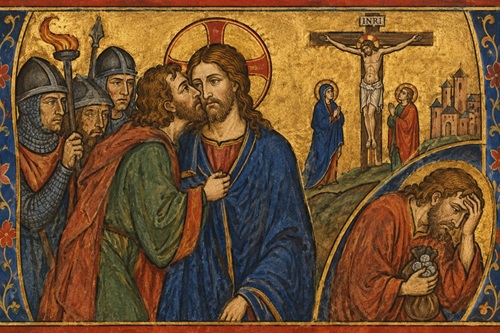
I've been thinkin' about this That Jesus Christ was Betrayed by a kiss But I can't think for you You'll have to decide Whether Judas Iscariot Had God on his side. — Bob Dylan, "With God on Our Side" The crucifixion of Jesus is at the center of Christianity, yet it contains a puzzle that is rarely given the attention it deserves. If Jesus had to die to redeem humanity, and if his death was part of God's plan from the beginning, why is Judas Iscariot condemned for betraying him? Wasn't Judas simply doing what needed to be done? If nobody had handed Jesus over to the authorities, the arrest might not have happened when and how it did. And without the arrest, there would have been no crucifixion—at least not in the familiar form through which Christianity understands salvation. The question is more than a biblical curiosity. It touches on one of the deepest problems in Christian theology: how can an event be simultaneously necessary for the salvation of humanity and the result of a morally blameworthy act? If the death of Jesus was God's plan, where does human responsibility begin and divine responsibility end? And if the crucifixion was not necessary, what exactly does it mean to say that Jesus died for us? To explore these questions, we must distinguish the historical events surrounding Jesus' death from the theological interpretations that Christianity subsequently developed around them. 1. The Basic Story—and Its Moral PuzzleAccording to the New Testament Gospels, Judas was one of Jesus' twelve disciples. He agreed to hand Jesus over to the authorities, traditionally in exchange for thirty pieces of silver. In the Gospel of Mark, Judas approaches the chief priests and offers to identify Jesus for them. In Matthew, the payment is explicitly mentioned. In the Gospel of John, Judas is portrayed in particularly negative terms, while Luke attributes his actions to the influence of Satan. Judas' betrayal facilitates Jesus' arrest, after which Jesus is interrogated, handed over to the Roman authorities, and crucified under Pontius Pilate. Christian theology assigns enormous significance to the resulting death. Jesus is not merely an innocent man executed by the state. He is the Son of God, whose suffering and death somehow make reconciliation between God and humanity possible. Depending on the Christian tradition, his death is understood as a sacrifice for sin, a ransom, a victory over the powers of evil, an act of divine solidarity with suffering humanity, or some combination of these. But here the narrative seems to divide against itself. The death of Jesus is celebrated as the indispensable event of salvation, while the act that helps bring about that death is remembered as a betrayal. Imagine a drama in which the hero must die to save the world. One character performs the action that makes the hero's death possible. The audience then praises the death as the world's salvation but condemns the character whose action helped bring it about. We would naturally ask whether that character was a villain, an unwitting instrument, or an indispensable participant in a plan whose ultimate purpose he could not understand. That is the Judas problem. 2. Was the Crucifixion Really God's Plan?The apparent contradiction becomes especially sharp when we consider the language of divine necessity in the New Testament. Jesus repeatedly predicts his suffering and death. In the Gospel of Mark, for example, he tells his disciples that the Son of Man must suffer, be rejected, be killed, and rise again. After the resurrection, the Gospel of Luke presents Jesus as explaining that the Messiah had to suffer before entering his glory. The crucifixion is therefore not portrayed simply as an unfortunate accident that God subsequently turned to good use. Within the developing Christian narrative, it belongs to a divine plan. The difficulty is that a plan ordinarily implies some relationship between an intended outcome and the means used to achieve it. If God intended Jesus to die, and if Judas' betrayal was instrumental in bringing about that death, then Judas' action appears to have served God's purpose. There are several possible responses, but none entirely eliminates the philosophical difficulty. One response is that God intended the outcome without intending or approving every action that contributed to it. Judas acted from his own motives, while God incorporated the consequences into a larger plan. This is a familiar distinction between an action's immediate intention and its ultimate consequences. A person can do something wrong even when that action inadvertently contributes to a good outcome. But this answer raises another question. If God knew what Judas would do, could have prevented it, and nevertheless arranged a world in which the betrayal would lead to the crucifixion, in what sense was the betrayal independent of the divine plan? The problem is not unique to Christianity. It appears whenever divine foreknowledge, providence, and human freedom are brought together. Nevertheless, the crucifixion makes the issue unusually vivid because the supposedly wrongful act helps bring about the very event Christianity regards as humanity's salvation. 3. The Difference Between Causing an Event and Intending Its PurposeOne possible solution is to distinguish Judas' intention from the meaning subsequently assigned to his action. Suppose Judas intended to make money, force Jesus into a confrontation, or somehow distance himself from a movement that had become dangerous. These are possibilities sometimes suggested in attempts to reconstruct his motives, but we do not possess reliable historical evidence that establishes which, if any, is correct. The Gospels themselves do not offer a single, consistent psychological explanation. Whatever Judas intended, it does not follow that he intended to redeem humanity. That interpretation belongs to the theological understanding of Jesus' death, not necessarily to Judas' own consciousness. This distinction is important. A person's action can have consequences that the person neither anticipates nor desires. Judas might have intended a betrayal without intending the salvation of the world. From that perspective, the two moral evaluations are not formally contradictory: an act can contribute to a beneficial consequence while remaining blameworthy because of the agent's intentions. Yet this explanation only takes us so far. It can explain why Judas might be culpable for his own motives, but it cannot establish that his particular action was necessary for salvation. Nor does it explain why an omnipotent God would require such a morally compromised sequence of events in the first place. If God could redeem humanity, why arrange for redemption through betrayal, political intrigue, torture, and execution? The traditional answer is that God did not simply arrange a death. God entered into the human condition and accepted the consequences of human violence. But this is already a different account of the crucifixion from the idea that Jesus had to be killed to satisfy a divine requirement. And the difference matters. 4. Did God Need a Sacrifice?
The phrase Jesus died for our sins sounds straightforward until we ask what kind of problem his death was supposed to solve. Christianity has developed several major interpretations of the cross, and they do not all share the same assumptions. In penal substitution, particularly influential in some Protestant traditions, Jesus bears the punishment that sinful humanity deserves. Human beings have violated divine justice, and Christ takes their place, allowing them to be forgiven. In satisfaction theories, associated especially with Anselm of Canterbury, sin is understood as an offense against God's honor and the moral order. Christ's self-offering restores what humanity has failed to give. In ransom and Christus Victor interpretations, the emphasis falls elsewhere: Christ's death and resurrection liberate humanity from the powers of sin, death, and evil. The cross is not primarily a transaction in which God punishes an innocent substitute but part of a victory over forces that hold humanity captive. In moral-influence interpretations, the cross reveals the depth of divine love and the seriousness of human violence, inviting people to repentance and transformation. These approaches should not be treated as identical versions of one doctrine. They differ over what salvation requires and what the cross accomplishes. The Judas problem is particularly acute for interpretations that treat Jesus' violent death as a necessary payment or punishment. If divine justice required a death, the obvious question is why an omnipotent and merciful God could not forgive without demanding one. And if the sacrifice had to occur, why should the person who helped bring it about be condemned for doing so? Moral-influence and Christus Victor approaches can give the event a different meaning. Jesus' death might expose the violence of political and religious power, or represent God's solidarity with its victims, without implying that God needed to punish an innocent person before being able to forgive humanity. But these approaches also change the emphasis. The cross becomes less a divinely required execution and more a revelation of what human beings do, and of how divine love is understood to respond. The more we move away from the idea that God required Jesus' death as payment, the less mysterious Judas' involvement becomes. The betrayal is part of the historical and political circumstances of the execution, rather than a necessary component of a cosmic transaction. 5. Could Judas Have Refused?Here the problem becomes even more interesting. If the crucifixion was essential to God's plan, what would have happened had Judas refused to betray Jesus? There are several possibilities. Jesus might have been arrested by other means. The authorities might have found another informant. The confrontation might have unfolded differently. Or, if the crucifixion depended specifically on Judas' betrayal, the entire sequence might have been altered. From the perspective of divine omniscience, however, the question is more difficult. If God knew from eternity that Judas would betray Jesus, was Judas genuinely free to do otherwise? If Judas could not have acted differently, how can he be held fully responsible? If he could have acted differently, was God's plan contingent on a human decision that might never have occurred? Theologians have offered different accounts of the relationship between foreknowledge and freedom. Knowing that an action will occur is not necessarily the same as causing it. But the difficulty is not simply whether God causes Judas to act. It is whether Judas could have done otherwise in a world whose future God infallibly knows and whose ultimate course God intends. One traditional response is that God's foreknowledge does not compel human actions: Judas acts voluntarily, and God knows what he will freely choose. Another is that providence encompasses human decisions without eliminating their responsibility. These positions attempt to preserve both divine sovereignty and human freedom, although their compatibility remains contested. The narrative itself does not resolve the philosophical problem. Indeed, the story becomes more troubling when we consider Judas' fate. In Matthew's Gospel, Judas regrets his actions, returns the money, and dies by suicide. In Acts, his death is described differently. The accounts do not agree on the details. More fundamentally, the Christian imagination has often treated Judas as the archetypal betrayer, even though his role belongs to the very chain of events through which salvation is said to have become possible. If God knew the outcome, if Jesus predicted his betrayal, and if the crucifixion was necessary, then Judas seems to occupy a particularly unfortunate position: indispensable to the story, yet condemned for playing his part. 6. Jesus' Death Was Not Simply a Roman ExecutionIt is important to distinguish the historical question from the theological one. Historically, crucifixion was a Roman form of execution, particularly associated with slaves, rebels, and people regarded as threats to public order. Jesus was executed under Roman authority. The Gospels portray local religious authorities as playing a role in the events leading to his death, but the responsibility for the execution itself belonged to the Roman state. The historical reasons for Jesus' execution are not identical to the theological reasons Christians later gave for it. A movement centered on a proclaimed kingdom of God could become politically dangerous in a volatile province, especially under a ruler who was sensitive to challenges to Roman authority. Judas' role, in the Gospel accounts, was to facilitate the arrest by identifying Jesus to those seeking him. That is intelligible as a historical function. It does not, by itself, establish that Judas was necessary to God's plan of salvation. The theological interpretation developed around the execution answers a different question: what does Jesus' death mean for humanity? Once that distinction is made, a good deal of the apparent paradox becomes clearer. The historical event may have resulted from betrayal, political calculations, religious conflict, and imperial violence. The claim that it was a sacrifice for humanity is an interpretation of that event. The two accounts can coexist, but the second does not follow automatically from the first. 7. Why Is Judas the Villain While Others Are Forgiven?There is also a striking asymmetry in the Gospel narrative. Judas betrays Jesus, but Peter denies knowing him. The other disciples abandon Jesus or flee. The authorities hand him over, and Roman officials execute him. Yet Judas becomes the emblem of treachery, while Peter is eventually restored to a position of leadership in the Christian movement. Why? Part of the answer lies in the different narrative roles assigned to these figures. Peter's failure becomes a story of weakness, remorse, and restoration. Judas' betrayal becomes a story of treachery, despair, and death. The contrast is dramatically powerful: Peter represents the possibility of forgiveness, while Judas represents the danger of betrayal. But this literary contrast also serves a theological purpose. Christianity is a religion of forgiveness, yet the story of Judas illustrates how selectively that principle can appear to be applied. If remorse can restore Peter, why does Judas not receive a comparable narrative of reconciliation? Matthew depicts Judas as regretting what he has done. That detail makes the question particularly difficult. His remorse does not save him from the tragic conclusion of the story. We should not assume that the Gospels establish Judas' eternal fate. Nor should we assume that later Christian condemnations exhaust the possibilities for interpreting his role. But the contrast invites a legitimate question: why does the tradition make one disciple's failure an occasion for redemption and another's an emblem of damnation? The answer may have less to do with the abstract logic of salvation than with the narrative and theological purposes the two figures came to serve. There is also a historical danger here. Christian portrayals of Judas, combined with broader traditions of blaming Jewish people for Jesus' death, have contributed to antisemitic interpretations. Judas was Jewish, as were Jesus and his earliest followers. His individual role should never be used to assign collective guilt to Jews, either ancient or modern. 8. Perhaps the Cross Was Not a Divine Requirement After AllWe can now return to the original question. If Jesus died for our sins, why was Judas a traitor? One answer is that Judas was a traitor because of his own intentions, irrespective of the consequences that Christian theology subsequently attributed to his actions. A good outcome does not automatically make every means of achieving it morally good. But this response leaves the larger problem untouched. If the crucifixion was necessary for salvation, why did God make redemption depend on an act of betrayal? Why could forgiveness not be granted without a violent death? And if Judas' act was not necessary, why has his betrayal acquired such enormous theological significance? Perhaps the difficulty arises from assuming that the crucifixion must have been necessary in precisely the way some atonement theories describe it. Consider a different interpretation. Jesus lived and taught in a world characterized by political domination, religious conflict, and human violence. His message challenged established authorities, and he was executed. His followers, confronted with the apparent defeat of their teacher, came to interpret his death in the light of their belief that God had vindicated him through the resurrection. The cross, initially a symbol of humiliation and defeat, became a symbol of divine love, forgiveness, and hope. On this account, God did not need Judas to betray Jesus in order to satisfy a cosmic demand for punishment. Judas helped bring about a historical execution, and the early Christian community subsequently interpreted that execution as an event of universal significance. This reconstruction does not prove that the resurrection did not occur, nor does it settle the theological meaning of Jesus' life and death. It simply distinguishes the historical circumstances of an execution from the religious claims built around it. It also opens up a possibility that traditional formulations can obscure: God's ability to bring good out of evil is not the same as God's requiring evil in order to accomplish good. A murder may inspire a movement for justice without having been necessary for justice to exist. A martyr's death may become a source of courage without the death having been demanded by the cause. Similarly, the cross might become a powerful symbol of love and reconciliation without implying that God needed an innocent victim to be killed before humanity could be forgiven. Under this interpretation, Judas remains responsible for whatever wrongful act he intended, but his betrayal is not a divinely mandated ingredient in a cosmic mechanism of salvation. 9. The Deeper Problem: Could an Omnipotent God Forgive Without Bloodshed?The Judas paradox ultimately points toward a more fundamental question about the nature of God. If God is omnipotent, why should forgiveness require a sacrifice? Human beings forgive one another without demanding the death of an innocent third party. Of course, human wrongdoing can have consequences that cannot simply be erased, and genuine reconciliation may require acknowledgment, restitution, and a change of heart. But these requirements are not the same as demanding that someone be punished in the offender's place. The traditional response is that sin is not merely a personal offense. It damages the relationship between humanity and God and disrupts the moral order of creation. The cross is therefore said to accomplish something that ordinary human forgiveness cannot. Yet this explanation risks turning a metaphor into a mechanism. What exactly changes in the relationship between God and humanity when Jesus dies? Is a debt paid? Is a punishment transferred? Is divine honor restored? Are the powers of evil defeated? Is humanity morally transformed by witnessing an act of sacrificial love? These are different claims. They cannot simply be treated as interchangeable expressions of one self-evident truth. If the cross is a payment, we must ask why God requires payment. If it is punishment, we must ask why an innocent person can justly bear another's guilt. If it is a victory over evil, we must ask what precisely is defeated and how. If it is a revelation of love, we must ask why such a revelation requires an execution. The more clearly we formulate the question, the less satisfactory it becomes to answer that everything happened because it was God's plan. That statement may express faith in providence, but it does not explain why this particular plan was necessary or morally coherent. Conclusion: Judas as the Uncomfortable Accomplice of SalvationThe story of Judas exposes a tension at the heart of traditional Christian accounts of the crucifixion. The event that makes salvation possible is brought about through actions that the narrative condemns. Judas is blamed for facilitating Jesus' death, even though that death is subsequently presented as the means through which humanity is redeemed. The contradiction can be softened by distinguishing Judas' intentions from the consequences of his actions, or by distinguishing divine foreknowledge from divine causation. But neither distinction establishes that Judas' betrayal was necessary for salvation. Nor does either explain why an omnipotent God would require the execution of an innocent person to forgive the guilty. The deeper issue is the relationship between history and theology. Jesus' execution was a historical event; its interpretation as a sacrifice for the sins of humanity is a theological claim. The latter cannot simply be read off the former. Perhaps the cross is best understood not as evidence that God required a death, but as the Christian tradition's most powerful expression of what it believes God does in response to human violence: refuses to abandon humanity, even when humanity kills the innocent. That interpretation preserves the moral seriousness of the crucifixion without requiring Judas' betrayal to be part of a divinely necessary transaction. But it also leaves us with a question that Christianity has never entirely resolved: if divine love is powerful enough to transform an execution into a symbol of redemption, why should that love have needed the execution in the first place? And perhaps that is the most revealing way to return to Judas. He is remembered as the man who betrayed Jesus, but his role forces us to confront a more uncomfortable possibility: the theological system that condemns Judas may itself depend on the very act for which it condemns him.
Widget is loading comments...
|