|
TRANSLATE THIS ARTICLE
Integral World: Exploring Theories of Everything
An independent forum for a critical discussion of the integral philosophy of Ken Wilber
  Frank Visser, graduated as a psychologist of culture and religion, founded IntegralWorld in 1997. He worked as production manager for various publishing houses and as service manager for various internet companies and lives in Amsterdam. Books: Ken Wilber: Thought as Passion (SUNY, 2003), and The Corona Conspiracy: Combatting Disinformation about the Coronavirus (Kindle, 2020). Frank Visser, graduated as a psychologist of culture and religion, founded IntegralWorld in 1997. He worked as production manager for various publishing houses and as service manager for various internet companies and lives in Amsterdam. Books: Ken Wilber: Thought as Passion (SUNY, 2003), and The Corona Conspiracy: Combatting Disinformation about the Coronavirus (Kindle, 2020).
Check out my other conversations with ChatGPT Anthony Flew's 'There Is a God'How an Atheist's Conversion Became an Apologist's TriumphFrank Visser / ChatGPT
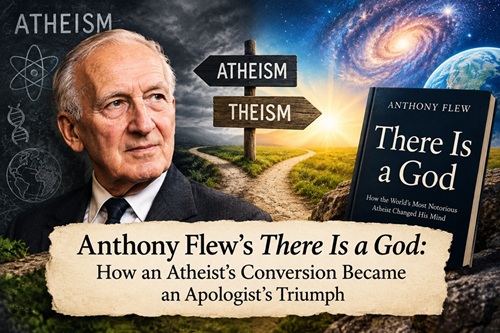 Introduction: The Most Famous Conversion in Modern AtheismFew events in contemporary philosophy of religion have generated as much excitement among theists as the reported conversion of Anthony Flew from atheism to belief in God. Flew, who died in 2010, had been one of the twentieth century's most prominent philosophical critics of theism. His 1950 essay “Theology and Falsification” became a classic challenge to religious belief, arguing that many theological claims are rendered meaningless when believers continually reinterpret them to accommodate contrary evidence. His later book, God and Philosophy (1966), was a sustained examination of traditional arguments for God's existence. Then, in 2004, Flew publicly announced that he had changed his mind. His final major statement of this position, There Is a God: How the World's Most Notorious Atheist Changed His Mind (2007), written with contributions from Roy Abraham Varghese, presented his intellectual journey from atheism to a form of deism. The book was widely celebrated in religious circles as a dramatic intellectual surrender by one of atheism's most formidable opponents. But what, precisely, had Flew conceded? Did he discover evidence for the God of classical theism, or did he merely become convinced that the universe required some kind of transcendent explanation? Did he abandon atheism because the evidence had decisively turned against it, or because a collection of philosophical arguments had persuaded him that naturalism was inadequate? A critical reading suggests that the significance of Flew's conversion has often been exaggerated. His arguments deserve consideration, particularly his emphasis on the intelligibility of nature, the origin of life, and the apparent fine-tuning of the universe. But the conclusion that these phenomena establish the existence of God is considerably less secure than the book's title implies. Flew's intellectual journey is interesting; the case he makes for theism is far less conclusive. From Atheism to Deism: What Actually Changed?The first thing to clarify is that Flew did not convert to Christianity, accept the Bible as divine revelation, or embrace the familiar conception of a personal God who intervenes in human affairs. His position was closer to philosophical deism: the universe appears to have an intelligent source, but this does not establish that the source answers prayers, performs miracles, reveals itself through sacred texts, or promises life after death. This distinction is important because the religious reception of Flew's conversion frequently blurred it. The headline was that a famous atheist had finally admitted that God exists. The more limited philosophical conclusion was that Flew had come to regard an intelligent source of the universe as a better explanation of certain features of reality than he had previously thought. These are not equivalent claims. There is an enormous distance between believing that the universe has some kind of intelligent origin and accepting the elaborate theological systems developed by Judaism, Christianity, Islam, Hinduism, or other religious traditions. Even the word God can obscure the difference. A minimally defined cosmic intelligence is not automatically the omnipotent, omniscient, perfectly good creator of classical theology. Nor does the existence of such an intelligence establish that it has any concern for human beings. Flew's position was therefore less a conversion to religion than a retreat from philosophical atheism toward a form of metaphysical theism. Whether that retreat was justified must be determined by examining the arguments, not by celebrating the dramatic reversal of a famous intellectual. The Argument from the Origin of LifeOne of the central themes of There Is a God is the apparent difficulty of explaining the origin of life through natural processes. Flew was impressed by developments in molecular biology, particularly the extraordinary complexity of the biochemical systems that make life possible. DNA stores information, proteins perform highly specialized functions, and living cells depend on intricate networks of mutually interacting processes. Flew regarded this complexity as evidence that the origin of life might require an intelligent explanation. His reasoning reflects a long-standing intuition: where we encounter sophisticated organization and information, intelligence is often responsible. Yet this argument moves too quickly from the complexity of present-day life to the conclusion that intelligence must have been responsible for its origin. The fact that modern organisms contain extraordinarily complex molecular machinery does not establish that the first living systems emerged in their present form. Contemporary cells are the products of a long evolutionary history, and the origin of life is a distinct scientific problem from the subsequent evolution of organisms. Abiogenesis research investigates how nonliving chemistry could have produced self-organizing systems capable of replication, heredity, and ultimately Darwinian evolution. The precise historical pathway remains uncertain. Scientists have proposed and investigated several possibilities involving prebiotic chemistry, catalytic molecules, membrane formation, and the emergence of systems capable of replication. No complete account has yet been established. But an incomplete natural explanation is not positive evidence for a supernatural one. To establish that intelligence is the better explanation, Flew would need to show not merely that life's origin is difficult to explain, but that an intelligent cause accounts for the evidence more successfully than plausible natural alternatives. What mechanism would this intelligence have used? What independent evidence identifies it as intelligent? What observations would distinguish its activity from an unknown natural process? How would we test the proposal? These questions remain unanswered. The argument risks turning a genuine scientific mystery into a philosophical conclusion before the relevant evidence is available. Historically, many phenomena once attributed to supernatural agency have acquired natural explanations. This does not prove that every remaining mystery will be resolved in the same way. It does, however, provide a strong reason to distinguish the limits of current knowledge from evidence for a supernatural cause. There is also a problem of explanatory symmetry. If the complexity of living systems demands an intelligent designer, what explains the designer's own intelligence? The theist may respond that God is eternal, necessary, or fundamentally different from physical things. But these are additional metaphysical claims, not conclusions established by the complexity of DNA. A designer hypothesis can therefore relocate the mystery rather than resolve it. Instead of asking how organized complexity emerged from simpler natural conditions, we must ask how an intelligent source exists, what its nature is, and why it should be exempt from the explanatory demands imposed on the universe. The Argument from Fine-TuningFlew was also impressed by the apparent fine-tuning of the universe. The fundamental constants and physical conditions of our universe seem to occupy ranges compatible with the emergence of complex structures, stars, chemistry, and eventually life. Small changes in some parameters, depending on the parameter and the physical model considered, could make familiar forms of complexity impossible. This observation has genuine philosophical significance. It raises questions about why the universe has the properties it does and whether those properties require explanation. But the move from fine-tuning to a cosmic designer is not straightforward. First, the probabilities involved are difficult to establish. To say that a universe is improbably fine-tuned requires some account of the possible values of its constants, the distribution over those possibilities, and the conditions under which observers could exist. We do not possess a universally accepted probability distribution over possible universes. Without one, many confident statements about the precise improbability of our universe exceed what the mathematics can establish. Second, the anthropic principle introduces an important selection effect. Any observers who ask why their universe permits observers must necessarily find themselves in a universe compatible with their existence. This does not explain why the universe has its particular properties, but it does caution against treating our presence in a life-permitting universe as independent evidence that the universe was arranged specifically for us. Third, there are competing explanatory possibilities. Some physicists and philosophers have considered multiverse hypotheses, in which a much larger reality contains many domains with different physical conditions. Such proposals remain speculative in important respects, and they are not automatically superior to the design hypothesis. Other possibilities include deeper physical principles that constrain the constants in ways we do not yet understand. The crucial point is that the alternatives are not simply "God" or "nothing." There are multiple hypotheses, with different strengths and weaknesses, and their comparative merits require investigation. Even if fine-tuning ultimately demanded an explanation beyond current physics, a designer would not follow automatically. We would still need to establish why the explanation should be intelligent, why that intelligence should be supernatural, and why it should be identified with anything deserving the religious name God. Fine-tuning may be a legitimate puzzle. It is not a completed proof of theism. The Argument from the Intelligibility of NatureAnother consideration that influenced Flew was the intelligibility of the universe. Nature is governed by regularities that can be expressed mathematically. Human beings, through scientific inquiry, have discovered laws that describe phenomena across extraordinary ranges of scale, from elementary particles to galaxies. Why should the universe be comprehensible to minds that evolved within it? Theists often argue that this intelligibility is less surprising if the universe originates in a rational intelligence. A rational creator would produce an ordered world, while rational creatures created in that image would be capable of understanding it. The appeal is understandable, but the explanatory gain is less obvious than it first appears. The regularity of nature is a prerequisite for scientific investigation. If the world were entirely chaotic, stable structures and the organisms that depend on them might never emerge. Human cognitive capacities evolved within this regular environment, and natural selection could favor organisms capable of recognizing patterns, anticipating events, and responding successfully to their surroundings. Our mathematical abilities extend far beyond their immediate evolutionary origins, but they did not arise in a vacuum. They developed through biological evolution and cultural accumulation, supported by language, abstraction, measurement, and centuries of mathematical refinement. Moreover, the success of mathematics in describing nature is partly a story of selection. Scientists develop mathematical frameworks, test them against observations, discard failures, and retain theories that work. We do not possess an independent catalogue of every possible universe against which to compare the mathematical comprehensibility of ours. None of this fully explains why the fundamental laws have the form they do. But the explanatory gap does not establish a divine mind as its solution. To explain the universe's intelligibility by appealing to an intelligent creator is to introduce another instance of intelligence whose own nature and intelligibility require clarification. The question "Why is nature mathematically intelligible?" is legitimate. The assertion "Therefore, nature was created by a divine intelligence" is a further inference, not an empirical discovery. Does the Universe Need a First Cause?Flew's arguments also touch on the broader question of why anything exists at all. If the universe has a beginning, what explains that beginning? If physical reality depends on conditions beyond itself, what accounts for those conditions? These questions have occupied philosophers for centuries, and they are not resolved simply by invoking the Big Bang. The Big Bang model describes the early evolution of the observable universe from an extremely hot, dense state. Its implications for the ultimate origin of reality, or for whether time itself has a boundary, remain questions for cosmology and fundamental physics. The traditional cosmological argument maintains that contingent things require explanations and that the chain of explanations must eventually terminate in a necessary being. But several controversial assumptions enter this reasoning. Does everything that exists require a cause? Does every contingent fact have a sufficient explanation? Must an explanatory chain terminate in a single entity? If it does, why should that entity be a mind rather than some fundamental physical reality or principle? The theist often treats God as an exception to the rule that things require explanations: God exists necessarily and does not require a cause. But the atheist may ask why the universe, or a more fundamental reality underlying it, cannot occupy a comparable explanatory role. There may be important differences between God and the physical universe, but those differences must be argued for. Simply defining God as a necessary being does not demonstrate that such a being exists. The deeper problem is that a demand for an ultimate explanation does not automatically identify what that explanation must be. Even if we conclude that the universe cannot be the ultimate explanation of itself, we have not thereby established a supernatural person, let alone the God of any particular religion. At most, the cosmological argument raises a difficult metaphysical question. It does not settle the answer. The Problem of Evil and Divine IndifferenceOne striking feature of Flew's deistic conclusion is that it does not need to resolve the traditional problem of evil in the way classical theism does. A creator or cosmic intelligence need not be omnipotent, perfectly good, or personally concerned with human suffering. This makes deism philosophically less vulnerable to certain objections against the God of classical religion. If the creator does not promise to intervene in the world, the existence of childhood cancer, natural disasters, predation, and mass extinction does not directly contradict a promise of benevolent providence. But this apparent advantage comes at a price. The less we know about the proposed intelligence, the less explanatory work it can do. A cosmic intelligence that establishes the conditions for a universe and then leaves it to develop independently might be compatible with the evidence. Yet the evidence does not clearly distinguish this hypothesis from a universe whose basic structure arises through impersonal processes. And what would the creator's intelligence mean in this context? Intelligence normally refers to capacities such as learning, representing information, solving problems, and adapting behavior. These capacities are known through organisms and artificial systems whose organization and functioning can be investigated. Applying the term to a timeless, disembodied creator requires a more developed account of what the attribution entails. If the creator has intentions, why are those intentions so difficult to identify? If the creator has no discernible intentions, in what sense is intelligence a better explanation than an impersonal fundamental reality? Flew's deism avoids some theological difficulties by declining to make strong claims about God. But this restraint also weakens the positive case for identifying the source of reality as a mind. A hypothesis cannot claim explanatory credit for the features of the universe while remaining indefinitely vague about the nature of the entity supposed to explain them. What Happened to Flew's Own Philosophy of Religion?Flew's earlier philosophical work offers a particularly revealing perspective on his later position. His essay "Theology and Falsification" challenged believers to explain what their claims actually meant and what, if anything, could count against them. His criticism was directed at the tendency to protect religious assertions from contrary evidence. If a believer says that God loves humanity, but every instance of suffering is explained away as mysterious divine wisdom, what could possibly count as evidence against that love? If every apparent failure of a religious claim is met by a reinterpretation, the claim risks losing substantive content. This criticism does not prove that God does not exist. Flew's original argument was primarily about meaningfulness and the evidential status of theological claims. Nevertheless, it established an important standard: religious assertions must be clear enough to expose themselves to serious evaluation. That standard should also be applied to Flew's later deism. If the universe's order is evidence of a divine intelligence, what observations would count against that conclusion? Would a universe dominated by disorder and destruction count against it? Would a universe incapable of supporting life? Would a universe in which life emerged through demonstrably natural processes undermine the inference? A defender of deism could respond that God might create any kind of universe and that no particular arrangement is required. But this response makes the hypothesis difficult to test. If every possible universe is compatible with the existence of an unknown creator, then the hypothesis does not distinguish among those universes. There is a difference between a proposition being logically compatible with all possible observations and being supported by any particular observation. The former does not establish the latter. Flew's own philosophical legacy therefore invites a question he could not answer merely by changing his position: What does the claim that an intelligent source created the universe actually explain, and what evidence could show that the claim is mistaken? His later work does not entirely abandon his earlier standards, but it does not consistently satisfy the evidential demands that made him famous. The Role of Personal Intellectual AuthorityThe reception of There Is a God illustrates a recurring feature of religious debate: the symbolic importance of conversions. When a lifelong atheist changes his mind, believers may treat the event as a vindication of their position. When a believer becomes an atheist, skeptics may celebrate the reverse journey in the same way. Both reactions risk confusing the authority of the person with the validity of the argument. Flew's philosophical reputation made his change of mind newsworthy. But his prior eminence cannot substitute for evidence. Nor does the fact that he had spent decades studying the arguments for and against God guarantee that his final judgment was correct. There is also a question about the book's production. There Is a God was written with Roy Abraham Varghese, and its development involved extensive collaboration and editorial assistance. This matters because the book is often presented as a direct and comprehensive statement of Flew's mature philosophy. Its contents should be distinguished from the broader public narrative that developed around his conversion. It would be unreasonable to dismiss the book simply because Flew collaborated with another writer. Philosophers routinely discuss, revise, and co-develop their ideas. But the history of the book does caution against treating every formulation and argumentative emphasis in it as an unmediated expression of Flew's own independent philosophical work. The central question remains what the arguments establish. Intellectual biography can explain why someone changed his mind; it cannot, by itself, demonstrate that the new position is true. The God of the Gaps RevisitedA recurring weakness in the book is the temptation to infer intelligence from what remains unexplained. The origin of life is difficult; therefore, perhaps it required a designer. The physical constants appear delicately balanced; therefore, perhaps they were selected. The universe is intelligible; therefore, perhaps it originates in a rational mind. Each argument begins with a legitimate question. The problem arises when the absence of a complete natural explanation is treated as positive evidence for a supernatural alternative. This is the familiar God-of-the-gaps problem, although not every design argument is reducible to it. Some defenders of theism argue that God explains the very existence of natural laws rather than intervening wherever science fails. Such a proposal is philosophically more ambitious than simply inserting God into a gap in current scientific knowledge. Nevertheless, the broader explanatory problem remains. A divine intelligence must be specified sufficiently to explain why the universe has the characteristics it does. If God is invoked to explain order, we need an account of how the hypothesis predicts or illuminates that order. If God can equally explain order, disorder, life, extinction, fine-tuning, or apparently arbitrary physical conditions, its explanatory power becomes difficult to distinguish from unrestricted compatibility. The naturalist, by contrast, need not claim that every fundamental question has already been answered. One can acknowledge the limits of current scientific understanding without filling those limits with a preferred metaphysical conclusion. This is not an assertion that science must explain everything or that only measurable entities can exist. It is a demand for a reason to prefer one explanation over another. A hypothesis does not become more credible merely because the alternative remains incomplete. A More Modest ConclusionThe deepest weakness of There Is a God is not that Flew considered arguments for theism. Such arguments deserve serious philosophical attention. Nor is it that he revised a position he had held for decades. Changing one's mind in response to new considerations is a virtue, not a failure. The problem is the gap between the phenomena Flew discusses and the conclusion he draws from them. The existence of a life-permitting universe is a genuine puzzle. The origin of life remains an active scientific research program. The mathematical structure of nature raises questions about the relationship between the world and the minds that investigate it. The ultimate nature of physical reality remains an open philosophical question. But none of these considerations, separately or collectively, establishes that the universe originated in an intelligent supernatural agent. They may motivate further philosophical inquiry, and they may be compatible with theism. Compatibility, however, is not confirmation. The book's title announces a conclusion more definite than its arguments warrant. Even if one accepts that the universe requires an explanation beyond familiar physical processes, the explanation might not be a personal intelligence. Even if an intelligence were established, it would not follow that this intelligence is omnipotent, omniscient, perfectly good, or worthy of worship. And even if a creator existed, the truth of any particular religion would remain a separate question requiring its own evidence. Flew's destination was therefore much more modest than the publicity surrounding his conversion suggested. He moved from rejecting God to considering a divine intelligence a plausible explanation of certain features of the universe. That is a philosophical shift, but it is not a demonstration that God exists. Conclusion: A Conversion Is Not a ProofAnthony Flew's There Is a God remains an interesting document in the history of contemporary philosophy of religion. It records the late intellectual development of a philosopher who had devoted much of his career to criticizing theism and who eventually found some traditional objections less decisive than he had once believed. Yet the drama of the conversion has often overshadowed the limitations of the reasoning. The book moves from the complexity of life to design, from the apparent fine-tuning of physical constants to cosmic intelligence, and from the intelligibility of nature to a rational source. At every stage, the conclusion goes beyond what the evidence establishes. The most defensible lesson of Flew's journey is not that atheism has been refuted. It is that philosophical positions should remain open to reconsideration, while the arguments used to justify them must still be examined critically. An atheist should not dismiss the origin of life, fine-tuning, or the existence of the universe as trivial questions. A theist should not mistake the difficulty of those questions for evidence that a divine explanation has already won. The honest position is to distinguish what we know, what we reasonably infer, and what remains speculative. Flew's intellectual courage in revising a longstanding position deserves respect. His final conclusion, however, deserves no special immunity from criticism. A famous atheist's conversion may be a fascinating biographical event. It is not a substitute for a compelling argument. And the most important question remains the one Flew's book does not decisively answer: not whether the universe is mysterious, but whether invoking God explains that mystery better than the alternatives.
Widget is loading comments...
|