|
TRANSLATE THIS ARTICLE
Integral World: Exploring Theories of Everything
An independent forum for a critical discussion of the integral philosophy of Ken Wilber
  Frank Visser, graduated as a psychologist of culture and religion, founded IntegralWorld in 1997. He worked as production manager for various publishing houses and as service manager for various internet companies and lives in Amsterdam. Books: Ken Wilber: Thought as Passion (SUNY, 2003), and The Corona Conspiracy: Combatting Disinformation about the Coronavirus (Kindle, 2020). Frank Visser, graduated as a psychologist of culture and religion, founded IntegralWorld in 1997. He worked as production manager for various publishing houses and as service manager for various internet companies and lives in Amsterdam. Books: Ken Wilber: Thought as Passion (SUNY, 2003), and The Corona Conspiracy: Combatting Disinformation about the Coronavirus (Kindle, 2020).
Check out my other conversations with ChatGPT Integral SemioticsWhen a Map of Meaning Becomes a Map of RealityFrank Visser / ChatGPT
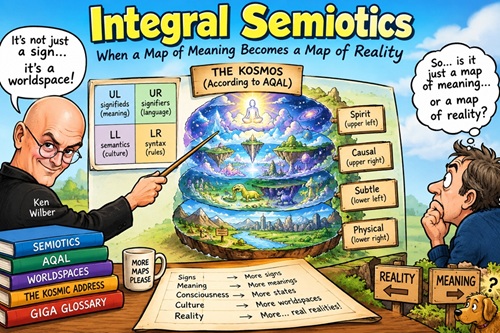 Ken Wilber's “Integral Semiotics” is one of the more ambitious—and revealing—extensions of the AQAL framework. It begins with a legitimate philosophical problem: how do signs, meanings, minds, cultures, and objects relate to one another? But it gradually turns into something much more controversial: an attempt to use semiotics to establish the reality of different “worldspaces,” developmental stages, subtle realms, and ultimately spiritual referents. That shift is the central problem. Wilber's basic semiotic intuition is not without merit. Human beings do not encounter the world as a collection of brute physical objects. We encounter it through signs, concepts, languages, cultural meanings, perceptual structures, and interpretive frameworks. A word such as “dog” involves a material signifier, a psychological signified, grammatical relations, and a culturally mediated meaning. Wilber therefore proposes mapping these dimensions onto the four AQAL quadrants: signifiers with the Upper Right, signifieds with the Upper Left, syntax with the Lower Right, and semantics with the Lower Left.
The trouble begins when this useful observation about meaning is transformed into an ontology of multiple realities. From Semiotics to AQALWilber's argument is easiest to understand as a progression. • First, signs point to something. • Second, what they point to cannot always be reduced to physical objects. • Third, different forms of human experience disclose different domains of meaning. • Fourth, these domains can be organized according to AQAL. • Finally, therefore, different “worldspaces” contain different kinds of real referents. The first three propositions are broadly defensible. The fourth is a theoretical proposal. The fifth is where the epistemological burden becomes much heavier. Wilber himself describes the project in remarkably ambitious terms. Integral Semiotics is supposed to provide a framework for identifying the “Kosmic Address” of phenomena: not merely where something is located physically, but where it belongs within the multidimensional AQAL system. His later formulation explicitly says that phenomena such as Buddha-nature, Spirit, or other spiritual referents exist in particular worldspaces and can supposedly be experienced when the subject enters those spaces. This is no longer simply semiotics. It is an ontology of experience. And that distinction matters. Semiotics Is About SemiosisThe first conceptual problem is that Wilber's account is much narrower than semiotics itself. Semiotics, in the classical traditions of Charles Sanders Peirce and Ferdinand de Saussure and in their many subsequent developments, is concerned with signs, sign systems, meaning-making and interpretation. Peirce's triadic conception of sign, object and interpretant, for example, is considerably more dynamic than the simple equation of signifier, signified and referent. The object of semiotics is therefore not simply the question, “Where does the referent exist?” It is the process by which something functions as a sign for someone or something in a particular context. This distinction has been noted even by proponents of an integral approach. Sebastián Mariano Giorgi, writing on “Integral Semiotics,” observes that Wilber's treatment focuses primarily on the relationship between signs, referents and their “worldspaces,” whereas semiotics properly concerns semiosis, the production and interpretation of sense. Giorgi explicitly argues that Wilber's approach risks reducing semiotics to one level of analysis. That is a significant criticism. An integral theory of semiotics should presumably explain more than where different objects supposedly reside in AQAL space. It should explain how signs operate, how meanings change, how interpretations conflict, how symbolic systems reproduce social structures, how power affects meaning, how signs refer to absent or fictional objects, and how interpretation itself transforms what is being interpreted. Wilber's “Kosmic Address” approach does not obviously accomplish all of this. The Four Quadrants Become a Theory of MeaningThere is nevertheless something interesting in Wilber's attempt to connect semiotics with the four quadrants. Consider the word “dog.” There is the observable inscription or sound. There is the individual's mental association with the animal. There are linguistic conventions governing how the word is used. And there is the cultural world in which the sign acquires significance. This is a useful reminder that language cannot be reduced either to physical sounds or to private mental representations. Meaning is simultaneously embodied, psychological, social and cultural. But Wilber's move from this observation to a four-quadrant mapping creates a familiar problem within AQAL: the map can become so flexible that almost anything can be assigned a quadrant. Once that happens, explanatory power becomes difficult to distinguish from organizational convenience. A framework that says that a phenomenon has an interior, exterior, individual and collective dimension may be useful as a heuristic. But it does not follow that the four dimensions constitute the fundamental architecture of reality. The distinction between a classification scheme and an ontology is crucial here. The Worldspace ProblemThe most controversial element is Wilber's concept of “worldspaces.” The basic idea is reasonable enough. A physicist, a child, a theologian, a musician and a mathematician do not inhabit exactly the same meaningful world. Each has access to domains of phenomena that may be invisible or unintelligible from another perspective. But there are two very different ways of interpreting this observation. The modest interpretation says: Different cognitive, linguistic, cultural and experiential frameworks make different aspects of reality salient. The stronger Wilberian interpretation says: Different stages and states disclose different worlds containing different kinds of real referents. The first is compatible with ordinary epistemology, developmental psychology and hermeneutics. The second requires an ontology. And the evidence needed for the second proposition cannot simply be supplied by the experience itself. This is particularly important when the examples move from mathematics, morality and art toward “subtle,” “causal” and nondual phenomena. Wilber argues that a spiritual referent should not be dismissed merely because it cannot be found in the sensorimotor world. Instead, one should enter the appropriate worldspace and investigate it there. At first glance this sounds like an expansion of empiricism: don't reject an experience before investigating it. But there is a serious epistemological circularity lurking here. If a practice is said to produce access to a particular worldspace, and experiences generated within that practice are then taken as evidence for the existence of that worldspace, the method risks validating its own ontology. Meditation produces an experience. The experience is interpreted according to a spiritual ontology. That ontology then explains the experience as perception of a higher realm. The resulting experience is offered as evidence that the realm exists. But the crucial question remains: what independently distinguishes perception of a metaphysically existing realm from an unusual but naturally generated state of consciousness? Integral Semiotics does not adequately solve that problem. “World” Versus “Worldview”A related problem concerns Wilber's use of the word world. There is an enormous difference between saying: “People at different developmental stages interpret the world differently” and: “People at different developmental stages inhabit different worlds.” The first is a claim about cognition and interpretation. The second sounds like a claim about ontology. Wilber frequently moves between these two formulations. This produces an ambiguity at the heart of Integral Semiotics. If “worldspace” means a domain of meaning constituted through perception, cognition and culture, the concept is relatively uncontroversial. If it means an ontologically distinct domain containing its own objects and phenomena, the argument requires considerably more evidence. This is where the distinction between phenomenology and metaphysics becomes indispensable. A person can have a profound experience of emptiness. That establishes, at minimum, that the person had a profound experience of emptiness. It does not by itself establish that “Emptiness” exists as an ontologically independent cosmic domain. Likewise, experiencing God does not settle the metaphysical question of God's existence. Integral Semiotics tends to move too quickly from what appears within experience to what exists in reality. The Developmental TrapThe developmental component introduces another difficulty. Wilber connects different “worldspaces” to stages and states of consciousness. This fits naturally into his broader developmental model. A person at one stage may not perceive or interpret certain phenomena in the same way as someone at another stage. Again, there is an important insight here. Human perception is developmentally and culturally conditioned. A five-year-old, a trained scientist and a Zen practitioner can encounter the same situation while noticing radically different features. But developmental difference does not automatically entail ontological difference. A medieval astronomer and a modern astrophysicist literally describe different “worlds” of experience. Yet this does not mean that medieval people occupied a different physical universe. Their conceptual systems organized observations differently. This is one reason the phrase “co-created worldspace” requires careful handling. Human beings certainly participate in constructing meaningful worlds. But meaning construction should not be confused with creation of the objects being interpreted. A culture can construct the concept of a unicorn. It does not thereby construct unicorns as biological organisms. A religious tradition can construct an elaborate symbolic world around angels. It does not follow that angels therefore exist as independently existing entities. The semiotic construction of a world and the ontological existence of its inhabitants are different questions. The “Giga-Glossary” and the Bureaucratization of RealityWilber's later proposal for a “Giga Glossary” illustrates both the ambition and the weakness of the project. The idea is to catalogue the phenomena associated with the various quadrants, levels, lines, states, types and perspectives, thereby giving phenomena their “Kosmic Address.” One can appreciate the impulse. Integral theory wants to prevent category errors. A physical object should not be treated like a cultural value; a subjective state should not be treated like an external measurement; a moral obligation should not be reduced to a chemical event. But there is a danger that the proliferation of categories creates an illusion of explanatory precision. Giving something a sophisticated address does not explain it. Calling an experience “Upper Left, causal-state, second-tier, nondual” may tell us how Wilber's system classifies it. It does not establish that the classification corresponds to an independently existing structure of reality. This is the difference between taxonomy and explanation. An elaborate filing system can become extraordinarily precise without becoming empirically true. What About Art?Wilber's original interest in semiotics was partly connected to art and interpretation. His essay on Anselm Kiefer explicitly grew out of his attempt to understand signifiers, signifieds, syntax and semantics through an integral framework. He argued that artists can make different worldviews visible through their work.[1] This is arguably where the approach is most productive. An artwork is never merely pigment on canvas. Its significance depends upon the artist, viewer, historical context, artistic conventions, cultural codes and interpretive communities. A religious icon, an abstract painting and a political poster cannot be adequately understood by analyzing their physical properties alone. Here AQAL can function as a useful reminder to avoid reductionism. But the argument becomes weaker when the artwork is treated as evidence that the worldview depicted corresponds to an objectively existing metaphysical worldspace. An artist can depict heaven without demonstrating heaven. A novelist can create an extraordinarily coherent fictional universe without demonstrating its independent existence. The semiotic capacity to disclose a world should therefore not be confused with proof that the disclosed world exists independently of the symbolic system. The Missing Role of FalsificationThere is another methodological issue. What observation would show that a proposed worldspace does not exist? Suppose practitioners report experiences of a causal realm. Suppose their descriptions converge. Suppose they report extraordinary peace, luminosity or nonduality. What result would count against the hypothesis that these experiences disclose an independently existing causal realm? If no possible observation could count against the interpretation, then “worldspace” risks becoming a protected explanatory category. This is especially problematic because alternative explanations are readily available. Neuroscience can investigate altered states. Psychology can investigate meditation and mystical experience. Anthropology can investigate culturally patterned religious experience. Comparative religion can investigate recurring mystical motifs. Phenomenology can describe the structure of first-person experience. None of these disciplines needs to deny the experience in order to question its metaphysical interpretation. That distinction is fundamental. The skeptic does not need to say, “Your experience is unreal.” The skeptic can say: “Your experience is real as an experience. What remains undecided is what caused it and what, if anything, it reveals about ultimate reality.” Integral Semiotics too often wants to settle the second question by appealing to the first. The Real Contribution: Contextualizing MeaningDespite these criticisms, Integral Semiotics should not simply be dismissed. Its strongest contribution is the insistence that meaning is multidimensional. Signs operate within bodies, minds, linguistic systems, communities, cultures and developmental contexts. A serious theory of meaning cannot reduce everything to either physical objects or private mental representations. Wilber is also right to challenge the crude assumption that only sensorimotor objects can be meaningful. Numbers, moral principles, social institutions, fictional characters, aesthetic values and subjective experiences do not fit comfortably into a simplistic inventory of physical things. But this does not require a hierarchy of metaphysical worlds. We can recognize multiple domains of meaning without turning them into multiple ontological realms. That would produce a considerably more modest—and arguably more defensible—Integral Semiotics. From Integral Semiotics to Critical SemioticsA genuinely productive integral semiotics might therefore reverse the direction of Wilber's argument. Instead of asking: “Where does this referent exist in the AQAL cosmos?” we might first ask: “How does this sign acquire meaning, for whom, under what conditions, through which interpretive practices, and with what consequences?” That would bring integral semiotics into conversation with Peircean semiotics, hermeneutics, phenomenology, developmental psychology, cognitive science, anthropology and social theory. It would also make room for power. Who gets to define a “higher” meaning? Who decides that one interpretation represents a deeper worldspace? What happens when two spiritual traditions report incompatible referents? If two practitioners occupy allegedly identical states but interpret their experiences through radically different religious frameworks, does one have the correct “Kosmic Address”? These are precisely the questions that a theory of signs ought to illuminate. AQAL can provide a vocabulary for organizing the answers. It cannot simply presuppose them. The Semiotic Inflation of AQALThe deeper issue is therefore not that Wilber takes semiotics seriously. It is that he takes AQAL too seriously. A framework originally designed as an orienting map becomes increasingly capable of absorbing every phenomenon it encounters. Experience becomes states. Interpretations become stages. Communities become cultures. Behaviors become quadrants. Spiritual phenomena become worldspaces. And eventually every phenomenon can receive its appropriate “Kosmic Address.” At that point, the map risks becoming self-confirming. Nothing is outside the system because the system has categories for everything. But a theory that can classify everything is not necessarily a theory that explains everything. This is the recurring danger of integral metatheory: comprehensiveness can be mistaken for confirmation. Conclusion: Semiotics Needs Less Cosmology, Not MoreIntegral Semiotics begins with a genuinely important insight: human beings do not simply encounter a preinterpreted world. We inhabit worlds of meaning, and those worlds are shaped by language, consciousness, culture, history and development. That insight does not require the existence of multiple metaphysical realms. Wilber's most interesting contribution is therefore also his most modest one: signs cannot be understood independently of the subjects, communities and interpretive worlds in which they function. The controversial step is the conversion of these interpretive worlds into ontologically distinct “worldspaces,” populated by referents that become accessible through corresponding states or stages of consciousness. Here the semiotic argument becomes metaphysical. And once that happens, the burden of proof changes. Semiotics can demonstrate that humans interpret signs differently. It can investigate how meanings are constructed, transmitted and transformed. Phenomenology can describe what mystical experience is like. Developmental psychology can investigate changes in cognition and perspective. Neuroscience can investigate the biological correlates of altered states. None of these automatically establishes that spiritual experiences disclose independently existing cosmic realms. The crucial distinction, then, is between a map of meaning and a map of reality. Integral Semiotics is compelling when it remains the former. It becomes questionable when it claims to be the latter. The irony is that an integral theory of meaning may ultimately need to become less metaphysical in order to become more genuinely integral. Instead of assigning every experience a place in Wilber's Kosmos, it should investigate how different people, cultures and developmental systems construct, negotiate and contest the meanings of those experiences. That would turn Integral Semiotics from a sophisticated vocabulary for defending integral metaphysics into something much more interesting: a critical theory of how human beings make worlds of meaning. Clarify Peirce's triadic conception of sign, object and interpretantWhat I meant is that Peirce's model is not simply another three-part vocabulary for the familiar distinction between signifier, signified, and referent. The important difference is the role of the interpretant. In a simplified Saussurean-style model: signifier → signified The signifier is the perceptible form (a word, sound, image), while the signified is the concept associated with it. If we add a referential dimension, we can say: signifier → signified → referent For example, the word “tree” is the signifier; the concept tree is the signified; and an actual tree in the world is the referent. Peirce's model is: Sign → Object → Interpretant But this should not be understood as three static things lined up in a row. For Peirce, a sign is something that stands for an object to an interpretant. The interpretant is the effect or understanding produced by the sign in the process of interpretation. It can itself become another sign, generating further interpretation. So, take the word “tree.” The physical word or sound is a sign. Its object may be an actual tree, or more abstractly the class of things to which the sign refers. But what matters is what the sign produces as an interpretant: perhaps the concept of a tree, an image of a tree, the recognition “there is a tree over there,” or even a further thought such as “that tree needs water.” This gives us something like: Sign → Object → Interpretant → further sign/interpretation → further interpretant → ... That recursive element is what I meant by “considerably more dynamic.” There is another important difference. Peirce's object is not simply equivalent to the referent, and the interpretant is not simply equivalent to the signified. Peirce distinguishes, among other things, between the Immediate Object—the object as represented by the sign—and the Dynamical Object—the object that the sign is actually about. Likewise, the interpretant has several dimensions, including the immediate, dynamical, and final interpretant. The interpretant is especially important because it makes meaning an ongoing process rather than a fixed correspondence. A sign does not merely point from a linguistic form to a pre-existing concept. It enters into a process in which one sign generates an interpretation, and that interpretation can function as another sign. This is also why Peirce's semiotics is closely connected with his theory of inference and inquiry. Interpretation can involve recognition, association, habit, practical consequences, and even reasoning. His famous distinction between icon, index, and symbol further complicates the picture: signs can signify through resemblance, causal or existential connection, or convention. So I would sharpen the original sentence. Rather than saying: “Peirce's triadic conception of sign, object and interpretant is considerably more dynamic than the simple equation of signifier, signified and referent.” I would write: Peirce's triadic semiotics cannot simply be reduced to the familiar distinction between signifier, signified, and referent. Whereas the latter can be represented as a relatively static relation between a signifying form, a meaning, and what it refers to, Peirce places interpretation at the heart of semiosis: a sign represents an object to an interpretant, which can itself function as a sign and generate further interpretation. Meaning is therefore not merely a correspondence but an ongoing process of semiosis. That formulation would also fit better with your Integral Semiotics essay, because it prevents the Peircean model from being treated as merely a more sophisticated version of the signifier/signified distinction. NOTE[1] See: Ken Wilber, 'To see a world: Art and the I of the beholder', [essay for art exhibition of Anselm Kiefer, a major European painter]. The Journal of Transpersonal Psychology, 1997, Vol. 29, No.2, and this supplementary essay: Ken Wilber, "To See A World, Some technical points", www.integralworld.net, ca. 2001.
Widget is loading comments...
|