|
TRANSLATE THIS ARTICLE
Integral World: Exploring Theories of Everything
An independent forum for a critical discussion of the integral philosophy of Ken Wilber
  Frank Visser, graduated as a psychologist of culture and religion, founded IntegralWorld in 1997. He worked as production manager for various publishing houses and as service manager for various internet companies and lives in Amsterdam. Books: Ken Wilber: Thought as Passion (SUNY, 2003), and The Corona Conspiracy: Combatting Disinformation about the Coronavirus (Kindle, 2020). Frank Visser, graduated as a psychologist of culture and religion, founded IntegralWorld in 1997. He worked as production manager for various publishing houses and as service manager for various internet companies and lives in Amsterdam. Books: Ken Wilber: Thought as Passion (SUNY, 2003), and The Corona Conspiracy: Combatting Disinformation about the Coronavirus (Kindle, 2020).
Check out my other conversations with ChatGPT Europe's Future in Eurasia?A Critical Review of Joseph Dillard's Geopolitical ArgumentFrank Visser / ChatGPT
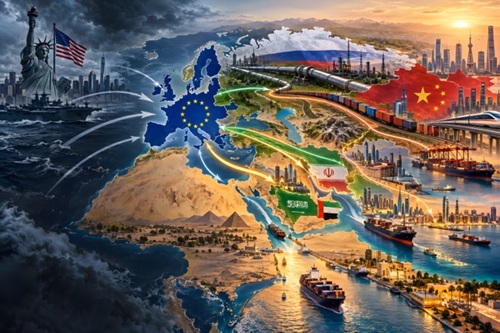
Joseph Dillard and the temptation of geopolitical determinismJoseph Dillard's latest essay, Why Europe's Future Lies in Eurasia, makes an ambitious claim: Europe's long-term future lies not primarily in its transatlantic relationship with the United States, but in deeper economic and strategic integration with Russia, China, Iran and the Gulf states. Dillard presents this not merely as one possible European strategy among several, but as the direction supposedly dictated by geography, economics and the changing distribution of global power. There is much in the essay that deserves serious consideration. The United States is indeed reassessing its global military commitments. Europe is under pressure to assume greater responsibility for its own defence. Russian energy has become much less important to the European Union, while Chinese trade remains enormous. The international system is becoming more multipolar. And European governments clearly cannot assume that the transatlantic relationship will look exactly as it did during the post-Cold War decades. But Dillard's argument contains a curious tension. He criticizes Western geopolitical thinking for being ideological and insufficiently realistic, yet his own analysis sometimes turns contingent geopolitical developments into historical necessities. The result is a provocative essay, but one whose conclusions are considerably stronger than its evidence warrants. Geography is not destinyDillard's first major proposition is encapsulated in the heading “Geography Is Destiny.” Europe and Russia share a continent, he argues, whereas the United States is separated from Europe by an ocean. Consequently, Europe must ultimately develop a working relationship with Russia. Geography certainly matters. It matters enormously. But geography does not determine political relationships by itself. The twentieth century provides an obvious counterexample. Europe and Russia shared a continent throughout the Cold War, yet geographical proximity did not produce political integration. Instead, Europe was divided between competing security systems. Conversely, geographical separation did not prevent the United States from becoming deeply integrated into European security. The relevant variable is therefore not simply distance but the political, military and economic relationships constructed across that geography. This distinction becomes especially important after Russia's invasion of Ukraine. Whatever one's assessment of Western policy, the EU's relationship with Russia has not simply deteriorated because Europeans forgot their geographical interests. It has deteriorated because European governments have interpreted Russian military action as a fundamental security problem. NATO's current assessment explicitly describes Russia's war against Ukraine as the gravest threat to Euro-Atlantic security in decades. One may disagree with that assessment. But Dillard needs to explain why the European interpretation is wrong rather than simply invoking geography as the superior explanation. The Russian-energy argument has a serious empirical problemDillard argues that Europe's industrial system was built around cheap Russian energy and that breaking those ties has damaged European competitiveness. There is a substantial factual basis for the first half of this argument. Russian gas was enormously important to Europe before 2022. Energy prices have also posed serious problems for European industry. But Dillard then presents the restoration of Russian economic relations as though it were the obvious solution. That is where the argument becomes considerably less convincing. The European Union has already undergone a remarkable reduction in Russian energy dependence. The European Commission reports that Russian gas's share of EU gas imports fell from 45% in 2021 to 12% in 2025, while Norway, the United States, North Africa and Qatar became important suppliers. This does not prove that Europe's energy transition has been painless or economically optimal. It does demonstrate, however, that Dillard's description of Europe as structurally dependent upon Russia is increasingly outdated. There is also a conceptual problem. Economic efficiency is not the only variable in energy policy. Security of supply is itself an economic variable. A cheaper supplier that can potentially turn energy dependence into geopolitical leverage may not be cheaper once the strategic risk is incorporated into the calculation. Dillard treats energy primarily as a matter of geographical-economic rationality. European policymakers increasingly treat it as a combination of economics, diversification and strategic resilience. Those are not irrational calculations simply because they produce higher short-term costs. China: partner, competitor and strategic rivalDillard is on firmer ground when describing China's growing economic significance. EU-China trade is enormous. In 2025, EU imports from China were approximately €559.5 billion, while EU exports were about €199.5 billion. The resulting goods deficit was approximately €359.9 billion. But Dillard interprets these numbers primarily as evidence that Europe should deepen its Eurasian economic orientation. That does not necessarily follow. A large trade relationship can indicate interdependence, but it can also indicate asymmetrical dependence. The European Commission itself describes China simultaneously as a partner, competitor and systemic rival and explicitly identifies major structural asymmetries in the relationship. Dillard notices the first part of this equation but pays insufficient attention to the second. Indeed, there is an almost revealing asymmetry in his treatment of the United States and China. American dependence is described as dangerous; Chinese dependence is largely described as an opportunity. Yet if the fundamental argument is that Europe should avoid excessive dependence upon any external power, then that principle should apply equally to Beijing, Moscow and Washington. The logical conclusion of Dillard's own argument might therefore be strategic diversification, not Eurasian alignment. And interestingly, that is much closer to the policy language actually emerging in Europe: reduce vulnerabilities, diversify suppliers and partners, and avoid excessive dependence on any single external power. The missing variable: Russia's own strategic interestsThere is another weakness in the essay: Russia appears primarily as a geographical and economic resource for Europe rather than as an independent strategic actor with its own objectives. Dillard writes that Europe will eventually need a working relationship with Russia. But what kind of relationship would Russia seek? Would Moscow accept a European-Russian relationship primarily on European terms? Would Russia regard a politically autonomous Europe as desirable? What would happen to Ukraine? What security architecture would govern Eastern Europe? What would be the status of NATO? How would Poland and the Baltic states perceive a restoration of close European-Russian economic ties? These questions cannot be answered by geography. They require an analysis of power, interests, institutions and threat perceptions. That omission is particularly striking because Dillard's broader intellectual project is often concerned with adaptive systems. Yet here he sometimes treats Europe as though it were a rational organism responding automatically to its environment. But geopolitical systems do not merely adapt to geography. They adapt to other adapting systems. Russia adapts. China adapts. The United States adapts. European states adapt. Smaller states adapt to the strategies of larger states. Alliances adapt to changing threats. There is no single environmental pressure called “Eurasia” to which Europe can simply adjust. The United States really is changing its roleDillard's strongest argument concerns the changing American security role. Here he has substantial evidence behind him. The 2026 U.S. National Defense Strategy explicitly states that while U.S. forces focus on homeland defence and the Indo-Pacific, allies elsewhere are expected to assume primary responsibility for their own defence, with more limited U.S. support. This represents an important change in emphasis. Dillard is therefore justified in challenging the assumption that Europe can simply continue outsourcing a large part of its security to Washington. But again he goes further than the evidence. A reduction in American responsibility does not logically entail a European turn toward Russia, China and Iran. It could just as easily produce greater European strategic autonomy within a continuing NATO framework. And that is in fact closer to what current NATO policy suggests. NATO continues to describe itself as the central framework for Euro-Atlantic deterrence and defence while simultaneously encouraging European allies to assume greater responsibility. The choice therefore isn't necessarily: America or Eurasia. There is a third possibility: a more autonomous Europe that remains connected to the transatlantic system while developing additional relationships elsewhere. Dillard acknowledges something like this in his conclusion, but his overall rhetoric points considerably more strongly toward Eurasian realignment. The remarkable absence of UkrainePerhaps the most important omission is Ukraine. For an essay arguing that Europe's future lies in Eurasia and that Europe should eventually rebuild relations with Russia, the question of Ukraine cannot be peripheral. Ukraine is not merely an American-Russian dispute occurring somewhere outside Europe. It is a European security issue involving European borders, European refugees, European defence spending, European sanctions, European energy policy and the future of the European security order. Dillard's Eurasian framework tends to turn Ukraine into an obstacle to be overcome rather than a central component of the European strategic problem. That is theoretically significant. A genuinely geopolitical analysis has to explain not only why Europe might benefit economically from reconciliation with Russia, but what security order would make such reconciliation sustainable. Otherwise “reconciliation” risks becoming shorthand for restoring economic relations without resolving the underlying conflict. Iran and the Gulf: another leap from possibility to inevitabilityDillard also places considerable emphasis on Iran and the Gulf, arguing that the changing regional balance and declining American predominance will push the Gulf states toward greater accommodation with Iran and China. There are certainly signs of strategic diversification. Saudi Arabia and Iran restored diplomatic relations in 2023 in an agreement brokered by China, and Gulf states have increasingly pursued relationships with multiple major powers. But diversification is not the same thing as alignment. This distinction is crucial throughout Dillard's essay. A state can simultaneously maintain relationships with Washington, Beijing, Moscow and European capitals. Indeed, that is precisely what many middle powers increasingly seek to do. Dillard's multipolar world therefore does not necessarily produce the Eurasian bloc he describes. Multipolarity can instead produce hedging: states deliberately refusing to become fully dependent upon any one pole. This is potentially the biggest conceptual weakness in the paper. Dillard correctly identifies the emergence of a more multipolar international system, but sometimes interprets multipolarity as though it necessarily means the weakening of the West and the rise of a coherent Eurasian alternative. Those are two different propositions. The “Eurasian order” may be less coherent than it appearsDillard writes that China, Russia and Iran are constructing a multipolar order based upon sovereignty, non-interference and trade in local currencies. He points toward BRICS, the Shanghai Cooperation Organisation, the Eurasian Economic Union and the Belt and Road Initiative as evidence of this emerging architecture. There is certainly institutional proliferation outside the traditional Western order. But these organizations should not automatically be interpreted as components of a coherent alternative system. China and Russia have overlapping but not identical interests. India is simultaneously a member of BRICS and a major partner of the United States. Gulf states cooperate with China while retaining extensive American security relationships. Turkey is a NATO member while simultaneously pursuing relations with Russia and China. This is not necessarily a new Eurasian bloc. It may instead be something more complicated and interesting: a world in which states increasingly refuse to organize themselves into rigid blocs. Dillard's analysis would become stronger if he took this possibility seriously. The problem with “the American model”The essay becomes most polemical in its discussion of the United States. Dillard describes America as being in relative decline and argues that its political system is polarized, its infrastructure is aging, its public-health outcomes are poor and its military spending is extraordinarily high. He concludes that “the American model” is not the future. Some of these observations are measurable. Others are interpretive. But combining them into a single narrative of American decline creates a methodological problem: relative decline is not the same thing as collapse. A country can lose relative economic or military predominance while remaining enormously powerful. The EU's own data illustrate this complexity. The United States remains the EU's largest overall trading partner, and EU-US goods and services trade amounts to roughly €1.7 trillion. European and American companies also hold approximately €4.8 trillion in investment in each other's markets. These relationships are not trivial remnants of an obsolete order. They constitute one of the world's most deeply integrated economic systems. Consequently, “America is declining” is too crude a description. A more defensible formulation would be that American relative predominance is declining while American economic and strategic significance remains enormous. That is a much more interesting historical situation. Dillard's strongest insight: Europe should diversifyIronically, the most convincing part of Dillard's argument is somewhat less dramatic than his title suggests. Europe probably does need greater strategic diversification. It cannot assume permanent American predominance. It cannot assume permanent access to cheap Russian energy. It cannot assume that China will remain merely an economic partner. And it cannot assume that instability in the Middle East will remain geographically contained. Europe therefore has good reasons to develop:
That is a considerably more pluralistic conclusion than Dillard's Eurasian thesis. And it has the advantage of being consistent with the very multipolarity he identifies. An irony from Dillard's own intellectual frameworkThere is an interesting irony here for readers familiar with Dillard's earlier work. Dillard has spent considerable effort criticizing rigid conceptual systems and emphasizing adaptive reorganization. His approach generally suggests that successful systems must remain capable of responding to changing circumstances rather than becoming attached to a single developmental trajectory. Yet Why Europe's Future Lies in Eurasia occasionally seems to replace one fixed narrative with another. The old narrative was: Europe belongs to the West. Dillard's counter-narrative becomes: Europe's future lies in Eurasia. But perhaps the genuinely adaptive position would be: Europe should avoid permanent dependence upon any single geopolitical centre. That would mean maintaining American connections where useful, developing Asian relationships where advantageous, engaging Russia where possible, cooperating with China where interests overlap, and building European capabilities sufficient to make those relationships choices rather than necessities. In other words, multipolarity should perhaps be treated as a condition of strategic flexibility rather than as an invitation to choose a new bloc. That conclusion would fit Dillard's adaptive philosophy better than his own geopolitical determinism. Conclusion: an important diagnosis, an overstated prescriptionDillard's essay is worth reading because it raises questions that European policymakers increasingly have to confront. The post-Cold War assumption of effortless American security provision is changing. Russia's role in European energy has been dramatically reduced. China's economic importance has grown enormously. The Gulf is becoming more strategically autonomous. And the international system is becoming more distributed. Those are important developments. But Dillard's central conclusion—that Europe's future therefore lies eastward with Russia and China and southeastward with Iran and the Gulf—is not established by those facts. The essay repeatedly moves from interdependence to alignment, from possibility to necessity, and from relative decline to historical replacement. Its deepest weakness is therefore not that it is insufficiently “pro-Western” or insufficiently “Eurasian.” It is that it occasionally reproduces the very kind of geopolitical simplification it seeks to overcome. Europe's future may indeed become more Eurasian. But it may also become more Atlantic, more autonomous, more Asian, or—most plausibly—more strategically pluralistic. The real geopolitical transformation may not be the replacement of one hegemon by another. It may be the end of the assumption that Europe must belong to one geopolitical world at all. And that, ironically, would be the genuinely adaptive conclusion.
Widget is loading comments...
|