|
TRANSLATE THIS ARTICLE
Integral World: Exploring Theories of Everything
An independent forum for a critical discussion of the integral philosophy of Ken Wilber
  Frank Visser, graduated as a psychologist of culture and religion, founded IntegralWorld in 1997. He worked as production manager for various publishing houses and as service manager for various internet companies and lives in Amsterdam. Books: Ken Wilber: Thought as Passion (SUNY, 2003), and The Corona Conspiracy: Combatting Disinformation about the Coronavirus (Kindle, 2020). Frank Visser, graduated as a psychologist of culture and religion, founded IntegralWorld in 1997. He worked as production manager for various publishing houses and as service manager for various internet companies and lives in Amsterdam. Books: Ken Wilber: Thought as Passion (SUNY, 2003), and The Corona Conspiracy: Combatting Disinformation about the Coronavirus (Kindle, 2020).
Check out my other conversations with ChatGPT Jeff MeyerhoffAnd the Problem of Criticizing Ken WilberFrank Visser / ChatGPT
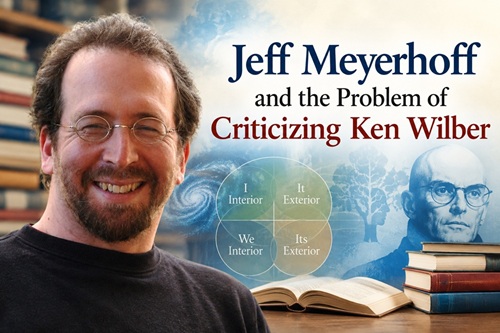 Jeff Meyerhoff occupies a peculiar and important place in the history of criticism of Ken Wilber. He is not merely another critic who objected to Wilber's spiritual metaphysics, nor was he primarily interested in finding empirical counterexamples to the Integral model. His deeper target was the way Wilber constructs knowledge itself: how sources are selected, how disagreements within academic fields are converted into apparent consensus, how empirical findings become ingredients in a grand developmental story, and finally how a personal vision of reality can acquire the appearance of an objective map of the Kosmos. Meyerhoff's Bald Ambition remains one of the most sustained attempts to examine Wilber's intellectual machinery from the inside. But Meyerhoff's own alternative has serious limitations. His criticism sometimes becomes so concerned with the psychology, rhetoric and perspectival character of belief that it risks weakening the very distinction between why somebody believes something and whether that belief is true. His work is therefore both an unusually powerful critique of Wilber and an instructive example of how criticism can itself become theoretically overambitious. Going Back to the SourcesMeyerhoff's importance begins with the unusual seriousness of his project. Rather than dismissing Wilber as a New Age writer, he went back to the sources Wilber used to construct his system: developmental psychology, sociology, philosophy, postmodernism, mysticism, evolutionary theory and the history of ideas. Bald Ambition was explicitly conceived as a sustained examination of Wilber's scholarly sources and arguments, something Meyerhoff believed had largely been missing from the literature. This was exactly the right place to attack Wilber. The weakness of Integral Theory is not simply that some of its conclusions are controversial. A sufficiently ambitious theory is bound to contain controversial conclusions. The more fundamental question is whether the route from evidence to conclusion is legitimate. Wilber presents himself as a synthesizer. He does not, in principle, claim to have invented developmental psychology, evolutionary biology, sociology, contemplative traditions and postmodern philosophy. He claims to have discovered the larger pattern connecting them. That immediately creates an enormous methodological burden. If Wilber says that hundreds of disciplines independently point toward a common developmental architecture, one must ask whether those disciplines actually agree. If they do not, then the synthesis may be Wilber's interpretation rather than a discovery made by the disciplines themselves. Meyerhoff saw this problem very clearly. The Orienting Generalization ProblemPerhaps Meyerhoff's strongest criticism concerns Wilber's famous appeal to orienting generalizations. Wilber's idea was attractive. Rather than pretending to master every detail of every academic discipline, the integral theorist would identify the broad truths already accepted within different fields and then integrate those truths into a larger framework. The difficulty is obvious once one examines the sources closely: what counts as an "already-agreed-upon" truth? Meyerhoff argues that Wilber repeatedly treats contested positions as though they represented disciplinary consensus. His examples include developmental psychology and cross-cultural psychology, where Wilber sometimes presents one theoretical position as if it were a summary of the field when the cited source itself acknowledges competing positions. This is a devastating criticism because it attacks the epistemological foundation of the entire enterprise. Suppose Wilber cites a developmental psychologist who believes that human beings exhibit universal developmental structures. That establishes that a developmental psychologist holds that position. It does not establish that developmental psychology as a discipline has demonstrated the position. The difference is enormous. Meyerhoff therefore reverses the image of Wilber as a cartographer who surveys the intellectual landscape and discovers its underlying structure. He suggests that Wilber already has a developmental story in mind and then searches the literature for scholars whose work can be incorporated into it. This is essentially the accusation of confirmation through selective synthesis. And it remains one of the most important questions anyone interested in Integral Theory can ask. Wilber as a StorytellerMeyerhoff's second major contribution is his analysis of the difference between facts and stories. Wilber does not merely catalogue discoveries. He tells a story about the Kosmos: matter gives rise to life, life to mind, mind to higher consciousness, and consciousness ultimately discloses Spirit. Wilber calls this an integral history of "cosmos, bios, psyche, theos." But scientific facts do not automatically assemble themselves into that narrative. This is where Meyerhoff's use of Hayden White becomes important. Historians do not simply reproduce events. They select, arrange and interpret them. A chronology is not yet a meaningful history. Once events are organized into a developmental narrative, values and assumptions enter the picture. Meyerhoff argues that Wilber does precisely this while often presenting the resulting narrative as though it followed directly from the underlying facts. This distinction is crucial. There is nothing illegitimate about telling a philosophical story about evolution. The problem occurs when the story is presented as though science itself had established its deeper meaning. Evolutionary biology can establish common descent, differential reproductive success, genetic inheritance, selection and many other things. It does not automatically establish that evolution is aiming at Spirit. That additional conclusion belongs to philosophy or metaphysics. Meyerhoff's great achievement was to keep asking: where does Wilber's evidence end and Wilber's interpretation begin? The Four Quadrants: A Map That Wants to Be an OntologyMeyerhoff also questions the status of Wilber's Four Quadrants. The quadrants are often presented as a wonderfully simple solution to the problem of reductionism: every phenomenon can be viewed from an interior-individual, exterior-individual, interior-collective and exterior-collective perspective. As a heuristic, this can be useful. But Meyerhoff asks a more uncomfortable question: are these really four fundamental divisions in reality? His analysis points out that Wilber moves between three different claims. Sometimes the quadrants look like an ontology: four fundamental dimensions of every holon. Sometimes they are methodological perspectives. Sometimes they correspond to different kinds of validity claims. Meyerhoff argues that these classifications do not necessarily coincide. That is a recurring problem throughout Integral Theory. A distinction that begins as a useful way of looking at something can gradually become a claim about what something is. This is the difference between: "We can study consciousness subjectively and objectively." and: "Reality itself consists of an interior and an exterior dimension." The first is an uncontroversial methodological observation. The second is an ontological thesis requiring considerably more argument. Meyerhoff is at his best when he catches Wilber making this kind of slide. The Developmental TrapMeyerhoff's criticism of developmentalism is even more fundamental. Wilber's entire architecture depends upon developmental hierarchy. There are lower and higher stages, less differentiated and more differentiated structures, pre-rational, rational and trans-rational forms of consciousness, and increasingly comprehensive forms of integration. Meyerhoff does not deny development altogether. His objection is that Wilber often treats a highly contested body of developmental theory as though it established a universal architecture of consciousness. This distinction matters. Children obviously develop. Societies change. Cognitive capacities can become more complex. Scientific knowledge accumulates. None of that, by itself, establishes a universal hierarchy of human consciousness. And even if developmental sequences can be demonstrated in particular domains, it does not follow that the entire Kosmos possesses one developmental trajectory. This is where Meyerhoff's criticism converges with some of the strongest criticisms that can be made of Wilber today. The existence of development does not establish developmentalism as a metaphysics. Where Meyerhoff Goes Too FarBut Meyerhoff's critique becomes more problematic when he moves from epistemology to psychology. His tenth chapter of Bald Ambition is explicitly devoted to a psychological analysis of Wilber's beliefs. Meyerhoff argues that Wilber's recurring concern with fragmentation and integration corresponds to patterns in his personal history, and that his Kosmology can therefore be understood partly as a psychological construction. This is fascinating. It is also dangerous. Meyerhoff is aware of the danger. He explicitly argues that psychological analysis does not by itself invalidate a belief. He says that beliefs must ultimately be evaluated by arguments and evidence. But his own argument sometimes comes close to violating that principle. If Wilber's theory of cosmic integration reflects Wilber's personal need for integration, that may explain why Wilber formulated it in this particular way. It does not establish that the theory is false. A person who believes in gravity because his father taught him about gravity has a psychological history of believing in gravity. That history tells us nothing about whether gravity exists. Meyerhoff knows this, but the psychological chapter occasionally gives the impression that discovering the psychological origin of a belief has epistemological consequences beyond what has actually been demonstrated. This is precisely the problem of the genetic fallacy that Meyerhoff himself discusses. His response is subtle: because ultimate justification always involves assumptions, circularity or regress, he argues that understanding the psychological sources of belief can become part of the process of intellectual inquiry. There is something valuable here. But there is also a danger of overcorrection. The Psychology of Belief Is Not the Psychology of TruthMeyerhoff's "Arguments Beyond Reason" proposes that once rational argument reaches an impasse, we should investigate the psychological basis of people's commitments. Deep beliefs are often emotionally invested, and discovering those investments can loosen intellectual deadlocks. As a therapeutic or dialogical strategy, this is compelling. As an epistemology, it is much less secure. Imagine two people arguing about climate change, evolution or God. Suppose we discover that one person's position satisfies a deep psychological need while the other's position satisfies a different psychological need. We have learned something important about the debaters. But we have learned nothing decisive about the climate, evolution or God. The truth of a proposition does not become distributed according to the psychological needs of its advocates. Meyerhoff sometimes seems to move toward a more radical conclusion: that because our ultimate reasons terminate in assumptions, there is no neutral Archimedean standpoint from which competing worldviews can simply be adjudicated. That is a respectable philosophical position. But it does not follow that competing propositions are therefore epistemically equivalent. The fact that human knowledge is fallible does not mean that all claims are equally plausible. The fact that absolute certainty is unavailable does not abolish evidence. This is where Meyerhoff could have pushed his criticism of Wilber further rather than moving in a somewhat relativistic direction. From "Everything Is Perspective" to "Nothing Can Be Settled"Meyerhoff's alternative to Wilber is essentially a more modest pluralism. In his later formulation, he contrasts Wilber's attempt to achieve an overarching Kosmic integration with the recognition of the limits of reason and the possibility that perspectives remain irreconcilable. He recommends investigating the psychological sources of our attachments rather than assuming that every disagreement can be resolved through a higher-order synthesis. This is an important corrective to Wilber. But it creates its own problem. There are disagreements that really are irresolvable at the level of ultimate metaphysics. But there are also disagreements that can be resolved by evidence. Whether a species existed in a particular geological period is not simply a matter of perspective. Whether a medicine has a measurable effect is not settled by exploring the psychological needs of people who favor or oppose it. Whether a historical event occurred cannot be reduced to competing interpretive horizons. Meyerhoff's perspectivism therefore needs to be carefully delimited. There are questions where perspectives genuinely compete. There are questions where evidence breaks the symmetry. And there are questions where the correct answer is simply that we do not yet know. A mature epistemology needs all three possibilities. Meyerhoff's Most Important InsightIronically, Meyerhoff's most valuable insight may be simpler than his own philosophical apparatus. Integral Theory is not merely a collection of facts. It is a story about those facts. That observation changes everything. Once this is recognized, we no longer need to decide whether Wilber is a genius or a fraud, whether AQAL is true or false, or whether his entire system should be accepted or rejected. We can take it apart. • Which parts are empirical? • Which parts are interpretive? • Which parts are philosophical? • Which parts are metaphysical? • Which parts are borrowed from established scholarship? • Which parts are minority interpretations? • Which parts depend upon Wilber's own developmental assumptions? • And which parts are simply rhetorical bridges connecting otherwise independent domains? Meyerhoff was one of the first critics to perform this kind of forensic disassembly at book length. The Critic Who Became Part of the StoryThere is an amusing paradox here. Wilber wanted to integrate everything. Meyerhoff wanted to demonstrate why that integration does not work. But Meyerhoff himself eventually constructed a fairly ambitious theory about why people believe what they believe: intellectual disagreements are rooted in psychological needs; worldviews become emotionally invested; rational argument reaches foundational limits; psychological investigation can therefore reveal what conventional debate misses. In other words, the critic of the grand theory developed a theory of his own. This does not invalidate Meyerhoff's work. It makes it more interesting. The critical question is simply whether Meyerhoff applies to himself the same standards he applies to Wilber. • If Wilber's personal history can influence his Kosmology, then Meyerhoff's own intellectual biography can influence his anti-Kosmic pluralism. • If Wilber's developmental narrative is partly a construction, Meyerhoff's narrative about the psychological construction of belief is also a construction. • If Wilber must distinguish evidence from interpretation, Meyerhoff must do the same. The critic is not outside the field he criticizes. That may actually be Meyerhoff's deepest lesson. From Meyerhoff to a Post-Integral CriticismThere is therefore a productive way to move beyond both Wilber and Meyerhoff. Wilber's mistake is to believe that the enormous diversity of human knowledge can ultimately be fitted into one developmental Kosmic architecture. Meyerhoff's temptation is to respond by emphasizing perspectival plurality, psychological origins and the limits of rational adjudication. A stronger position would retain Meyerhoff's methodological skepticism without surrendering empirical discrimination. We do not need a Theory of Everything. But neither do we need a Theory of Why Everyone Believes Different Things. We need something more modest: careful distinctions between evidence, interpretation, explanation, metaphor, philosophy and metaphysics. That would transform Integral Theory from a purported map of the Kosmos into what it can more defensibly be: a particular intellectual synthesis produced by a particular thinker, containing useful conceptual tools alongside controversial empirical, philosophical and metaphysical claims. Meyerhoff's achievement was to make that distinction difficult to ignore. His limitation was that he sometimes replaced Wilber's grand synthesis with an equally ambitious theory of the psychological and perspectival foundations of belief. The next step is therefore neither Wilberian integration nor Meyerhoffian deconstruction. It is epistemic housekeeping. And perhaps that is precisely what Integral Theory has needed from the beginning.
Widget is loading comments...
|