|
TRANSLATE THIS ARTICLE
Integral World: Exploring Theories of Everything
An independent forum for a critical discussion of the integral philosophy of Ken Wilber
  Frank Visser, graduated as a psychologist of culture and religion, founded IntegralWorld in 1997. He worked as production manager for various publishing houses and as service manager for various internet companies and lives in Amsterdam. Books: Ken Wilber: Thought as Passion (SUNY, 2003), and The Corona Conspiracy: Combatting Disinformation about the Coronavirus (Kindle, 2020). Frank Visser, graduated as a psychologist of culture and religion, founded IntegralWorld in 1997. He worked as production manager for various publishing houses and as service manager for various internet companies and lives in Amsterdam. Books: Ken Wilber: Thought as Passion (SUNY, 2003), and The Corona Conspiracy: Combatting Disinformation about the Coronavirus (Kindle, 2020).
Check out my other conversations with ChatGPT The Elimination ProjectA Critical Reading of B'Tselem's New ReportFrank Visser / ChatGPT
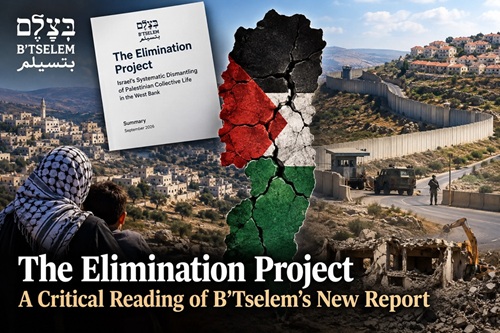 From Human-Rights Documentation to a Theory of EliminationB'Tselem's new report, The Elimination Project, is considerably more than another human-rights indictment of Israeli policy in the West Bank. Its central argument is that violence, checkpoints, land seizures, settlement expansion, economic restrictions, arrests, demolitions and settler attacks should not be viewed as separate abuses. They constitute, B'Tselem argues, an integrated mechanism whose cumulative effect is to dismantle the material, social and political conditions of Palestinian collective existence. That is the report's most important intellectual move. B'Tselem says it has drawn on more than thirty years of documentation and approximately 2,000 testimonies collected from Palestinians in recent years, supplemented by legislation, government decisions, official documents and other research. It organizes the alleged mechanism into five mutually reinforcing domains: violence and intimidation, movement restrictions, economic strangulation, social and political destruction, and ethnic cleansing and territorial takeover. There is considerable explanatory value in looking at the West Bank in precisely this systemic way. A checkpoint is one thing when considered in isolation. A checkpoint combined with settlement roads, land restrictions, home demolitions, settler violence and barriers to economic activity produces something considerably larger: a structure in which Palestinians experience their territory and their lives very differently from Israeli settlers living alongside them. The report is therefore strongest when it says, in effect: stop looking at the individual trees and examine the forest. But this is also where the central methodological problem begins. The Evidence Is Stronger Than the TheoryThere is little reason to doubt that serious abuses documented by B'Tselem occur. The report presents extensive evidence concerning killings, arrests, movement restrictions, land confiscation, demolitions, settlement expansion and settler violence. Some of its claims also overlap with findings from international institutions. The International Court of Justice's 2024 advisory opinion, for example, found that Israeli settlements in the West Bank and East Jerusalem violate international law, that settlement policy and related practices contribute to forced displacement, and that Israel's continued presence in the Occupied Palestinian Territory is unlawful. The Court also found Israel's systematic failure to prevent or punish settler attacks to be inconsistent with its obligations. This makes it impossible to dismiss B'Tselem's report as simply an inventory of invented grievances. Much of the underlying factual terrain is independently documented. Indeed, some of B'Tselem's numbers are striking. It reports that between 7 October 2023 and 30 June 2026, Israeli forces killed 1,087 Palestinians in the West Bank, including East Jerusalem, among them 242 children and 21 women. It reports more than 200 new checkpoints established between October 2023 and June 2026, and says that 64 Palestinian shepherding communities had been expelled from their homes by June 2026. It also documents 185 new settler outposts established between 2023 and 2025. These are not trivial observations. The question is what they prove. When Does a Collection of Policies Become a Project?The word project is doing enormous work in B'Tselem's argument. There is an important difference between saying that a collection of policies has a common effect and saying that those policies constitute a coherent project with a common purpose. The first proposition can be demonstrated largely through observable consequences. The second requires evidence about intentions, coordination and causation. B'Tselem attempts to provide such evidence. It points particularly to the political rise of settlement advocates, the increasing integration of state institutions with settler organizations, and Bezalel Smotrich's 2017 “Decisive Plan.” The report is careful to acknowledge that Smotrich's plan was never formally adopted as a complete government program. It nevertheless argues that important elements of its logic have subsequently been translated into budgets, delegated powers and policies. That is a legitimate line of investigation. But it is not quite the same thing as demonstrating that every element of the system has been consciously coordinated toward one overarching goal. This distinction matters because states routinely produce contradictory policies. Governments contain competing institutions, political parties and ideological factions. Security policies can have both genuine security rationales and discriminatory effects. Settlement policies can be motivated simultaneously by ideology, religion, nationalism, security concerns, domestic politics and economic interests. Bureaucracies can perpetuate policies long after their original rationale has changed. A convincing theory of an “elimination project” therefore needs to demonstrate not merely convergence of outcomes, but convergence of intentions and mechanisms. B'Tselem provides substantial evidence for the former. The evidence for the latter is more uneven. The Problem of a Very Elastic DefinitionThe report defines “elimination” unusually broadly. It does not mean the physical extermination of Palestinians. Rather, it means sustained damage to the material, social and political conditions that permit Palestinian collective existence: land, institutions, culture, social relationships, leadership, memory and the possibility of a common future. This is an intellectually interesting concept, but it creates a serious problem of falsifiability. If elimination means killing, expulsion and forced displacement, it describes a relatively specific set of phenomena. If it also includes movement restrictions, economic hardship, political repression, symbolic domination, restrictions on institutions, settlement expansion and the fragmentation of communities, the category becomes so broad that many different forms of domination can potentially be classified as manifestations of the same phenomenon. The broader the definition becomes, the easier it is to demonstrate the thesis. This does not make the thesis false. It means that B'Tselem has to work harder to distinguish between policies that cause elimination-like effects and policies deliberately designed as components of an elimination strategy. That distinction is particularly important for a report that wishes to move from human-rights documentation into historical explanation. Settler Colonialism: Useful Framework or Master Narrative?The report also places contemporary Israeli policy within the conceptual framework of settler colonialism. B'Tselem explicitly invokes historian Patrick Wolfe's “logic of elimination,” arguing that settler-colonial systems can seek to reduce Indigenous presence not only through direct expulsion or killing but through legal, economic, geographical and political mechanisms that undermine collective existence. As a conceptual framework, this is useful. It directs attention toward land, demography, sovereignty and the relationship between settlement and displacement. But frameworks can also become master narratives. Once Zionism is characterized as a settler-colonial project whose underlying logic is elimination, contemporary developments can easily be interpreted as confirmations of that original diagnosis. The Nakba becomes the first manifestation, the 1967 occupation the next stage, Oslo another stage, and today's policies the latest intensification. There is a danger here of turning history into a one-directional story. The history of Zionism and Israel contains displacement and dispossession, but it also contains Jewish immigration, the Holocaust and its aftermath, Arab-Israeli wars, Palestinian nationalism, Arab nationalism, Israeli security doctrines, the peace process, Palestinian armed movements, terrorism, Israeli political divisions and changing international circumstances. These factors do not excuse abuses, but they complicate causal explanations. A critical report should distinguish between historical context and historical inevitability. B'Tselem sometimes comes close to the latter. The Apartheid Argument Needs More PrecisionB'Tselem also operates within its established interpretation of Israel as an apartheid regime. It argues that Jews and Palestinians living under Israeli control are subjected to different legal systems, political rights, protections and access to resources. In the West Bank, Israeli settlers are generally governed through Israeli civil law while Palestinians are governed under military law. This is one of the report's more concrete arguments because the different legal regimes are demonstrable. But here again, the terminology requires careful handling. B'Tselem's classification of the entire Israeli regime as apartheid is its own legal and political assessment. It should not be presented as though every international judicial institution has reached the same conclusion. The 2024 ICJ advisory opinion found extensive violations of international law, including settlement illegality, annexation and violations of Palestinian self-determination. But the Court did not issue a general finding that Israel's regime constitutes apartheid. Indeed, one of the Court's separate judicial opinions explicitly noted that the Court had not qualified its findings as apartheid. This distinction does not refute B'Tselem's argument. It simply means that “apartheid” remains an interpretive legal characterization that requires argument, rather than an established judicial fact equivalent to the ICJ's findings on settlements or the occupation. That is exactly the kind of distinction a report of this importance should make unmistakable. The Report's Treatment of Violence Is More PersuasiveB'Tselem is particularly compelling when discussing the relationship between settler violence and state institutions. The report documents cases in which settlers attack Palestinian communities while soldiers or police allegedly fail to intervene, restrict Palestinian self-defence, or participate directly in violence. It describes the recruitment of settlers into regional defence battalions and settlement security squads following October 2023. Its argument is not simply that “some settlers are violent.” It is that the distinction between official and unofficial coercion is becoming increasingly difficult to maintain. The report's statistics concerning accountability are also significant. According to B'Tselem, of 2,427 complaints concerning harm to Palestinians and their property submitted to the military law-enforcement system between 2016 and 2024, investigations were opened in only 22.7 percent and indictments filed in only 0.9 percent. It further reports that 93.6 percent of investigation files concerning Israeli violence against Palestinians between 2005 and 2025 ended without an indictment. Such figures, if accurately constructed from the underlying records, are powerful evidence of an accountability problem. They do not by themselves prove an “elimination project,” however. They demonstrate something more specific and arguably more difficult to dispute: a system in which Palestinian victims face inadequate protection and perpetrators frequently face inadequate accountability. That is already an extremely serious conclusion. The Missing CounterfactualOne weakness throughout the report is the limited attention to counterfactual explanations. Suppose Israel genuinely believes that movement restrictions are necessary for security. Suppose some checkpoints were introduced because of attacks rather than demographic objectives. Suppose military operations have multiple motivations. Suppose some restrictions were imposed for security reasons but have nevertheless become discriminatory, excessive or permanent. Would B'Tselem's framework be capable of distinguishing these cases from measures whose primary purpose is territorial displacement? That question is crucial. A strong causal analysis should ask not only, “What does this policy accomplish?” but also, “Why was it introduced, what alternatives existed, what evidence demonstrates the decision-makers' objective, and what observable evidence would count against our interpretation?” B'Tselem generally begins with the assumption that the different policies form an integrated mechanism and then interprets their cumulative consequences through that mechanism. That produces a powerful narrative. It does not necessarily produce a fully demonstrated causal model. Security Cannot Be the Universal Excuse—But Neither Can It Be IgnoredThere is another asymmetry. B'Tselem is entirely justified in rejecting “security” as a magic word that automatically legitimizes whatever Israel does. International humanitarian and human-rights law does not provide states with unlimited discretion simply because they invoke security. But a critical analysis should still examine genuine security considerations rather than treating them primarily as ideological camouflage. The October 7, 2023 Hamas attack profoundly changed Israel's security environment. The West Bank itself contains armed Palestinian groups, firearms, attacks on Israelis and longstanding Israeli fears of a repeat of October 7. Those facts do not justify collective punishment, unlawful settlement, settler violence or discriminatory treatment. But they are part of the causal environment in which Israeli policy is formulated. The report's framework would be stronger if it explicitly separated three questions: what Israel says its policies are intended to achieve, what those policies objectively achieve, and what evidence exists that their actual purpose differs from their stated purpose. Without that separation, explanation can become accusation. The Gaza Connection Is Important—and Potentially OverextendedB'Tselem connects the West Bank directly to Gaza, arguing that the destruction occurring in Gaza has normalized forms of violence that are increasingly being applied in the West Bank. There is certainly a connection worth investigating. The political environment after October 7 changed dramatically, and the West Bank has experienced intensified violence, military operations and restrictions. But the report occasionally risks collapsing two very different theatres of conflict into one conceptual process. Gaza and the West Bank have different political histories, different territorial arrangements, different Palestinian governing structures and different military circumstances. Hamas controls Gaza; the Palestinian Authority has limited administrative responsibilities in parts of the West Bank; Israel maintains extensive military control over the West Bank. These differences matter. The report gains rhetorical force by treating them as manifestations of one overarching structure, but explanatory precision can be lost in the process. A Particularly Important Legal DistinctionThere is also a problem with the report's language concerning genocide. B'Tselem describes Israel's conduct in Gaza as genocide and treats the Gaza and West Bank situations as related expressions of the same logic. The question of genocide, however, is legally more demanding than the documentation of massive civilian harm. The International Court of Justice has ordered provisional measures under the Genocide Convention and found that Palestinians in Gaza possess “plausible” rights requiring protection. It has not, in the provisional-measures proceedings, issued a final judgment that Israel committed genocide. At the same time, the allegation is not simply a fringe assertion: a UN Commission of Inquiry reported in September 2025 that Israel had committed genocide in Gaza, while other international actors and scholars have reached different conclusions. The responsible formulation, therefore, is to distinguish documented facts, legal findings, allegations, and contested legal interpretations. B'Tselem sometimes compresses those categories into one moral vocabulary. That makes the report rhetorically powerful but analytically less careful than it could be. The Report's Most Important ContributionDespite these criticisms, dismissing The Elimination Project would be a mistake. Its most valuable contribution is not necessarily its terminology. It is the accumulation and connection of evidence. A Palestinian family does not experience “settlement policy” as an abstract international-law problem. It may experience it as losing access to agricultural land. A road closure may mean missing work. A demolition may mean leaving one's community. Settler violence may make shepherding impossible. Administrative detention may remove a community organizer. Economic restrictions may weaken the institutions that sustain collective life. These effects can reinforce one another regardless of whether every individual policy was conceived as part of a master plan. That observation actually suggests a potentially stronger formulation than B'Tselem's own. We do not necessarily need to demonstrate that every Israeli institution and every Israeli actor consciously participates in one centrally coordinated “elimination project” in order to establish that a system of policies can cumulatively produce the systematic fragmentation and displacement of Palestinian life. That is a more modest claim—but also a more defensible one. Where B'Tselem Is Strongest—and Where It OverreachesThe report is strongest when it documents concrete practices: settlement expansion, land appropriation, movement restrictions, demolitions, settler violence, political repression and failures of accountability. Its evidence is extensive, its historical documentation is substantial, and several of its core findings overlap with conclusions reached by international judicial institutions. It becomes less convincing when it moves from these observations to a comprehensive theory of intention. There is a logical difference between: “These policies systematically undermine Palestinian collective life.” and: “These policies constitute a single coherent project intentionally designed to eliminate Palestinian collective life.” The first proposition can be established largely through evidence of effects. The second requires substantially more evidence concerning intention, coordination and institutional decision-making. B'Tselem frequently treats the second as though it follows automatically from the first. It does not. The Paradox of the ReportThere is an intriguing paradox at the heart of The Elimination Project. B'Tselem wants us to stop thinking of the occupation as a collection of isolated violations and start thinking systemically. That is exactly right as a methodological ambition. But its own system-level explanation risks becoming so comprehensive that almost everything becomes evidence for the system. Violence proves elimination. Movement restrictions prove elimination. Settlement expansion proves elimination. Economic hardship proves elimination. Political repression proves elimination. Symbolic domination proves elimination. Historical dispossession proves elimination. The framework consequently risks becoming self-confirming. A stronger version would identify specific predictions that distinguish the elimination hypothesis from alternative explanations. For example: where territorial displacement is the objective, do policies systematically correlate with settlement expansion? Where security is invoked, are comparable security risks treated differently depending on whether Palestinians or settlers are affected? Where settlers commit violence, does state protection correlate with subsequent territorial acquisition? Where Palestinian communities are removed, does Israeli territorial control subsequently expand? Those questions could transform B'Tselem's thesis from a powerful interpretive narrative into a more rigorous explanatory model. Beyond CondemnationThe report ends with a political conclusion: that piecemeal measures cannot solve the problem and that ending the underlying system of domination is necessary. Whether one accepts that political conclusion depends partly on one's assessment of the historical and legal arguments that precede it. But there is an important lesson here for anyone trying to understand the Israeli-Palestinian conflict. The debate should not be reduced to the choice between two caricatures: Israel as an innocent democracy merely defending itself, or Israel as a monolithic machine pursuing a perfectly coordinated plan of Palestinian elimination. Reality is almost certainly more complicated. There are genuine security threats. There are genuine Palestinian armed attacks. There are genuine Israeli fears. There are genuine ideological movements seeking permanent territorial control. There are genuine settlement policies. There is documented discrimination between populations. There is documented settler violence. There is documented failure of accountability. There is documented Palestinian dispossession and displacement. There are also enormous political divisions within Israeli society and among Palestinians. A serious analysis has to hold all of these realities together. A Valuable Report That Should Be Read CriticallyThe Elimination Project deserves attention not because every conceptual claim it makes is necessarily established, but because it assembles a formidable body of evidence about what Palestinian life in the West Bank has become. Its central insight—that cumulative policies can produce consequences much larger than any individual violation—is important. Its central weakness is that it sometimes turns a demonstrable pattern of domination and dispossession into a demonstrated theory of unified intention. The distinction matters. One can accept much of B'Tselem's empirical documentation while remaining cautious about its historical theory of Zionism, its characterization of the entire Israeli system as apartheid, its use of “elimination” as an overarching category, and its attribution of a single coherent purpose to a highly complex political and security system. Indeed, that critical distinction may make the report more—not less—important. The strongest case against Israeli policy does not require every accusation to be accepted wholesale. The evidence concerning settlement expansion, land seizure, displacement, movement restrictions, settler violence and inadequate accountability is serious enough to stand on its own. The International Court of Justice has independently found major elements of the settlement and occupation regime contrary to international law. The real intellectual challenge, therefore, is not whether Palestinian collective life is being severely constrained and fragmented. The evidence for that is substantial. The harder question is how much of this outcome is the product of a consciously coordinated project, how much emerges from institutional inertia and competing political motives, and how much is driven by security policy, ideology, territorial ambition and the dynamics of a prolonged occupation interacting with one another. B'Tselem gives one powerful answer. It should not be mistaken for the only possible answer. And precisely because the underlying evidence is so important, it deserves an analysis that separates what happened, what it produces, why it happened, and what its perpetrators intended. That distinction is where human-rights documentation becomes serious political history.
Widget is loading comments...
|