|
TRANSLATE THIS ARTICLE
Integral World: Exploring Theories of Everything
An independent forum for a critical discussion of the integral philosophy of Ken Wilber
  Frank Visser, graduated as a psychologist of culture and religion, founded IntegralWorld in 1997. He worked as production manager for various publishing houses and as service manager for various internet companies and lives in Amsterdam. Books: Ken Wilber: Thought as Passion (SUNY, 2003), and The Corona Conspiracy: Combatting Disinformation about the Coronavirus (Kindle, 2020). Frank Visser, graduated as a psychologist of culture and religion, founded IntegralWorld in 1997. He worked as production manager for various publishing houses and as service manager for various internet companies and lives in Amsterdam. Books: Ken Wilber: Thought as Passion (SUNY, 2003), and The Corona Conspiracy: Combatting Disinformation about the Coronavirus (Kindle, 2020).
Check out my other conversations with ChatGPT Trump's War on IranWhen a War Against Iran Becomes a War Against the World EconomyFrank Visser / ChatGPT
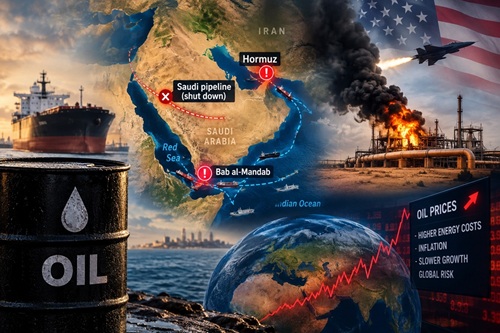 The war that was supposed to be shortWhen Donald Trump embarked on his war against Iran, the familiar logic of modern American intervention was once again on display: overwhelming military power would produce a rapid political result, the enemy would be forced to capitulate, and the consequences would remain manageable. That calculation now looks increasingly questionable. The war has entered its seventh month. Trump had initially predicted a conflict lasting only four or five weeks. Instead, the fighting has spread geographically and strategically, drawing in Iranian allies and proxies in Iraq and Yemen and transforming what began as an American-Israeli confrontation with Iran into a much wider struggle over the security of the Persian Gulf and the Red Sea. The most revealing development is perhaps not another missile strike or destroyed military installation. It is what is happening to Saudi Arabia's oil-export infrastructure. Saudi Arabia is the world's largest crude-oil exporter. It possesses enormous reserves, enormous production capacity and, crucially, infrastructure specifically designed to keep its oil flowing even when the Persian Gulf becomes dangerous. Now even that redundancy is being challenged. Saudi Arabia's escape route has been hitFor decades, the Strait of Hormuz has represented one of the world's great energy chokepoints. Saudi Arabia partly anticipated this vulnerability by constructing the 1,200-kilometre East-West pipeline, carrying oil from the kingdom's eastern oil fields across the Arabian Peninsula to Yanbu on the Red Sea. The pipeline is strategically important precisely because it bypasses Hormuz. During the Iran war, it became more important still. With tanker traffic through Hormuz severely reduced, Saudi Arabia increasingly relied on the pipeline and the Red Sea route to get its oil onto the world market. Reuters estimates that the pipeline had been moving approximately 4-5 million barrels per day, equivalent to roughly 4-5 percent of global oil supply. Then the pipeline itself was attacked. Saudi Arabia subsequently shut it down, describing the closure as precautionary while damage was assessed. Iraq confirmed that the attacks originated from Iraqi territory, although no group immediately claimed responsibility. President Trump said Iran was probably responsible. That attribution remains an allegation rather than an independently established fact. The timing could hardly be worse. The kingdom is therefore confronting an extraordinary strategic problem: the route designed to bypass Hormuz has itself become vulnerable to the regional war. And the Red Sea alternative is no longer secure either. Two maritime chokepointsThe second great vulnerability is the Bab al-Mandab Strait, the narrow maritime gateway between the Red Sea and the Gulf of Aden. Iran's Houthi allies in Yemen have expanded their control and influence in the region. The Houthis have captured strategic territory and islands around the Red Sea approaches and have declared restrictions on Saudi shipping. Their growing presence around Bab al-Mandab threatens another route by which Gulf oil can reach European and global markets. This creates a remarkable geographical trap. Hormuz is compromised. The Red Sea/Bab al-Mandab route is increasingly compromised. And Saudi Arabia's overland alternative has now been attacked. The kingdom still has other logistical possibilities, including limited shipments and attempts to reroute cargoes through Hormuz, but these alternatives cannot simply replace all the lost capacity overnight. Reuters reports that Saudi Arabia has already suspended some European oil shipments following the pipeline attack and that traders are searching for alternative crude supplies. This is why the crisis has suddenly acquired a different character. It is no longer merely an Iran war. It is becoming an energy-infrastructure war. The extraordinary irony of the oil weaponThere is a profound irony here. The United States has enormous military power and can destroy Iranian military installations. But oil markets do not obey military hierarchies. Destroying a refinery, missile battery or nuclear facility is one thing. Keeping millions of barrels of crude flowing every day through a war zone is something entirely different. A modern economy depends upon an immense network of interconnected physical systems: oil fields, pipelines, terminals, tankers, refineries, ports, electricity grids, insurance markets, shipping lanes and financial markets. The vulnerability of the system is determined not by the strongest component but by its chokepoints. Hormuz is one. Bab al-Mandab is another. Saudi Arabia's East-West pipeline has now demonstrated that infrastructure on land can become another. The result is a war in which military escalation can produce economic consequences far beyond the immediate battlefield. From oil shock to inflation shockThe first consequence is obvious: higher oil prices. Brent crude has recently moved above $100 and reached roughly $107-108 per barrel amid renewed concerns about Gulf supplies. But the price of crude is only the beginning. Oil is embedded in almost everything. It powers trucks, ships, aircraft, agricultural machinery and industrial equipment. Petroleum products are transformed into plastics, chemicals, lubricants, synthetic materials and countless industrial inputs. The first-order effect is therefore higher fuel prices. The second-order effect is higher transportation costs. The third-order effect is higher production costs. And the fourth-order effect is inflation. That is why the war can eventually become an economic problem even for countries thousands of kilometres from the Middle East and with no direct involvement in the conflict. The United States is already experiencing exceptionally high diesel prices, while European refiners are scrambling to replace disrupted Saudi supplies. One European buyer, Poland's Orlen, reportedly obtains a substantial share of its crude from Saudi Arabia and has begun seeking alternative supplies from North Sea, American, Kazakh, Algerian and Guyanese producers. The market therefore begins to perform a gigantic global reshuffling operation. Europe competes with Asia for alternative barrels. Asia competes with Europe. Refineries change their crude feedstocks. Shipping routes become longer. Insurance premiums rise. Inventories fall. And every additional military incident acquires an economic price tag. The return of stagflationThe most dangerous possibility is not simply inflation. It is stagflation. A sustained oil shock can simultaneously increase prices and reduce economic activity. Consumers spend more on energy and therefore have less money for other goods and services. Businesses pay more for transportation and production. Central banks face an unpleasant dilemma: inflation argues for tighter monetary policy, while slowing growth argues for monetary easing. The Iran war therefore creates precisely the sort of policy dilemma central banks dislike most. If oil remains above $100 for a prolonged period, inflation can become embedded in economies that had previously been moving toward price stability. If central banks respond aggressively, borrowing becomes more expensive and investment slows. If they do not, inflation expectations can become harder to contain. The war consequently exports an economic problem without exporting a single Iranian missile. The danger to LNG is even greaterOil attracts most of the attention, but natural gas may prove equally important. The Persian Gulf is a major source of liquefied natural gas, particularly for Asian economies. Disruption to shipping lanes therefore threatens not merely petroleum but the global gas market. That matters enormously for countries that replaced Russian pipeline gas with LNG following the invasion of Ukraine. Europe has spent years attempting to diversify away from dependence on Russian energy. A prolonged Middle Eastern crisis creates a different vulnerability: dependence upon maritime LNG routes. Energy security turns out not to mean eliminating dependence. It often means changing the identity of the supplier and the route. Asia may bear the greatest burdenThere is another irony. A war fought primarily by the United States, Israel and Iran can impose some of its greatest economic costs upon countries that have nothing to do with the conflict. China, India, Japan and South Korea are among the world's largest energy importers. Asian economies therefore have an enormous stake in the security of the Persian Gulf. The strategic geography of the global economy means that the Middle East is not merely a Middle Eastern problem. It is part of the industrial bloodstream of Asia. And China in particular has an additional strategic advantage: it can portray the crisis as another demonstration of the instability produced by American military intervention while simultaneously strengthening its own diplomatic and economic relationships with the Gulf states. America's strategic paradoxThis produces perhaps the most important question of the entire war. What exactly has the United States gained by creating a conflict whose consequences increasingly undermine the stability of the very regional order Washington has traditionally sought to protect? There is a legitimate American security argument for confronting Iran. Iran's nuclear ambitions, missile capabilities, regional alliances and attacks on American and allied interests are matters of genuine concern. But destroying military targets is not the same thing as creating a stable political order. And military superiority does not automatically produce strategic control. The United States can dominate the skies and still struggle to keep commercial shipping moving. It can destroy Iranian weapons systems while Iranian-aligned groups attack Saudi infrastructure from neighboring countries. It can attempt to close the Iranian chapter while opening several new ones in Iraq, Yemen, Saudi Arabia and the Red Sea. That is the paradox of escalation. The more geographically dispersed the conflict becomes, the harder it becomes to define what victory actually means. The Saudi predicamentSaudi Arabia may ultimately become one of the most important casualties of this strategic miscalculation—not necessarily in the sense of military defeat, but in terms of the assumptions underlying its economic transformation. Mohammed bin Salman's Saudi Arabia has been attempting to diversify its economy beyond oil through Vision 2030. That transformation requires stability, foreign investment, tourism, infrastructure development and confidence in the kingdom as a predictable economic environment. A prolonged regional war attacks precisely those conditions. More importantly, Saudi Arabia has spent enormous resources building itself into a pivotal energy and investment power. Yet the current crisis demonstrates the vulnerability of even the world's largest crude exporter. The kingdom can produce the oil. The question is whether it can safely get the oil to its customers. That is a very different problem. The great unintended consequenceThis may ultimately be the defining lesson of Trump's Iran war. The objective of military action is usually described in political or military terms: destroy the enemy's capabilities, weaken its regime, force concessions, prevent nuclear proliferation or change its strategic behavior. But wars also generate second- and third-order consequences that cannot easily be controlled. Iran has allies. Those allies have geography. Geography creates chokepoints. Chokepoints create economic leverage. And economic leverage can transform a regional war into a global crisis. The Houthis do not need to defeat the United States Navy to have an enormous economic impact. They only need to make commercial shipping sufficiently dangerous or unpredictable that companies reroute their vessels. Iran does not need to destroy the entire Saudi oil industry. It only needs the perception of insecurity around the infrastructure through which Saudi oil reaches the world market. And the destruction of a single pumping station can have consequences extending thousands of kilometres beyond the site of the attack. A war with no obvious off-rampThe greatest danger now is therefore not necessarily one spectacular escalation. It is persistence. Every additional month gives the conflict more opportunities to spread, more infrastructure to damage, more proxies to activate and more economic relationships to disrupt. The longer this continues, the more difficult it becomes to restore the previous regional equilibrium. Chatham House has similarly argued that the war could alter the balance of power in the Persian Gulf, potentially weakening American predominance while forcing Arab monarchies to reconsider their security relationships. That may be one of the war's most consequential long-term effects. A United States intervention intended to demonstrate American power could instead encourage regional actors to hedge against American power. Saudi Arabia, the Gulf monarchies, Turkey, India and others have every reason to conclude that they cannot assume that American military power will always produce stability. They may therefore diversify their diplomatic relationships. That could mean more Chinese involvement, more Russian involvement, more regional diplomacy and greater attempts by Gulf states to maintain relations with competing powers simultaneously. The price of strategic overconfidenceThere is a recurring pattern in the history of war. A conflict begins with a limited objective. The opponent is expected to collapse quickly. The military balance appears overwhelmingly favorable. Then the opponent discovers asymmetric ways of imposing costs. The geographical scope of the conflict expands. The original objective becomes harder to achieve. And eventually the question changes from "Can we win?" to "How do we get out?" Trump's Iran war appears to have reached that dangerous stage. That does not mean that Iran has "won," nor does it mean that the United States has "lost." Such simple judgments obscure the much more interesting reality. The strategic environment itself is changing. The war has demonstrated that Iran and its regional partners possess means of retaliation that extend far beyond Iranian territory. It has exposed the vulnerability of Gulf energy infrastructure. It has endangered two of the world's most important maritime corridors. It has pushed oil above $100. And it has begun transmitting the conflict's economic costs into Europe, Asia and North America. That is a remarkable result for a war that was supposed to be short. The ultimate lessonThe Middle East has repeatedly demonstrated that military power and political power are not the same thing. The United States may have extraordinary capacity to destroy things. It has much less capacity to determine what happens afterward. The current Saudi oil crisis makes that distinction painfully visible. A pipeline built to bypass Hormuz is attacked. Hormuz itself is disrupted. The Red Sea route is threatened. Saudi oil shipments are cancelled. European buyers scramble for replacement barrels. Oil prices rise. Diesel prices rise. Inflationary pressures return. And millions of people around the world, who have never heard of the East-West pipeline and will never come within thousands of kilometres of the Persian Gulf, eventually pay the bill. That is how a war in Iran becomes a world economic event. The central question is therefore no longer simply whether Trump can defeat Iran. It is whether the United States can end the war without leaving behind a Middle East that is less stable, less secure and more economically dangerous than the one it entered. The answer will determine far more than the fate of Iran. It may determine the future architecture of the Persian Gulf, the position of the United States in the Middle East, the economic security of Europe and Asia—and the price of energy for the entire world.
Widget is loading comments...
|