|
TRANSLATE THIS ARTICLE
Integral World: Exploring Theories of Everything
An independent forum for a critical discussion of the integral philosophy of Ken Wilber
  Frank Visser, graduated as a psychologist of culture and religion, founded IntegralWorld in 1997. He worked as production manager for various publishing houses and as service manager for various internet companies and lives in Amsterdam. Books: Ken Wilber: Thought as Passion (SUNY, 2003), and The Corona Conspiracy: Combatting Disinformation about the Coronavirus (Kindle, 2020). Frank Visser, graduated as a psychologist of culture and religion, founded IntegralWorld in 1997. He worked as production manager for various publishing houses and as service manager for various internet companies and lives in Amsterdam. Books: Ken Wilber: Thought as Passion (SUNY, 2003), and The Corona Conspiracy: Combatting Disinformation about the Coronavirus (Kindle, 2020).
Check out my other conversations with ChatGPT The Mountains of Deep TimeA History of Earth's Great Mountain-Building EpisodesFrank Visser / ChatGPT
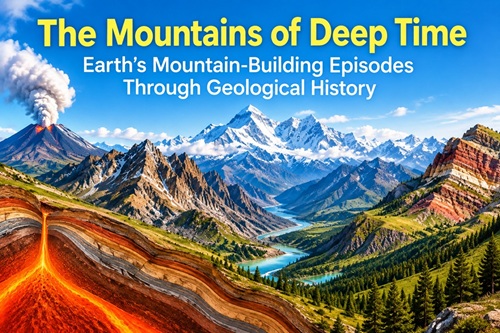 Mountains look permanent only because human beings live for such a short time. The Alps, Andes, Rockies and Himalayas seem like fixed features of the planet, but in geological time they are transient structures. Mountains rise, grow, erode, disappear, and sometimes leave behind only a belt of metamorphosed rocks deep inside a continent. The history of mountain building is therefore not simply the history of the mountains we can see today. It is the history of orogeny—the deformation, thickening, metamorphism and uplift of Earth's crust. Most major orogens are associated with convergent plate boundaries, where oceanic plates are subducted, volcanic arcs and fragments of continental crust are accreted, or continents eventually collide. There is also an important qualification. We cannot produce a complete catalogue of every mountain range that ever existed. Ancient mountains have mostly been eroded away, buried, metamorphosed or incorporated into younger continental crust. The geological record is consequently a highly incomplete archive. What follows is therefore a history of the major recognizable phases and orogenic systems, rather than a list of every named orogen. The first mountains: the Archean EarthThe earliest part of Earth's history, the Hadean and early Archean, is the most difficult period to reconstruct. Earth's crust was hotter, the continents were smaller and less stable, and the style of tectonics was probably substantially different from that of today. Nevertheless, the Archean already contains evidence for processes that look remarkably familiar: oceanic crust, volcanic arcs, subduction-related rocks, crustal accretion and deformation. Ancient granite-greenstone belts preserve fragments of these early tectonic environments. Some Archean orogenic belts have subsequently been incorporated into the great continental cratons. This is one reason we should be careful with statements that "modern plate tectonics began" at one particular moment. Geological evidence suggests that horizontal plate motions, oceanic spreading and accretionary processes were already operating at least 3.8 billion years ago, although their precise relationship to modern plate tectonics remains debated. The mountains of the Archean have therefore almost completely vanished as mountains. What survives are their roots. That distinction is fundamental to understanding Earth's mountain history. A mountain range can disappear from the landscape while its deep crustal roots remain recognizable for billions of years. The Paleoproterozoic mountain revolutionA much clearer mountain-building record appears during the Paleoproterozoic, particularly between about 2.1 and 1.8 billion years ago. This was an extraordinary period of continental assembly. Numerous cratons and smaller continental blocks collided, producing extensive belts of deformation and metamorphism. Among the important examples are the Trans-Amazonian and Eburnean orogens, the Limpopo Belt, the Trans-Hudson, Penokean, Wopmay and Torngat orogens, the Nagssugtoqidian Orogen of Greenland and several major belts in what are now Europe, Siberia, India and China. The concentration of orogenic activity around 2 billion years ago is striking. Geological evidence indicates widespread crustal shortening, thrusting, folding, shearing, metamorphism and granite formation. One study of twenty Paleoproterozoic orogens found a remarkably widespread episode of deformation between approximately 2.1 and 1.8 billion years ago. This was not merely a collection of unrelated mountain ranges. These collisions helped assemble larger continental masses and are closely associated with the proposed supercontinent Nuna, also called Columbia. Orogenesis was therefore already part of the supercontinent cycle: continents came together, mountain belts formed along their sutures, and later tectonic processes broke the resulting landmass apart. The Nuna world and Mesoproterozoic mountainsAfter the great Paleoproterozoic collisions, Earth entered a comparatively quieter-looking but still tectonically active period. Between roughly 1.6 and 1.0 billion years ago, numerous additional orogenic systems developed. Among the most important was the Grenville orogeny. The Grenville belt is extraordinarily significant because it represents one of the great episodes of continental collision associated with the assembly of Rodinia. In eastern North America, rocks of the Grenville Province preserve a history beginning with accretion, continuing through extensive magmatism and culminating in continental collision around 1.1-1.0 billion years ago. The Grenville system was enormous. Its remnants can be traced through parts of North America and, in broader reconstructions, through several other continental fragments that once formed part of the same tectonic system. These mountains are difficult to imagine today because their original landscapes have almost entirely disappeared. The modern Appalachian landscape, for example, is not simply the eroded Grenville mountain range. But ancient rocks exposed in places such as the Adirondacks and other parts of the eastern North American basement preserve the deep history of these enormous Precambrian events. The Grenville episode illustrates a recurring principle: the age of the rocks beneath a mountain range is not necessarily the age of the mountain range visible today. The assembly of Gondwana: Pan-African mountainsThe next great phase came toward the end of the Precambrian, roughly 650-500 million years ago. During this interval, numerous continental fragments collided as Gondwana was assembled. The resulting mountain-building events are collectively associated with the Pan-African orogenic systems and related belts such as the Brasiliano, East African and Mozambique orogens. "Pan-African" is actually a convenient umbrella term rather than the name of one simple mountain range. It encompasses a complicated collection of collisions and tectonic events extending across Africa and into Arabia, Madagascar, South America, India, Antarctica and Australia. The scale was enormous. The Pan-African and Grenville systems are among the largest orogenic systems recognized in Earth's history, and their formation was intimately connected with the assembly of supercontinents. By the end of this process, many previously separate pieces of continental crust had been welded together into Gondwana. Again, the mountains themselves did not survive intact. What survives are their suture zones, metamorphic rocks, granites and deformed sedimentary sequences. The Paleozoic mountain worldThe Paleozoic brought another extraordinary succession of mountain-building episodes. As oceans opened and closed and continental fragments moved around the planet, new collision zones developed. Several of the world's familiar ancient mountain systems ultimately derive from these events. The Caledonian orogeny, approximately 490-390 million years ago, resulted principally from the closure of the Iapetus Ocean and collisions involving Laurentia, Baltica and Avalonia. Its remnants occur in Scotland, Ireland, Scandinavia, Greenland, Svalbard and elsewhere. The Caledonian mountains were once much more extensive than their present remnants suggest. Their roots have survived in the Scandinavian Caledonides and in the ancient geological foundations of Britain and Ireland. At approximately the same broad stage of Earth history, other continental collisions were constructing mountain belts elsewhere. The Appalachian mountains before the AppalachiansThe Appalachians are a particularly instructive example because they are not the product of one single mountain-building event. Their geological history stretches back roughly a billion years, although the major Appalachian mountain-building episodes occurred during the Paleozoic. Several distinct orogenies successively deformed eastern North America as oceans opened and closed and continental fragments collided with Laurentia. The Taconic, Acadian and Alleghanian episodes were particularly important. The final great phase, the Alleghanian orogeny, involved the collision of Laurentia with the continental masses associated with West Gondwana, including Africa. It produced extensive thrusting, folding and crustal deformation. The mountains created by these collisions were once considerably higher and more rugged than the Appalachians of today. Hundreds of millions of years of erosion have transformed them into an old, deeply dissected mountain system. Their rounded ridges and broad valleys therefore conceal an extraordinary history of continental collision. The Appalachians are a geological palimpsest: several mountain-building episodes written over one another. The Variscan and Hercynian mountainsWhile the Appalachian story was unfolding, another enormous mountain-building system developed during the Devonian and Carboniferous periods. The Variscan, also called Hercynian, orogeny resulted from the convergence and collision of continental blocks that ultimately contributed to the formation of Pangaea. Its remnants extend across much of Europe, including parts of France, Germany, Spain, Portugal, Britain and central Europe. Ancient Variscan structures also continue farther eastward. The original mountains were formidable. Some reconstructions envisage a major mountain system extending across the European continent, comparable in tectonic significance to later Alpine mountain building. Today, however, much of this system survives as eroded uplands, basement rocks and isolated mountain ranges. This is a recurring geological paradox: the biggest ancient mountains are often not the most spectacular mountains today. The Ural Mountains and the birth of PangaeaAnother crucial Paleozoic collision produced the Ural Mountains. The Urals mark the approximate geological boundary between Europe and Asia, but their significance is much greater than their modern appearance suggests. They formed during the collision of the East European and Siberian-related continental masses and other terranes as the intervening oceanic basins closed. The Uralian orogeny was one of the processes that helped assemble Pangaea. The modern Urals are relatively subdued compared with the Himalayas. Yet they are the surviving remnants of a major continental collision hundreds of millions of years old. Their present modest height is therefore not an indication that their original tectonic event was modest. Pangaea and the destruction of the old mountain beltsBy the late Paleozoic, many of these collisions had brought the major continental blocks together into Pangaea. Pangaea represented the culmination of a supercontinent cycle that had repeatedly opened and closed oceans and generated mountain belts along continental sutures. But supercontinents do not remain assembled indefinitely. During the Mesozoic, Pangaea began to fragment. New oceans opened, continental margins became passive, and some of the great Paleozoic mountain belts were gradually worn down. This is one reason mountain building should be understood as part of a Wilson cycle. Ocean basins open, mature, close through subduction, and eventually disappear in continental collisions. Mountains rise along the closing margins. Erosion then reduces them while another tectonic cycle begins elsewhere. The Mesozoic mountainsThe Mesozoic is sometimes portrayed as a relatively quiet interval between the Paleozoic mountains and the spectacular Cenozoic ranges. That is misleading. Major mountain building continued around the margins of the continents. The breakup of Pangaea created new ocean basins, while subduction continued along the Pacific margins. Volcanic arcs and accretionary systems developed as oceanic crust was consumed. One of the most important consequences was the development of the Cordilleran mountain system along western North America. Much of its history involves subduction, terrane accretion and crustal deformation rather than a single continent-continent collision. This is the other great model of mountain building. The Himalayas represent the collision of two continental masses. The Andes and much of the North American Cordillera represent mountain building along a subduction margin. In the latter case, oceanic lithosphere descends beneath continental lithosphere. The overriding continent is compressed, volcanic arcs develop, magma intrudes the crust, and the crust can become thickened and uplifted. The Andes are a modern example of this type of accretionary orogen. The Alps: collision after the TethysAs Pangaea broke apart, a new sequence of collisions began around the former Tethys Ocean. Africa and fragments of Gondwana moved northward toward Europe and Asia. The resulting collisions generated the Alpine orogenic system, which includes the Alps and related mountain belts of southern Europe. The Alps are therefore considerably younger than the Appalachians, Caledonides and Urals. Their formation began during the Mesozoic and continued into the Cenozoic. The Alps are still tectonically active, although erosion and uplift now interact in a complex balance. The Alpine system extends beyond the Alps themselves into the Carpathians, Dinarides, Apennines and other mountain belts around the Mediterranean region. The Himalayas: Earth's great continental collisionThe most spectacular modern example of continent-continent collision is the Himalayas. The Indian continental plate moved northward after separating from Gondwana and eventually collided with Eurasia. The collision began approximately 40-50 million years ago, although the exact chronology and the progressive development of the mountain system are more complicated than a single "collision date" suggests. Unlike oceanic crust, continental crust does not readily sink into the mantle because it is relatively buoyant. When India encountered Eurasia, neither continent could simply disappear beneath the other. Instead, the crust was compressed, folded, faulted and thickened. The result was the Himalayas and the enormous Tibetan Plateau. And this mountain-building process is not finished. India continues to move northward, while erosion simultaneously removes material from the rising mountains. The Himalayas are consequently a dynamic balance between tectonic uplift and erosion. The mountains are still being made. The Andes: mountains without continental collisionThe Andes illustrate a different mechanism. Along the western margin of South America, oceanic lithosphere is subducted beneath the South American continent. This process has operated for a very long time, although the configuration and intensity of deformation have changed through geological history. The Andes are therefore not simply "folded mountains." They are a complex system involving subduction, volcanic activity, crustal shortening, crustal thickening, faulting, uplift and erosion. This distinction is important because there is no single recipe for making a mountain range. Mountains can form through continent-continent collision, ocean-continent subduction, terrane accretion, arc collision, crustal extension and volcanic construction. Orogeny is a family of related tectonic processes rather than one mechanism. The Rockies and the western North American CordilleraThe Rocky Mountains are younger than the Appalachians but older than the Himalayas. Their major uplift occurred during the Laramide orogeny, beginning roughly 80 million years ago and continuing into the early Cenozoic. The tectonic circumstances were unusual because the subducting Farallon Plate descended beneath North America at a relatively shallow angle for a considerable distance. The resulting deformation reached far inland from the Pacific margin. This demonstrates another important feature of mountain building: the mountains do not necessarily form immediately above the place where one plate disappears beneath another. The forces transmitted through the continental lithosphere can deform regions hundreds of kilometres away from the active plate boundary. The youngest mountainsMany of the world's highest and most dramatic mountain systems belong to the Cenozoic, particularly the last 65 million years. The Himalayas, Alps, Zagros, Caucasus, Carpathians and many other mountain belts formed or were substantially rejuvenated during this period as fragments of Gondwana moved northward and collided with Eurasia. The Zagros Mountains, for example, record the continuing convergence between Arabia and Eurasia. The collision has produced extensive folding and thrusting and remains active today. The Caucasus similarly represents a relatively young collision zone. These mountains demonstrate that the supercontinent cycle did not end with Pangaea. The continents continue to move, oceans continue to close, and new mountain belts continue to develop. A mountain is never simply "finished"One of the most misleading ideas about mountains is that tectonic uplift creates them and then erosion merely destroys them. In reality, uplift and erosion operate simultaneously. As a mountain rises, streams cut valleys into it. Glaciers excavate cirques and valleys. Landslides remove material from unstable slopes. Rivers transport sediment toward the oceans. At the same time, tectonic forces may continue pushing the crust upward. The Himalayas provide an excellent example. The Indian-Eurasian collision continues to thicken and deform the crust, while enormous quantities of sediment are simultaneously removed from the mountains and deposited in the surrounding basins and ultimately the ocean. Over sufficient time, erosion can reduce even a great mountain chain to low hills or expose the deep metamorphic roots of the former range. The mountain disappears, but its geological signature remains. The great sequenceSeen over the entire history of Earth, mountain building can therefore be imagined as a succession of enormous waves. • The Archean produced the earliest preserved accretionary and collisional structures. • The Paleoproterozoic witnessed an extraordinary expansion of large-scale continental collision, especially around 2.1-1.8 billion years ago. • The Mesoproterozoic saw further continental amalgamation, culminating in major Grenvillian mountain building associated with Rodinia. • The Neoproterozoic Pan-African and related orogenies accompanied the assembly of Gondwana. • The Paleozoic generated the Caledonides, Appalachians, Variscans, Urals and numerous other mountain systems during the progressive assembly of Pangaea. • The Mesozoic saw continued subduction and accretion around the Pacific and the breakup of Pangaea. • The Cenozoic produced some of the most spectacular surviving mountain ranges, including the Alps, Andes in their modern configuration, Himalayas, Zagros and Caucasus. And the process continues today. Mountains as the visible record of continental evolutionThe deeper lesson is that mountains are not isolated geographical objects. They are records of continental history. A mountain belt tells us that something happened to the crust: an ocean closed, an island arc collided with a continent, two continents converged, or a subduction zone compressed and thickened the continental margin. This is why geologists pay so much attention to apparently unremarkable rocks in ancient mountain belts. A metamorphic rock may record pressures and temperatures corresponding to many kilometres of burial. A granite may mark an ancient volcanic arc. A thrust fault may record continental collision. An ophiolite may preserve fragments of ancient oceanic crust. The mountain landscape is merely the surface expression of a much deeper geological event. And there is a profound asymmetry in Earth's mountain history. We see the youngest mountains; we know the older ones mainly through their roots. The Himalayas will eventually be eroded. The Alps will eventually be reduced. The Andes will eventually change beyond recognition. New oceans will open, old oceans will close, continents will collide again, and entirely new mountain ranges will rise. Hundreds of millions of years from now, the mountains we regard as permanent features of the Earth will exist primarily as geological memories embedded in the crust. That is perhaps the most striking perspective supplied by deep time: Earth has never had a permanent mountain range. It has had a permanent process of mountain making.
The chronology is necessarily simplified: many "orogenies" are composite histories lasting tens or hundreds of millions of years, and different parts of a single mountain system can have very different ages. Modern research increasingly treats Precambrian orogenesis as a spectrum of tectonic regimes rather than a neat sequence of discrete events.
Widget is loading comments...
|